
NCERT Solutions Class 10 History Chapter 1: The Rise of Nationalism in Europe
Answers to every Activity and Discuss box inside Chapter 1, The Rise of Nationalism in Europe, of India and the Contemporary World – II, the Class 10 History textbook, and to all the end-of-chapter questions: Write in brief 1–5, Discuss 1–5 and the Project. Page numbers follow the 2026-27 reprint (pages 3–28). The end-of-chapter questions are quoted from the book; the boxes inside the chapter are restated in short, in our own words. Short notes: Chapter 1 notes.
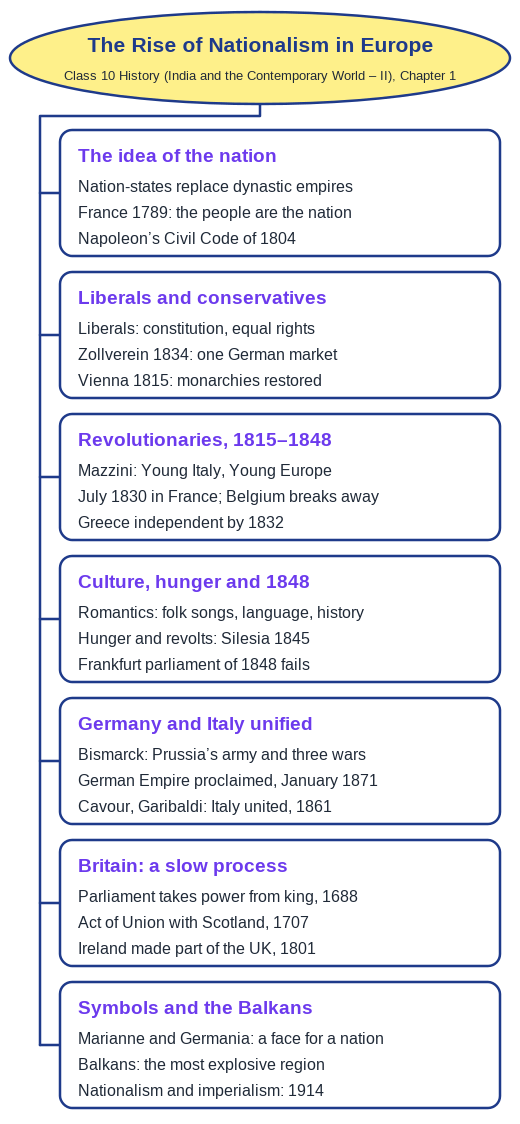
Activity and Discuss boxes inside the chapter (pages 3–25)
Activity, page 3: in what way is Sorrieu’s print (Fig. 1) a utopian vision? It shows a world that did not exist in 1848 and was unlikely to come soon. The peoples of Europe and America march together peacefully, as equals, each as a separate nation with its own flag and dress, to honour the statue of Liberty. The symbols of absolute monarchy lie smashed on the ground, and Christ, saints and angels look down to bless the brotherhood of nations. In reality, most of these peoples still lived under kings and emperors, Germany and Italy were not yet nations, and the revolutions of 1848 were crushed. A world of liberated democratic republics living in harmony was an ideal, and that is what utopian means.
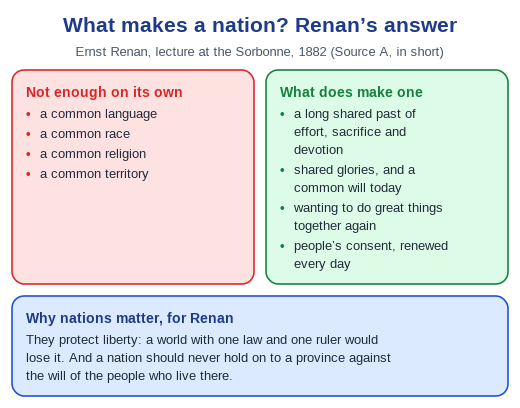
Discuss, page 4 (Source A): how does Renan describe a nation, and why does he think nations matter? For Ernst Renan, a nation is not made by a shared language, race, religion or territory alone. It grows from a long shared past of effort, sacrifice and devotion, with heroes and glories that people remember together. It also needs a common will in the present: the wish to go on living together and to achieve more together. It is a large-scale solidarity that rests on the continuing consent of its people, which he compares to a plebiscite held every day; so a nation has no right to hold on to a region against the will of its people. Nations matter, he argues, because they protect liberty, which would be lost in a world under one law and one master.
Discuss, page 10 (Source B): what political goals did Friedrich List hope to reach through economic measures? List, a professor of economics at Tübingen, saw the zollverein of 1834 as much more than a trade arrangement. Its purpose was to bind the Germans together into a nation through economics. By protecting German interests against outsiders and boosting production at home, it would make the nation materially strong. By merging the separate interests of individuals and provinces, it would awaken national feeling. In short, a single open German market was his road to a politically united German nation.
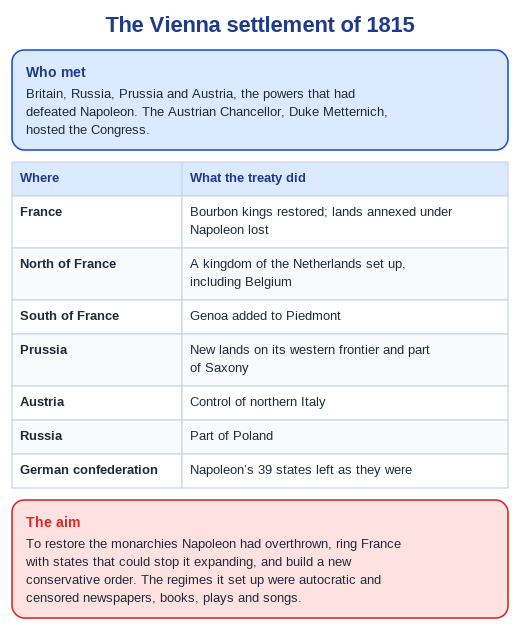
Activity, page 11: show on a map of Europe the changes made by the Vienna Congress. On an outline map of Europe, compared with the chapter’s map of Europe after 1815 (Fig. 3), mark: France under the restored Bourbon kings, without the lands Napoleon had annexed; the new kingdom of the Netherlands, with Belgium, to the north of France; Genoa joined to Piedmont, to the south-east of France; new Prussian territories on Prussia’s western frontier, and part of Saxony; northern Italy under Austria; part of Poland under Russia; and the German confederation of 39 states, left unchanged. Use one colour for each power and add a legend.
Discuss, page 11: what is the caricaturist trying to show in The Club of Thinkers (Fig. 6)? The cartoon of about 1820 shows a group of learned men seated round a table, some with their mouths covered, under a notice that asks how long they will still be allowed to think; the club’s rules demand silence and hand out muzzles. It mocks the conservative regimes set up after 1815, which censored newspapers, books, plays and songs and would not tolerate criticism. The artist’s point is that freedom of thought and of speech was being gagged, so even thinkers had to keep their mouths shut.
Discuss, page 15: why did language and popular traditions matter in creating national identity? First, they gave people a shared heritage to be proud of: Herder argued that the true spirit of the nation lived in the folk songs, poetry and dances of the common people, and the Grimm brothers collected folktales as an authentic German heritage. Second, they reached ordinary people: most were illiterate, so songs, stories and the spoken local language carried the national message better than books. Third, they kept a nation alive where it had no state. Poland had been divided up by Russia, Prussia and Austria in the late 18th century, yet Karol Kurpinski’s operas and the polonaise and mazurka kept national feeling alive; when Russia forced Russian on Polish schools, priests used Polish in church and in religious teaching, and many were jailed or sent to Siberia. Using Polish became a sign of resistance to Russian rule.
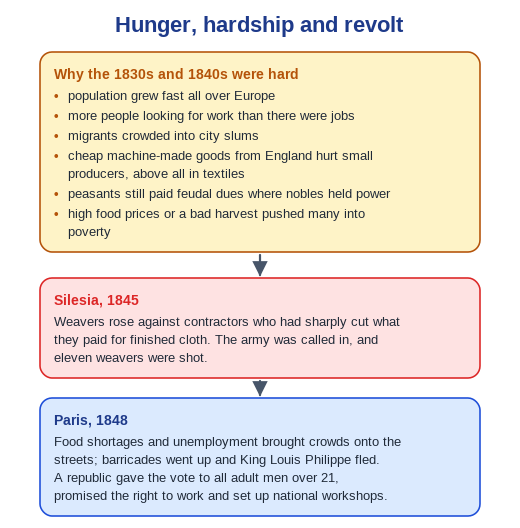
Discuss, page 16: what caused the Silesian weavers’ uprising, and what is the journalist’s point of view? Cause: the weavers depended on contractors who supplied the raw material and ordered the finished cloth. Taking advantage of the weavers’ desperate need for work, the contractors cut their payments drastically, and the weavers sank into extreme poverty. In June 1845 a crowd marched to their contractor’s mansion to demand higher wages; met with scorn and threats, some broke in and wrecked the house and the stores of cloth. The contractor fled, came back with the army, and eleven weavers were shot. Viewpoint: Wilhelm Wolff is on the weavers’ side. He stresses their misery and blames the contractors for exploiting it, points out that even the neighbouring village refused to shelter the contractor, and ends with the shooting, so readers see the weavers as victims driven to anger rather than as criminals.
Activity, page 16: as a weaver who saw the events, write a report. A sample report:
What I saw on 4 June. Our village lives by weaving cotton, and lately we have been paid less and less for the same cloth. At two in the afternoon we left our homes and walked in pairs to our contractor’s mansion to ask for fair wages. Instead of listening, he mocked us and threatened us. Some of our younger men lost patience; they broke into the house and the storehouse and tore up the cloth. The contractor ran away with his family, but the next village would not take him in. A day later he came back with soldiers. When they fired, eleven of our people fell. We asked for bread and got bullets; we want everyone to know why we marched.
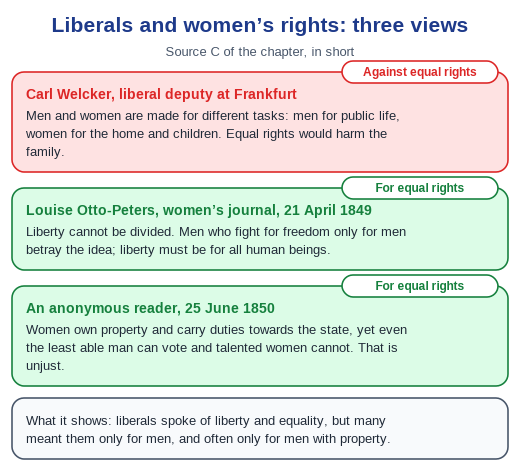
Discuss, page 18 (Source C): compare the three views on women’s rights. What do they show about liberal ideology? Carl Welcker, a liberal member of the Frankfurt parliament, argued that men and women are made for different tasks: men for public life, law and defence, women for the home and children; equal rights, he said, would upset the harmony and dignity of the family. Louise Otto-Peters, in the first issue of her women’s newspaper (21 April 1849), replied that liberty cannot be divided: men who fight for freedom only for men are not fighting for the freedom of all people. An anonymous reader (25 June 1850) called it unjust that women who own property and carry duties towards the state have no vote, while any man, however ignorant, has one. What it shows: liberals spoke of liberty and equality for all, but many meant political rights only for men, and often only for men with property. Liberal ideology contained a contradiction, and women had to fight for their own rights.
Activity, page 20: the caricature of Bismarck in the Reichstag (Fig. 13). Description: Bismarck stands at the front of the parliament, cracking a long whip over his head, while the deputies duck down behind their benches so that hardly any of them can be seen. Relationship: Bismarck is the master and the elected deputies are frightened and obedient, like animals being driven. Interpretation: the artist suggests that in the new Prussian-led Germany parliament was a show. Real power lay with Bismarck and the state, and debate and voting counted for little; the army and the chief minister, not the people’s representatives, made the nation.
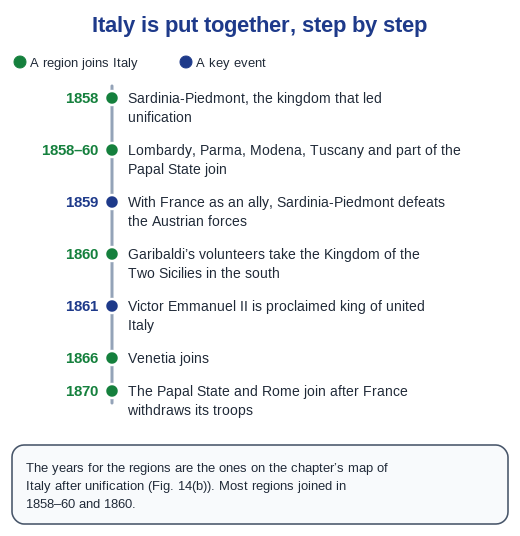
Activity, page 21: the Italian states before and after unification (Figs. 14(a) and 14(b)). Did people think of themselves as Italians? Probably very few did. Italy was split into seven states under different rulers: Austria in the north, the Pope in the centre, the Bourbon kings in the south, and an Italian house only in Sardinia-Piedmont. The Italian language had many local forms, most people could not read, and southern peasants thought ‘La Talia’ was Victor Emmanuel’s wife. Only educated liberals, like Mazzini’s followers, thought of Italy as one nation. Fig. 14(b): the first region was Sardinia-Piedmont, marked 1858, the kingdom that led unification; the last was the Papal State around Rome, in 1870. The largest number of states joined in 1858–60: Lombardy, Parma, Modena, Tuscany and part of the Papal State, and in 1860 the Kingdom of the Two Sicilies joined too.
Activity, page 22: what statement does the caricature of Garibaldi and the boot (Fig. 15) make? On the map, Italy is shaped like a boot. In the English cartoon of 1859, Garibaldi kneels at the bottom, holding the boot named ‘Italy’ in place, while King Victor Emmanuel II steps into it from the top. The statement is that Garibaldi, the popular hero, did the hard work on the ground, especially in the south, the foot of the boot, but the King of Sardinia-Piedmont was the one who got to wear Italy. Unification was carried out for the monarchy, with the volunteers serving the king.
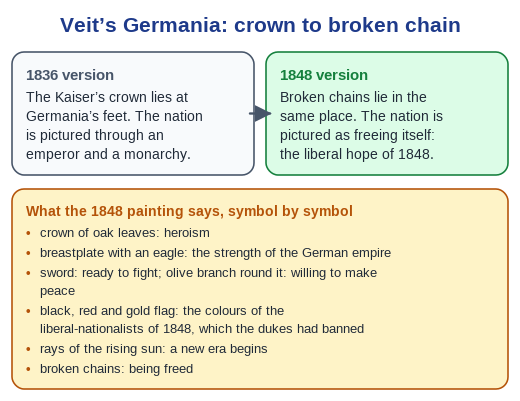
Activity, page 24: the symbols of Veit’s Germania (Box 3), and the change from crown to broken chain. Attributes in Fig. 17: a crown of oak leaves (heroism); a breastplate with an eagle (the strength of the German empire); a sword (readiness to fight) with an olive branch round it (willingness to make peace); the black, red and gold flag (the colours of the liberal-nationalists of 1848, which the dukes of the German states had banned); the rays of the rising sun (the start of a new era); and broken chains (freedom). Meaning: painted in 1848 to hang in the Frankfurt parliament, Germania stands for a liberated, united and strong German nation, ready to defend itself yet willing to live in peace, at the dawn of a new liberal age. The change: in Veit’s earlier version of 1836, the Kaiser’s crown lay where the broken chain now is. The crown tied the nation to an emperor and monarchy; the broken chain shows the nation freeing itself from autocratic rule. The change reflects the liberal, democratic hopes of 1848.
Activity, page 24: Hübner’s fallen Germania. (The box asks about Fig. 17, but Hübner’s painting is Fig. 18; Fig. 17 is Veit’s Germania.) Description: Germania lies face down on the bare ground, worn out or defeated. Her crown and sceptre have fallen beside her, and a skull lies nearby, a sign of death. The proud, upright figure of 1848 has collapsed. Events: painted in 1850, it most likely mourns the failure of the 1848 revolution in the German states: the King of Prussia refused the crown offered by the Frankfurt parliament, monarchs and the army crushed the liberal movement, and the parliament was forced to break up. The dream of a united Germany with liberty seemed to have died.
Activity, page 25: a man and a woman at the Frankfurt parliament (Fig. 10), and the banner of Germania. (a) As a man among the deputies: I would feel proud and hopeful. The banner of Germania above the hall, with her broken chains and the black, red and gold flag, would express exactly what we are doing: building a united, liberated German nation with a constitution. (b) As a woman in the gallery: I would feel mixed. The nation hanging above us is shown as a strong, liberated woman, yet I, a real woman who has worked for this movement, cannot vote or sit in the hall; I can only watch. Liberty is pictured in a woman’s form but denied to women. A note on the date: the box says March 1848, as does the caption of Fig. 17, while the chapter’s text dates the opening of the elected parliament to 18 May 1848. Extra: a preparatory assembly met in the same church at the end of March 1848.
Write in brief (page 28)
1. “Write a note on: a) Guiseppe Mazzini b) Count Camillo de Cavour c) The Greek war of independence d) Frankfurt parliament e) The role of women in nationalist struggles”
(a) Giuseppe Mazzini (the book prints “Guiseppe”)
Answer: An Italian revolutionary who wanted Italy to become one united republic.
- Early life: born in Genoa in 1805. He joined the Carbonari, a secret society of revolutionaries.
- Exile: in 1831, aged 26, he was sent out of the country for trying to start a revolution in Liguria.
- Two secret societies: he founded Young Italy in Marseilles and Young Europe in Berne. Young people with the same ideals joined from Poland, France, Italy and the German states.
- His idea: God had made nations the natural units of humankind. So Italy, then a patchwork of small states, had to become one republic.
- His influence: secret societies on his model sprang up across Europe. Metternich, the Austrian Chancellor, called him the most dangerous enemy of the social order.
(b) Count Camillo de Cavour
Answer: The chief minister of Sardinia-Piedmont who led the unification of Italy through diplomacy and war.
- Not a rebel: he was neither a revolutionary nor a democrat.
- Elite background: like many rich and educated Italians, he spoke French better than Italian.
- Alliance with France: he arranged a clever diplomatic alliance with France.
- Victory in 1859: with this alliance, Sardinia-Piedmont defeated the Austrian forces in 1859.
- Result: this opened the way for Garibaldi’s march into the south in 1860, and for Victor Emmanuel II to be proclaimed king of united Italy in 1861.
(c) The Greek war of independence
Answer: The struggle of the Greeks, from 1821, to end Ottoman rule over Greece. Greece became independent in 1832.
- Ottoman rule: Greece had been part of the Ottoman Empire since the 15th century.
- Start: inspired by revolutionary nationalism, the Greeks began their fight for independence in 1821.
- Support: Greeks living in exile helped. So did many West Europeans who admired ancient Greek culture. Poets and artists praised Greece as the cradle (birthplace) of European civilisation and won public opinion for it.
- Lord Byron: the English poet raised funds, went to fight, and died of fever in 1824.
- Independence: the Treaty of Constantinople (1832) recognised Greece as an independent nation.
- Importance: the war stirred national feeling among educated people all over Europe.
(d) The Frankfurt parliament
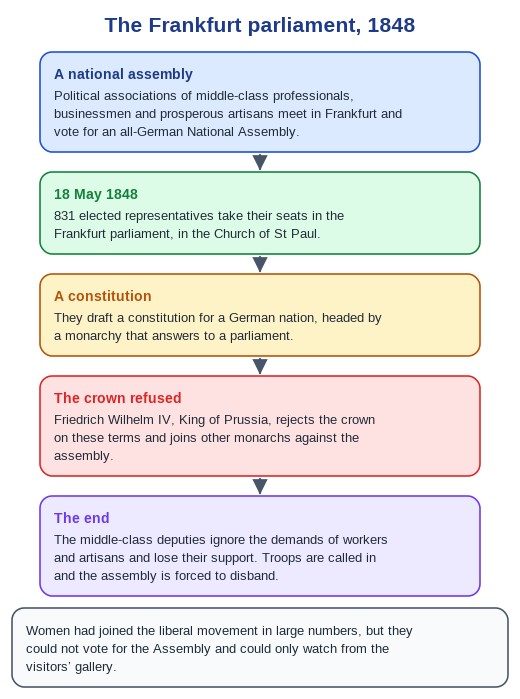
Answer: An elected all-German National Assembly of 1848 that tried to unite Germany under a constitution, but failed.
- Who set it up: political associations of middle-class professionals, businessmen and well-off artisans met in Frankfurt. They decided to elect a National Assembly for all of Germany.
- Opening: on 18 May 1848, its 831 elected members took their seats in the Church of St Paul.
- Constitution: they drafted a constitution for a German nation headed by a monarch, but a monarch under the control of parliament.
- Crown refused: they offered the crown on these terms to Friedrich Wilhelm IV, King of Prussia. He refused and joined the other monarchs against the assembly.
- Support lost: the aristocracy and the army opposed it more and more. The middle-class members ignored the demands of workers and artisans, so they lost their support.
- End: troops were called in and the assembly had to break up.
- No place for women: women could not vote for it, and could only watch from the visitors’ gallery.
(e) The role of women in nationalist struggles
Answer: Women worked hard in the liberal and national movements, but they were denied political rights.
- Active role: large numbers of women took part in the liberal movement.
- What they did: they formed their own political associations, started newspapers, and joined political meetings and demonstrations.
- Example: Louise Otto-Peters founded a women’s journal and later a feminist political association.
- No vote: women could not vote in the election of the Frankfurt Assembly. In the Church of St Paul they could only watch from the visitors’ gallery.
- Old limits: the Napoleonic Code had treated women as minors (like children), under the authority of fathers and husbands. Liberals such as Carl Welcker said a woman’s place was the home.
- A double struggle: so women fought for the nation and also for their own equal rights.
- A contrast: nations were shown as women, Marianne and Germania, while real women were kept out of politics.
2. “What steps did the French revolutionaries take to create a sense of collective identity among the French people?”
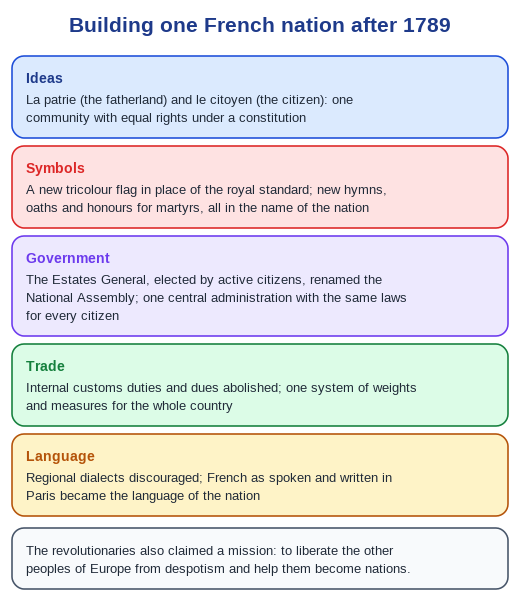
Answer: They used shared ideas, symbols, laws and one language to make the French feel like one people.
- New ideas: la patrie (the fatherland) and le citoyen (the citizen) presented the French as one community with equal rights under a constitution.
- New flag: the tricolour replaced the old royal flag.
- New assembly: the Estates General was now elected by active citizens and renamed the National Assembly.
- Shared rituals: new hymns were written, oaths taken and martyrs remembered, all in the name of the nation.
- Same laws: a centralised administration made uniform laws for all citizens.
- One market: customs duties and dues inside France were abolished, and one system of weights and measures was used everywhere.
- One language: regional dialects were discouraged. French, as spoken and written in Paris, became the common language of the nation.
3. “Who were Marianne and Germania? What was the importance of the way in which they were portrayed?”
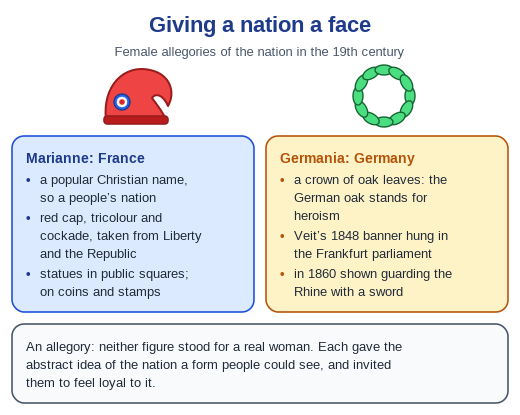
Answer: Marianne and Germania were female figures that stood for France and Germany. They gave the idea of the nation a face that people could see and love.
- Allegories: neither stood for a real woman. Each was an allegory (a figure that stands for an idea), here the idea of the nation.
- Marianne (France): a popular Christian name, showing that the nation belonged to the people. She carried the signs of Liberty and the Republic: the red cap, the tricolour and the cockade (a rosette badge).
- Where Marianne was seen: her statues stood in public squares, and her image was put on coins and stamps.
- Germania (Germany): she wears a crown of oak leaves, because the German oak stands for heroism. Philip Veit painted her on a banner for the Frankfurt parliament in 1848. In 1860 Lorenz Clasen showed her guarding the Rhine with a sword.
- Importance, a face for the nation: many people could not read, but they could recognise a picture and feel loyal to it.
- Importance, a reminder of unity: seen everywhere in daily life, the images reminded people of the nation and persuaded them to identify with it.
- Importance, political messages: the objects they carried had meanings, such as broken chains for freedom and a sword for readiness to defend the nation.
4. “Briefly trace the process of German unification.”
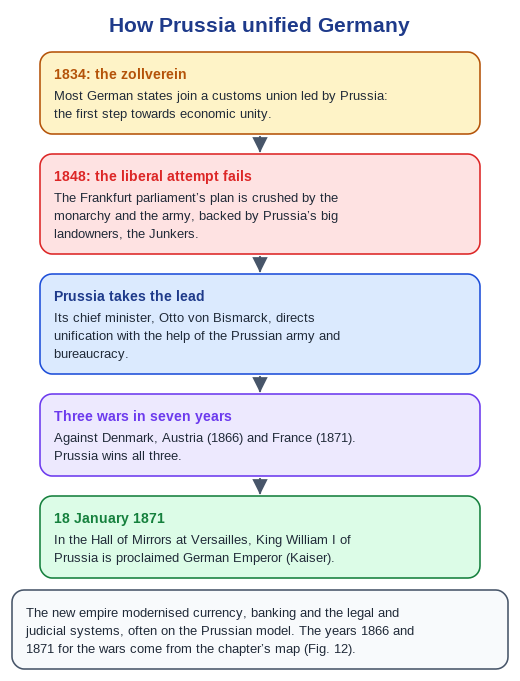
Answer: After the liberal attempt of 1848 failed, Prussia united Germany “from above”, under Bismarck, with its army and three wars.
- Economic unity first: in 1834 Prussia led the zollverein, a customs union joined by most German states. Railways then linked their markets.
- Liberal attempt, 1848: middle-class Germans tried to unite the country through the elected Frankfurt parliament.
- Its failure: the King of Prussia refused its crown. The monarchy and the army, backed by the Junkers (big landowners of Prussia), crushed the attempt.
- Prussia takes the lead: Otto von Bismarck, Prussia’s chief minister, was the architect (chief planner) of unification. He worked through the Prussian army and bureaucracy.
- Three wars: in seven years Prussia fought Denmark, Austria (1866) and France (1871), and won all three.
- Empire proclaimed: on 18 January 1871, King William I of Prussia was proclaimed German Emperor in the Hall of Mirrors at Versailles. The princes of the German states, army leaders and Prussian ministers were present.
- After unification: the new empire modernised its currency, banking, and legal and judicial systems, often on the Prussian model.
So Germany’s unification showed the dominance of Prussian state power.
5. “What changes did Napoleon introduce to make the administrative system more efficient in the territories ruled by him?”
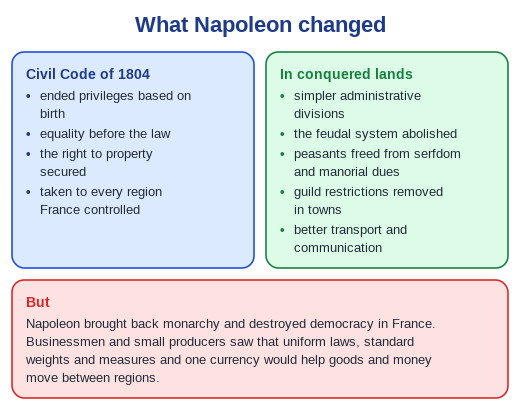
Answer: Napoleon brought uniform laws and a simpler administration to the lands he ruled, mainly through his Civil Code of 1804.
- Civil Code of 1804 (the Napoleonic Code): it ended privileges based on birth, made everyone equal before the law and protected the right to property. It was applied in all regions under French control.
- Simpler divisions: in the Dutch Republic, Switzerland, Italy and Germany he simplified the administrative divisions.
- End of feudalism: he abolished the feudal system and freed peasants from serfdom and manorial dues (payments owed to the lord of the land).
- Freer towns: he removed guild restrictions (rules by which craft groups controlled who could work in a trade).
- Better transport: transport and communication systems were improved.
- Result: administration became more rational and efficient. Businessmen and small producers saw that uniform laws, standard weights and measures and one currency would help goods and capital move between regions.
Note: in France itself, Napoleon destroyed democracy by bringing back monarchy.
Discuss (page 28)
1. “Explain what is meant by the 1848 revolution of the liberals. What were the political, social and economic ideas supported by the liberals?”
Answer: In 1848 the educated middle classes led a revolution of their own, demanding a constitution and a nation-state run through a parliament. This is called the revolution of the liberals.
What the revolution was:
- Two kinds of revolt in 1848: poor, jobless and hungry workers and peasants revolted in many countries. Alongside them, the educated middle classes led their own revolution.
- France: events of February 1848 made the king give up the throne. A republic was declared in which every adult man could vote (universal male suffrage).
- Lands not yet nations: in Germany, Italy, Poland and the Austro-Hungarian Empire, liberal men and women joined the demand for a constitution to the demand for national unification.
- Their demands: a nation-state on parliamentary lines, with a constitution, freedom of the press and freedom to form associations.
- Most famous example: the Frankfurt parliament in the German regions (see Write in brief 1(d)).
The ideas of the liberals:
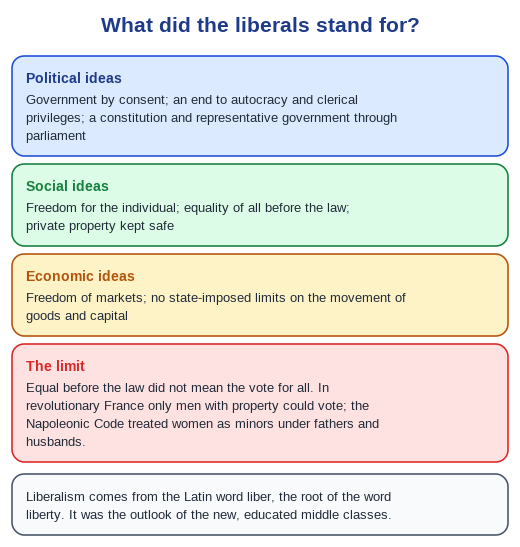
- Political: government by the consent of the people; an end to autocracy (rule by one person with total power) and to the special privileges of the clergy; a constitution and representative government through parliament.
- Social: freedom for the individual, equality of all before the law, and safety of private property. But equality before the law did not mean votes for all. In revolutionary France and in most liberal plans, only men with property could vote, and women were left out.
- Economic: freedom of markets, and an end to state limits on the movement of goods and capital. An example is the demand for one German economic area, which led to the zollverein of 1834.
2. “Choose three examples to show the contribution of culture to the growth of nationalism in Europe.”
Answer: Art, folk culture, music and language made people feel that they shared one nation. Three examples:
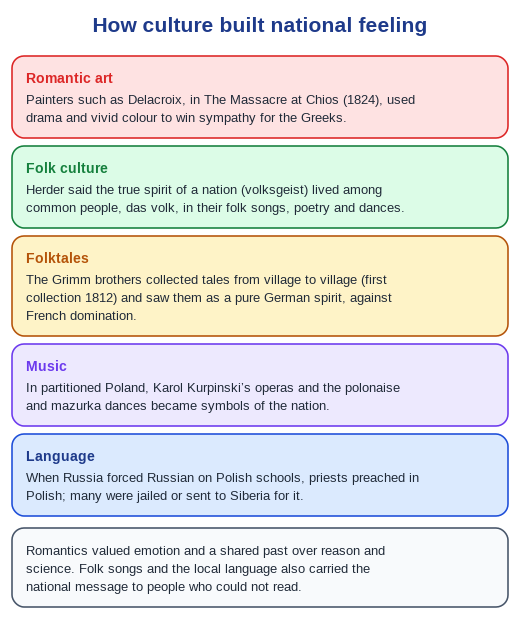
- Romantic painting (Delacroix): in The Massacre at Chios (1824), the French painter Delacroix showed the suffering of Greek women and children in vivid colours. It moved viewers and built sympathy for the Greeks in their war of independence.
- Folk culture (Herder and the Grimm brothers): the German philosopher Herder taught that the true spirit of the nation, the volksgeist, lived in the folk songs, poetry and dances of common people. The Grimm brothers spent six years collecting folktales. They published their first collection in 1812, and also a 33-volume German dictionary. They saw this work as part of building a German national identity against French domination.
- Music and language (Poland): Poland had been divided up among Russia, Prussia and Austria. Karol Kurpinski’s operas, and folk dances like the polonaise and mazurka, became national symbols. After Russian occupation, Russian was forced on Polish schools. After a failed armed revolt against Russian rule in 1831, priests used Polish in church gatherings and religious teaching. Many were jailed or sent to Siberia. Using Polish became a sign of the struggle against Russian rule.
Why culture worked: most people could not read, so songs, stories and the local language carried the national message to them.
3. “Through a focus on any two countries, explain how nations developed over the nineteenth century.”
Answer: Germany and Italy were both split into many states in the early 19th century. Liberals and revolutionaries spread the idea of unity, but kings, chief ministers and armies finally united them.
Germany
- Divided: a confederation of 39 states, each with its own currency and its own weights and measures.
- Economic and cultural unity: the zollverein of 1834 joined their markets. Romantics such as Herder and the Grimm brothers built pride in a shared German culture.
- Liberal attempt failed: in 1848 the elected Frankfurt parliament tried to unite Germany, but the monarchy, the army and the Junkers crushed it.
- Prussia leads: Bismarck used the Prussian army and bureaucracy. Prussia won three wars in seven years, against Denmark, Austria and France.
- The empire: on 18 January 1871, William I was proclaimed German Emperor at Versailles. The nation was made from above, under Prussian power.
Italy
- Divided: seven states. The Austrian Habsburgs ruled the north, the Pope the centre and the Bourbon kings of Spain the south. Only Sardinia-Piedmont had an Italian ruling family.
- Mazzini: in the 1830s he planned a united Italian republic and formed Young Italy. But the risings of 1831 and 1848 failed.
- Sardinia-Piedmont leads: under King Victor Emmanuel II and Chief Minister Cavour, an alliance with France defeated Austria in 1859.
- Garibaldi: in 1860 his volunteers marched into the south and took the Kingdom of the Two Sicilies.
- United: in 1861 Victor Emmanuel II was proclaimed king of united Italy. Venetia joined in 1866 and Rome in 1870 (the book’s map, Fig. 14(b)).
In both countries, the nation was finally made by states and armies, not by the people’s elected parliaments.
4. “How was the history of nationalism in Britain unlike the rest of Europe?”
Answer: In Britain the nation-state grew slowly over a long time, not through a sudden revolution or a war of unification. It was built by England dominating the other nations of the islands.
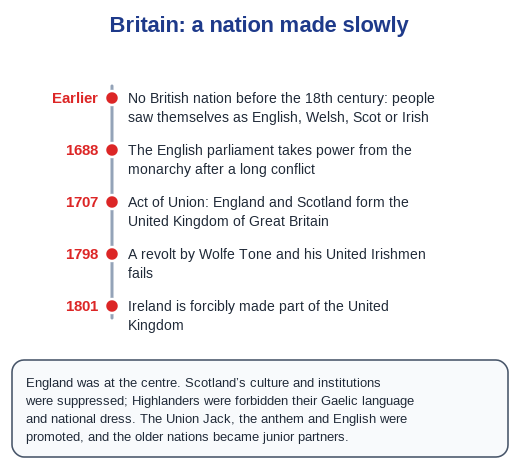
- A slow process: elsewhere, nation-states came out of revolutions or wars. In Britain the nation-state was the result of a long, slow process.
- No British nation at first: before the 18th century, people saw themselves as English, Welsh, Scot or Irish. Each group had its own culture and political traditions.
- England grows: as England grew richer and more powerful, it spread its influence over the other nations.
- The English parliament: it took power from the monarchy in 1688, after a long conflict. It became the tool for building a nation-state with England at its centre.
- Scotland, 1707: the Act of Union joined England and Scotland into the ‘United Kingdom of Great Britain’. In practice England dominated. Scottish culture and institutions were suppressed. Highlanders could not speak their Gaelic language or wear their national dress, and many were driven from their homeland.
- Ireland, 1801: Ireland was divided between Catholics and Protestants, and the English helped the Protestants dominate. After the failed revolt of Wolfe Tone and his United Irishmen (1798), Ireland was forcibly made part of the United Kingdom in 1801.
- English culture spread: the Union Jack, the national anthem and the English language were promoted. The older nations survived only as junior partners in the union.
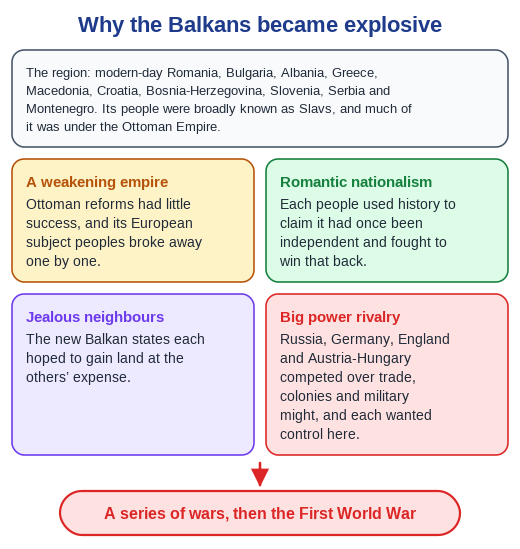
5. “Why did nationalist tensions emerge in the Balkans?”
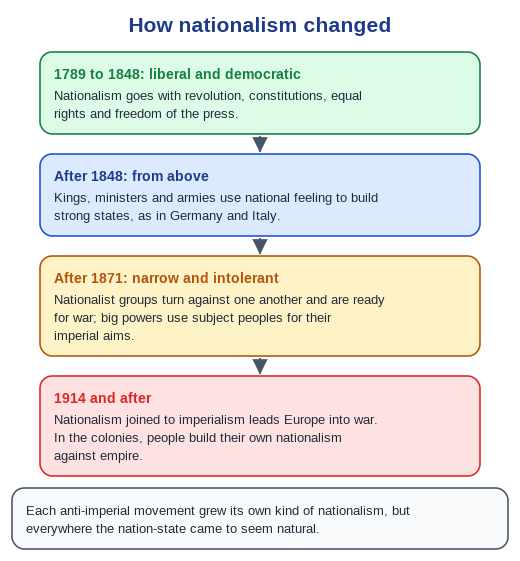
Answer: Many different peoples, a weakening Ottoman Empire, jealous new states and rivalry among the big European powers made the Balkans the most serious source of nationalist tension in Europe after 1871.
- Many peoples: the Balkans covered today’s Romania, Bulgaria, Albania, Greece, Macedonia, Croatia, Bosnia-Herzegovina, Slovenia, Serbia and Montenegro. It had great geographical and ethnic variety (many communities with their own descent and culture). Its people were broadly known as Slavs.
- A weak empire: much of the region was under the Ottoman Empire. All through the 19th century the empire tried reforms, with little success. One by one, its European subject peoples broke away and declared independence.
- Romantic nationalism: each people used history to claim that it had once been independent and was later conquered by foreign powers. So they saw their struggle as winning back their lost independence.
- Jealous neighbours: the Balkan states were fiercely jealous of one another. Each hoped to gain more land at the others’ cost.
- Big power rivalry: Russia, Germany, England and Austria-Hungary competed over trade, colonies and naval and military strength. Each wanted to stop the others and extend its own control over the Balkans.
- Result: a series of wars in the region, and finally the First World War.
Project (page 28)
“Find out more about nationalist symbols in countries outside Europe. For one or two countries, collect examples of pictures, posters or music that are symbols of nationalism. How are these different from European examples?”
Answer: This is a project to do yourself. Here is a plan, with India as the first country.
- India: Chapter 2 of this book, Nationalism in India, gives you material.
- ‘Vande Mataram’, written by Bankim Chandra Chattopadhyay in the 1870s as a hymn to the motherland.
- Bharat Mata, painted by Abanindranath Tagore in 1905 as a calm, spiritual mother figure.
- The red, green and yellow tricolour designed during the Swadeshi movement in Bengal.
- The Swaraj flag designed by Gandhiji by 1921: a red, green and white tricolour with a spinning wheel.
- A second country: pick one that won its independence from a colonial power. From your school library or textbooks, collect its flag, its anthem and a poster or song from its freedom struggle.
- Compare with Europe. Ask:
- Is the nation shown as a woman or a mother, as Marianne and Germania were?
- Do the symbols come from the country’s own religion, folklore and crafts, such as the spinning wheel, or from European ideas of liberty?
- Were they made to resist a foreign empire, as in India, rather than to unite small states or glorify an empire, as many European symbols did?
- Present it: make a chart with the pictures and a short note under each.
Practice
-
Who painted Germania on a cotton banner in 1848 for the hall of the Frankfurt parliament?
Show answer
Answer: (b) Philip Veit
-
Which professor wrote in 1834 that the zollverein would bind the Germans economically into a nation?
Show answer
Answer: (b) Friedrich List
-
In which year did the weavers of Silesia rise against their contractors?
Show answer
Answer: (b) 1845
-
Who was Louise Otto-Peters?
Show answer
Answer: A political activist (1819–95) who founded a women’s journal and later a feminist political association. In 1849 she argued that liberty cannot be divided, so it must include women.
-
Why did Renan call a nation a daily plebiscite?
Show answer
Answer: A plebiscite is a direct vote on a proposal. Renan meant that a nation lives on the continuing consent of its people, as if they voted every day to stay together.
Stuck on a question?
Take a photo and Lagnever AI explains it step by step. Try it for 7 days for ₹2.
Get it on Google Play Open in browser
For parents: after the trial, the plan renews monthly by UPI or card autopay. You can cancel anytime in the app.