
What happened in Europe between 1815 and 1848?
Answer in short
After Napoleon’s defeat, the Treaty of Vienna of 1815 restored monarchies and set up a conservative order with censorship. Liberals, who wanted constitutions, equal rights and national unity, formed secret societies such as Mazzini’s Young Italy. Revolts broke out in 1830 and, after years of hunger, in 1848, when liberals tried and failed to unite Germany through the Frankfurt parliament.
Stuck on a question? Take a photo and Lagnever AI explains it step by step. Try it for 7 days for ₹2. Get it on Google Play
What did liberal nationalism stand for?
In the early 19th century, ideas of national unity went hand in hand with liberalism, the outlook of the new educated middle classes. The word comes from the Latin liber, the root of ‘liberty’. Liberals wanted freedom for the individual, equality before the law, government by consent, an end to autocracy and the privileges of the clergy, a constitution and a parliament. They also valued private property.
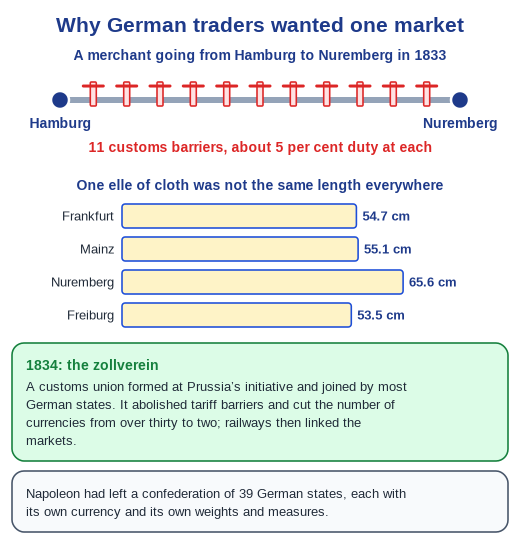
Equality before the law did not mean votes for everyone, though. In revolutionary France only men with property could vote, and the Napoleonic Code treated women as minors under their fathers and husbands. In the economy, liberals wanted markets without state restrictions. The German lands show why: Napoleon had left a confederation of 39 states, each with its own currency and its own weights and measures. A merchant travelling from Hamburg to Nuremberg in 1833 crossed 11 customs barriers and paid about 5 per cent duty at each. In 1834 a customs union, the zollverein, was formed at Prussia’s initiative. It abolished tariff barriers and cut over thirty currencies to two, and railways then linked the markets.
What did the Congress of Vienna do in 1815?
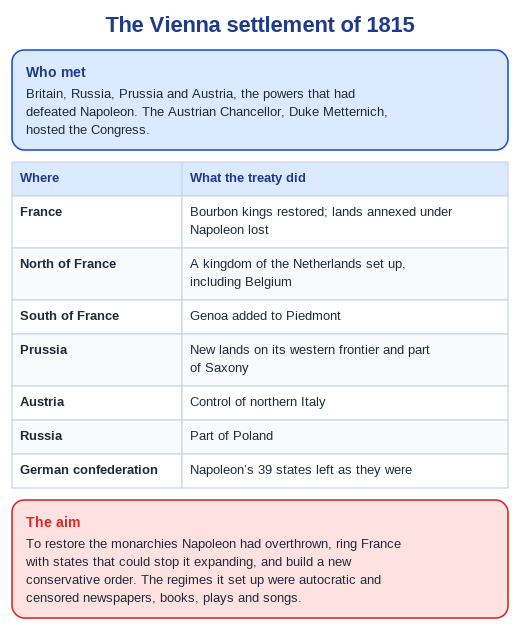
After Napoleon’s defeat, European governments turned conservative: they wanted to keep the monarchy, the Church, social ranks, property and the family. In 1815 Britain, Russia, Prussia and Austria met at Vienna, with the Austrian Chancellor, Duke Metternich, as host. The Treaty of Vienna restored the Bourbon kings in France, ringed France with new or larger states, and gave Prussia, Austria and Russia new lands. The new regimes did not tolerate criticism and censored newspapers, books, plays and songs.
Who were the revolutionaries?
Afraid of being punished, many liberal-nationalists went underground and formed secret societies. The most famous was Giuseppe Mazzini, born in Genoa in 1805 and a member of the Carbonari. Exiled in 1831, he founded Young Italy in Marseilles and Young Europe in Berne. He believed nations were the natural units of humankind, so Italy had to become one republic. Metternich saw him as the most dangerous enemy of the conservative order.
What happened in 1830, and in Greece?
In July 1830, liberal revolutionaries in France overthrew the Bourbon kings and set up a constitutional monarchy under Louis Philippe. This sparked an uprising in Brussels, and Belgium left the United Kingdom of the Netherlands. Greece, part of the Ottoman Empire since the 15th century, began its war of independence in 1821. Greeks in exile and many West Europeans who admired ancient Greek culture backed it; the English poet Lord Byron raised funds and went to fight, and died of fever in 1824. The Treaty of Constantinople recognised Greece as independent in 1832.
How did culture build national feeling?
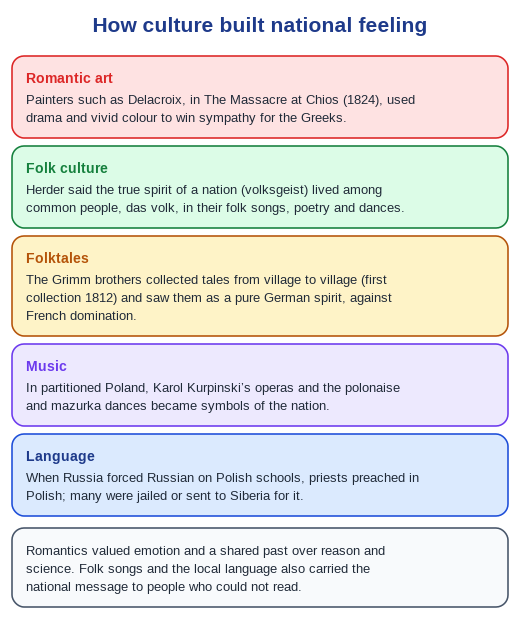
Romantic artists and poets valued emotion and a shared past more than reason and science. Herder said that the true German spirit lived in the folk songs, poetry and dances of the common people. The Grimm brothers collected folktales as a pure German heritage. In Poland, divided among Russia, Prussia and Austria, music and the Polish language kept national feeling alive.
Why did the poor revolt?
The 1830s and 1840s were hard years. Population grew fast, jobs were scarce, and cheap machine-made goods from England ruined many small producers. Bad harvests and high food prices spread poverty. In 1845 weavers in Silesia rose against contractors who had cut their pay. In 1848, food shortages and unemployment brought Paris onto the streets; Louis Philippe fled, and a republic gave the vote to all adult men over 21 and promised the right to work.
What was the revolution of the liberals in 1848?
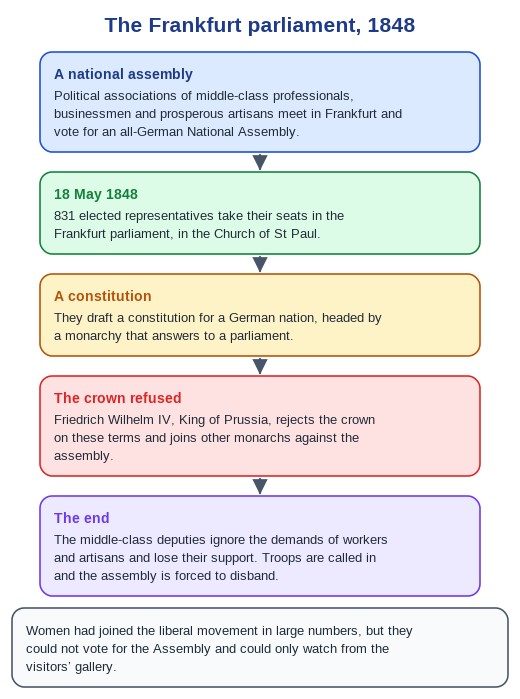
At the same time, educated middle-class liberals in Germany, Italy, Poland and the Austro-Hungarian Empire demanded nation-states with a constitution, an uncensored press and the right to form associations. On 18 May 1848, 831 elected representatives met in the Church of St Paul in Frankfurt and drafted a constitution for a German nation under a monarchy answerable to parliament. Friedrich Wilhelm IV, King of Prussia, refused the crown on these terms, and troops later broke up the assembly. Women had worked hard in the liberal movement but could not vote and could only watch from the gallery.
The conservatives won in 1848 but could not bring back the old order. Rulers began to give ground: serfdom and bonded labour were abolished in the Habsburg lands and Russia, and the Habsburgs gave the Hungarians more autonomy in 1867. Read on: How did the French Revolution create the idea of the nation?, How were Germany and Italy unified?, the chapter notes and the NCERT solutions.
Practice
-
The word liberalism comes from the Latin word liber, which is also the root of the English word:
Show answer
Answer: (b) liberty
-
Where was the Frankfurt parliament convened in 1848?
Show answer
Answer: (b) the Church of St Paul
-
Which German philosopher said that the true spirit of the nation lived among the common people?
Show answer
Answer: (b) Johann Gottfried Herder
-
Why did German merchants want a customs union?
Show answer
Answer: Each of the 39 German states had its own currency, weights and measures and customs posts. A merchant going from Hamburg to Nuremberg in 1833 crossed 11 customs barriers, so trade was slow and costly.
-
Why did the Frankfurt parliament fail?
Show answer
Answer: The King of Prussia refused the crown it offered and joined other monarchs against it, the aristocracy and the army opposed it, and its middle-class members lost the support of workers and artisans. In the end troops forced it to disband.
Questions students ask
What was the Treaty of Vienna of 1815?
It was the settlement that Britain, Russia, Prussia and Austria drew up after defeating Napoleon. It restored the Bourbon kings in France, set up states such as the kingdom of the Netherlands on France’s borders, and gave Prussia, Austria and Russia new lands, to build a conservative order.
Who was Giuseppe Mazzini?
An Italian revolutionary, born in Genoa in 1805. He joined the Carbonari, was exiled in 1831 and founded Young Italy and Young Europe. He wanted Italy to become one republic in a wider alliance of nations.
What was the 1848 revolution of the liberals?
In 1848, educated middle-class liberals in Germany, Italy, Poland and the Austro-Hungarian Empire demanded nation-states with a constitution, an uncensored press and the right to form associations. In Germany they set up the Frankfurt parliament, which failed.
Stuck on a question?
Take a photo and Lagnever AI explains it step by step. Try it for 7 days for ₹2.
Get it on Google Play Open in browser
For parents: after the trial, the plan renews monthly by UPI or card autopay. You can cancel anytime in the app.