
How did the French Revolution create the idea of the nation?
Answer in short
The French Revolution of 1789 took sovereignty from the king and gave it to the citizens, so the people now made up the nation. La patrie, le citoyen, the tricolour, one language, uniform laws and one system of weights and measures built a shared identity. Napoleon later carried its administrative ideas across Europe, but without political freedom.
Stuck on a question? Take a photo and Lagnever AI explains it step by step. Try it for 7 days for ₹2. Get it on Google Play
What changed in France in 1789?
Before 1789, France was already a large territorial state, but it was ruled by an absolute monarch: the king held power, and people were his subjects. The French Revolution turned this around. Its political and constitutional changes moved sovereignty, the supreme power to rule, from the monarchy to the body of French citizens. The Revolution declared that the people would form the nation and decide its future. That is why the chapter treats it as the first clear expression of nationalism in Europe.
How did the revolutionaries build a sense of one people?
A nation needs people who feel they belong together, so the revolutionaries took steps to build a collective identity, a feeling of being one people:
- Ideas. They spread the ideas of la patrie (fatherland) and le citoyen (citizen): the French were one community of people with equal rights under a constitution.
- Symbols. A new flag, the tricolour, replaced the royal standard. New hymns were written, oaths were taken and martyrs were honoured, all in the name of the nation.
- Government. The Estates General, now elected by active citizens, was renamed the National Assembly. A central administration made the same laws for every citizen.
- Trade. Customs duties and dues inside the country were scrapped, and the same weights and measures were used everywhere.
- Language. Regional dialects were discouraged, and the French of Paris was made the language of the whole nation.
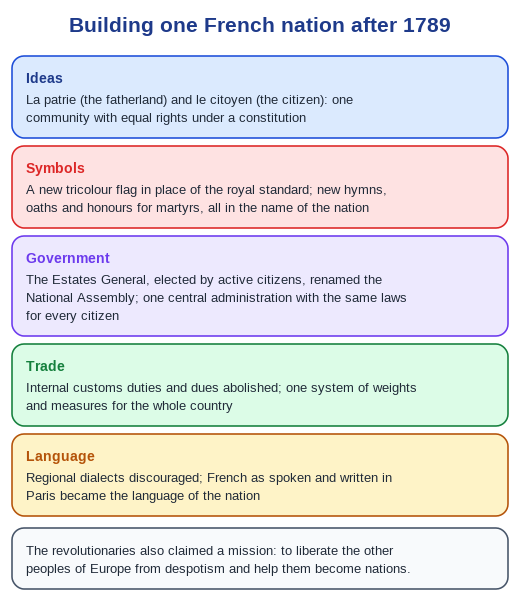
Think of how a school builds team spirit: a shared name, colours, a song and the same rules for everyone. France did something similar for a whole country.
How did the idea spread beyond France?
The revolutionaries also claimed that France had a mission: to rescue the other peoples of Europe from despotic rule and help them become nations. When news from France reached other European cities, students and members of the educated middle classes set up Jacobin clubs. Their campaigns prepared the ground for the French armies, which in the 1790s marched into Holland, Belgium, Switzerland and large parts of Italy. With the revolutionary wars, French soldiers carried the idea of nationalism abroad. A German journalist, Andreas Rebmann of Mainz, even put the storming of the Bastille on the cover of a German almanac in 1798, next to a German fortress, to urge Germans to take their own freedom.
What did Napoleon change?
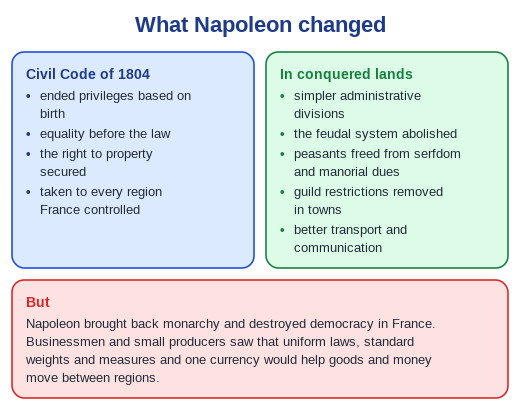
Napoleon’s return to monarchy destroyed democracy in France. Yet in administration he used revolutionary principles to make government more rational and efficient. His Civil Code of 1804, usually called the Napoleonic Code, swept away the privileges that came with birth, made everyone equal before the law and protected the right to own property. He took this code to every region France controlled.
Across the Dutch Republic, Switzerland, Italy and Germany he made the administrative divisions simpler, ended the feudal system, and released peasants from serfdom and from the dues they owed their lords. In towns, guild restrictions were removed, and transport and communication improved. Businessmen and small producers began to see that uniform laws, standard weights and measures and one national currency would make it easier to move goods and money between regions.
Why did people turn against French rule?
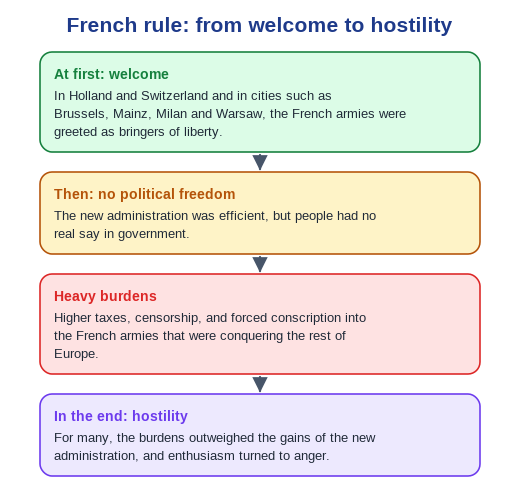
Reactions in the conquered areas were mixed. At first, in Holland and Switzerland and in cities such as Brussels, Mainz, Milan and Warsaw, French armies were welcomed as bringers of liberty. That enthusiasm soon faded, because the new administration did not come with political freedom. Taxes went up, newspapers were censored, and young men were forced to serve in the French armies that were conquering the rest of Europe. For many, these burdens outweighed the benefits. A German print of the time shows French soldiers as oppressors, and a cartoon of 1813 shows Napoleon as a postman losing his territories after his defeat at Leipzig.
Why does this matter for the rest of the chapter?
The French Revolution gave Europe two lasting ideas: that the people make up the nation, and that a nation should have common laws, symbols and a common language. Napoleon’s reforms spread the second idea, while resentment of French rule made other peoples think about their own nations. Next, see what happened in Europe between 1815 and 1848, then how Germany and Italy were unified. Go back to the chapter notes or the NCERT solutions.
Practice
-
What did the French revolutionaries put in place of the royal standard?
Show answer
Answer: (b) the tricolour
-
The Civil Code of 1804 is also known as the:
Show answer
Answer: (b) Napoleonic Code
-
In which year did Napoleon lose the battle of Leipzig, shown in a German cartoon as a postman dropping letters?
Show answer
Answer: (c) 1813
-
Why did many people in conquered lands turn against French rule?
Show answer
Answer: The new administration did not bring political freedom, and it came with higher taxes, censorship and forced conscription into the French armies. These burdens seemed to outweigh the benefits.
-
Name two economic measures of the revolutionaries that helped unite France.
Show answer
Answer: They abolished internal customs duties and dues, and they adopted a uniform system of weights and measures for the whole country.
Questions students ask
Why is the French Revolution called the first expression of nationalism?
Because it declared that the people, not the king, make up the nation and shape its future. It then gave the French shared symbols, institutions, laws and a common language, so that people began to feel part of one nation.
What did la patrie and le citoyen mean?
La patrie means the fatherland and le citoyen means the citizen. Together they stressed that the French were one community of citizens with equal rights under a constitution, not subjects of a king.
Was Napoleon good or bad for nationalism?
Both, in a sense. His reforms swept away feudal privileges and showed businessmen the value of uniform laws, weights and measures and one currency, which fed later demands for national unity. But his rule came without political freedom, and resentment of French domination itself stirred national feeling in other lands.
Stuck on a question?
Take a photo and Lagnever AI explains it step by step. Try it for 7 days for ₹2.
Get it on Google Play Open in browser
For parents: after the trial, the plan renews monthly by UPI or card autopay. You can cancel anytime in the app.