
Class 8 Social Science Part 2 Chapter 2: India’s Long Road to Independence Notes
This chapter in five lines
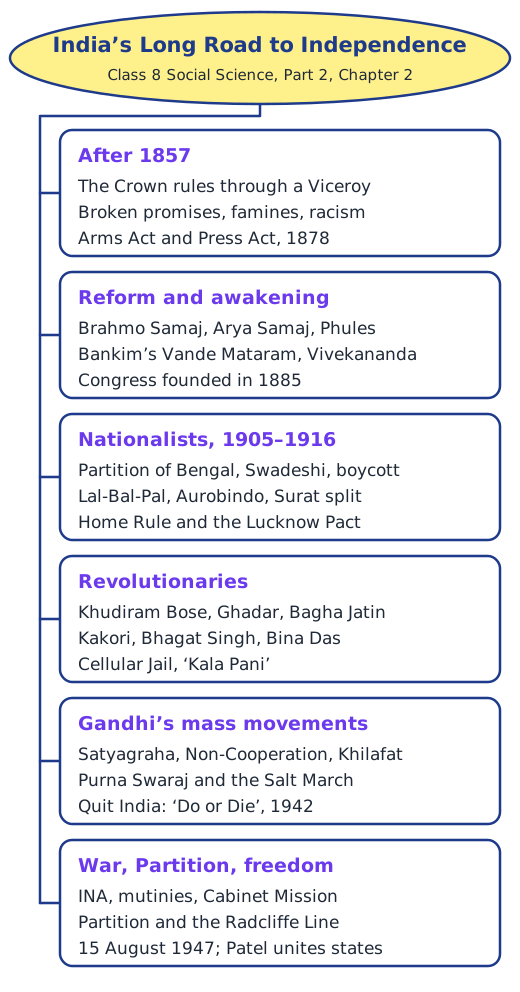
India’s Long Road to Independence traces the freedom struggle from 1857 to 1947. After the British Crown took over, broken promises, exploitation and racism fed discontent. Reformers and the Congress led early efforts; after the 1905 Partition of Bengal, Nationalists spread Swaraj, Swadeshi and boycott; revolutionaries took up arms; Gandhi led nonviolent mass movements; and India became independent on 15 August 1947, with Partition.
What is this chapter about?
People speaking hundreds of languages, following many faiths and customs, came together to challenge the most powerful empire of the time. This chapter tells, in brief, the story of that struggle from 1857 to 1947. Thousands of people took part; the Indian Council of Historical Research’s Dictionary of Martyrs alone lists some 14,000. Those the chapter cannot name were no less important, and the freedom fighters, though united in their goal, often disagreed on how to reach it.
British rule after 1857
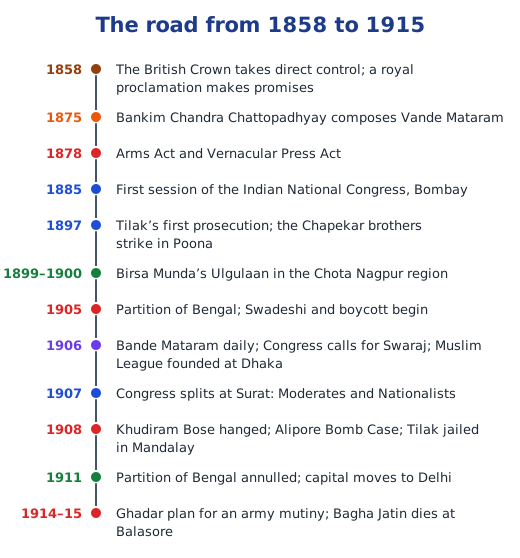
In 1858 the British Crown took over India’s government from the East India Company; a Viceroy governed in Queen Victoria’s name. A royal proclamation promised to respect the princes and treat Indians like other subjects, but British Residents meddled in the princely states, heavy land taxes caused famines, and British goods ruined local industries. Indians faced racial discrimination in pay, courts and public places, and in 1878 the Arms Act and the Vernacular Press Act treated them unequally.
Reformers and the Congress
Reformers challenged child marriage, caste discrimination and the neglect of education: Raja Ram Mohan Roy’s Brahmo Samaj, Swami Dayananda Saraswati’s Arya Samaj, Iswar Chandra Vidyasagar, Syed Ahmad Khan and Jyotirao and Savitribai Phule. Bankim Chandra Chattopadhyay’s Vande Mataram (1875) became a rallying cry, and Swami Vivekananda urged Indians to find their strength. In 1885 the Indian National Congress met in Bombay; at first it was loyal to the Crown and asked only for reforms. Read early nationalism and reform.
Discontent, Partition and Swadeshi
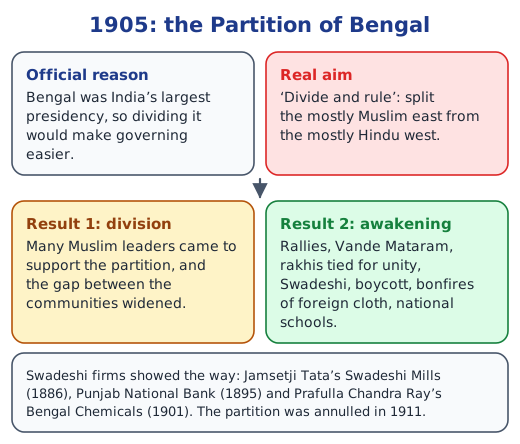
Resistance grew: the Kuka Movement in Punjab, Tilak’s Kesari and festivals in Maharashtra, the Anushilan Samiti in Bengal, and Birsa Munda’s Ulgulaan in the Chota Nagpur region. In 1905 Viceroy Curzon partitioned Bengal, officially for efficiency but really to divide Hindus and Muslims. The protests set off Swadeshi and boycott: bonfires of foreign cloth, Vande Mataram in the streets, national schools. In 1906 the Congress adopted Swaraj as its aim, and the All-India Muslim League was founded at Dhaka. At Surat in 1907 the Congress broke into two camps: the Moderates, and Nationalists such as Tilak, Lala Lajpat Rai, Bipin Chandra Pal and Aurobindo Ghose.
The revolutionaries
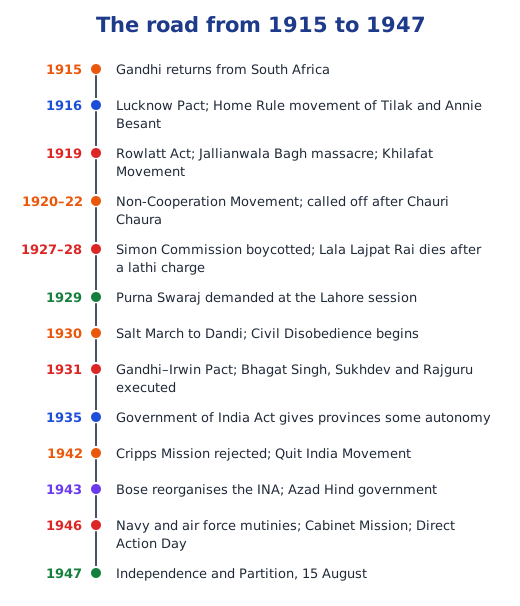
Some young Indians chose armed action. Khudiram Bose was hanged in 1908 at 18; the Ghadar Party planned an army mutiny during World War I; Bagha Jatin died after a gunfight at Balasore in 1915; and Bhagat Singh, Sukhdev and Rajguru were hanged in 1931. Many were sent to the Cellular Jail in the Andamans, ‘Kala Pani’. Read revolutionaries of the freedom struggle.
Gandhi and the mass movements
Gandhi returned from South Africa in 1915 with satyagraha, nonviolent resistance. After the Rowlatt Act and the Jallianwala Bagh massacre of 1919, he led the Non-Cooperation Movement with the Khilafat leaders, then called it off after Chauri Chaura in 1922. The Congress demanded Purna Swaraj in 1929, and the Salt March of 1930 began Civil Disobedience. In 1942 Gandhi’s call of ‘Do or Die’ launched the Quit India Movement. Read Gandhi and the mass movements.
Separate nations, war and the INA
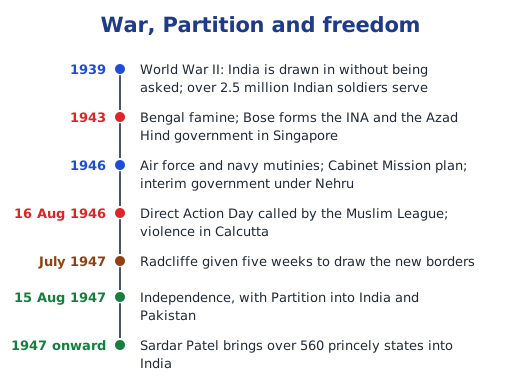
The Muslim League grew apart from the Congress. In 1930 Muhammad Iqbal proposed a separate Muslim territory in the north-west, and Jinnah came to support the idea of Pakistan, while Maulana Azad, Abdul Ghaffar Khan and most Congress leaders rejected the Two-Nation idea. World War II drew India in without consulting it; a famine struck Bengal in 1943. Subhas Chandra Bose escaped in 1941 and in 1943 formed the Indian National Army (INA) in Singapore.
Partition and independence
In 1946, mutinies in the air force and navy showed Britain it could no longer rely on Indian soldiers, and the Cabinet Mission tried to plan the handover. After Direct Action Day in August 1946, violence spread. In 1947 Cyril Radcliffe was given five weeks to draw the borders, and on 15 August 1947 India became independent, with Partition bringing huge migration and violence. Sardar Patel brought over 560 princely states into India.
Before we move on
India’s freedom was a long, hard and collective victory, won by many approaches and great sacrifice. Historians now see many causes for Britain’s exit, from mass movements to mutinies and the end of empires. The joy of 1947 was shadowed by Partition. Answers to every question are in the NCERT solutions for Part 2 Chapter 2.
Key terms
| Term | Meaning |
|---|---|
| Viceroy | The British monarch’s representative who governed India from 1858, also called the Governor General. |
| Paramountcy | British supremacy over the princely states, which kept their rulers but had to accept British control. |
| Indian National Congress | The political organisation founded in 1885 in Bombay that came to lead much of the freedom struggle. |
| Swaraj | Self-rule; a word whose meaning ranged from self-government within the British Empire to full independence. |
| Swadeshi | ‘Of one’s own country’: using Indian-made goods to build Indian industry and reduce dependence on Britain. |
| Boycott | Refusing to buy foreign goods or use British schools, colleges and courts, as a form of protest. |
| Moderates and Nationalists | Congress groups: the Moderates sought gradual reform within the Empire; the Nationalists, called ‘Extremists’ by the British, sought independence. |
| Sedition | Speech or writing said to encourage rebellion against a state; Tilak was jailed for it twice. |
| Satyagraha | Gandhi’s method of ‘insistence on truth’: nonviolent resistance and accepting suffering. |
| Purna Swaraj | Complete independence, demanded by the Congress at its Lahore session in December 1929. |
| Civil disobedience | Deliberately and peacefully breaking unjust laws, such as the salt law, as a protest. |
| Dominion status | Full internal self-government under the British Crown, like Canada or Australia then had. |
| Two-Nation idea | The claim that Hindus and Muslims formed separate nations, which led to the demand for Pakistan. |
| Partition | The division of British India in August 1947 into India and Pakistan along the Radcliffe Line. |
Topics in this chapter
Practice
-
When was the Indian National Congress founded?
Show answer
Answer: (b) 1885
-
The Partition of Bengal was announced in:
Show answer
Answer: (b) 1905
-
Who composed Vande Mataram?
Show answer
Answer: (b) Bankim Chandra Chattopadhyay
-
The Salt March went to:
Show answer
Answer: (b) Dandi
-
‘Do or Die’ was the call of the:
Show answer
Answer: (c) Quit India Movement
-
Who integrated the princely states into India?
Show answer
Answer: (b) Sardar Vallabhbhai Patel
Questions students ask
What are the main topics of Class 8 Social Science Part 2 Chapter 2?
British rule after 1858 and the growth of discontent; reform movements; the Indian National Congress; early resistance; the Partition of Bengal, Swadeshi and boycott; Moderates and Nationalists; the revolutionaries; Home Rule; Gandhi’s satyagraha and mass movements; the Muslim League and the idea of separate nations; World War II and the INA; and independence with Partition in 1947.
Is India’s Long Road to Independence in the new NCERT Class 8 book?
Yes. It is Chapter 2 of Exploring Society: India and Beyond, the Class 8 Social Science textbook Part 2 (first edition June 2026), in the theme Tapestry of the Past, on pages 35 to 84.
What are the Big Questions of this chapter?
How a land of many geographies, languages and religions came together to end nearly two centuries of British rule; what the main developments were and who some of the important figures were; and on which issues the leading freedom fighters agreed or disagreed.
Why did India’s freedom fighters follow different paths?
They shared the goal of freedom but differed on how to reach it. Moderates trusted petitions and gradual reform, Nationalists mass awakening through Swaraj, Swadeshi and boycott, revolutionaries armed action, and Gandhi nonviolent satyagraha, while Subhas Chandra Bose raised an army abroad. Historians study these approaches and their debates.
Stuck on a question?
Take a photo and Lagnever AI explains it step by step. Try it for 7 days for ₹2.
Get it on Google Play Open in browser
For parents: after the trial, the plan renews monthly by UPI or card autopay. You can cancel anytime in the app.