
NCERT Solutions Class 8 Social Science Part 2 Chapter 2: India’s Long Road to Independence
Answers to every question in Part 2 Chapter 2, India’s Long Road to Independence, of Exploring Society: India and Beyond Grade 8 (first edition, June 2026): each Let’s Explore and Think About It, the True or False and Who Am I questions, and the activities. Page numbers follow the book (pages 35–84). Short notes: Part 2 Chapter 2 notes.
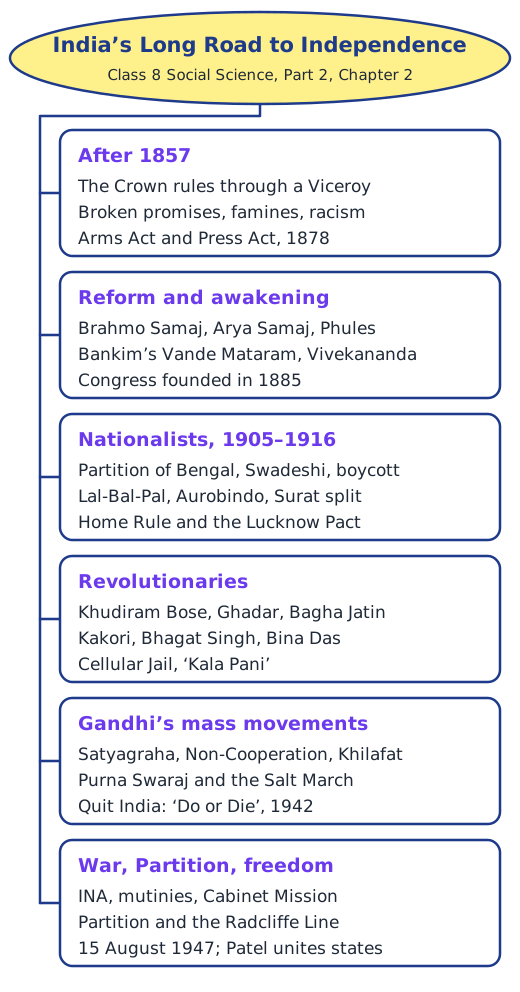
Let’s Explore and Think About It (pages 38–80)
Page 38: memories of the freedom struggle. Ask elders which leaders and events they heard about at home, such as Gandhi’s marches, Bhagat Singh, Subhas Bose or Partition, and whether their families favoured nonviolence or armed struggle. In class, compare the answers: people shared one goal but chose different paths.
Page 42: the meaning of Vande Mataram. In short: ‘I bow to you, Mother: well watered, rich with fruit, cooled by southern breezes, green with crops. Your nights glow with moonlight, your trees are crowned with flowers; you smile sweetly and speak softly; you give joy and grant blessings.’ The motherland is honoured as a mother.
Page 43: Vivekananda’s values today. His call to rise, overcome fear and self-doubt, build strength and character, value science while staying rooted in one’s own culture, and serve others still helps young people set goals and work for them with confidence.
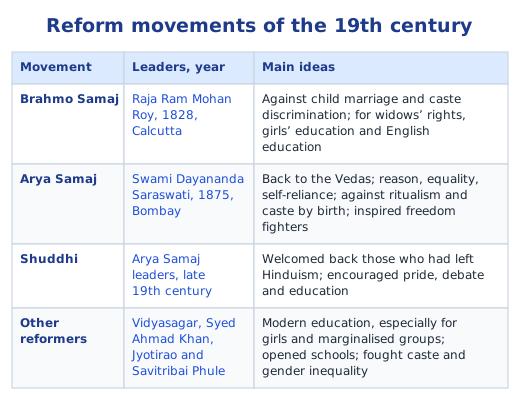
Page 50: the Bande Mataram daily. Why avoid ‘independence’? Openly demanding independence could be punished as sedition and get the paper shut down, so it used words the law could not easily attack. ‘Absolute national autonomy’ means complete self-rule, with India governing itself in every matter: freedom in all but name. The two boxes by the title read ‘Swadeshi paper of India’ and ‘Our policy: India for Indians’, so even the masthead preached Swadeshi and self-rule.
Page 52: two images of Mother India. Both show India as a divine mother. Abanindranath Tagore’s Bharat Mata is a calm, saffron-clad woman with four arms holding cloth, a book, prayer beads and a sheaf of grain, gifts of clothing, learning, spirit and food. Bharati’s Vijaya cover is a printed emblem: Mother India drawn over the shape of the country with ‘Vande Mataram’ written beside her and people below, under the title in Tamil, a call to rise rather than a quiet blessing.
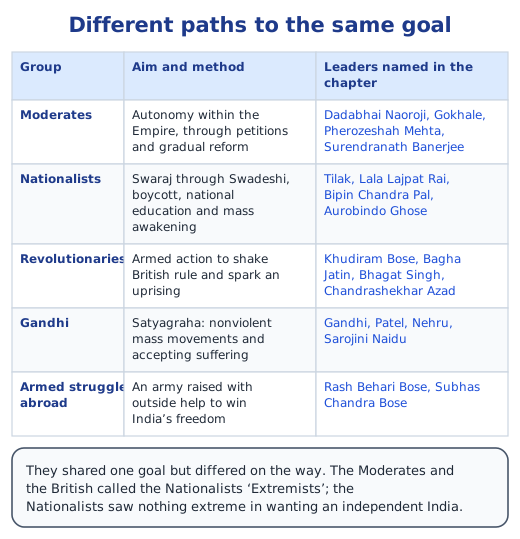
Page 55: the North-East. Starting points: Tirot Sing’s Khasi revolt (1829–33), the Singpho rebellion, Maniram Dewan and Piyali Baruah (1857), Rani Gaidinliu, and Quit India martyrs Kanaklata Barua and Kushal Konwar.
Page 56: Tilak’s words to the judge. He meant that his suffering in jail would serve the cause more than his writing and speeches: punishment would inspire people. ‘Swaraj is my birthright and I shall have it’ shows courage, self-respect and firm determination.
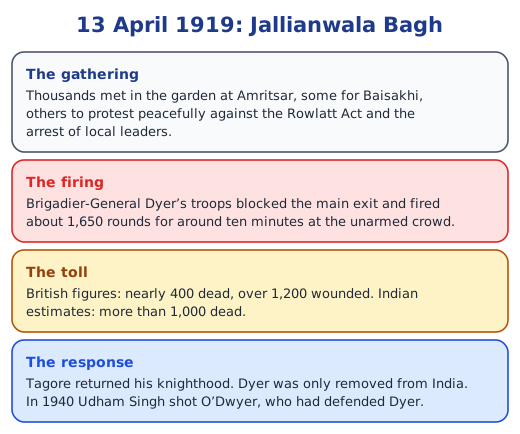
Page 63: Tagore’s letter. Tagore meant that the rulers were pleased with themselves, believing the massacre had taught Indians a ‘useful lesson’ in obedience, while ignoring the nation’s grief and anger.
Page 69: the Purna Swaraj resolution. Its elements: freedom is the inalienable right of every people; people have a right to the fruits of their work and the necessities of life; a people may change or abolish a government that oppresses them; British rule has harmed India in every way, its economy, politics, culture and spirit; so India must cut the British connection and win complete independence.
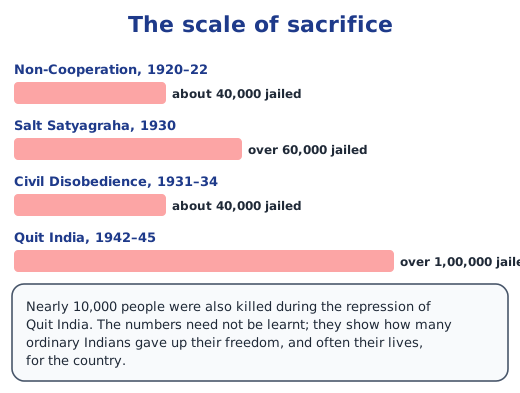
Page 76: the figures of imprisonment. Tens of thousands were jailed in each movement, and about 10,000 were killed during Quit India: freedom was won by the sacrifice of ordinary families, not only famous leaders.
Page 80: add a name. For example, Batukeshwar Dutt (with Bhagat Singh in the Assembly), Durgawati Devi, Kamaladevi Chattopadhyay or Sucheta Kriplani.
Questions and activities (pages 81–84)
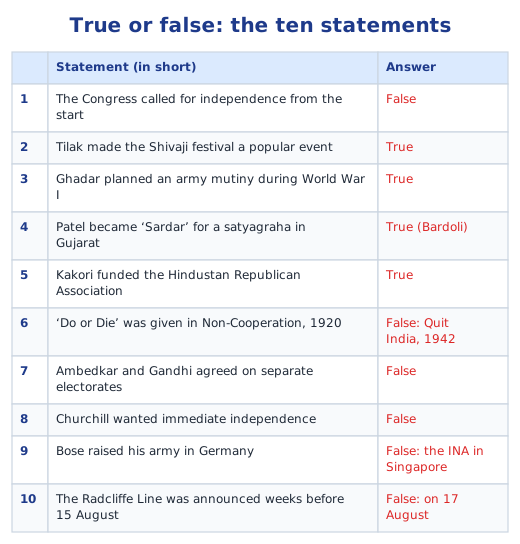
True or False. 1 False: the early Congress was loyal to the Crown. 2 True. 3 True. 4 True: the title came from the Bardoli satyagraha in Gujarat (1928). 5 True. 6 False: ‘Do or Die’ belongs to Quit India, 1942. 7 False: they disagreed, and the Poona Pact was a compromise. 8 False: Churchill sought India’s wartime support and offered dominion status after the war. 9 False, as the chapter tells it: Bose sought support in Germany but formed the INA in Singapore in 1943. 10 False: the Radcliffe Award was published on 17 August 1947, two days after Independence.
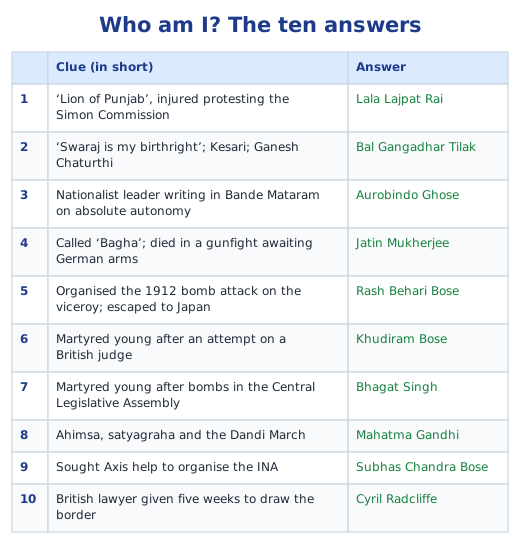
Who Am I? 1 Lala Lajpat Rai. 2 Bal Gangadhar Tilak. 3 Aurobindo Ghose (Sri Aurobindo). 4 Jatin Mukherjee, ‘Bagha Jatin’. 5 Rash Behari Bose. 6 Khudiram Bose. 7 Bhagat Singh. 8 Mahatma Gandhi. 9 Subhas Chandra Bose. 10 Cyril Radcliffe.
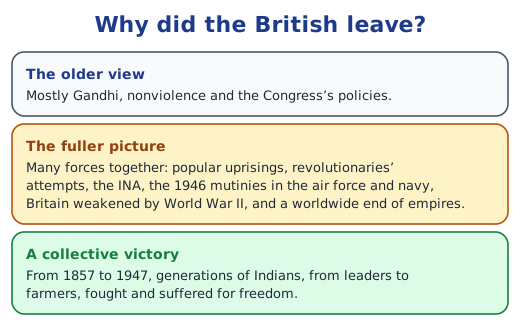
Sacrifices for freedom. Soldiers died in wars that were not their own, families starved in famines such as Bengal’s in 1943, leaders and ordinary people lost years in jail, and many lost homes and lives. A sample reflection: one might give up a comfortable job, studies abroad or safety at home, as many young people of that time did.
Tilak’s statement. It reflects self-respect, courage, a sense of one’s rights and determination. For young people today it can mean knowing their rights, standing up against injustice, and working hard for their goals.
Peasants, workers, tribals and students. Peasants refused unjust taxes (Kheda, Bardoli); workers struck (Ahmedabad, Quit India); tribal communities rose against the loss of land and dignity (Birsa Munda’s Ulgulaan); students joined Swadeshi rallies, left government schools and carried the 1942 movement. Their mass action gave the leaders’ demands real force.
Nehru’s speech. Redeem our pledge: fulfil the promise of independence that India had made after long years of struggle. The soul of a nation: the shared spirit, values and culture of its people, silenced under colonial rule and now able to speak freely.
Imagine you are a freedom fighter. A sample: supporting nonviolent mass action because it lets millions take part and wins moral support. Others may prefer armed resistance or slow reform. The debate teaches that people can share a goal, disagree on methods, and still stay united through respect.
A news report. Sample headline: ‘Gandhi Makes Salt at Dandi; Law Broken by Thousands’. Reaction: ‘We have made salt from our own sea,’ said a villager. Importance: it turned an everyday item into a symbol of defiance and started Civil Disobedience across India.
A museum exhibition. Sample title: ‘Threads of Freedom’. Objects: a charkha with khadi (self-reliance), an issue of the Bande Mataram daily (the power of ideas), a letter from the Cellular Jail (sacrifice). Visitors should leave grateful for the price of freedom.
A skit. For example, on the Salt March: Gandhi and marchers, villagers, police and a reporter, ending with salt being lifted at Dandi.
Citizens’ responsibilities today. Respect the Constitution and the law; vote and take part in democracy; protect the rights of others; keep peace between communities; protect public property and the environment; pay taxes honestly; stay informed; and help those in need.
Short notes and more practice are on the topic pages: early nationalism and reform, Gandhi and the mass movements and revolutionaries of the freedom struggle.
Practice
-
‘Do or Die’ was the call of which movement?
Show answer
Answer: (c) Quit India, 1942
-
Which leader was called the ‘Lion of Punjab’?
Show answer
Answer: (b) Lala Lajpat Rai
-
Who drew the line that partitioned India in 1947?
Show answer
Answer: (c) Cyril Radcliffe
-
Did the Congress call for independence from its start in 1885?
Show answer
Answer: No. It began by declaring faith in British rule and loyalty to the Crown, and asked only for reforms and a greater Indian share in governance. Complete independence, Purna Swaraj, became its demand only in 1929.
-
What does ‘redeem our pledge’ mean in Nehru’s 1947 speech?
Show answer
Answer: To keep the promise India had made to itself, the pledge of complete independence taken by the Congress after 1929 and by generations of freedom fighters. On 15 August 1947 that promise was being fulfilled ‘very substantially’, though building the nation still lay ahead.
Stuck on a question?
Take a photo and Lagnever AI explains it step by step. Try it for 7 days for ₹2.
Get it on Google Play Open in browser
For parents: after the trial, the plan renews monthly by UPI or card autopay. You can cancel anytime in the app.