
Gandhi and the mass movements, 1915 to 1942
Answer in short
Gandhi returned from South Africa in 1915 with satyagraha: nonviolent resistance and the acceptance of suffering. He led local satyagrahas, then the Non-Cooperation Movement (1920–22) after the Rowlatt Act and Jallianwala Bagh, the Salt March and Civil Disobedience (1930) after the demand for Purna Swaraj, and the Quit India Movement of 1942 with the call ‘Do or Die’.
Stuck on a question? Take a photo and Lagnever AI explains it step by step. Try it for 7 days for ₹2. Get it on Google Play
A new method: satyagraha
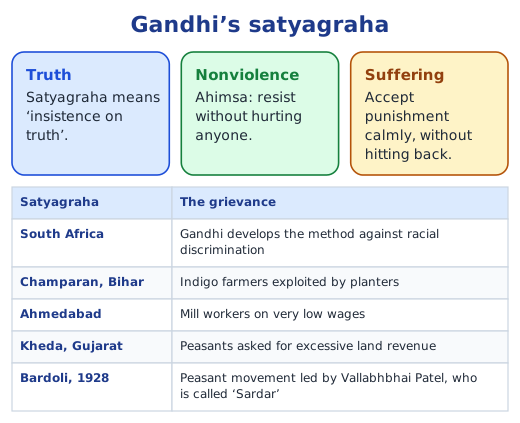
Mohandas Karamchand Gandhi, born in Porbandar in 1869, studied law in London and worked in South Africa, where he faced racial discrimination himself. There he shaped satyagraha, ‘insistence on truth’: passive resistance, nonviolence (ahimsa) and the acceptance of suffering. Back in India in 1915, he joined the Congress on Gokhale’s advice and used satyagraha for local causes: indigo farmers in Champaran, mill workers in Ahmedabad and peasants in Kheda. Later, Vallabhbhai Patel led the Bardoli movement of 1928 so well that Gandhi gave him the title ‘Sardar’.
1919: the Rowlatt Act and Jallianwala Bagh
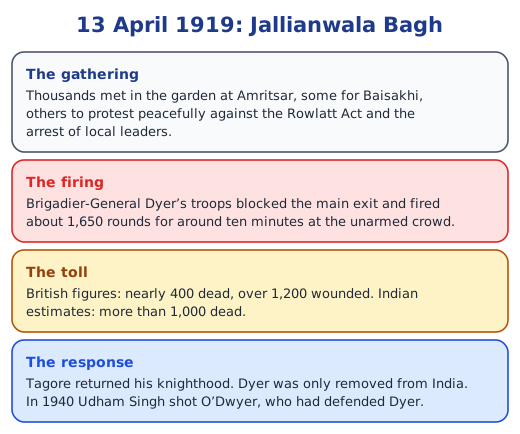
World War I brought no freedom. Food was exported for the war, prices rose, and the Rowlatt Act of 1919 let the police detain people without trial. Gandhi called for a day of prayer and fasting. On 13 April 1919, at Jallianwala Bagh in Amritsar, Dyer’s troops fired on a peaceful crowd; official figures admitted nearly 400 dead, Indian estimates more than 1,000. Tagore returned his knighthood, and trust in British rule was broken for good.
Non-Cooperation and Khilafat, 1920–22
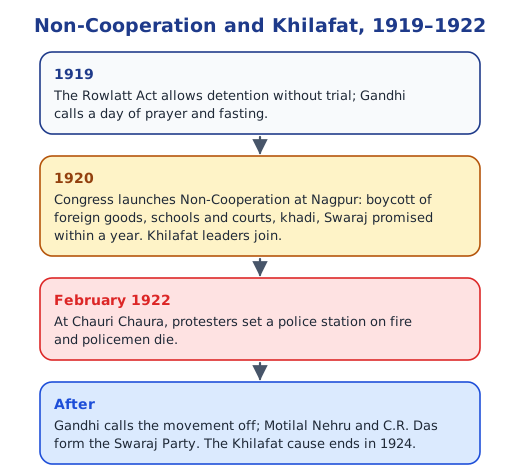
The Congress launched the Non-Cooperation Movement at Nagpur in December 1920, after Tilak’s death made Gandhi its foremost leader. People boycotted foreign goods, British schools and courts, and spun khadi, a symbol of self-reliance; Gandhi promised Swaraj within a year if they stayed nonviolent. Khilafat leaders such as the Ali brothers and Maulana Azad joined, bringing many Muslims into the movement, though some, Jinnah among them, objected to mixing religion with politics. In February 1922, protesters killed policemen at Chauri Chaura, and Gandhi called the movement off, to the dismay of many leaders.
Purna Swaraj and the Salt March
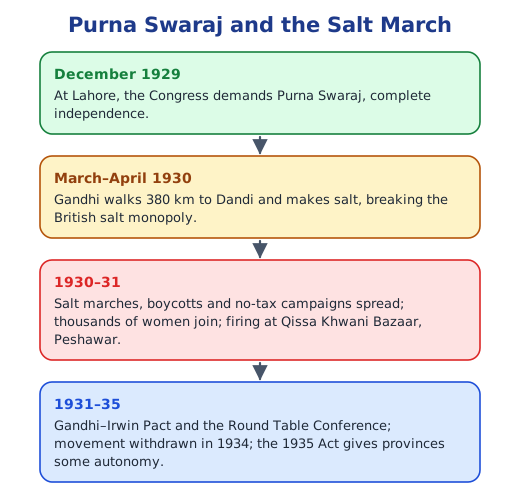
An all-British Simon Commission arrived in 1927 and was met with ‘Simon Go Back!’; Lala Lajpat Rai died after a police lathi charge in 1928. The Congress’s Lahore session of December 1929 demanded Purna Swaraj, complete independence. In March and April 1930, Gandhi walked 380 km to Dandi and made salt, breaking the British salt monopoly. Civil Disobedience spread with salt marches, boycotts and refusals to pay taxes; thousands of women joined, and Sarojini Naidu, the first Indian woman Congress president, marched with Gandhi. The Gandhi–Irwin Pact of 1931 led to a Round Table Conference, but the movement faded and was withdrawn in 1934.
Quit India, 1942
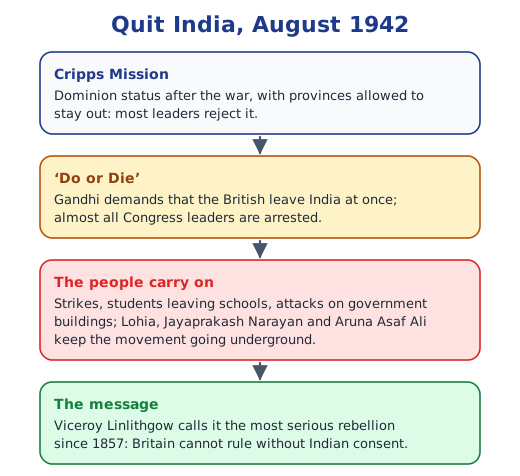
During World War II, the Cripps Mission offered dominion status after the war, with provinces allowed to stay out of post-war India; most leaders rejected it. In August 1942 Gandhi launched the Quit India Movement with the call ‘Do or Die’. Almost every Congress leader was arrested, yet strikes and protests went on, Ram Manohar Lohia and Jayaprakash Narayan kept an underground movement alive, Aruna Asaf Ali hoisted the flag at Gowalia Tank Maidan, and 17-year-old Kanaklata Barua was shot leading a procession in Assam. The repression was severe, with many deaths and mass arrests, but the message reached Britain: it could not rule India without Indian consent. See early nationalism and reform, revolutionaries of the freedom struggle, the Chapter 2 notes and the NCERT solutions.
Practice
-
Where did Gandhi first develop satyagraha?
Show answer
Answer: (b) South Africa
-
The Non-Cooperation Movement was called off after the incident at:
Show answer
Answer: (b) Chauri Chaura
-
Which leader became the Congress’s first Indian woman president, in 1925?
Show answer
Answer: (b) Sarojini Naidu
-
Why did Gandhi choose salt for Civil Disobedience?
Show answer
Answer: Salt was needed by everyone, rich or poor, and the colonial government held a monopoly on making it and taxed it heavily. Breaking the salt law was therefore a simple act that people across India could join.
-
What was the Poona Pact?
Show answer
Answer: A compromise between Gandhi and B.R. Ambedkar. Ambedkar wanted separate electorates for the Depressed Classes; Gandhi feared this would divide Hindu society and fasted. Instead of separate electorates, the pact increased the number of seats reserved for them in the legislatures.
Questions students ask
What is satyagraha?
Satyagraha, ‘insistence on truth’, was Gandhi’s method of struggle. It meant resisting injustice without violence, refusing to cooperate with unjust laws, and accepting punishment and suffering calmly, so that the opponent’s conscience and public opinion would be moved.
What happened at Jallianwala Bagh?
On 13 April 1919, Brigadier-General Dyer’s troops sealed the main exit of the garden in Amritsar and fired for about ten minutes on an unarmed crowd gathered for Baisakhi and to protest peacefully. British figures admitted nearly 400 dead; Indian estimates were over 1,000. Tagore returned his knighthood in protest.
What was the Quit India Movement?
Launched by Gandhi in August 1942 with the call ‘Do or Die’, it demanded that the British leave India at once. Although almost all Congress leaders were arrested, people kept protesting and an underground movement continued; the viceroy called it the most serious rebellion since 1857.
Stuck on a question?
Take a photo and Lagnever AI explains it step by step. Try it for 7 days for ₹2.
Get it on Google Play Open in browser
For parents: after the trial, the plan renews monthly by UPI or card autopay. You can cancel anytime in the app.