
Revolutionaries of the freedom struggle
Answer in short
The revolutionaries were freedom fighters who believed armed action would shake British rule and spark an uprising. They included Khudiram Bose, hanged at 18 in 1908; the Ghadar Party, which planned an army mutiny in 1914–15; Bagha Jatin; the Kakori group of Bismil, Ashfaqulla Khan and Azad; and Bhagat Singh, Sukhdev and Rajguru, hanged in 1931.
Stuck on a question? Take a photo and Lagnever AI explains it step by step. Try it for 7 days for ₹2. Get it on Google Play
Secret societies and fiery papers
From the late 19th century, newspapers in English and Indian languages exposed colonial injustice. The Bengali paper Yugantar, run by Barindra Ghose’s group and linked to the Anushilan Samiti (founded in 1902), openly called for revolt. In Maharashtra, V.D. Savarkar’s Abhinav Bharat was active. These groups trained young people and believed that only force would end British rule.
Khudiram Bose and the Alipore trial
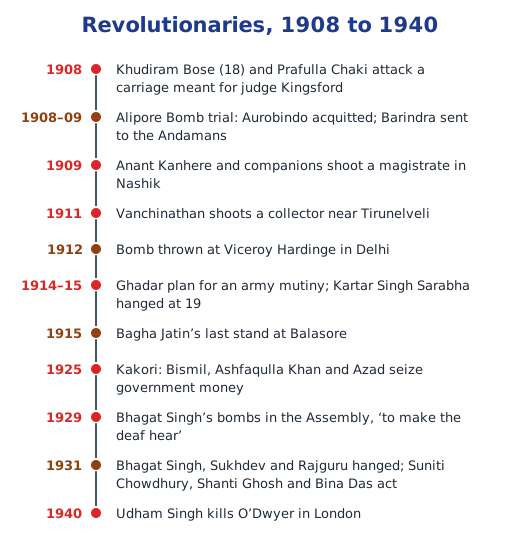
In April 1908, Khudiram Bose and Prafulla Chaki threw bombs at a carriage they thought carried judge Douglas Kingsford, known for harsh sentences on Swadeshi activists; two British women were killed instead. Prafulla shot himself, and Khudiram, just 18, was hanged; crowds showered flowers on his funeral procession. Aurobindo Ghose, his brother Barindra and others were then arrested. In the year-long Alipore Bomb trial, Aurobindo, defended by Chittaranjan Das, was acquitted; Barindra’s death sentence was reduced to life in the Andamans. More attacks followed: at Nashik in 1909, near Tirunelveli in 1911 and on Viceroy Hardinge in Delhi in 1912.
Ghadar and Bagha Jatin
The Ghadar Party, founded by Indians in North America such as Lala Hardayal and Sohan Singh Bhakna, planned a mutiny in the British Indian Army in 1914–15, during World War I. In India, Rash Behari Bose, Sachin Sanyal and Kartar Singh Sarabha tried to win over soldiers, but the plot was discovered; Kartar Singh was hanged at 19, and Rash Behari Bose escaped to Japan. Bagha Jatin, of the Anushilan Samiti, prepared to receive German arms; surrounded near Balasore on 9 September 1915, he and his companions fought a 75-minute gun battle, and he died of his wounds the next day.
Kala Pani
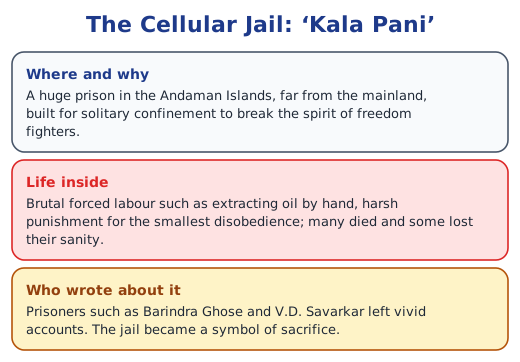
Many revolutionaries were sent to the Cellular Jail in the Andaman Islands, known as ‘Kala Pani’, black water. Built for solitary confinement, it was meant to break their spirit with brutal labour, such as pressing oil by hand, and harsh punishments. Barindra Ghose and V.D. Savarkar later described its horrors; many prisoners died there. The jail became a symbol of sacrifice.
Kakori, Bhagat Singh and after
In the 1920s, those who found Gandhi’s nonviolence too slow formed the Hindustan Republican Association. Its members, with Bismil, Ashfaqulla Khan and Azad among their leaders, seized government money from a train at Kakori; Bismil and Ashfaqulla were later executed. Renamed the Hindustan Socialist Republican Association, it was led by Azad and Bhagat Singh. To avenge Lala Lajpat Rai, they shot a British police officer in 1928; in 1929 Bhagat Singh dropped two low-intensity bombs in the Central Legislative Assembly ‘to make the deaf hear’. Bhagat Singh, Sukhdev and Rajguru were hanged in 1931, aged 22 to 23. Women joined too: Suniti Chowdhury, Shanti Ghosh and Bina Das acted in 1931, and in 1940 Udham Singh shot O’Dwyer in London.
Their place in the story
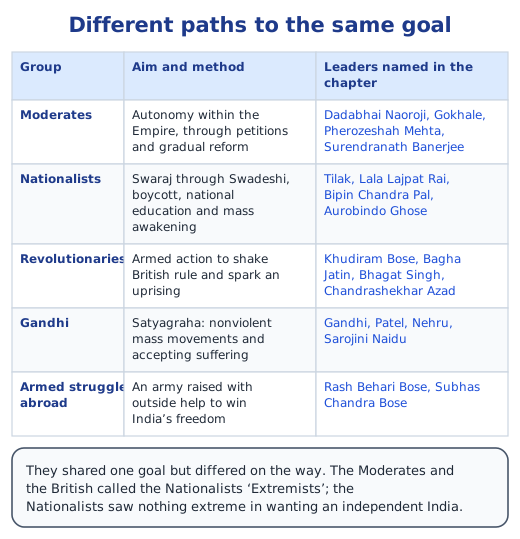
The revolutionaries rarely achieved their immediate aims, but their courage won wide popular support and rattled the government. Historians today count them among the many forces that ended British rule. Compare their path with others in early nationalism and reform and Gandhi and the mass movements, or see the Chapter 2 notes and NCERT solutions.
Practice
-
Who threw bombs at a carriage meant for judge Kingsford in 1908?
Show answer
Answer: (b) Khudiram Bose and Prafulla Chaki
-
The Ghadar Party was founded by Indians in:
Show answer
Answer: (b) North America
-
Which jail was called ‘Kala Pani’?
Show answer
Answer: (b) Cellular Jail, Andaman Islands
-
Why was Jatin Mukherjee called ‘Bagha Jatin’?
Show answer
Answer: ‘Bagha’ means tiger: he earned the name by fighting a tiger barehanded. An Anushilan Samiti leader, he died in 1915 after a gunfight with police at Balasore.
-
What did Udham Singh do?
Show answer
Answer: Udham Singh, a revolutionary of the Ghadar Party, tracked down Michael O’Dwyer, who as lieutenant governor of Punjab had defended Dyer after Jallianwala Bagh, and shot him dead in London two decades later. He was hanged after defending his action at his trial.
Questions students ask
Who were the revolutionaries of India’s freedom struggle?
They were freedom fighters who thought nonviolent methods were too slow and that force was a fair way to end British rule. They ran secret societies and newspapers, attacked harsh officials and tried to start mutinies; many were hanged or sent to the Cellular Jail.
What was the Kakori train robbery?
Members of the Hindustan Republican Association, among them Ram Prasad Bismil, Chandrashekhar Azad and Ashfaqulla Khan, seized government money carried by a train at Kakori near Lucknow to fund their activities. The crackdown that followed led to the execution of Bismil, Ashfaqulla Khan and others.
Were there women revolutionaries?
Yes. In 1931 two schoolgirls, Suniti Chowdhury and Shanti Ghosh, killed a District Magistrate in Comilla, and Bina Das, a Calcutta University student, tried to shoot the Governor of Bengal at a convocation; she was sentenced to nine years’ rigorous imprisonment.
Stuck on a question?
Take a photo and Lagnever AI explains it step by step. Try it for 7 days for ₹2.
Get it on Google Play Open in browser
For parents: after the trial, the plan renews monthly by UPI or card autopay. You can cancel anytime in the app.