
Early nationalism and reform, 1858 to 1916
Answer in short
After 1858, broken promises, famines and racial discrimination under British rule fed discontent. Reformers attacked social evils, Bankim and Vivekananda stirred national pride, and the Congress began in 1885 by asking for reforms. The 1905 Partition of Bengal turned protest into Swadeshi and boycott, and Nationalists such as Tilak, Lajpat Rai, Pal and Aurobindo demanded Swaraj.
Stuck on a question? Take a photo and Lagnever AI explains it step by step. Try it for 7 days for ₹2. Get it on Google Play
Rule by the Crown
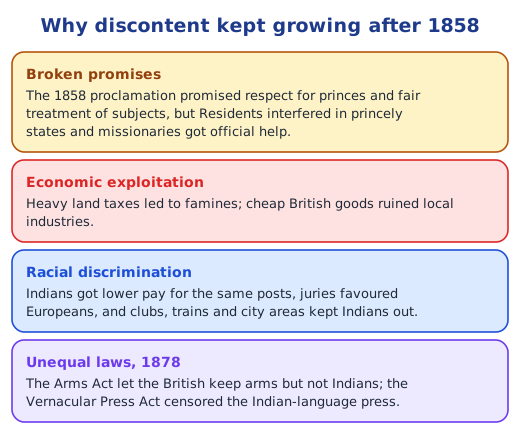
A year after the Great Uprising of 1857, the British Crown took over India’s government from the East India Company. A Secretary of State in London and a Viceroy in India now ruled in Queen Victoria’s name. Her 1858 proclamation promised to respect some 560 princes and to treat Indians like her other subjects. In practice, British Residents interfered in the princely states, missionaries received official help, heavy land taxes led to famines, and British goods crushed Indian industries. Indians were paid less for the same posts, faced biased juries and were kept out of clubs and trains. In 1878 the Arms Act stopped Indians, but not the British, from keeping arms, and the Vernacular Press Act censored the Indian-language press.
Reformers and new ideas
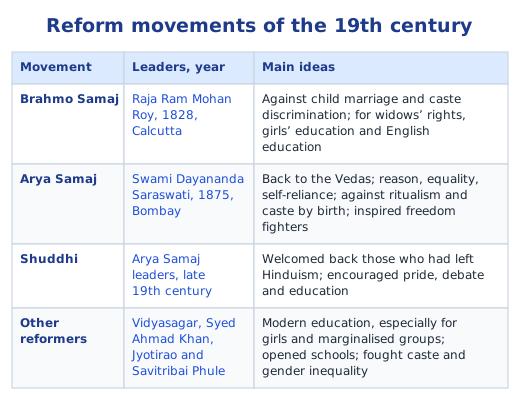
Many reformers took on child marriage, the plight of widows, caste discrimination and the lack of schooling. Raja Ram Mohan Roy founded the Brahmo Samaj in 1828; Swami Dayananda Saraswati’s Arya Samaj (1875) called for a return to the Vedas, reason and equality; Vidyasagar, Syed Ahmad Khan and Jyotirao and Savitribai Phule opened schools, especially for girls. Two cultural currents fed national feeling. Bankim Chandra Chattopadhyay composed Vande Mataram in 1875 and included it in his novel Anandamath (1882); in 1950 it became India’s National Song. Swami Vivekananda, famous for his 1893 speech in Chicago, urged Indians to overcome fear and draw on their own roots.
The Congress and early resistance
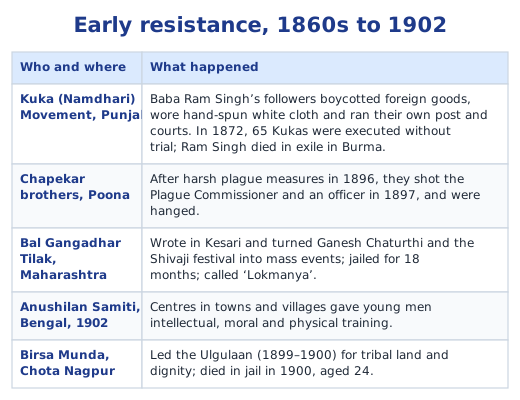
A.O. Hume, a British officer critical of colonial policy, worked with Indians such as Dadabhai Naoroji to launch the Indian National Congress in Bombay in 1885, with W.C. Bonnerjee as its first president and 72 delegates. It began by declaring loyalty to the Crown and asking for reforms, which were mostly ignored. Elsewhere, anger grew more open: the Kukas of Punjab boycotted foreign goods, the Chapekar brothers struck in plague-hit Poona, Tilak used his paper Kesari and the Ganesh and Shivaji festivals to rouse people, and Birsa Munda led the Ulgulaan of 1899–1900.
1905: Bengal divided, India awakened
Viceroy Curzon partitioned Bengal in 1905, claiming better administration but aiming to divide Hindus and Muslims. Two things followed. The communities drifted apart, as many Muslim leaders came to back the partition. But a national awakening also spread far beyond Bengal: rallies, Vande Mataram sung in the streets, rakhis tied as a sign of unity, and the Swadeshi and boycott movements, with bonfires of foreign cloth. Indian firms such as Tata’s Swadeshi Mills and Punjab National Bank already showed what self-reliance could do. The partition was annulled in 1911.
Nationalists and Moderates
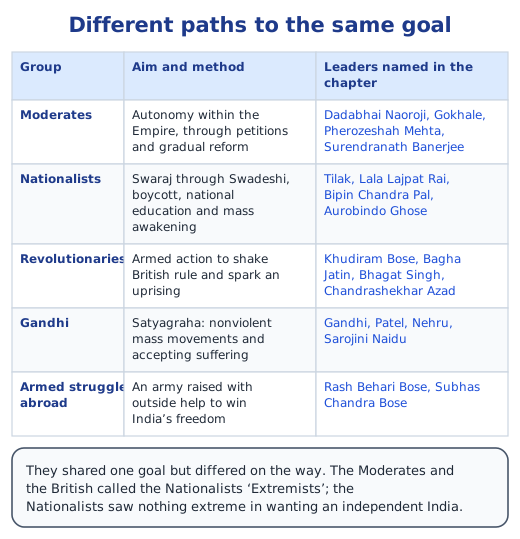
In 1906 Bipin Chandra Pal launched the daily Bande Mataram, soon run by Aurobindo Ghose, which called for ‘absolute national autonomy’ and national education; the Bengal National College opened with Aurobindo as principal. At Calcutta that December, the Congress adopted Swaraj, Swadeshi, Boycott and National Education, and the All-India Muslim League was founded at Dhaka. At Surat in 1907 the Moderates pulled back, and the Congress split. Tilak was jailed in Mandalay in 1908. After his release, the two wings reunited at Lucknow in 1916, which also brought the Lucknow Pact with the Muslim League, and Tilak and Annie Besant launched the Home Rule movement. Continue with Gandhi and the mass movements and revolutionaries of the freedom struggle, or see the Chapter 2 notes and NCERT solutions.
Practice
-
Who founded the Arya Samaj?
Show answer
Answer: (b) Swami Dayananda Saraswati
-
Which newspaper did Tilak write in?
Show answer
Answer: (a) Kesari
-
The Partition of Bengal was annulled in:
Show answer
Answer: (c) 1911
-
Why did Curzon partition Bengal in 1905?
Show answer
Answer: Officially to make the huge Bengal Presidency easier to govern; in reality to divide its largely Muslim east from its largely Hindu west, following the policy of ‘divide and rule’.
-
What were the Swadeshi and boycott movements?
Show answer
Answer: Swadeshi meant using Indian-made goods to strengthen Indian industry; boycott meant refusing foreign goods, especially cloth, and later British schools, colleges and courts. Bonfires of foreign cloth were lit, and Indian-made cloth became a symbol of national pride.
Questions students ask
Why did discontent grow after 1857?
The British broke the promises of the 1858 proclamation, interfered in the princely states, taxed land so heavily that famines followed, flooded markets with British goods, treated Indians as inferior in pay, courts and public places, and passed unequal laws such as the Arms Act and the Vernacular Press Act of 1878.
What did the Congress of 1906 demand?
At its Calcutta session in December 1906, with Dadabhai Naoroji presiding, the Congress declared Swaraj, Swadeshi, Boycott and National Education to be its aims. Swaraj was not defined, so it could mean anything from self-government within the Empire to full independence.
What was the Surat split?
At the Surat session of December 1907, the Moderates tried to step back from the 1906 resolutions. Tilak was prevented from speaking, chaos followed, and the Nationalists led by Tilak, Lala Lajpat Rai and Aurobindo Ghose held a separate session.
Stuck on a question?
Take a photo and Lagnever AI explains it step by step. Try it for 7 days for ₹2.
Get it on Google Play Open in browser
For parents: after the trial, the plan renews monthly by UPI or card autopay. You can cancel anytime in the app.