
Class 8 Social Science Chapter 6: The Parliamentary System: Legislature and Executive Notes
This chapter in five lines
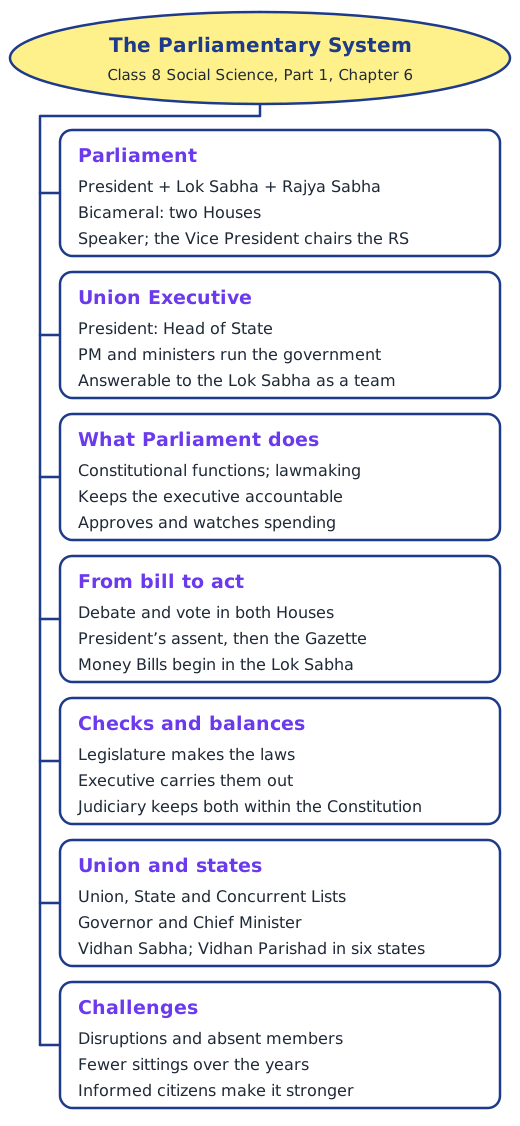
The Parliamentary System: Legislature and Executive explains how India’s Parliament, which is the President plus two Houses, makes laws and keeps watch over the government. It traces how a bill becomes an act, how the Prime Minister and the other ministers govern while answering to the Lok Sabha, and how each state copies this pattern.
What is this chapter about?
This is the second chapter of the theme Governance and Democracy. It opens with words of Alladi Krishnaswami Ayyar from the Constituent Assembly in 1949: the Constitution is a living guide for the nation, not just a legal text, and it carries the spirit of its time. A class on a school trip visits the new Parliament building in New Delhi, with its triangular shape and carvings from across India. Four Big Questions follow: what the parliamentary system is, what Parliament does, what the legislature and the executive do, and how both are organised in the Union and the states. You met elections in Chapter 5, and the three organs of government in Grade 7, in The State, the Government, and You.
What makes up the Parliament of India?
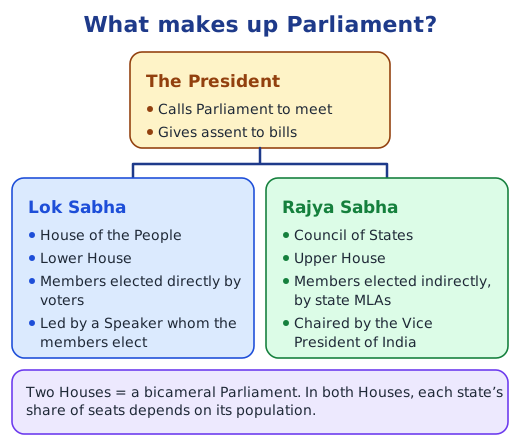
Parliament is the President plus two Houses: the Lok Sabha, or House of the People (the Lower House), and the Rajya Sabha, or Council of States (the Upper House). Two Houses make it bicameral. Voters elect the Lok Sabha directly; the Rajya Sabha is elected indirectly. The Lok Sabha’s members elect a Speaker to run its sittings, and the Vice President of India chairs the Rajya Sabha. India has had 17 Lok Sabhas since 1952; the 18th was formed in June 2024. Read What is India’s parliamentary system?
Who runs the government?
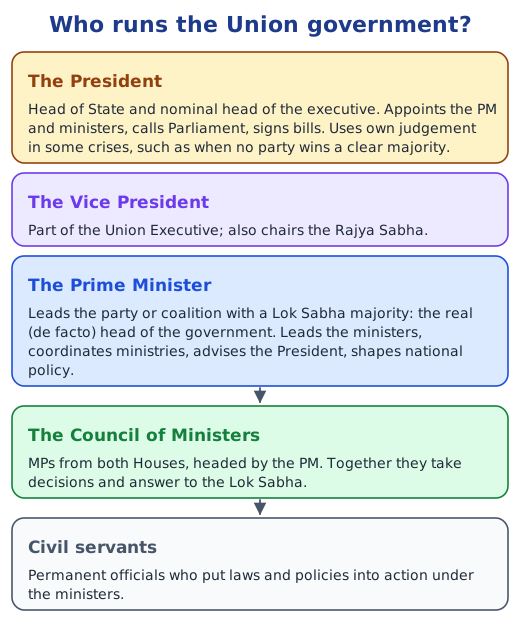
The Union Executive is made up of the President and the Vice President, plus the Council of Ministers, whose head is the Prime Minister. The President is Head of State but heads the executive only in name. The President appoints as Prime Minister the leader of the party or coalition with a majority in the Lok Sabha. The ministers come from both Houses, take decisions together and are collectively responsible to the Lok Sabha. Civil servants, permanent officials, help them carry out laws and policies.
What does Parliament do?
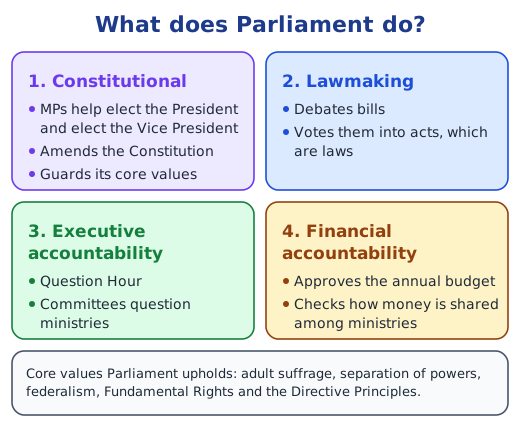
The chapter groups Parliament’s work under four heads. Constitutional functions include electing the President and the Vice President and amending the Constitution. Lawmaking turns bills into acts. Executive accountability means ministers must answer MPs, for example in the Question Hour and in committees. Financial accountability means Parliament approves the yearly budget and keeps an eye on how ministries spend it. Parliament also upholds core values of the Constitution, such as federalism and Fundamental Rights.
How does a bill become a law?
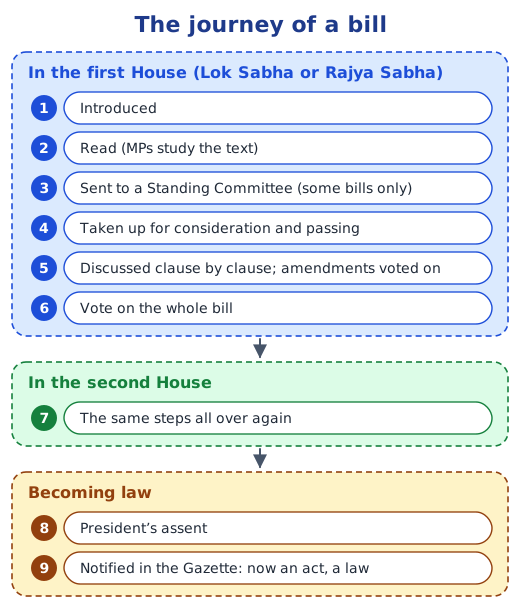
A bill, a law in draft form, can start in either House (except a Money Bill, which must start in the Lok Sabha). It is read, may go to a Standing Committee, is discussed clause by clause and is voted on. The other House repeats the steps. Then the President gives assent and the new act is announced in the Gazette. The chapter tells the story of the Right to Education (RTE) Act, which became law in August 2009. Read How does a bill become a law?
How is the legislature different from the executive?
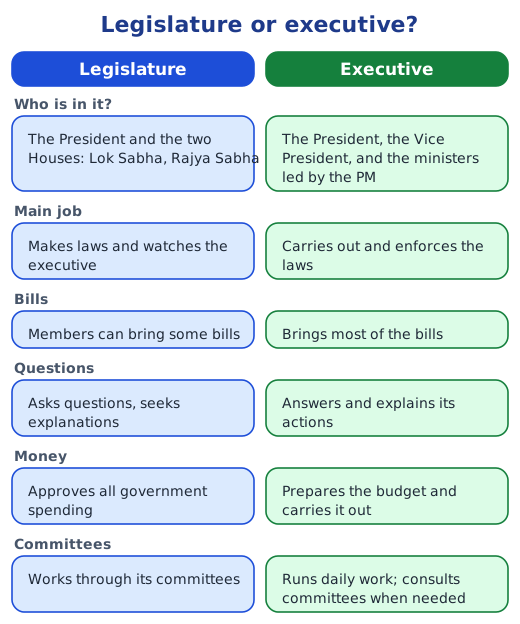
The legislature makes laws, approves spending and questions the government. The executive carries out the laws, brings most bills, prepares the budget and explains its actions. After a train accident in 1956, Lal Bahadur Shastri, then Railway Minister, resigned to take moral responsibility, a well-known example of a minister holding himself accountable. The judiciary checks that laws and government actions follow the Constitution. Together this is the separation of powers, with checks and balances so that no organ grows too strong.
How are the states governed?
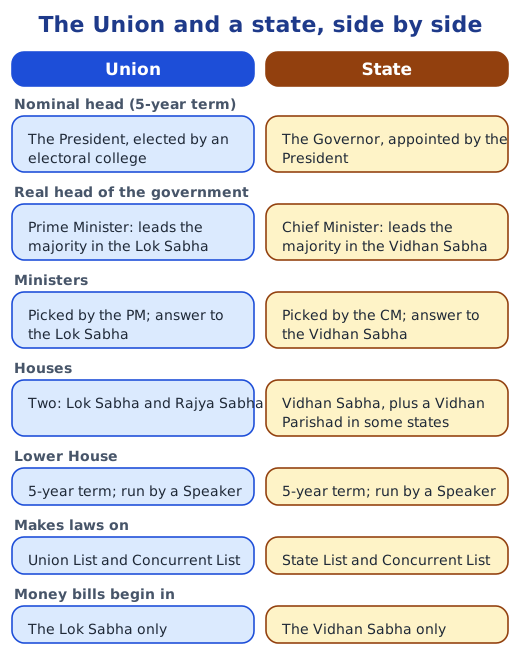
Every state has a legislature and an executive of its own. The Governor, appointed by the President, is the nominal head, and the Chief Minister, leader of the majority in the Vidhan Sabha, runs the government. Six states also have a Vidhan Parishad. Laws are shared out through the Union List, the State List and the Concurrent List. Read How are the Union and state governments organised?
What makes it hard for legislatures to work well?
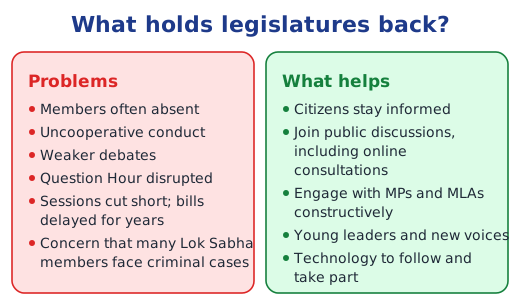
The chapter lists members staying away, uncooperative behaviour, poorer debates and a disrupted Question Hour. The Lok Sabha also sits far less often than it once did. Its answer is active citizens: people who stay informed, join public discussions and engage with their representatives help Parliament and the assemblies serve everyone. Answers to every question are in the NCERT solutions for Chapter 6.
Key terms
| Term | Meaning |
|---|---|
| Parliamentary system | A form of government in which the people elect a legislature, and the government comes from that legislature and answers to it. |
| Parliament | India’s highest law-making body: the two Houses, Lok Sabha and Rajya Sabha, together with the President. |
| Bicameral | Having two Houses (chambers). A legislature with only one House is unicameral. |
| Lok Sabha | The House of the People, or Lower House. Its members are elected directly by the voters. |
| Rajya Sabha | The Council of States, or Upper House. Most of its members are elected indirectly, by the elected MLAs of the states. |
| Speaker | The presiding officer whom Lok Sabha members elect from among themselves; the Speaker runs the sittings and keeps order. |
| Legislature | The branch of government that makes laws, such as Parliament or a state assembly. |
| Executive | The branch that carries out and enforces laws. At the Union level: the President, the Vice President, and the ministers led by the Prime Minister. |
| Council of Ministers | The ministers, all members of Parliament and led by the Prime Minister, who run the government together. |
| Collective responsibility | The ministers answer to the Lok Sabha as one team, not each on their own. |
| Bill | A law in draft form. Once both Houses pass it and the President gives assent, it becomes an act, which is law. |
| Standing Committee | A permanent committee of MPs that studies bills and the government’s work, questions ministries and recommends changes. |
| Question Hour | Usually the first hour of a Lok Sabha sitting, when MPs put questions to ministers about the government’s work. |
| Money Bill | A bill on money matters such as taxes and government borrowing. It can start only in the Lok Sabha, after the President recommends it. |
| Concurrent List | The list of subjects, such as education, on which both Parliament and the state legislatures can make laws. |
Topics in this chapter
Practice
-
Which three together make up the Parliament of India?
Show answer
Answer: (b) President, Lok Sabha and Rajya Sabha
-
Who presides over the Rajya Sabha?
Show answer
Answer: (c) The Vice President of India
-
To which House is the Council of Ministers collectively responsible?
Show answer
Answer: (b) The Lok Sabha
-
In which House can a Money Bill be introduced?
Show answer
Answer: (b) Only the Lok Sabha
-
Which step comes just before a new act is announced in the Gazette?
Show answer
Answer: (b) The President’s assent
-
How many states have a bicameral legislature, according to the chapter?
Show answer
Answer: (c) Six
Questions students ask
What are the main topics of Class 8 Social Science Chapter 6?
What the Parliament of India is made of; the Union Executive, from the President to the Prime Minister and the other ministers; Parliament’s four kinds of functions; how a bill becomes an act, with the RTE as the example; how the legislature and the executive differ, and how the judiciary checks both; the state governments; and the challenges legislatures face.
Is The Parliamentary System: Legislature and Executive in the new NCERT Class 8 book?
Yes. It is Chapter 6 of Exploring Society: India and Beyond, Grade 8 Part 1 (Reprint 2026-27), on pages 139 to 162, in the theme Governance and Democracy. It comes after Chapter 5, on universal franchise and elections, and before Chapter 7, Factors of Production.
What is the difference between the Lok Sabha and the Rajya Sabha?
The Lok Sabha, the House of the People, is elected directly by the voters and is led by a Speaker. The Rajya Sabha, the Council of States, is elected indirectly, mostly by state MLAs, and is chaired by the Vice President. The government answers to the Lok Sabha, and Money Bills can start only there.
Who is the real head of the government in India?
The Prime Minister. The President is Head of State but heads the executive only in name, while the Prime Minister, as leader of the majority in the Lok Sabha, leads the Council of Ministers that actually runs the government.
Stuck on a question?
Take a photo and Lagnever AI explains it step by step. Try it for 7 days for ₹2.
Get it on Google Play Open in browser
For parents: after the trial, the plan renews monthly by UPI or card autopay. You can cancel anytime in the app.