
How does a bill become a law?
Answer in short
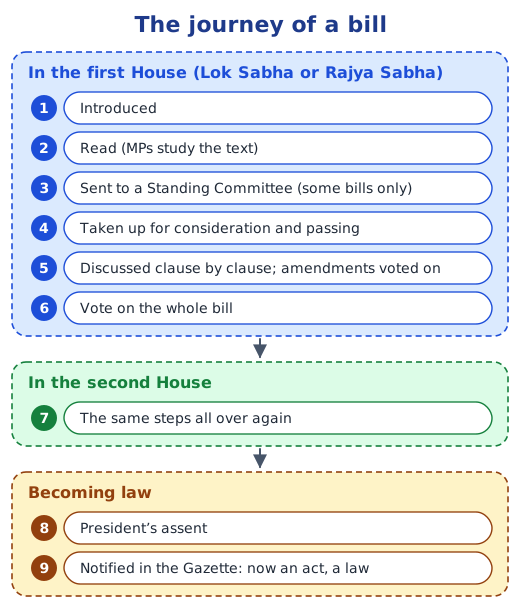
A bill is a law in draft form. It is introduced in either House of Parliament, read, often studied by a committee, debated clause by clause and put to the vote. The other House then repeats these steps. After the President gives assent, the bill is published in the Gazette as an act, and it is now law.
Stuck on a question? Take a photo and Lagnever AI explains it step by step. Try it for 7 days for ₹2. Get it on Google Play
What is a bill?
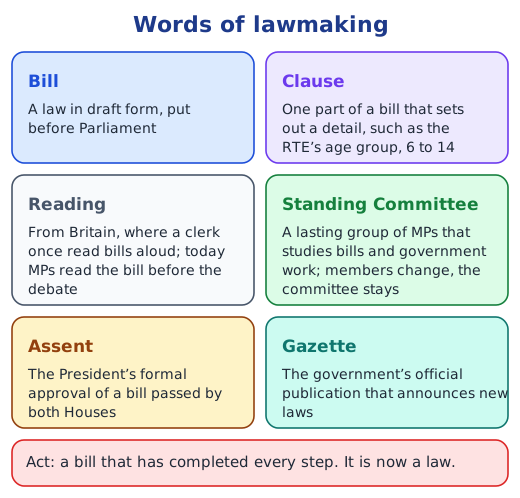
Making laws is one of Parliament’s main jobs, and the Constitution sets out a careful, demanding process for it. A new law usually takes the form of an act. Before that, it is a bill: a proposed law, written out in full, that Parliament must approve. A bill is divided into clauses, each setting out one detail. In the RTE, for example, one clause says that the law covers children aged 6 to 14. Most bills are brought in by the government, but members can introduce some too.
What are the steps in Parliament?
Here is the journey, simplified:
- Introduction in either House, the Lok Sabha or the Rajya Sabha.
- Reading. The name comes from the British Parliament, where a clerk once read the bill aloud because many MPs could not read. Today MPs read it before the debate.
- Standing Committee. Some bills, though not all, go to a committee of MPs for close study.
- Consideration and passing. The House takes up the bill.
- Clause by clause. Members discuss each clause and vote on any changes (amendments).
- Vote on the whole bill.
- The other House goes through the same steps.
- President’s assent, the formal approval.
- Gazette notification: the new act is announced in the government’s official publication.
What does a Standing Committee do?
A Standing Committee is permanent: its MPs may change, but the committee itself carries on. It looks closely at what the government is doing, makes recommendations and asks questions about actions the government has taken. When a bill is sent to it, the committee can suggest changes before the House votes.
How did the RTE become a law?
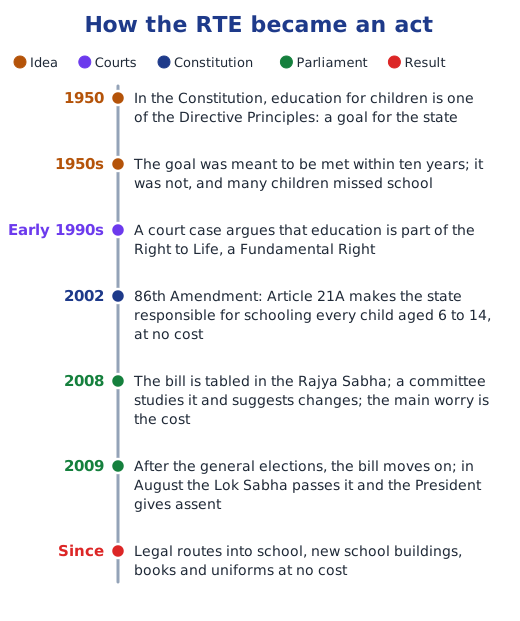
The chapter lets the Right to Education (RTE) Act tell its own story. Its roots go back to the Directive Principles of State Policy in the Constitution. The makers hoped to give every child schooling within about ten years of Independence, but that did not happen, and many children stayed out of school. In the early 1990s, a court case argued that education was part of the Right to Life, a Fundamental Right. In 2002, the 86th Constitutional Amendment added Article 21A: the state must give every child aged 6 to 14 education that is compulsory and costs nothing.
In 2008, the bill was tabled in the Rajya Sabha. A committee studied it and suggested changes, and the biggest debate was over money: new schools, buildings and teachers for millions of children. After the 2009 general elections, the new government took it up. In August 2009, the Lok Sabha passed it and the President gave assent, so it became an act. Since then, the RTE has opened legal routes into school, helped build new schools and given children books and uniforms at no cost.
What is a Money Bill?
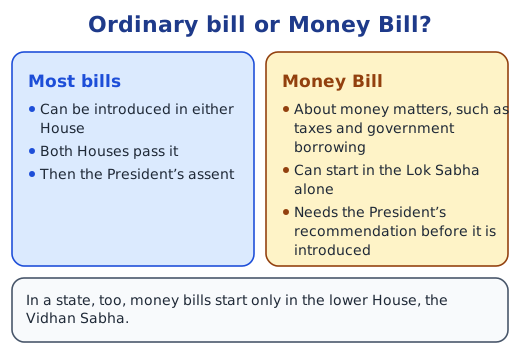
Some bills may be introduced only in the Lok Sabha. The main example is a Money Bill, which deals with money matters such as taxes and government borrowing. Before it can be introduced, the President must recommend it. The states follow the same rule: their money bills start only in the Vidhan Sabha.
Read on: What is India’s parliamentary system?, How are the Union and state governments organised?, the chapter notes and the NCERT solutions.
Practice
-
What is a law in draft form, before Parliament passes it, called?
Show answer
Answer: (b) A bill
-
What are the parts of a bill that set out its detailed rules called?
Show answer
Answer: (b) Clauses
-
Which Article, added in 2002, made the state responsible for educating every child aged 6 to 14?
Show answer
Answer: (b) Article 21A
-
Why is a stage in Parliament called the ‘reading’ of a bill?
Show answer
Answer: The name comes from the British Parliament, where many MPs once could not read, so a clerk read each bill aloud before the discussion. Today MPs read the bill themselves, but the name has stayed.
-
What two conditions apply before a Money Bill can be introduced?
Show answer
Answer: It can be introduced in the Lok Sabha alone, and only after the President has recommended it.
Questions students ask
What is the difference between a bill and an act?
A bill is a proposed law that Parliament is still considering. Once both Houses pass it and the President gives assent, it becomes an act, and the act is the law that everyone must follow.
What is the President’s assent?
It is the President’s formal approval of a bill that both Houses have passed. Only then does the bill become an act, which is announced in the Gazette, the government’s official publication.
Can a bill start in the Rajya Sabha?
Yes. Most bills can start in either House. The RTE bill, for example, was first tabled in the Rajya Sabha in 2008. Money Bills are different: they can start only in the Lok Sabha.
What happens to a bill when a Lok Sabha’s term ends?
Extra: a bill still pending in the Lok Sabha lapses when the Lok Sabha is dissolved, and must start again. A bill pending only in the Rajya Sabha does not lapse. So the RTE bill, tabled in the Rajya Sabha in 2008, could still be passed after the 2009 elections.
Stuck on a question?
Take a photo and Lagnever AI explains it step by step. Try it for 7 days for ₹2.
Get it on Google Play Open in browser
For parents: after the trial, the plan renews monthly by UPI or card autopay. You can cancel anytime in the app.