
What is India’s parliamentary system?
Answer in short
In India’s parliamentary system, voters elect the Lok Sabha, and the government is formed by the majority there. Parliament, which is the President plus the two Houses, makes laws and keeps watch on the government. The Prime Minister and the other ministers run the government, but they must keep answering to the Lok Sabha.
Stuck on a question? Take a photo and Lagnever AI explains it step by step. Try it for 7 days for ₹2. Get it on Google Play
What makes up the Parliament of India?
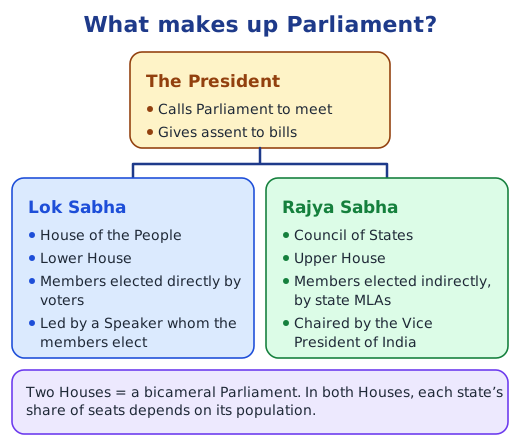
India’s Parliament is the President together with two Houses. The Lok Sabha, the House of the People, is the Lower House; the Rajya Sabha, the Council of States, is the Upper House. A legislature with two Houses is called bicameral: “bi” means two and “cameral” means chamber.
The people elect Lok Sabha members directly, through universal adult franchise, which you read about in Chapter 5. The chapter gives 550 as the largest Lok Sabha the Constitution allows. Rajya Sabha members are elected indirectly, by an electoral college. In both Houses, the number of seats a state gets depends on its population. Since the first Lok Sabha in 1952 there have been 17, and the 18th was formed in June 2024.
Why does India have two Houses?
The makers of the Constitution debated this at length. They felt that one directly elected House would not be enough for the tasks facing a newly independent country. In the spirit of federalism, where power is shared between the Union, the states and local governments, they wanted a House for the states: the Council of States. So the Rajya Sabha was given a different make-up and a different way of being elected.
Who keeps order in each House?
Each House has a presiding officer. Lok Sabha members elect a Speaker, who runs the sessions, decides who may speak, keeps discipline and makes sure the rules are followed. The Vice President of India chairs the Rajya Sabha. So that every member can follow the debates, speeches are interpreted into many Indian languages: 12 at first, and 6 more were added recently, making 18.
Who forms the Union Executive?
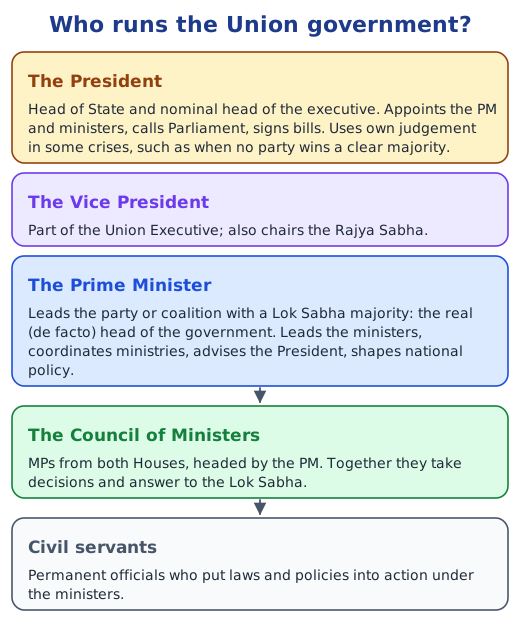
Making laws is only half the work; someone has to carry them out. That is the executive. At the Union level it has three parts: the President and the Vice President, plus the Council of Ministers, whose head is the Prime Minister. The ministers are chosen from the MPs of both Houses, and together they are answerable to the Lok Sabha. The President is Head of State but heads the executive only in name. The Prime Minister, leader of the Lok Sabha majority, is the real (de facto) head of the government. Permanent officials called civil servants help put laws and policies into action.
How does Parliament keep the government answerable?
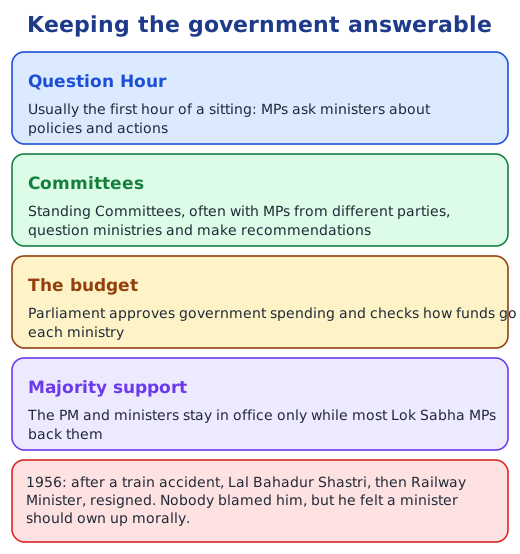
The chapter sorts Parliament’s work into four heads: constitutional functions, lawmaking, executive accountability and financial accountability. Accountability means the government must justify what it does. MPs use the Question Hour, usually the first hour of a sitting, to question ministers. Committees, often with MPs from several parties, call ministries to explain their policies. Parliament also approves the yearly budget and checks how money reaches each ministry. Ministers can also hold themselves to account: after a train accident in 1956, Lal Bahadur Shastri, then Railway Minister, resigned, though nobody blamed him.
How do checks and balances work?
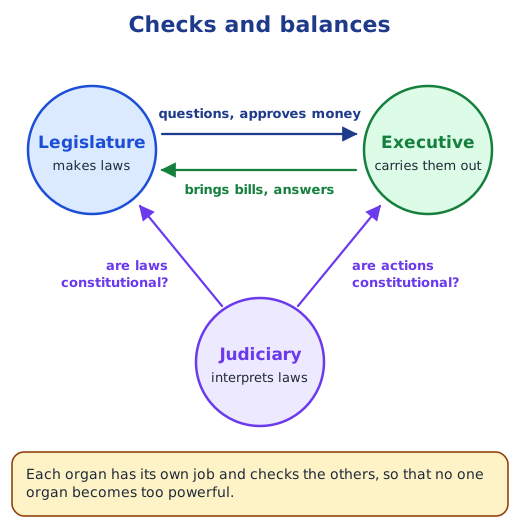
The legislature makes laws and watches the executive. The executive carries out the laws and introduces most of the bills that Parliament discusses. The judiciary, the system of courts, checks that laws and government actions stay within the Constitution. Each organ has its own job and keeps an eye on the others, so no single organ can become too powerful. You met the three organs in Grade 7, in Legislature, executive and judiciary.
Read on: How does a bill become a law?, How are the Union and state governments organised?, the chapter notes and the NCERT solutions.
Practice
-
What is a legislature with two Houses called?
Show answer
Answer: (b) Bicameral
-
When is the Question Hour usually held in the Lok Sabha?
Show answer
Answer: (b) In the first hour of a sitting
-
Who appoints the Prime Minister?
Show answer
Answer: (c) The President
-
Why did Lal Bahadur Shastri resign as Railway Minister in 1956?
Show answer
Answer: After a train accident, he believed that a minister should own up morally to whatever goes wrong in the ministry, even though nobody blamed him. He insisted, and his resignation was finally accepted.
-
Name two ways in which Parliament keeps the executive accountable.
Show answer
Answer: Any two of: the Question Hour, when MPs question ministers; committee meetings, where ministries explain their policies; and approving and checking the budget.
Questions students ask
Why is India’s system called parliamentary?
Because the government comes out of Parliament and depends on it. The Prime Minister leads the majority in the Lok Sabha, the ministers are members of Parliament, and they stay in office only while most Lok Sabha members support them.
Is the President a part of Parliament?
Yes. Parliament is the President and the two Houses. The President calls Parliament to meet and must give assent before a bill passed by both Houses becomes an act.
Where did India get its parliamentary system from?
The chapter says Britain’s system was the main model. Indian leaders also drew on their limited experience of colonial councils, the memory of ancient republics (mahajanapadas), and village panchayats where elders decided together.
What is special about the new Parliament building?
It has a rounded triangular shape, and the chapter says its green design cuts electricity use by 30 per cent. Its walls carry carvings of peacocks and lotuses, tribal art, temple designs and freedom fighters. The old building, from the 1920s, where the Constituent Assembly met, is now called Samvidhan Sadan.
Stuck on a question?
Take a photo and Lagnever AI explains it step by step. Try it for 7 days for ₹2.
Get it on Google Play Open in browser
For parents: after the trial, the plan renews monthly by UPI or card autopay. You can cancel anytime in the app.