
Class 8 Social Science Chapter 5: Universal Franchise and India’s Electoral System Notes
This chapter in five lines
Universal Franchise and India’s Electoral System explains how every Indian citizen aged 18 or above gets one vote of equal value, and how India runs what the chapter calls the world’s largest democratic exercise. It introduces the Election Commission of India, the Model Code of Conduct, voting with the EVM and VVPAT, and direct and indirect elections, from the Lok Sabha to the President.
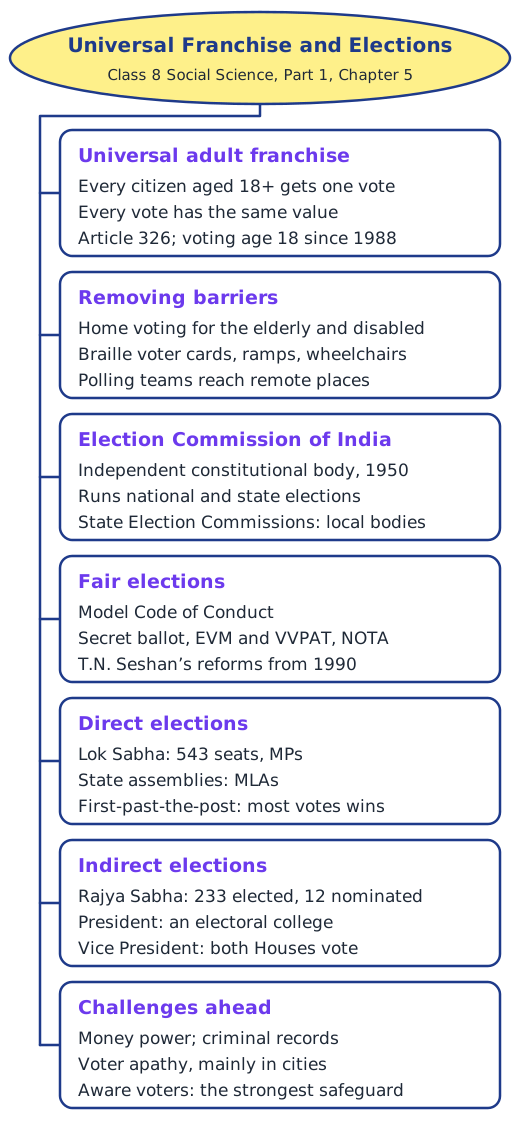
What is this chapter about?
This chapter opens Theme D of Part 1, Governance and Democracy. It begins with the words of Alladi Krishnaswami Ayyar in the Constituent Assembly in November 1949: by giving the vote to every adult, India was placing great trust in ordinary people, and no country had ever tried something so bold. Its three Big Questions ask what universal adult franchise means, what an electoral system is, and how India’s works. You met democracy in Grade 7, in From the Rulers to the Ruled, and local government in Grade 6, in Grassroots Democracy.
What is universal adult franchise?
Franchise, or suffrage, is the right to vote. Universal adult franchise means that every citizen aged 18 or above gets one vote, and every vote counts the same. Caste, creed, race, religion, gender, education and income make no difference. Your name must be on the voter list of your constituency, nobody can vote on someone else’s behalf, and a person found guilty of certain serious crimes is barred. The chapter links the principle to Article 326 of the Constitution. Read What is universal adult franchise?
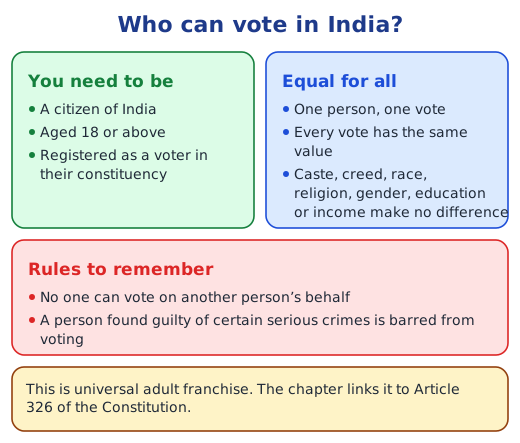
Why does every adult have the vote?
Before Independence, only about 13 per cent of Indians could vote. The makers of the Constitution chose universal franchise from the outset, even though only about 14 per cent of Indians could read in 1947. Women voted from the very first election, while women in Switzerland won the vote only in 1971. In 1988 the voting age came down from 21 to 18. Universal franchise treats everyone as equal, lets people choose their future, and makes leaders answer to voters.
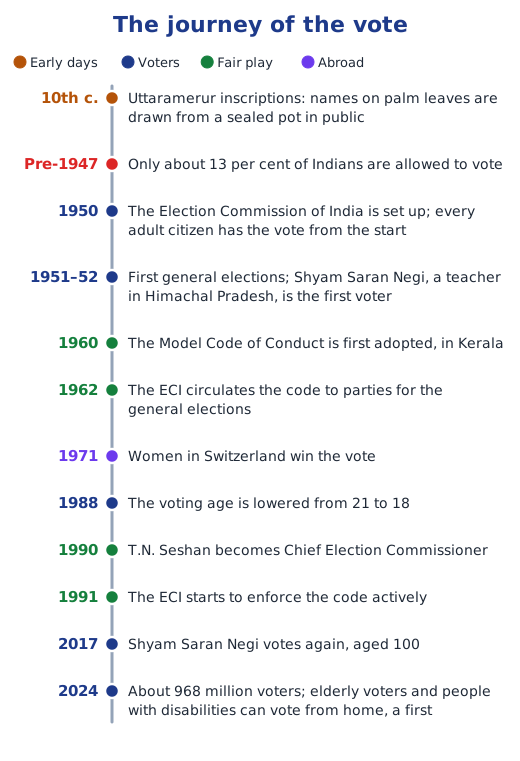
How does India help every voter to vote?
India’s eligible voters outnumber the people of the United Kingdom fifteen times over, and its land stretches across mountains, deserts and islands. Election officials travel to remote places; in 2024, for the first time, elderly voters and people with disabilities could vote from home. Voter cards with braille, and requests made through an app for wheelchairs and ramps, help too. Even so, about a third of eligible voters, 34 per cent, did not vote in 2024.
What does the Election Commission of India do?
The Election Commission of India (ECI), set up in 1950, is an independent constitutional body. It conducts elections to the Lok Sabha, the Rajya Sabha and the state legislative assemblies, and for the offices of President and Vice President. It sets election dates, registers political parties, enforces the Model Code of Conduct and oversees the whole process. Elections to panchayats and municipal bodies are run by the State Election Commissions. Read What does the Election Commission of India do?
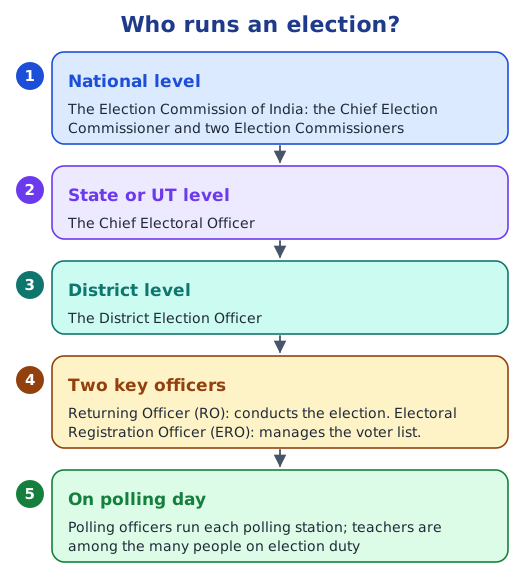
How are elections kept fair?
The Model Code of Conduct tells leaders, parties and candidates what they may and may not do. The party in government may not use government resources for its campaign or announce new schemes that could sway voters, and offering gifts for votes is punishable. The code began in Kerala in 1960. From 1990, Chief Election Commissioner T.N. Seshan brought in stricter campaign rules, voter IDs against proxy voting and a close watch on spending.
How do people vote?
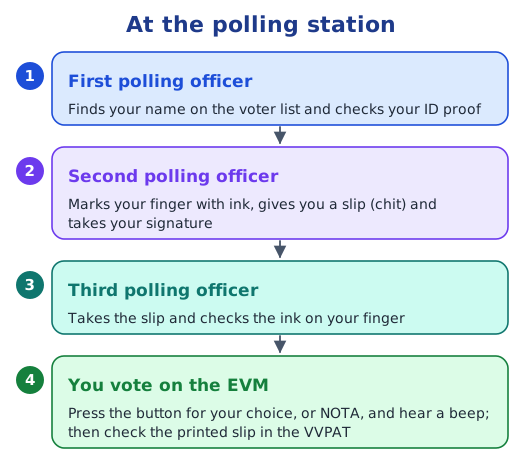
At the polling station, three polling officers check your name and ID, ink your finger and take your signature, and check the slip and the ink. Then you press a button on the EVM, or choose NOTA, hear a beep, and check the printed slip in the VVPAT. The vote is a secret ballot: nobody knows whom you chose. Read How are elections held in India?
How are MPs and MLAs elected?
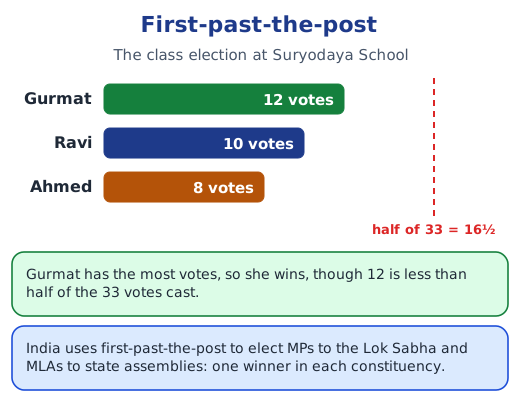
The country is divided into 543 Lok Sabha constituencies, which elect Members of Parliament (MPs); state assembly constituencies elect Members of Legislative Assembly (MLAs). India uses first-past-the-post: the candidate with the most votes wins, even without half of them. Of the Lok Sabha seats, 84 are reserved for scheduled castes and 47 for scheduled tribes. The party or coalition that wins a majority of seats forms the government, and its leader usually becomes Prime Minister, or Chief Minister in a state.
What are indirect elections?
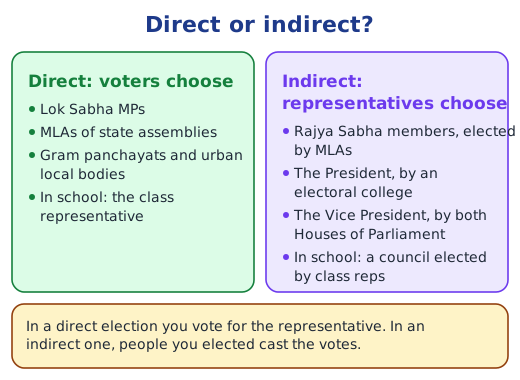
In an indirect election, representatives chosen by the people do the voting. Of the Rajya Sabha’s 245 members, 233 are elected by the elected MLAs and 12 are nominated by the President. The Rajya Sabha is never dissolved: members serve six years, and one-third retire every two years. The President is chosen by an electoral college of elected MPs and MLAs, and the Vice President by all members of both Houses of Parliament, all through the single transferable vote.
What challenges remain?
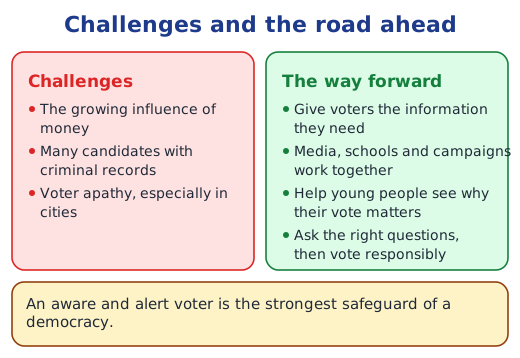
The chapter names three: money playing a bigger part in elections, the many candidates who have criminal records, and voter apathy, especially in cities. Its answer is informed voters. Media, schools and awareness campaigns can help people, above all the young, to vote thoughtfully, because an aware and alert voter is a democracy’s strongest safeguard. Answers to every question are in the NCERT solutions for Chapter 5.
Key terms
| Term | Meaning |
|---|---|
| Franchise | The right to vote, given by the constitution or the government. Another word for it is suffrage. |
| Universal adult franchise | Every adult citizen, aged 18 or above, gets one vote of equal value, whatever their caste, religion, gender, education or income. |
| Constituency | An area whose voters choose one representative for a law-making body, such as the Lok Sabha or a state assembly. |
| Electoral system | The connected rules, bodies and steps through which a country holds its elections and turns votes into seats. |
| Election Commission of India (ECI) | An independent constitutional body, set up in 1950, that conducts elections to Parliament, the state assemblies and the offices of President and Vice President. |
| State Election Commission | The body in each state that conducts elections to panchayats and municipal bodies. |
| Model Code of Conduct | The ECI’s list of dos and don’ts for leaders, parties and candidates, so that elections stay fair and peaceful. |
| Secret ballot | A way of voting in which nobody else gets to know whom you voted for. |
| EVM | Electronic voting machine: you press a button next to your choice, and a beep confirms the vote. |
| VVPAT | Voter Verifiable Paper Audit Trail: a printed slip that lets you check your vote and keeps a paper record for recounts. |
| NOTA | None Of The Above: the option to reject every candidate. It does not change the result, but it sends a message. |
| First-past-the-post | The system in which the candidate with the most votes in a constituency wins, even with less than half of them. |
| Indirect election | An election in which representatives chosen by the people, not the people themselves, cast the votes, as for the Rajya Sabha. |
| Electoral college | The group of elected representatives who elect the President, or the members of Parliament who elect the Vice President. |
| Single transferable vote | A method in which voters rank candidates in order of preference; it is used for the Rajya Sabha, the President and the Vice President. |
Topics in this chapter
Practice
-
What is the minimum age for voting in India?
Show answer
Answer: (b) 18 years
-
In which year did India lower the voting age from 21 to 18?
Show answer
Answer: (c) 1988
-
Which Article of the Constitution does the chapter connect with universal franchise?
Show answer
Answer: (c) Article 326
-
How many Lok Sabha constituencies are there?
Show answer
Answer: (c) 543
-
Who elects 233 of the members of the Rajya Sabha?
Show answer
Answer: (b) The elected MLAs of the states
-
Where was the Model Code of Conduct first adopted, in 1960?
Show answer
Answer: (b) Kerala
Questions students ask
What are the main topics of Class 8 Social Science Chapter 5?
Universal adult franchise and why it matters; how India helps every voter to vote; the Election Commission of India and the Model Code of Conduct; voting with the EVM, VVPAT and NOTA; elections to the Lok Sabha, the state assemblies and the Rajya Sabha; how the President and Vice President are elected; and the challenges ahead.
Is Universal Franchise and India’s Electoral System in the new NCERT Class 8 book?
Yes. It is Chapter 5 of Exploring Society: India and Beyond, Grade 8 Part 1 (Reprint 2026-27), on pages 117 to 138. It opens the theme Governance and Democracy and is followed by Chapter 6, The Parliamentary System.
How is an MP different from an MLA?
An MP (Member of Parliament) represents us in the national Parliament, while an MLA (Member of Legislative Assembly) represents us in the state assembly. They are chosen in similar ways but work at different levels of government.
What is NOTA?
NOTA stands for None Of The Above. It lets a voter reject all the candidates. It does not change who wins, but it shows that voters want better choices.
Stuck on a question?
Take a photo and Lagnever AI explains it step by step. Try it for 7 days for ₹2.
Get it on Google Play Open in browser
For parents: after the trial, the plan renews monthly by UPI or card autopay. You can cancel anytime in the app.