
What is universal adult franchise?
Answer in short
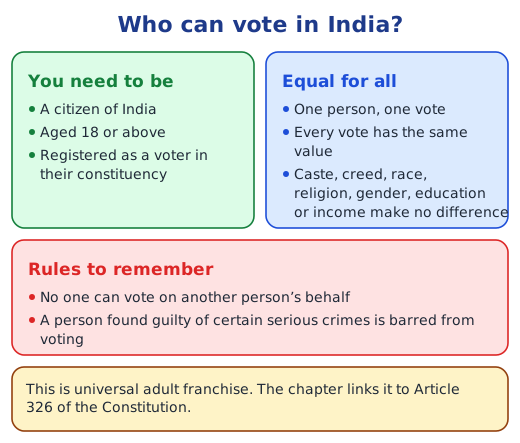
Universal adult franchise means that every citizen aged 18 or above has the right to vote, and every vote has the same value. Caste, creed, race, religion, gender, education and income make no difference. India gave this right to all adults, women included, from the very start, and lowered the voting age from 21 to 18 in 1988.
Stuck on a question? Take a photo and Lagnever AI explains it step by step. Try it for 7 days for ₹2. Get it on Google Play
What does universal adult franchise mean?
Franchise is the right to vote; another word for it is suffrage. When the right is universal and adult, every citizen aged 18 or above gets one vote, and each vote carries the same weight. A farmer’s vote counts exactly as much as a minister’s. Caste, creed, race, religion, gender, education and income make no difference.
A few rules go with the right. Your name must be on the voter list of your constituency, the area that elects your representative. Nobody can vote on another person’s behalf, and a person found guilty of certain serious crimes is barred from voting. The chapter links universal franchise to Article 326 of the Constitution. It applies to elections to the Lok Sabha, to every state and union territory assembly, and to village and city bodies.
Why did India give every adult the vote from the start?
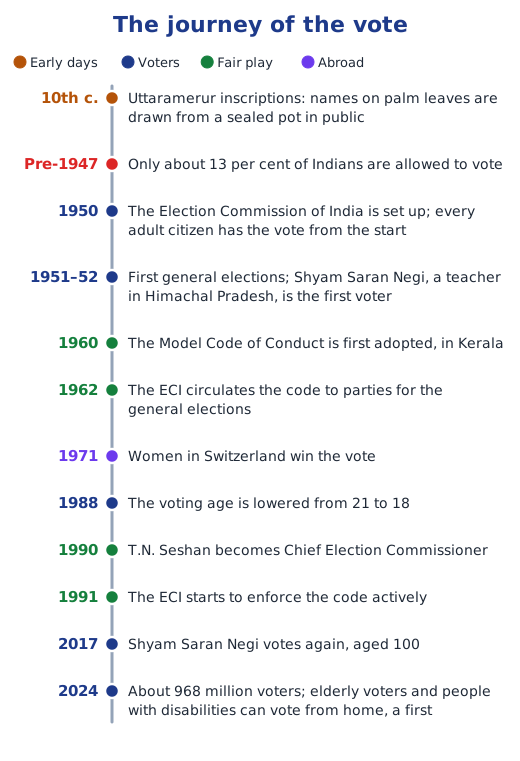
Before Independence, only about 13 per cent of Indians had the right to vote. When the Constitution was written, some people argued that only those who could read should vote. In 1947 only about 14 per cent of Indians were literate, and only about 8 per cent of women. The Constitution makers still chose universal adult franchise from the very beginning. They trusted ordinary people to know what was good for their lives, and they did not want a small, educated group to decide for everyone else.
Women were included from day one. In many countries women had to struggle for years to win the vote; in Switzerland, for example, they won it only in 1971. The chapter credits India’s forward-looking Constitution and its old democratic values for this. In 1988 India lowered the voting age from 21 to 18, so young adults got a say too.
Why does universal franchise matter?
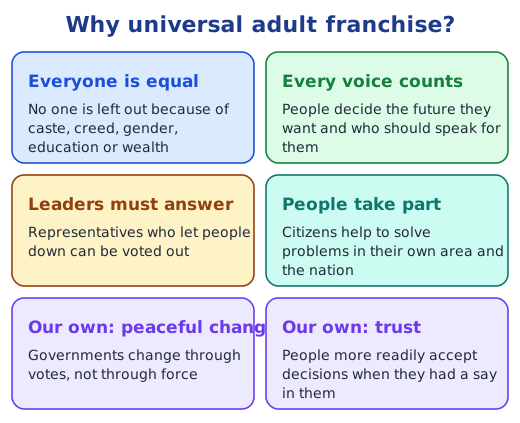
It treats every citizen as equal. It lets people choose the kind of future they want and the people who will speak for them. It makes representatives answerable, because voters can remove them at the next election. And it draws people into public life, from fixing problems in their own street to shaping the nation. Two more reasons of our own: it allows governments to change peacefully, and people accept decisions more readily when they had a say.
How does India remove barriers to voting?
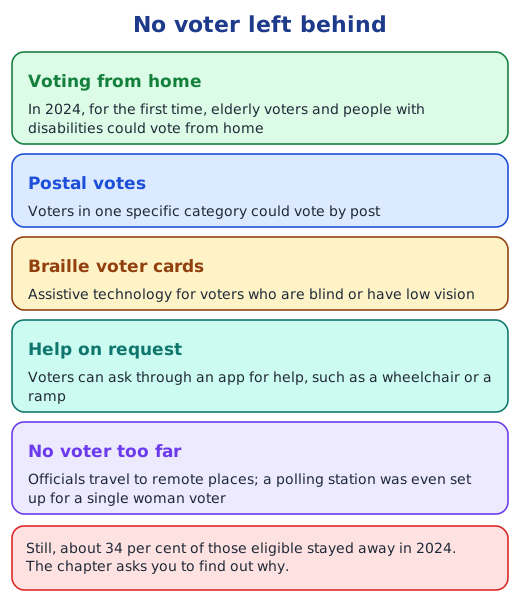
A right means little if people cannot use it. India is huge and varied: it has fifteen times as many eligible voters as the United Kingdom has people, and it covers six times the area of France. So the Election Commission of India works to make sure no voter is left behind. Officials travel to remote places, and a polling station has even been set up for a single woman voter. In 2024, for the first time, elderly voters and people with disabilities could vote from home, and postal voting was offered to a specific category of voters. Voter cards with braille, and requests made through an app for help such as a wheelchair or a ramp, made voting easier too.
Why do some people still not vote?
In the 2024 general election, about a third of the people entitled to vote, 34 per cent, stayed away. The chapter lists three worries for India’s democracy: money playing a bigger and bigger part in elections, the many candidates who have criminal records, and voter apathy, a lack of interest that is seen especially in cities. Its answer is awareness. The right to vote is also a responsibility, and an informed voter who asks the right questions before voting is the strongest safeguard a democracy has.
Was there voting in ancient India?
The chapter points to the Uttaramerur inscriptions of the 10th century. They describe an open way of choosing representatives: the names of eligible candidates were written on bits of palm leaf, put in a pot and sealed. On the chosen day the pot was opened in public, a young boy drew out the leaves one by one, and a respected person, after showing the crowd that his hands were empty, read out each name. Everyone could see that the selection was fair.
Read on: What does the Election Commission of India do?, How are elections held in India?, the chapter notes and the NCERT solutions.
Practice
-
Which of these does NOT decide whether a citizen may vote in India?
Show answer
Answer: (c) How much schooling they have had
-
About what share of Indians could vote before Independence?
Show answer
Answer: (a) About 13 per cent
-
In which country did women win the vote only in 1971?
Show answer
Answer: (b) Switzerland
-
Why did the Constitution makers give every adult the vote, though few Indians could read in 1947?
Show answer
Answer: They trusted ordinary people to judge what was good for them and wanted all citizens to be equal. Leaving out people who could not read would have let a small group decide for everyone else.
-
Name two steps that helped voters with special needs in 2024.
Show answer
Answer: Elderly voters and people with disabilities could vote from home for the first time; voter cards with braille and app requests for wheelchairs and ramps also helped.
Questions students ask
What is the meaning of universal adult franchise?
It means that all adult citizens can vote, with no difference based on caste, creed, race, religion, gender, education or income. ‘Universal’ says the right belongs to everyone; ‘adult’ says the voter must be at least 18.
When was the voting age changed from 21 to 18?
In 1988. Since then every Indian citizen aged 18 or above who is registered as a voter can vote in elections to the Lok Sabha, the state assemblies and local bodies.
What are the Uttaramerur inscriptions?
Tenth-century inscriptions that describe an open, careful way of choosing representatives: the names of eligible candidates were written on palm leaves, sealed in a pot and drawn out one by one in public. Extra: Uttaramerur is a village in today’s Tamil Nadu.
Stuck on a question?
Take a photo and Lagnever AI explains it step by step. Try it for 7 days for ₹2.
Get it on Google Play Open in browser
For parents: after the trial, the plan renews monthly by UPI or card autopay. You can cancel anytime in the app.