
NCERT Solutions Class 8 Social Science Chapter 5: Universal Franchise and India’s Electoral System
Answers to the Big Questions, every Let’s Explore, Think About It and Don’t Miss Out box that asks something, and all nine Questions and activities in Chapter 5, Universal Franchise and India’s Electoral System, of Exploring Society: India and Beyond, Grade 8 Part 1. Page numbers follow the book (pages 117–138). Short notes: Chapter 5 notes.
The Big Questions (page 117)
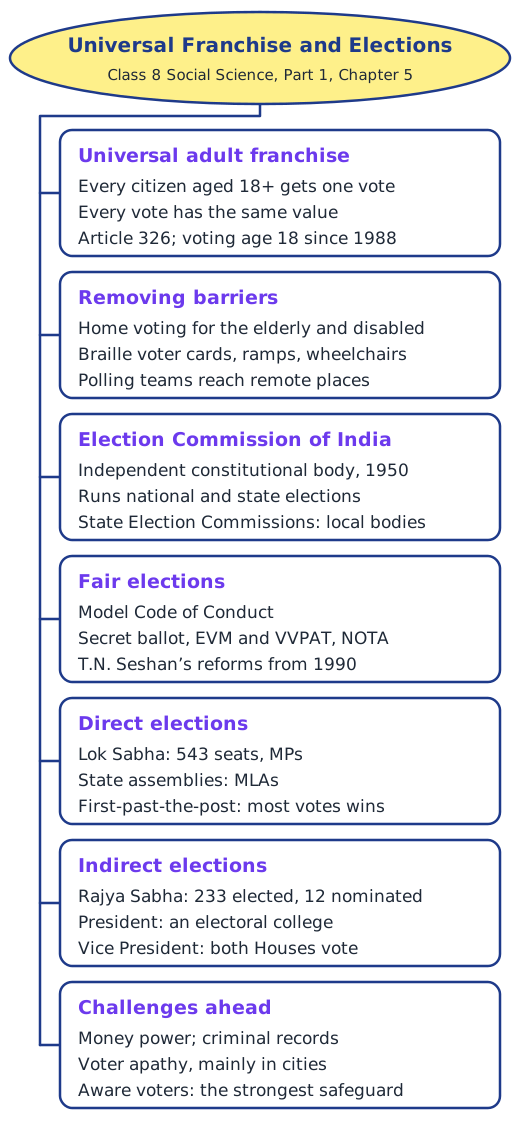
1. What does universal adult franchise mean? It means that every adult citizen, aged 18 or above, has the right to vote, and that every vote has the same value. Nobody is left out because of caste, creed, race, religion, gender, education or income. A voter must be registered in their constituency, cannot vote for anyone else, and is barred only if found guilty of certain serious crimes. India adopted it from the very beginning; the chapter links it to Article 326 of the Constitution.
2. What do we mean by an electoral system? The chapter defines a system as a group of connected parts that work together for one purpose. An electoral system is the set of parts that turns people’s choices into representatives: the voters and the voter lists; constituencies; the Election Commission and its officers; rules such as the Model Code of Conduct; the way of voting (secret ballot, EVM, VVPAT and NOTA); the rule for deciding the winner (first-past-the-post, or the single transferable vote for indirect elections); and, after the count, the forming of a government.
3. How does India’s system of elections work in practice? The Election Commission of India sets the dates and runs elections to Parliament, the state assemblies and the offices of President and Vice President; State Election Commissions run local elections. Parties and candidates follow the Model Code of Conduct. On polling day, voters in each constituency vote in secret on an EVM and check the VVPAT slip. The candidate with the most votes wins (first-past-the-post), and the party or coalition with a majority of seats forms the government. Rajya Sabha members, the President and the Vice President are chosen indirectly, by elected representatives.
Let’s Explore, Think About It and Don’t Miss Out (pages 118–136)
Voting at 18 instead of 21 (page 118). For: at 18, young people can work, pay taxes and take on many adult duties, so they should help choose the government; their concerns, such as education and jobs, get heard; and voting early builds a lifelong habit. Against: some felt 18-year-olds were not yet experienced enough to judge parties and candidates. A sample conclusion: it was a good move, because young people are as affected by government decisions as anyone, and schools and awareness campaigns can help them vote wisely. How long must you wait? Subtract your age from 18: a 13-year-old waits 18 − 13 = 5 years. Extra: since 2022, 17-year-olds can apply in advance to join the voter list; their names are added once they turn 18.
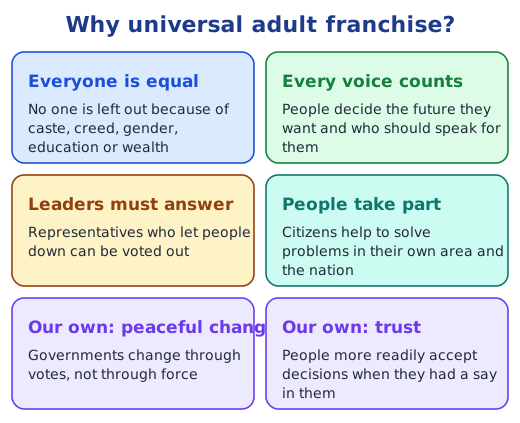
Why universal franchise from the start? (page 120). The Constitution makers believed that every citizen was equal and that ordinary people could judge what was good for their own lives, whether or not they could read. Keeping out the roughly 86 per cent who could not read in 1947, and most women, would have handed power to a small group and left the poor unheard. Voting itself would also teach people about democracy and push governments to spread education. They had seen that, before Independence, only about 13 per cent of Indians could vote, and they wanted a clean break from that.
Two more reasons for Fig. 5.4 (page 120). (1) It lets governments change peacefully, through votes, not through force. (2) People accept and follow decisions more readily when they had a say in choosing who makes them.
Measures that help people vote (page 121). Their role: they turn a right on paper into a right people can actually use, so that age, disability or distance does not silence anyone; that makes the result truer to the will of all the people. Who benefits: ask at home, for example about grandparents who voted from home in 2024 or a neighbour who used a wheelchair at the booth. More turnout: people who once stayed away because they could not reach or enter the polling station can now vote, and seeing them vote encourages others. Technology: apps to request a wheelchair or a ramp, braille-enabled voter cards, online information about polling stations and queues. The ECI website: note each help it lists in a three-column table: the difficulty, the help, and who benefits. The chapter itself names home voting, postal votes for a specific category of voters, voter cards with braille, and app requests for wheelchairs and ramps. Extra: the ECI’s app for voters with disabilities is called Saksham.
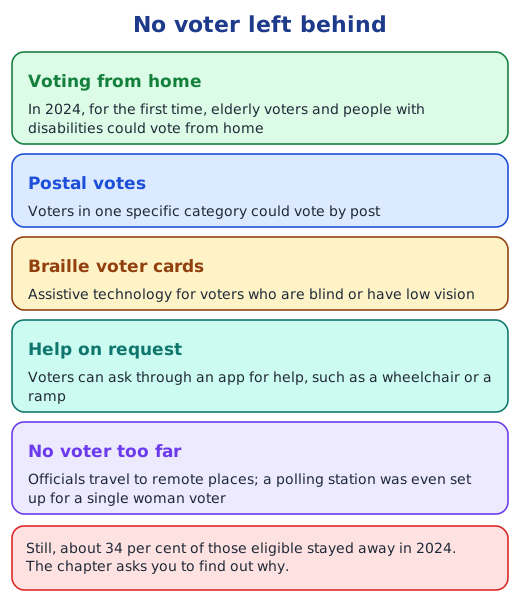
Why did about 34 per cent not vote in 2024? A survey (page 123). Possible reasons: work or travel on polling day, illness or old age, a name missing from the voter list, having moved away from the place where one is registered, long queues, not knowing the candidates, or feeling that one vote makes no difference. Sample questions for adults: (1) Did you vote in the last election? (2) If not, what stopped you? (3) How far is your polling station, and how long did you wait? (4) Is your name on the voter list where you live now? (5) Where do you get information about candidates? (6) What would make voting easier for you? Analysis: count the answers to each question and show them in a bar graph. Report: an introduction, how many people you asked, the main reasons you found, and suggestions, such as reminders and help with registering, more booths or better information. Use only the answers you actually collect.
The class election (page 125). Important aspects: candidates with clear promises, fair campaigning, an Election Officer, a secret ballot, a sealed box, counting in front of a witness, and a clear rule that the most votes wins. Why a secret ballot? So that nobody would know who voted for whom: students could vote by their own choice, without pressure or fear of upsetting a friend. What students may have considered: which promise mattered most to them, such as cleanliness, help with studies or the arts, and which candidate seemed able to keep it. Responsibilities after the result: to support Gurmat whoever they voted for, to tell her their problems and ideas, to help with peer coaching, and to ask her to keep her promises. Ms Usha’s role: as Election Officer she made the rules clear, kept the ballot secret and the box sealed, and had the count witnessed, so that everyone could trust the result. The braille ballot for Neha: without it, Neha would have needed someone to read the ballot to her, and her vote would no longer be secret; universal franchise means every voter must be able to vote independently. If many students marked no preference: their ballots would be invalid, and a small group of voters would decide the result for the whole class.
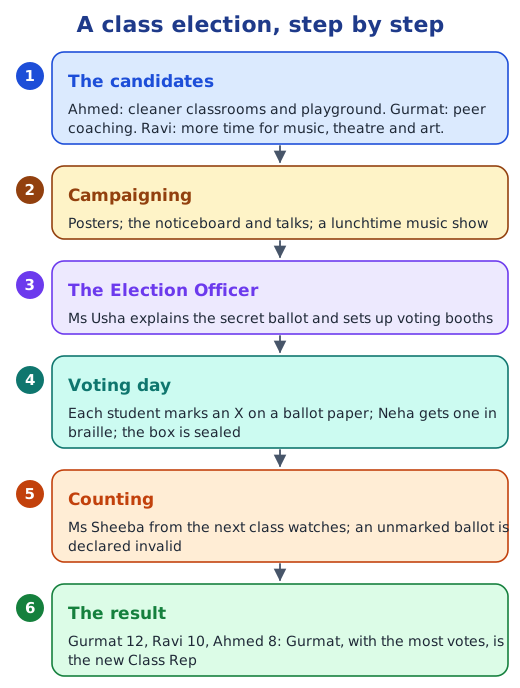
If no candidate is good enough (page 125). In the class they could only spoil the ballot or leave it blank. In India’s elections they could choose NOTA, None Of The Above. It does not change the result, but it shows the parties that voters want better choices.
Teachers on election duty (page 128). Questions to ask a teacher who has done election duty: What was your role, for example as a polling officer? What training did you get? How did you reach the polling station and set it up? What time did polling start and end? How did you help elderly voters or voters with disabilities? What was hardest, and what made you proud? Write down the answers and share the most interesting ones with the class.
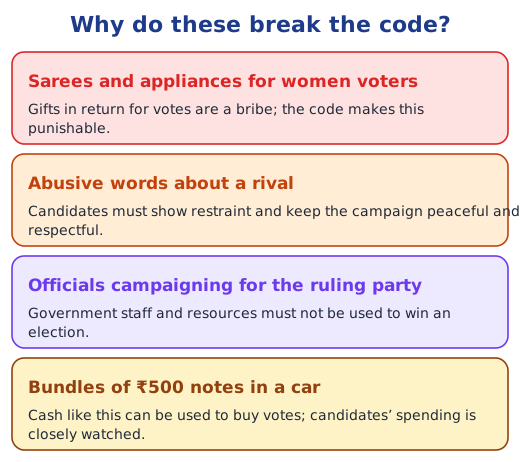
Complaints to the ECI (page 131). All four break the Model Code of Conduct. Sarees and appliances for women voters: gifts in return for votes are a bribe and are punishable. Abusive language against a rival: candidates must show restraint so that the campaign stays peaceful. Officials campaigning for the ruling party: government resources and staff must not be used to win an election. Bundles of ₹500 notes in a candidate’s car: cash like this can be used to buy votes, and candidates’ spending is closely watched.
The next election near you (page 132). The answer depends on where you live. Find out from the news, from the Election Commission of India for Lok Sabha and assembly elections, or from your State Election Commission for panchayat and municipal elections. Note the type of election, the date if it has been announced, and which officials will run it.
What is the assembly called in your state? (page 133). The book gives Vidhan Sabha and Niyama Sabha. Extra: it is the Vidhan Sabha in Hindi-speaking states such as Uttar Pradesh and Rajasthan, the Niyamasabha in Kerala, the Vidhana Sabha in Karnataka, the Bidhan Sabha in West Bengal, and the Shasana Sabha in Andhra Pradesh and Telangana. Ask your teacher for the name in your state’s language.
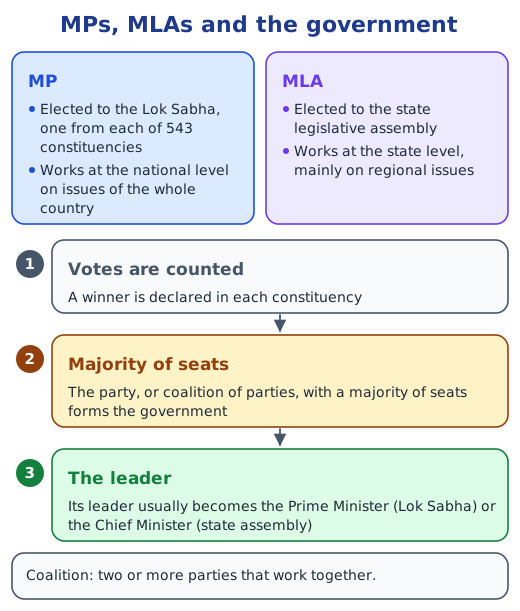
Your MP and MLAs (page 134). Find your Lok Sabha and assembly constituencies on your family’s voter ID or the voter list, then look up the winners in the official results of the Election Commission of India. Write their names and parties in a table. This page names no MP, MLA or party, because the answer is different for every constituency. Concerns: an MP deals with national matters in Parliament and with the needs of a large constituency; an MLA deals with state matters and more local needs of the assembly area. Remember that one Lok Sabha constituency may contain two or more assembly constituencies.
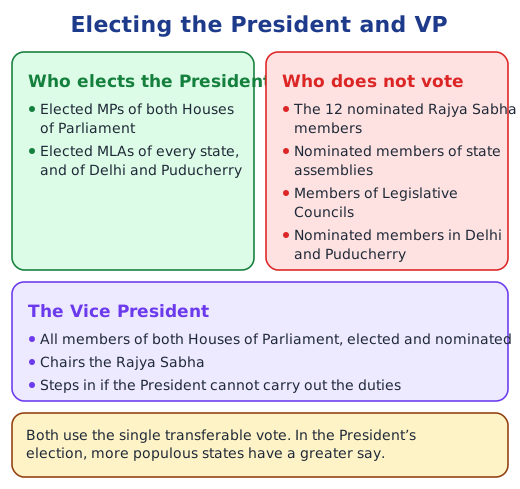
Who does not elect the President, and why? (page 136). Nominated members of the Rajya Sabha and of the assemblies, members of Legislative Councils and nominated members in Delhi and Puducherry have no vote because they were not directly elected by the people. Keeping only directly elected MPs and MLAs in the electoral college means the President is chosen, indirectly but meaningfully, by the people’s own representatives, which gives the office democratic legitimacy. Ordinary people do not vote directly because, as the chapter explains, this method makes sure the President, who represents the whole country, has the support of both the Centre and the states, with the more populous states having a greater say.
Questions and activities (page 138)
Q1. “Why is universal adult franchise important for a healthy democracy?” (1) It treats every citizen as equal: one person, one vote, whatever their caste, religion, gender, education or wealth. (2) It lets the people decide their own future and choose who represents them. (3) It makes representatives answerable, since voters can remove them at the next election. (4) It brings everyone into public life and makes them care about problems in their area and the country. (5) Because everyone has a say, decisions and governments have the support of the whole people, not of a small group.
Q2. “What is the meaning of ‘secret ballot’? Why is this important in a democracy?” A secret ballot is a way of voting in which nobody else gets to know whom a person voted for, as in the class election, where no one knew who voted for whom. It matters because voters can choose by their own judgement, without fear of anger from family, employers, the powerful or a candidate’s supporters. It also makes buying or forcing votes pointless, because nobody can check how a person voted. That keeps elections fair.
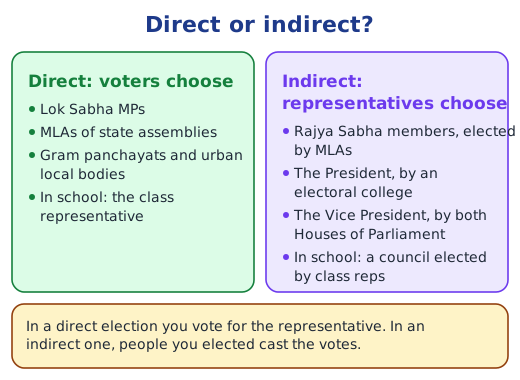
Q3. “Give examples of direct and indirect elections.” Direct (voters choose the representative): elections of MPs to the Lok Sabha; of MLAs to state assemblies; of members of gram panchayats and urban local bodies; and of the Class Representative at Suryodaya School. Indirect (elected representatives choose): the election of Rajya Sabha members by MLAs; of the President by an electoral college of elected MPs and MLAs; of the Vice President by the members of both Houses of Parliament; and a school council elected by class representatives.
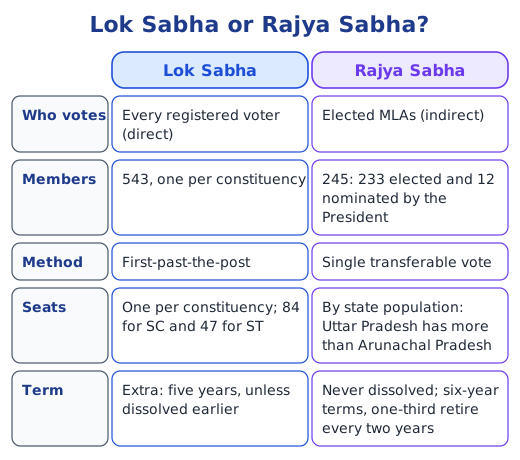
Q4. “How is the election of members to the Lok Sabha different from that to the Rajya Sabha?” Who votes: Lok Sabha members are elected directly by all the registered voters of a constituency; Rajya Sabha members are elected indirectly by the elected MLAs of each state. Numbers: the Lok Sabha has 543 elected members, one per constituency; the Rajya Sabha has 245, of whom 233 are elected and 12 are nominated by the President. Method: the Lok Sabha uses first-past-the-post; the Rajya Sabha uses the single transferable vote. Seats: Lok Sabha seats are constituencies, with 84 reserved for scheduled castes and 47 for scheduled tribes; Rajya Sabha seats are shared among the states by population. Timing: the whole Lok Sabha is elected at a general election (Extra: every five years, unless it is dissolved earlier); the Rajya Sabha is never dissolved, and every two years, one-third of its members retire.
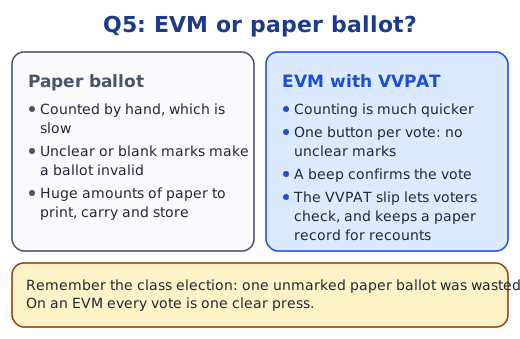
Q5. “What, in your view, are the advantages of the EVM over paper ballots?” (1) Counting is much quicker, so results come sooner. (2) A vote is one press of a button, so there are no unclear or wrongly marked ballots; in the class election one paper ballot was wasted because it was not marked. (3) The beep tells voters their vote is recorded. (4) Far less paper has to be printed, carried and stored. (5) With the VVPAT, voters can see a printed slip of their vote, and the paper record is a backup for checking and recounting if there is a dispute. (6) The machines have worked well enough for other countries, such as Namibia and Bhutan, to use them with the ECI’s support.
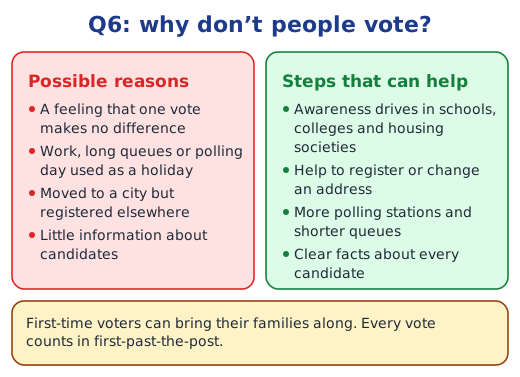
Q6. “Voter turnout has been declining in some urban areas of India. What could be the reasons for this trend, and what steps can be taken to encourage more people to vote?” Possible reasons: voter apathy, a feeling that one vote makes no difference; long working hours or treating polling day as a holiday; people who moved to the city for work but are still registered in their home town; long queues; and too little information about candidates. Steps: awareness drives in schools, colleges, offices and housing societies; help with registering and changing addresses; more polling stations close to homes, with shorter queues; clear and simple information about every candidate; reminders from employers and residents’ groups; and first-time voters bringing their families along. Extra: the ECI runs a voter education programme called SVEEP for this purpose.
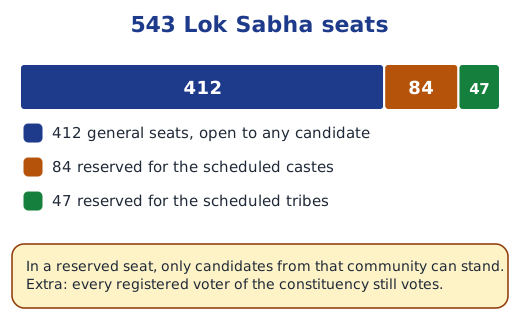
Q7. “Why do you think a proportion of seats in the Lok Sabha is reserved for scheduled castes and scheduled tribes? Write a short note.” A short note: Of the 543 Lok Sabha seats, 84 are reserved for scheduled castes and 47 for scheduled tribes. For centuries, many people of these communities faced discrimination and exclusion, and many lived in remote areas, far from power. Without reserved seats, they might have few representatives of their own in Parliament. Reservation makes sure their voices are heard where laws are made, in line with the equality that universal franchise promises. In a reserved seat only a candidate from that community can stand, but (Extra) every registered voter of the constituency votes, so the winner must earn the trust of all groups. Extra: the number of reserved seats is linked to each community’s share of the population.
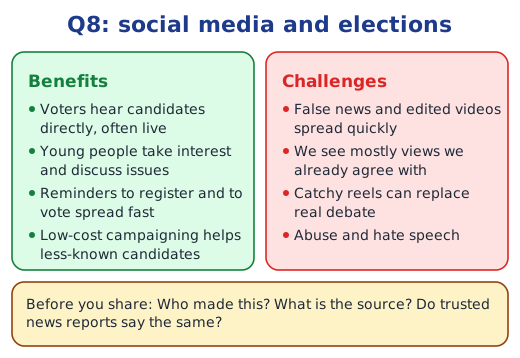
Q8. “Social media is changing the way we experience elections — from catchy campaign reels and live speeches to political debates on Instagram and Twitter. But is this strengthening democracy or confusing it? Discuss in pairs: What are the benefits, what are the challenges, and what might the future of elections be in a digital age?” Benefits: voters, especially the young, can hear candidates directly and often live; more people discuss issues; reminders to register and vote spread fast; and campaigning costs less, which helps less-known candidates. Challenges: false news and edited videos spread quickly; we mostly see views we already agree with; a catchy reel can replace a serious debate; and abuse and hate speech can spread. The future: more information and campaigning will move online, so voters will need to check facts, ask who made a post and what its source is, and compare it with trusted news before believing or sharing it. A sample conclusion for the pair: social media can strengthen democracy when voters use it to learn, and confuse it when they use it only to react.
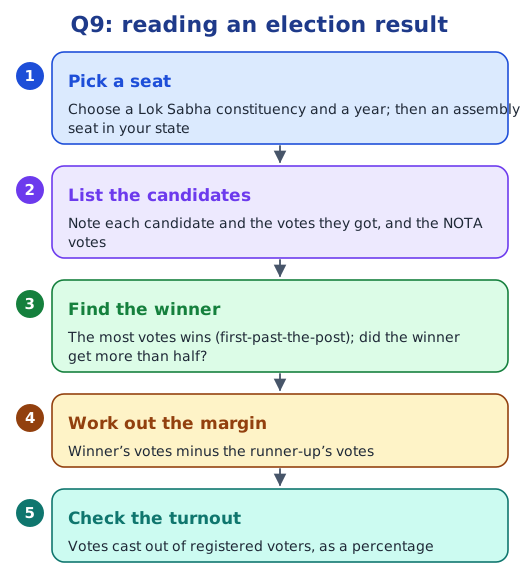
Q9. “Visit the website https://www.indiavotes.com, and choose a parliamentary constituency election from any year and explore its results. Do the same for an assembly election in your state.” Choose a Lok Sabha constituency and a year, then an assembly seat in your state, and for each note: (1) the candidates and the votes each received, including NOTA; (2) the winner, the one with the most votes under first-past-the-post, and whether the winner got more than half; (3) the margin, the winner’s votes minus the runner-up’s; (4) the turnout, the votes cast as a percentage of registered voters; and (5) whether the seat is general or reserved. Then compare the two results. Extra: official results are also published by the Election Commission of India.
Practice
-
Who cast the first vote in independent India’s first general elections, in 1951?
Show answer
Answer: (b) Shyam Saran Negi
-
In which two countries have India’s EVMs and VVPATs been used with the ECI’s support?
Show answer
Answer: (a) Namibia and Bhutan
-
How many members does the Rajya Sabha have in all?
Show answer
Answer: (b) 245
-
If NOTA does not change the result, what does it tell the parties?
Show answer
Answer: That some voters were not satisfied with any of the candidates and want better choices next time.
-
Who elects the Vice President, and what does the Vice President do?
Show answer
Answer: All the members of both Houses of Parliament, elected and nominated, elect the Vice President, who chairs the Rajya Sabha and steps in if the President cannot carry out the duties.
Stuck on a question?
Take a photo and Lagnever AI explains it step by step. Try it for 7 days for ₹2.
Get it on Google Play Open in browser
For parents: after the trial, the plan renews monthly by UPI or card autopay. You can cancel anytime in the app.