
How are elections held in India?
Answer in short
Voters go to a polling station in their constituency, where officers check their name and ID and ink a finger. They vote in secret on an EVM, can choose NOTA, and check a VVPAT slip. The candidate with the most votes wins. MPs and MLAs are elected directly; the Rajya Sabha, President and Vice President indirectly.
Stuck on a question? Take a photo and Lagnever AI explains it step by step. Try it for 7 days for ₹2. Get it on Google Play
How does a class election work?
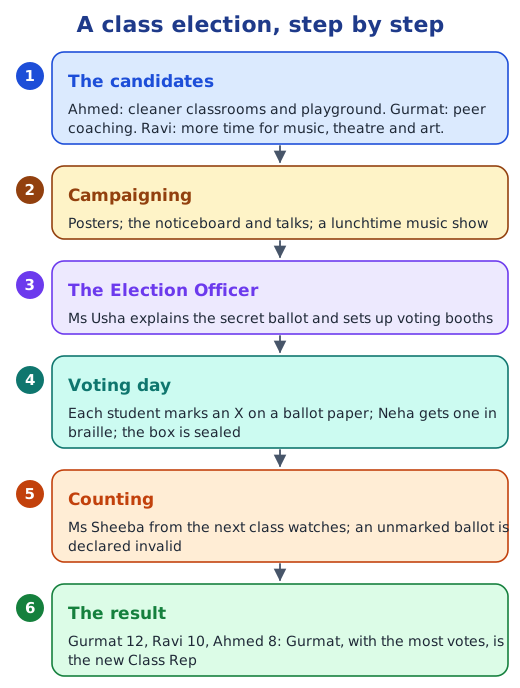
The chapter starts small, with a Grade 8 class at Suryodaya School choosing its Class Representative. Three students stood. Ahmed promised cleaner classrooms and a cleaner playground, Gurmat a system of peer coaching, and Ravi more time for music, theatre and art. They campaigned with posters, the noticeboard and a lunchtime music show.
The class teacher, Ms Usha, acted as Election Officer. She explained the rules and used a secret ballot, so that nobody would know who voted for whom. Each student marked an X beside one name, and Neha received a ballot paper in braille. The sealed box was opened with a teacher from the next class watching. One blank ballot was declared invalid. Gurmat got 12 votes, Ravi 10 and Ahmed 8, so Gurmat became Class Rep, and the other two offered to help her.
What happens at the polling station?
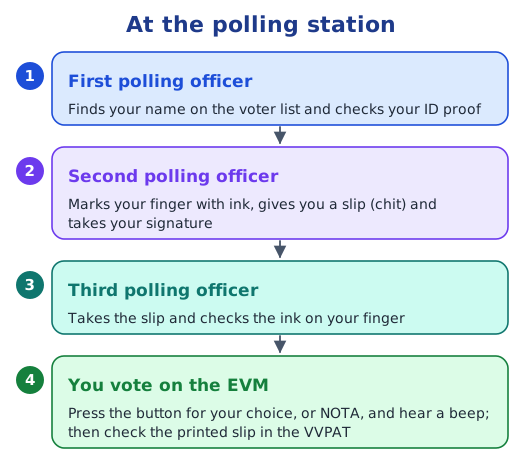
Real elections to the Lok Sabha and state assemblies follow the same ideas. The first polling officer finds your name on the voter list and checks your ID proof. The second marks your finger with ink, gives you a slip and takes your signature. The third takes the slip and checks the ink. Then you vote.
How do the EVM and VVPAT work?
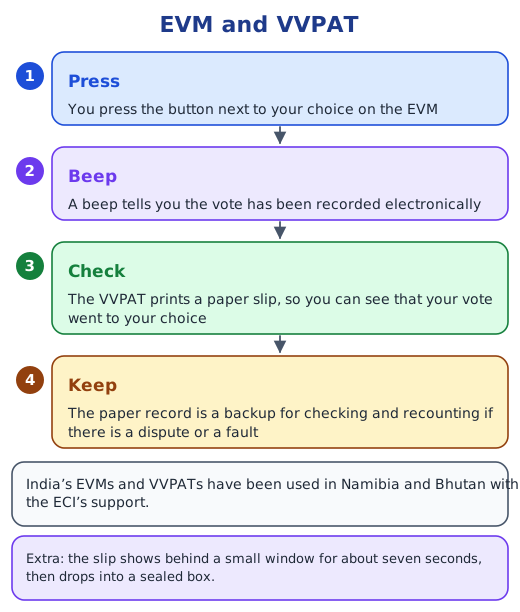
You press the button next to your choice on the electronic voting machine (EVM) and hear a beep. The VVPAT (Voter Verifiable Paper Audit Trail) then prints a slip so that you can see your vote went where you meant. This paper record is a backup for checking and recounting if there is a dispute or a fault. The EVM also offers NOTA, None Of The Above, for voters who want to reject every candidate. India’s EVMs and VVPATs have been used in Namibia and Bhutan with the ECI’s support.
Who wins?
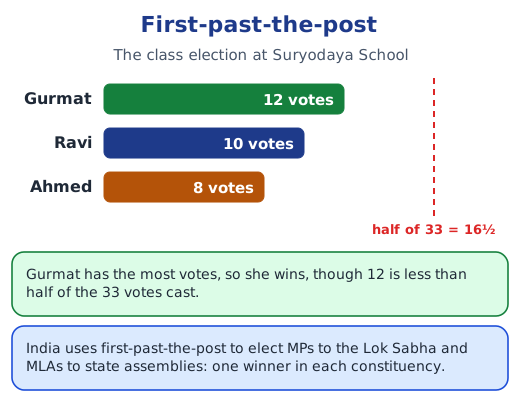
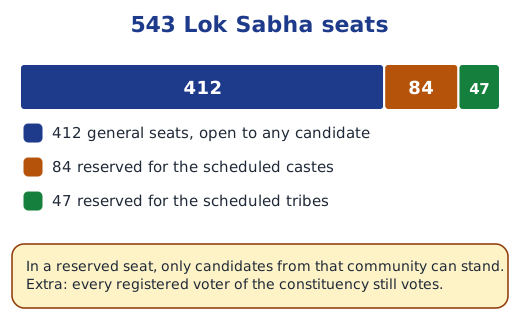
India uses first-past-the-post: in each constituency, the candidate with the most votes wins. A winner may have less than half of the votes, just as Gurmat won with 12 of the 33 votes cast. The country has 543 Lok Sabha constituencies. In 84 of them only candidates from the scheduled castes can stand, and in 47 only candidates from the scheduled tribes.
How is a government formed?
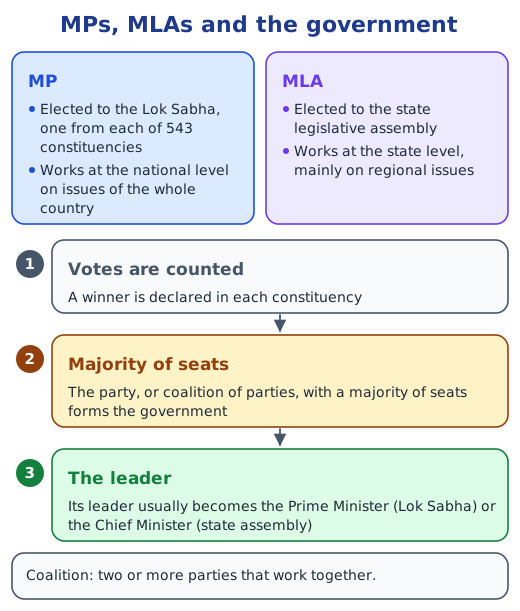
Winners to the Lok Sabha are Members of Parliament (MPs); winners to a state assembly, called the Vidhan Sabha or Niyama Sabha in some languages, are Members of Legislative Assembly (MLAs). MPs work on national issues, MLAs mainly on issues of their state. After the count, whichever party or coalition holds a majority of the Lok Sabha’s seats forms the government at the Centre, and its leader usually becomes Prime Minister. In a state, the leader of the majority becomes Chief Minister. One Lok Sabha constituency may contain two or more assembly constituencies.
How are Rajya Sabha members elected?
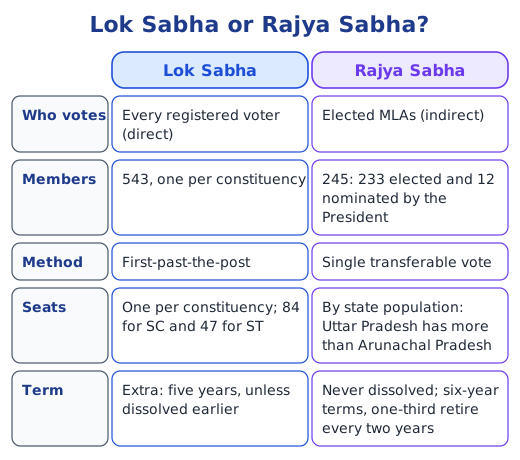
Rajya Sabha members are MPs too, but they are chosen by indirect election, as if the class representatives of a school elected a school council. Of the 245 members, 233 are elected by the elected MLAs, and the President nominates 12. Each state gets seats according to its population, so Uttar Pradesh has more than Arunachal Pradesh. MLAs vote by the single transferable vote, ranking candidates by preference, which helps smaller states to get fair representation. The Rajya Sabha is never dissolved: members serve six years, and one-third retire every two years.
How are the President and Vice President elected?
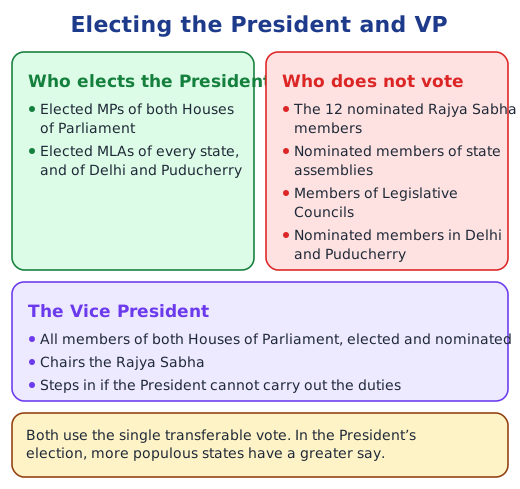
The people do not elect the President directly. An electoral college does: the elected MPs of both Houses and the elected MLAs of all the states and of Delhi and Puducherry. Nominated members and members of Legislative Councils have no vote, so only directly elected representatives choose the President. The single transferable vote is used, and states with more people have a bigger say, so the President has the support of both the Centre and the states. The Vice President is elected by all the members of both Houses of Parliament, chairs the Rajya Sabha, and steps in if the President cannot act.
Read on: What is universal adult franchise?, What does the Election Commission of India do?, the chapter notes and the NCERT solutions.
Practice
-
Which machine prints a slip so that voters can check their vote?
Show answer
Answer: (b) The VVPAT
-
How many members of the Rajya Sabha are nominated by the President?
Show answer
Answer: (b) 12
-
Who does NOT vote in the election of the President?
Show answer
Answer: (d) Nominated Rajya Sabha members
-
Why was a secret ballot used in the class election?
Show answer
Answer: So that nobody would know whom anyone voted for. Each student could follow their own choice without fear of upsetting a friend or being pressured.
-
What is the difference between a direct and an indirect election? Give one example of each.
Show answer
Answer: In a direct election the voters choose the representative themselves, as in Lok Sabha elections. In an indirect one, elected representatives vote, as when MLAs elect Rajya Sabha members.
Questions students ask
What is first-past-the-post?
It is the electoral system India uses for the Lok Sabha and the state assemblies. In each constituency the candidate who gets the most votes wins, even without half of the votes.
Why is the Rajya Sabha called a permanent House?
Because it is never dissolved. Its members serve six-year terms and one-third of them retire every two years, so new members join while the others carry on.
Who elects the Vice President of India?
An electoral college of all the members of both Houses of Parliament, elected and nominated, using the single transferable vote. The Vice President chairs the Rajya Sabha and steps in when the President cannot carry out the duties.
When did NOTA come to Indian elections?
Extra: NOTA was added to Indian ballots in 2013, after a judgment of the Supreme Court. The chapter explains that it lets voters reject every candidate without changing the result.
Stuck on a question?
Take a photo and Lagnever AI explains it step by step. Try it for 7 days for ₹2.
Get it on Google Play Open in browser
For parents: after the trial, the plan renews monthly by UPI or card autopay. You can cancel anytime in the app.