
What does the Election Commission of India do?
Answer in short
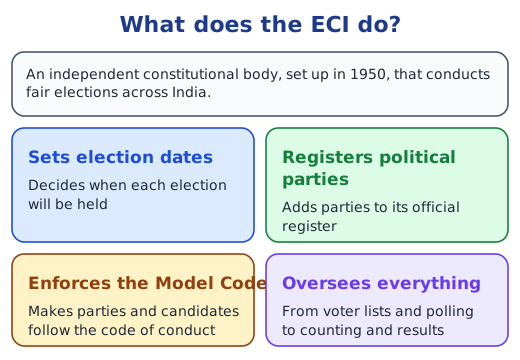
The Election Commission of India (ECI), set up in 1950, is an independent constitutional body that conducts fair elections. It runs elections to the Lok Sabha, the Rajya Sabha and the state assemblies, and for President and Vice President. It sets election dates, registers political parties, enforces the Model Code of Conduct and oversees the whole process.
Stuck on a question? Take a photo and Lagnever AI explains it step by step. Try it for 7 days for ₹2. Get it on Google Play
What kind of body is the ECI?
The Election Commission of India (ECI), an independent body created under the Constitution, has one job: to conduct fair elections. It was set up in 1950, and the first general elections of independent India followed in 1951–1952. Its main office is in Delhi.
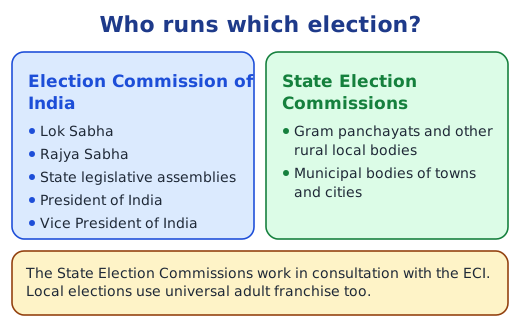
The ECI conducts elections to the Lok Sabha, the Rajya Sabha and the state legislative assemblies, and it holds the elections of the President and the Vice President. Elections to gram panchayats, and to the local bodies of towns and cities, which you read about in Grade 6, are different: the State Election Commissions run them, working in consultation with the ECI. Universal adult franchise applies to these local elections too.
How is the ECI organised?
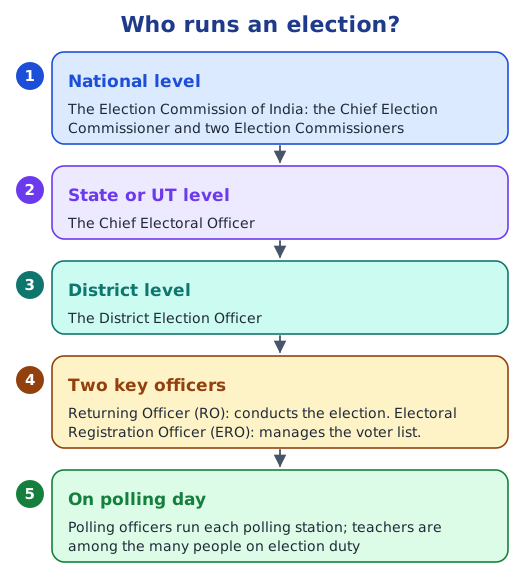
At the top, in Delhi, is the Commission itself: the Chief Election Commissioner and two Election Commissioners. Each state or union territory has a Chief Electoral Officer, and each district a District Election Officer. Below them, two officers matter most to voters. The Returning Officer (RO) conducts the election, and the Electoral Registration Officer (ERO) manages the voter list. On polling day, polling officers run each polling station.
What does the ECI do?
The chapter lists four key tasks. The ECI sets election dates, registers political parties, enforces the Model Code of Conduct and oversees the entire electoral process, from the voter list to the counting. It has kept upgrading its methods to meet the needs of a modern country, for example with electronic voting machines and new ways for people with disabilities to vote.
How big is the job?
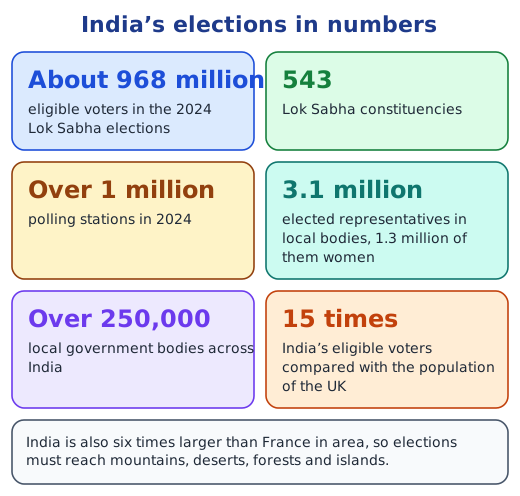
Huge. In the 2024 Lok Sabha elections, about 968 million people were eligible to vote, in 543 constituencies, at over 1 million polling stations. More than 250,000 local government bodies in the country have 3.1 million elected representatives between them, and 1.3 million of these are women. Elections to the Lok Sabha and the state assemblies fall due at different times, so some election is held somewhere in India almost every year. Many people, including teachers, are put on election duty to make it all work.
What is the Model Code of Conduct?
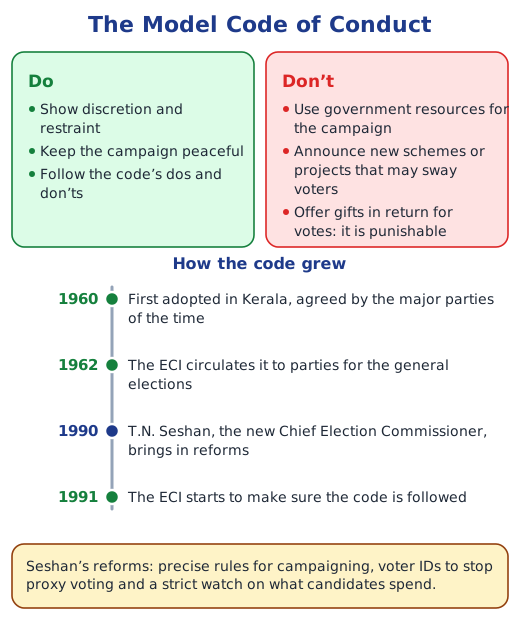
The Model Code of Conduct (MCC) is a set of dos and don’ts that leaders, political parties and candidates must follow, so that elections are fair and peaceful. Three of its elements, as the chapter gives them:
- The party in government must not use government resources for its campaign. For example, it may not announce new schemes or projects that could sway voters.
- All candidates must show discretion and restraint, so that the elections stay peaceful.
- Trying to win votes with gifts is punishable.
The code has a history. It was first adopted in Kerala in 1960, when the major parties of the time agreed to it voluntarily. For the general elections of 1962 the ECI sent it to all the parties, and from 1991 onwards it took active steps to see that the code was obeyed. Complaints the ECI deals with include gifts handed to voters, abusive language against rivals, officials campaigning for the ruling party, and bundles of cash found in a candidate’s car.
How did T.N. Seshan change elections?
T.N. Seshan became Chief Election Commissioner in 1990. He insisted that campaigning follow precise rules, pushed for voter IDs so that nobody could vote in someone else’s name, and kept a strict watch on how much candidates spent. He worked hard to protect voters’ rights, and the chapter says many remember him for making Indian elections fairer, more open and fearless.
Read on: What is universal adult franchise?, How are elections held in India?, the chapter notes and the NCERT solutions.
Practice
-
When was the Election Commission of India set up?
Show answer
Answer: (b) 1950
-
Which officer manages the voter list?
Show answer
Answer: (b) The Electoral Registration Officer
-
Who became Chief Election Commissioner in 1990 and made election rules much stricter?
Show answer
Answer: (c) T.N. Seshan
-
Why may the party in government not announce a new scheme during an election?
Show answer
Answer: Under the Model Code of Conduct, government resources must not be used to win votes. A new scheme announced at election time could sway voters unfairly, so it is not allowed.
-
Name the four tasks of the ECI shown in the chapter.
Show answer
Answer: Fixing election dates, registering parties, making sure the Model Code of Conduct is followed, and overseeing the entire election process.
Questions students ask
Is the Election Commission of India a constitutional body?
Yes. The chapter calls it an independent constitutional body responsible for conducting fair elections. Extra: it is set up under Article 324 of the Constitution.
Who conducts panchayat elections?
The State Election Commission of each state. You met gram panchayats and urban local bodies in Grade 6. Their direct elections are organised by the State Election Commissions, which consult the ECI.
Why is T.N. Seshan remembered?
He became Chief Election Commissioner in 1990 and brought in reforms: precise rules for campaigning, voter IDs to stop proxy voting and a strict watch on candidates’ spending. The chapter says many people remember him for making Indian elections fairer and more open.
When is National Voters’ Day?
Extra: on 25 January, the day the Election Commission of India was set up in 1950. It is marked every year to encourage people, especially new voters, to register and vote.
Stuck on a question?
Take a photo and Lagnever AI explains it step by step. Try it for 7 days for ₹2.
Get it on Google Play Open in browser
For parents: after the trial, the plan renews monthly by UPI or card autopay. You can cancel anytime in the app.