
Class 6 Social Science Chapter 11: Grassroots Democracy — Part 2: Local Government in Rural Areas Notes
This chapter in five lines
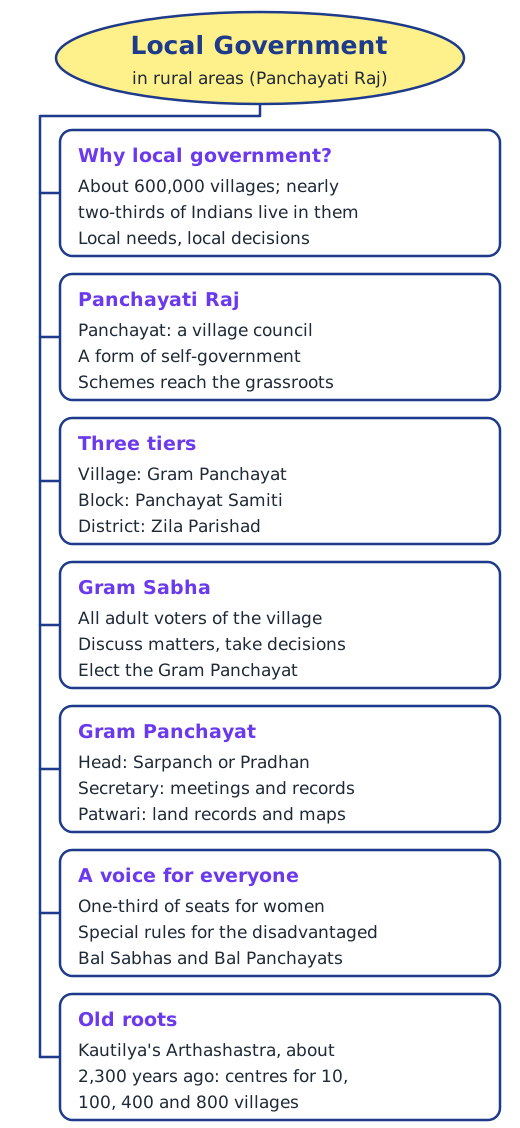
In rural India, local government is the Panchayati Raj system, a form of self-government that brings governance close to the people. It has three tiers: the Gram Panchayat at the village level, the Panchayat Samiti at the block level and the Zila Parishad at the district level. The Gram Sabha, made up of all the adult voters of a village, discusses local matters and elects the Gram Panchayat, whose head is the Sarpanch. One-third of the seats are reserved for women.
Why do villages need their own government?
India has about 600,000 villages, 8,000 towns and over 4,000 cities, and almost two-thirds of its more than 1.4 billion people live in rural areas. Think of Lakshmanpur, a village of about 700 people in the foothills of the Himalayas, most of them farmers. They need water for their fields, the main road repaired after heavy rain and the primary school kept running; sometimes there is a quarrel over land or some crop is stolen. People cannot run to the State or the national capital for every such issue. So who decides, and where do the resources come from?
What is Panchayati Raj?
Like every village in India, Lakshmanpur has a local government called a Panchayat, a village council. Panchayats bring governance close to the people and let them take an active part in decisions. That is why the Panchayat system, or Panchayati Raj, is a form of self-government. Panchayats deal with local issues, promote development and make sure that government schemes reach the grassroots.
The three tiers
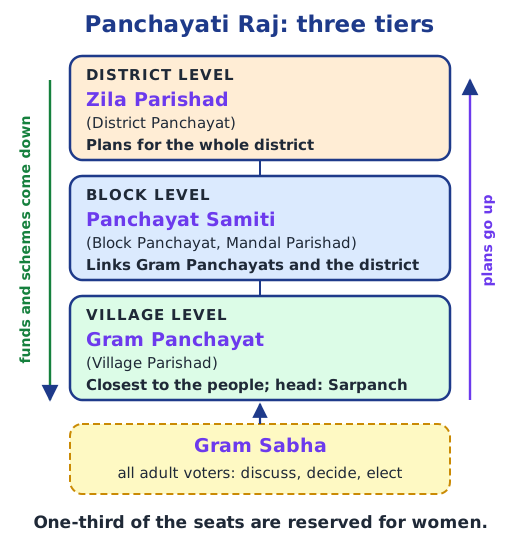
Panchayati Raj works at three levels, from the bottom up, so it is called a three-tier system:
- Gram Panchayat (or Village Parishad) at the village level;
- Panchayat Samiti (or Block Panchayat, or Mandal Parishad) at the block level;
- Zila Parishad (or District Panchayat) at the district level.
Together, their work covers almost every part of life in a district: agriculture, housing, roads, water resources, education, health care, social welfare and cultural activities. The Panchayat Samiti links the Gram Panchayats with the Zila Parishad. It collects the development plans of all the Gram Panchayats and puts them together for the district or State, which helps get funds for projects and for schemes like the Pradhan Mantri Gram Sadak Yojana, which builds all-weather roads in villages. More in the Panchayati Raj system.
Gram Sabha and Gram Panchayat
The Gram Sabha is all the adults of a village, or a group of neighbouring villages, who are enrolled as voters. In it, women and men discuss all the matters of their area and take decisions, and they directly elect the members of the Gram Panchayat. Each Gram Panchayat elects a head, the Sarpanch or Pradhan; more and more women have become Sarpanchs in recent years. A Panchayat Secretary calls meetings and keeps records, and in many parts of India a Patwari keeps the villagers’ land records, sometimes with maps that are generations old. More in Gram Sabha and Gram Panchayat.
Sarpanchs who made a difference
- Dnyaneshwar Kamble, a transgender person, was elected Sarpanch of Tarangfal village in Solapur district, Maharashtra, in 2017, defeating six other candidates. Kamble’s motto is lok seva, gram seva: service to the village is service to the public.
- Vandana Bahadur Maida, of the Bhil community, became the first woman Sarpanch of Khankhandvi village in Madhya Pradesh. She brought women to the Sabha meetings and worked on education and sanitation.
- Popatrao Baguji Pawar, Sarpanch of drought-hit Hiware Bazar in Ahmednagar district, Maharashtra, used rainwater harvesting, watershed conservation and the planting of lakhs of trees to recharge the groundwater. With the villagers’ help, it became green and prosperous, and he received the Padma Shri in 2020.
Children have a voice too
Under the Child-Friendly Panchayat Initiative, children share their ideas in Bal Sabhas and Bal Panchayats, and village elders look for solutions to their concerns. In Maharashtra, some Bal Panchayats have worked against child labour and child marriage and brought children back to school. Sangkhu Radhu Khandu Gram Panchayat in west Sikkim built safety walls and kitchens for mid-day meals in schools. In rural Rajasthan, the Children’s Parliament of the Barefoot College let children aged 8 to 14 hold elections and run a ‘Cabinet’; it won the World’s Children’s Honorary Award in 2001.
A voice for everyone
At all three levels there are special rules so that disadvantaged sections of the population can make their needs heard, and one-third of the seats are reserved for women. The structure of Panchayats differs a little from State to State, because States have authority over them, but the aim is the same: to let villagers take an active part in managing and developing their area. Democracy here works both directly, through the Gram Sabha, and through elected representatives.
An idea from the Arthashastra
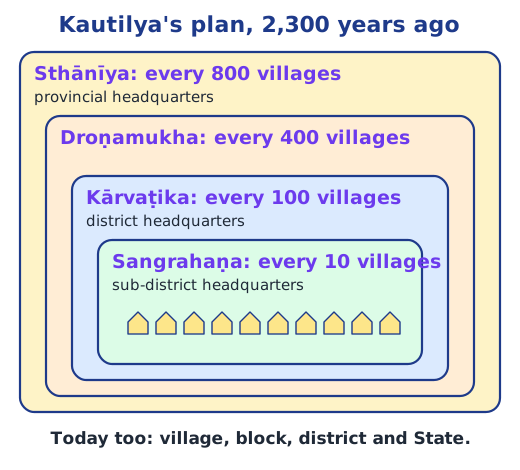
The Arthashastra, a text on governance written by Kautilya (also known as Chanakya) some 2,300 years ago, describes how a whole administration should be set up from the village upwards: a headquarters for every 10, 100, 400 and 800 villages. A similar step-by-step structure is used today. Answers to every question in the chapter are in the NCERT solutions for Chapter 11.
Key terms
| Term | Meaning |
|---|---|
| Panchayat | A village council: the local government of a village. |
| Panchayati Raj | The system of local government through Panchayats in rural India, working at the village, block and district levels. |
| Self-government | People governing their own area by taking part in decisions about it, as villagers do through Panchayats. |
| Three-tier system | Panchayati Raj works at three levels, from the bottom up: the village, the block and the district. |
| Gram Sabha | All the adults of a village, or a group of neighbouring villages, who are enrolled as voters. They discuss local matters and take decisions. |
| Gram Panchayat | The village-level body, closest to the people. Its members are elected directly by the Gram Sabha. |
| Sarpanch or Pradhan | The head or president of a Gram Panchayat. |
| Panchayat Secretary | The person who does the Gram Panchayat's office work, such as calling meetings and keeping records. |
| Patwari | An officer in many parts of India who keeps the land records of villagers, sometimes with maps generations old. |
| Panchayat Samiti | The block-level body (also called Block Panchayat or Mandal Parishad), the link between the Gram Panchayats and the Zila Parishad. |
| Zila Parishad | The district-level body of Panchayati Raj, also called the District Panchayat. |
| Bal Panchayat | A children's Panchayat where children share ideas on matters that concern them, as part of the Child-Friendly Panchayat Initiative. |
Topics in this chapter
Practice
-
Which is the lowest tier of the Panchayati Raj system?
Show answer
Answer: (c) Gram Panchayat
-
Who elects the members of the Gram Panchayat?
Show answer
Answer: (b) The Gram Sabha
-
The head of a Gram Panchayat is called the:
Show answer
Answer: (b) Sarpanch or Pradhan
-
Which body is the link between the Gram Panchayat and the Zila Parishad?
Show answer
Answer: (c) Panchayat Samiti
-
What share of the seats in Panchayati Raj institutions is reserved for women, according to the chapter?
Show answer
Answer: (b) One-third
Questions students ask
What are the main topics of Class 6 SST Chapter 11?
Why villages need local government, the Panchayati Raj system and its three tiers, the Gram Sabha and Gram Panchayat, the Sarpanch, the Panchayat Secretary and Patwari, exemplary Sarpanchs, Bal Sabhas and Bal Panchayats, the Panchayat Samiti and Zila Parishad, reserved seats, and Kautilya's plan in the Arthashastra.
Is Local Government in Rural Areas in the new Exploring Society book?
Yes. Grassroots Democracy — Part 2: Local Government in Rural Areas is Chapter 11 of Exploring Society: India and Beyond, the Class 6 Social Science textbook used in the 2026-27 session. Chapter 12 covers local government in urban areas.
How many end-of-chapter questions does Chapter 11 have?
The “Questions, activities and projects” section has 4 items, including a letter to the Sarpanch. Our NCERT solutions page answers them, along with the Big Questions, the Think About It questions and the Let's Explore activities.
Stuck on a question?
Take a photo and Lagnever AI explains it step by step. Try it for 7 days for ₹2.
Get it on Google Play Open in browser
For parents: after the trial, the plan renews monthly by UPI or card autopay. You can cancel anytime in the app.