
What are the Gram Sabha and the Gram Panchayat?
Answer in short
The Gram Sabha is made up of all the adults of a village, or a group of villages, who are enrolled as voters. It discusses local matters, takes decisions and directly elects the members of the Gram Panchayat, the village council. The Gram Panchayat is headed by a Sarpanch or Pradhan and helped by a Panchayat Secretary and a Patwari.
Stuck on a question? Take a photo and Lagnever AI explains it step by step. Try it for 7 days for ₹2. Get it on Google Play
A village with many questions
Lakshmanpur is a small village in the foothills of the Himalayas, with 200 houses and about 700 people, most of them farmers who grow crops and keep cows or goats. Its people need water for their fields, a road repaired after the rains and a primary school kept running. How will they decide such matters, and who will settle a quarrel over land? The answer is their local government, the Panchayat, which works through two groups: the Gram Sabha and the Gram Panchayat.
The Gram Sabha
The Gram Sabha is made up of all the adults of a village, or of a group of neighbouring villages, who are enrolled as voters. In the Gram Sabha, women and men discuss all matters related to their area and take decisions. Because every adult voter can take part directly, the Gram Sabha is a form of direct democracy at the grassroots.
The Gram Panchayat
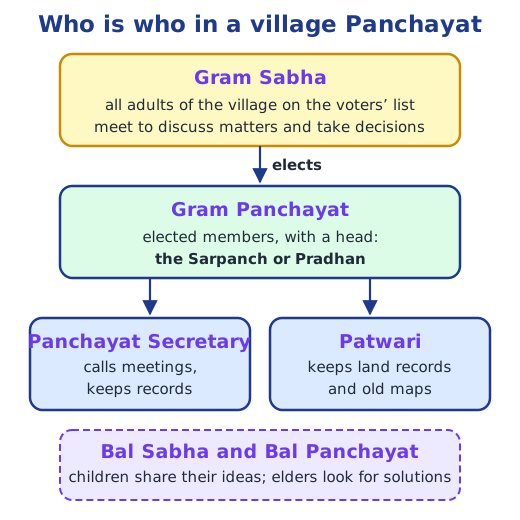
The Gram Panchayat is the base of the Panchayati Raj system and the body closest to the people in rural areas. Its members are elected directly by the Gram Sabha. Each Gram Panchayat elects a head or president, called the Sarpanch or Pradhan. In recent years, more and more women have become Sarpanchs.
The Gram Panchayat has helpers:
- a Panchayat Secretary, who does administrative work such as calling meetings and keeping records;
- in many parts of India, a Patwari, who keeps the villagers’ land records. Some Patwaris keep maps that are generations old, which show who owned which land and how the village has changed.
Sarpanchs who made a difference
- Dnyaneshwar Kamble, a transgender person, became Sarpanch of Tarangfal in Solapur district, Maharashtra, in 2017, defeating six other candidates. Kamble’s motto is lok seva, gram seva: service to the village is service to the public.
- Vandana Bahadur Maida, of the Bhil community, became the first woman Sarpanch of Khankhandvi in Madhya Pradesh. She persuaded women to attend the Sabha meetings and took up education and sanitation.
- Popatrao Baguji Pawar turned drought-hit Hiware Bazar in Ahmednagar district, Maharashtra, green and prosperous through rainwater harvesting, watershed conservation and planting lakhs of trees, with the villagers’ help. He received the Padma Shri in 2020.
Children in the Panchayat
Panchayats are meant to listen to everyone, children included. Under the Child-Friendly Panchayat Initiative, children share their ideas in Bal Sabhas and Bal Panchayats, and village elders try to find solutions to their concerns.
- In Maharashtra, some Bal Panchayats have worked to end child labour and child marriage, and have brought many children back to school by talking to parents.
- Sangkhu Radhu Khandu Gram Panchayat in west Sikkim built compound walls to make schools safer and kitchens so that mid-day meals are cooked hygienically. It was declared a child-friendly Gram Panchayat.
- In rural Rajasthan, the Children’s Parliament of Bunker Roy’s Barefoot College let children aged 8 to 14 learn democracy through night schools and elections with voter ID cards; the elected ‘Cabinet’ helped run schools. It won the World’s Children’s Honorary Award in 2001.
Two kinds of democracy in one village
In the Panchayati Raj system, democracy works both through the direct participation of people, in the Gram Sabha, and through their elected representatives, in the Gram Panchayat. Above the village are the block and district levels; see the Panchayati Raj system.
Practice
-
Who are the members of the Gram Sabha?
Show answer
Answer: (b) All the adults of the village who are enrolled as voters
-
Who keeps the villagers' land records in many parts of India?
Show answer
Answer: (b) The Patwari
-
Popatrao Pawar, who received the Padma Shri in 2020, was Sarpanch of:
Show answer
Answer: (a) Hiware Bazar
-
How is the Gram Sabha an example of direct democracy?
Show answer
Answer: Every adult voter of the village can attend, speak and take part in decisions directly, instead of only sending a representative.
-
What can a Bal Panchayat do? Give one example from the chapter.
Show answer
Answer: Children can raise issues that affect them. In Maharashtra, some Bal Panchayats worked to stop child labour and child marriage and convinced parents to send children back to school.
Questions students ask
What is the difference between the Gram Sabha and the Gram Panchayat?
The Gram Sabha is all the adult voters of a village, who meet to discuss and decide. The Gram Panchayat is the smaller council whose members the Gram Sabha elects to carry out the village's work.
Who is the Sarpanch?
The head or president of the Gram Panchayat, also called the Pradhan. In recent years, more and more women have become Sarpanchs.
What does the Panchayat Secretary do?
The Secretary does the Gram Panchayat's administrative work, such as calling meetings and keeping records.
What is the Child-Friendly Panchayat Initiative?
An effort to make Panchayats listen to children too. Through Bal Sabhas and Bal Panchayats, children express their ideas on matters that concern their wellbeing, and village elders try to find solutions.
Stuck on a question?
Take a photo and Lagnever AI explains it step by step. Try it for 7 days for ₹2.
Get it on Google Play Open in browser
For parents: after the trial, the plan renews monthly by UPI or card autopay. You can cancel anytime in the app.