
What is the Panchayati Raj system?
Answer in short
Panchayati Raj is the system of local self-government in India's villages. It works at three levels: the Gram Panchayat for a village, the Panchayat Samiti for a block and the Zila Parishad for a district. These bodies look after local needs such as water, roads, schools, health and farming, and help government schemes reach the grassroots.
Stuck on a question? Take a photo and Lagnever AI explains it step by step. Try it for 7 days for ₹2. Get it on Google Play
Why villages need their own government
India has about 600,000 villages, and almost two-thirds of its people live in rural areas. Each village has its own needs: water for the fields, a road repaired after heavy rain, a primary school kept in good shape. Disputes over land or stolen crops have to be settled too. People cannot travel to the State capital or to Delhi for every such matter. Decisions about village life work well when they are taken close to home, by the people who live there.
Panchayati Raj: self-government
Every village in India has a local government called a Panchayat, which means a village council. Panchayats bring governance closer to the people and make it possible for them to take an active part in decisions. That is why the Panchayat system, also known as Panchayati Raj, is a form of self-government. Panchayats deal with local issues, promote development and make sure that the benefits of government schemes reach the grassroots.
The three tiers
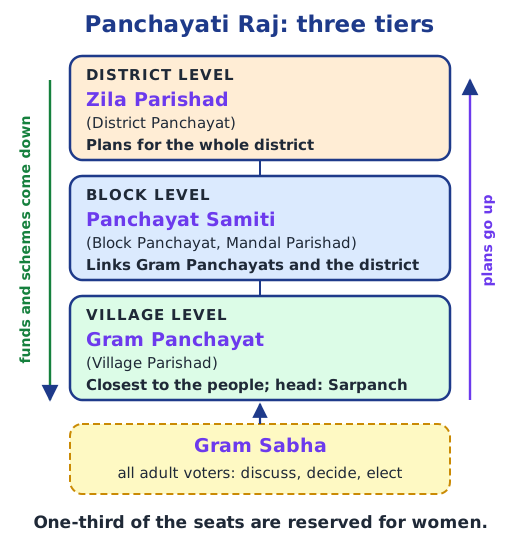
Panchayati Raj works at three levels, from the bottom up: the village, the block and the district. This is called a three-tier system.
| Level | Body (other names) | Main role |
|---|---|---|
| Village | Gram Panchayat (Village Parishad) | Closest to the people; looks after the village’s needs |
| Block | Panchayat Samiti (Block Panchayat, Mandal Parishad) | Links the Gram Panchayats and the Zila Parishad; puts plans together |
| District | Zila Parishad (District Panchayat) | Looks after the whole district |
Together, these institutions cover almost all parts of life in a district: agriculture, housing, the upkeep of roads, water resources, education, health care, social welfare and even cultural activities.
How the tiers work together
The Panchayat Samiti at the block level is the link between the Gram Panchayats below it and the Zila Parishad above it. It coordinates matters across Gram Panchayats: for example, it collects the development plans of all the Gram Panchayats and puts them together to present at the district or State level. This helps in allotting funds for development projects and for government schemes such as the Pradhan Mantri Gram Sadak Yojana, which builds all-weather roads in rural areas.
The members of the Panchayat Samiti and the Zila Parishad are elected by the local people, but there may be other members too, such as the Sarpanchs of villages in the area and local members of the State Legislative Assembly.
A fair voice for all
At all three levels, special rules have been made so that disadvantaged sections of the population can make their needs and problems heard. One-third of the seats are reserved for women. (Extra: Panchayati Raj institutions got their place in the Constitution through the 73rd Amendment, which came into force in 1993.)
Different States, same aim
The structure and work of Panchayati Raj institutions differ a little from State to State, because the States have authority over them. But their aim is the same everywhere: to let villagers take an active part in managing and developing their villages and their area. Democracy here works in two ways: directly, when all the adults meet in the Gram Sabha, and through the representatives they elect.
Panchayats and the Central government
Both the Panchayats and the Central government are made up of representatives elected by adult citizens, and both have a head and officials who help them. But a Panchayat looks after a village, block or district, while the Central government looks after the whole country, with matters like defence and currency. And in the Gram Sabha, every adult voter can take part directly, which is not possible for a whole country. Read how the village level works in Gram Sabha and Gram Panchayat.
Practice
-
At which level does the Zila Parishad work?
Show answer
Answer: (c) District
-
The Panchayat Samiti is also known as:
Show answer
Answer: (b) Block Panchayat or Mandal Parishad
-
Which scheme mentioned in the chapter builds all-weather roads in rural areas?
Show answer
Answer: (a) Pradhan Mantri Gram Sadak Yojana
-
Why is Panchayati Raj called a form of self-government?
Show answer
Answer: Because it brings governance close to the people and lets villagers take an active part in decisions about their own area, through the Gram Sabha and the members they elect.
-
How does the Panchayat Samiti help the Gram Panchayats?
Show answer
Answer: It coordinates matters across the Gram Panchayats of a block. It collects their development plans and puts them together for the district or State, which helps get funds for projects and government schemes.
Questions students ask
What are the three tiers of Panchayati Raj?
The Gram Panchayat at the village level, the Panchayat Samiti (Block Panchayat or Mandal Parishad) at the block level, and the Zila Parishad (District Panchayat) at the district level.
What do Panchayati Raj institutions do?
They deal with local issues and development: agriculture, housing, roads, water resources, education, health care, social welfare and cultural activities. They also make sure government schemes reach people at the grassroots.
Who are the members of the Panchayat Samiti and Zila Parishad?
Members elected by the local people, and sometimes others too, such as the Sarpanchs of villages in the area and local members of the State Legislative Assembly. The details differ from State to State.
Why are seats reserved for women in Panchayats?
So that women, who have often had less say in decisions, are fairly represented and their needs are heard. One-third of the seats are reserved for women.
Stuck on a question?
Take a photo and Lagnever AI explains it step by step. Try it for 7 days for ₹2.
Get it on Google Play Open in browser
For parents: after the trial, the plan renews monthly by UPI or card autopay. You can cancel anytime in the app.