
Class 7 Social Science Chapter 9: From the Rulers to the Ruled: Types of Governments Notes
This chapter in five lines
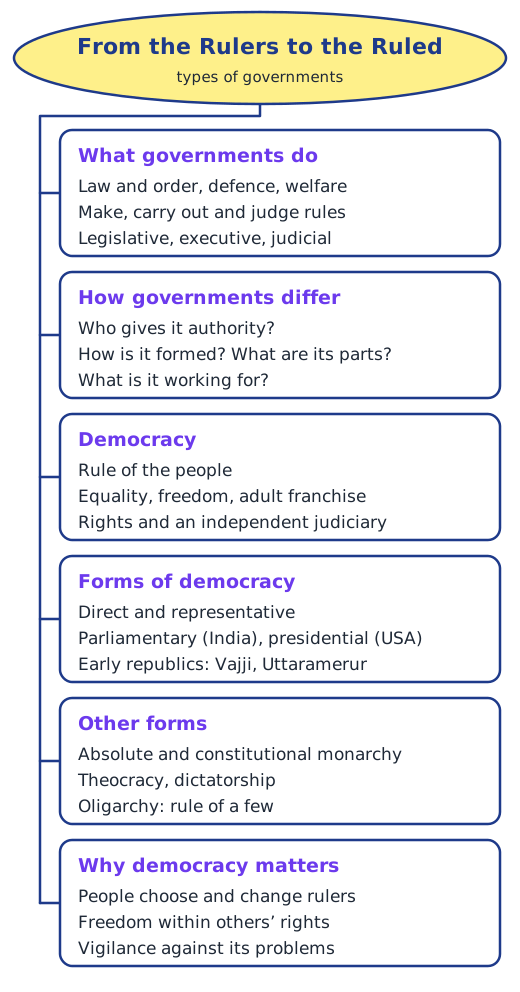
From the Rulers to the Ruled compares types of government. Every government makes rules, carries them out and settles disputes, but governments differ in who gives them power, how they are formed and whom they serve. Democracies, direct or representative, parliamentary or presidential, rest on the people; monarchy, theocracy, dictatorship and oligarchy keep power with one or a few.
What is this chapter about?
The chapter opens with Kautilya’s Arthashastra, which says a ruler’s duties at home are threefold: protecting the state from attack (raksha), keeping law and order (palana) and caring for the people’s welfare (yogakshema). It then asks four questions: what types of government there are, where governments get their power, how a government deals with its people, and why democracy matters.
What governments do
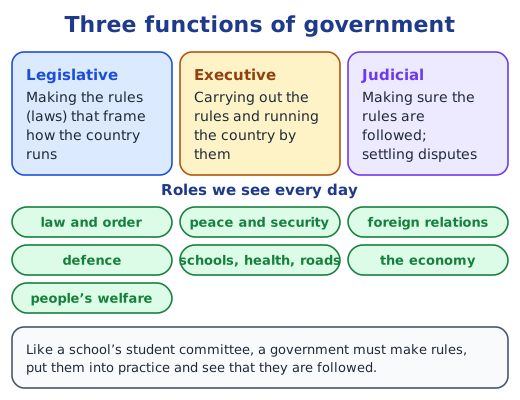
A government keeps law and order, provides peace and security, deals with other countries, defends the nation, delivers services such as education, health care and infrastructure, manages the economy and works for people’s welfare. To do all this it must make rules, put them into practice and see that they are followed. These are its three functions: legislative, executive and judicial.
Democracy: rule of the people
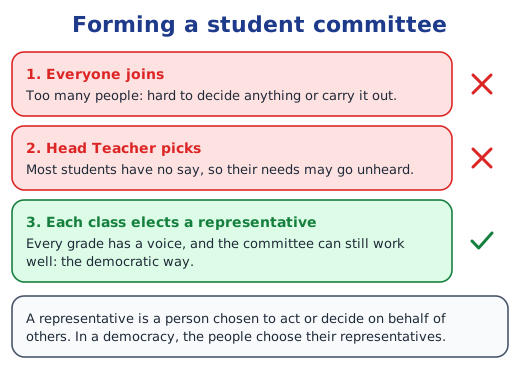
A school story explains democracy. A Head Teacher wants a student committee to help make and run school rules. The students consider three ways: everyone joins, the Head Teacher chooses, or each class elects a representative. The third way gives every grade a voice while keeping the committee workable, and that is how democracy works: the people choose representatives to govern on their behalf. Abraham Lincoln described democracy as government of the people, by the people, for the people. Read why democracy matters.
How governments differ
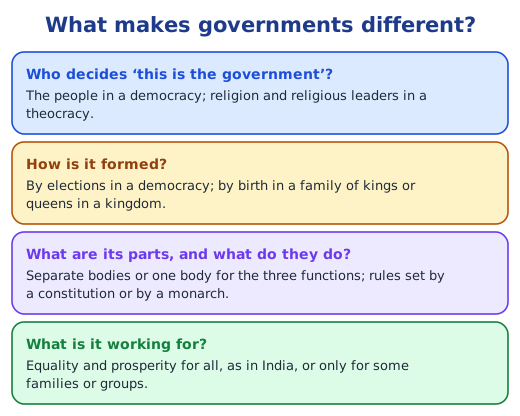
Four questions bring out the differences. Who gives the government its authority: the people, as in India, or religious belief, as in a theocracy? How is it formed: by elections, or by birth in a royal family? What are its parts, and are the three functions done by separate bodies or one? And what is it working for: everyone’s equality and prosperity, or only that of a few families or groups?
Forms of democracy
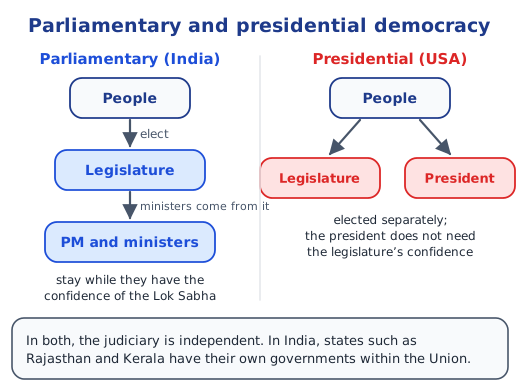
Democracy is the most common form of government today. Its principles are equality, freedom, representative participation, universal adult franchise, fundamental rights and an independent judiciary, though not every democracy meets these ideals. In a direct democracy all citizens decide everything, which is hard in large countries; most countries are representative democracies, with regular elections, every five years in India and every four in the USA. India is a parliamentary democracy, where the prime minister and council of ministers come from Parliament; the USA is a presidential democracy, where the president is elected separately. Read parliamentary and presidential democracy.
A peek into history
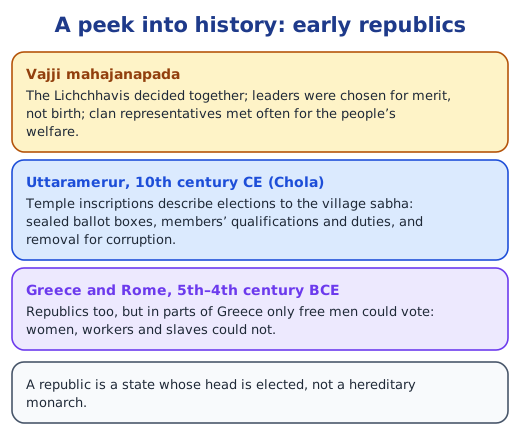
In ancient India, the Lichchhavis of the Vajji mahajanapada chose leaders on merit and took decisions together, so such states are called early republics. Tenth-century Chola inscriptions at Uttaramerur in Tamil Nadu describe elections to the village sabha, with sealed ballot boxes and rules to remove corrupt members. Even kings were expected to follow rajadharma, ruling by dharma for everyone’s welfare, as Bhishma taught Yudhishthira.
Other forms of government
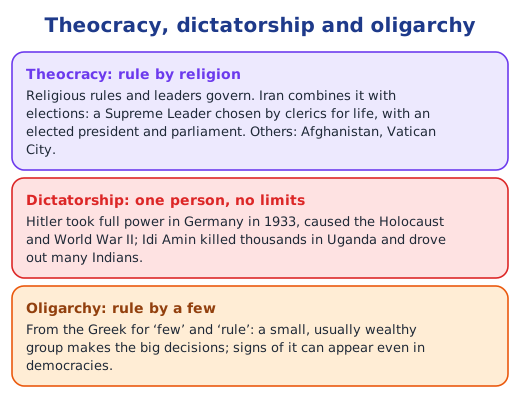
In a monarchy a king or queen rules, usually by inheritance: an absolute monarch, as in Saudi Arabia, holds all power, while a constitutional monarch, as in the United Kingdom, has only nominal power. In a theocracy, such as Iran, religious rules and leaders govern. In a dictatorship, one person or a small group holds unlimited power, as Hitler did in Germany and Idi Amin in Uganda. In an oligarchy, a few wealthy or influential people make the big decisions. Read types of government.
Before we move on
Every country needs a government, but they differ in who decides, how they form, what their parts do and whom they serve. Democracy, now the most popular form, comes in direct, parliamentary and presidential versions; monarchy, theocracy, dictatorship and oligarchy are the other forms. Democracy matters, but citizens must stay alert to its challenges. Answers to every question are in the NCERT solutions for Chapter 9.
Key terms
| Term | Meaning |
|---|---|
| Government | The system that runs a country: it keeps law and order, defends it, provides services and works for people’s welfare. |
| Legislative, executive and judicial functions | Making rules, carrying them out and running the country by them, and making sure they are followed. |
| Democracy | ‘Rule of the people’: the people are the source of power and choose their representatives to govern. |
| Representative | A person picked to speak and decide for a group, like a class representative or a member of Parliament. |
| Universal adult franchise | The right of every adult citizen above a set age to vote; India gave it from the start of the republic in 1950. |
| Accountability | The duty of a government to answer to the people who elected it. |
| Parliamentary democracy | A democracy in which the executive comes from the legislature and stays in office while it has the legislature’s confidence, as in India. |
| Presidential democracy | A democracy in which the president is elected separately and does not need the legislature’s confidence, as in the USA. |
| Republic | A state whose head is elected rather than a hereditary monarch, such as the Vajji mahajanapada of ancient India. |
| Monarchy | Rule by a king or queen, usually hereditary; absolute if the monarch holds all power, constitutional if the monarch’s power is only nominal. |
| Theocracy and dictatorship | Rule by religious rules and leaders; and rule by one person or a small group with no limits from any constitution or law. |
| Oligarchy | Rule by a few, usually a small group of wealthy or influential people, from Greek words for ‘few’ and ‘rule’. |
Topics in this chapter
Practice
-
Which function of government is about making laws?
Show answer
Answer: (b) Legislative
-
What type of democracy does India have?
Show answer
Answer: (c) Parliamentary
-
Which country is a constitutional monarchy?
Show answer
Answer: (b) United Kingdom
-
In which year did women in Switzerland get the right to vote?
Show answer
Answer: (d) 1971
-
Rule by a small, powerful group of people is called:
Show answer
Answer: (b) Oligarchy
-
Where do 10th-century inscriptions describe village elections with sealed ballot boxes?
Show answer
Answer: (b) Uttaramerur
Questions students ask
What are the main topics of Class 7 SST Chapter 9?
What government is and its three functions; how governments differ; what democracy means and its principles; direct and representative democracy, and its parliamentary and presidential forms; early republics in India and elsewhere; monarchy, theocracy, dictatorship and oligarchy; and why democracy matters, along with its challenges.
Is From the Rulers to the Ruled in the new NCERT Class 7 Social Science book?
Yes. It is Chapter 9 of Exploring Society: India and Beyond, the Class 7 Social Science textbook Part 1 (Reprint 2026-27), on pages 185 to 208, in the theme Governance and Democracy. Its full title is From the Rulers to the Ruled: Types of Governments.
What are the different types of government?
Democracies, in which the people choose their representatives, can be direct or representative, and representative ones can be parliamentary, like India, or presidential, like the USA. Other forms are monarchy (absolute or constitutional), theocracy (rule by religion), dictatorship (one person with unlimited power) and oligarchy (rule by a few).
Why is democracy considered better than other forms?
In a democracy, people choose their government and can change it at the next election, so the government must answer to them. Citizens have equal rights, freedom of speech and an independent judiciary to protect them, and the government is meant to work for everyone’s wellbeing. Democracies still face problems like corruption, so citizens must stay vigilant.
Stuck on a question?
Take a photo and Lagnever AI explains it step by step. Try it for 7 days for ₹2.
Get it on Google Play Open in browser
For parents: after the trial, the plan renews monthly by UPI or card autopay. You can cancel anytime in the app.