
NCERT Solutions Class 7 Social Science Chapter 9: From the Rulers to the Ruled: Types of Governments
Answers to every question in Chapter 9, From the Rulers to the Ruled: Types of Governments, of Exploring Society: India and Beyond, the Class 7 Social Science textbook Part 1 (Reprint 2026-27): the Big Questions, all eight Let’s Explore activities, both Think About It questions, Table 9.2 and all eight Questions and activities. Page numbers follow the book (pages 185–208). Short notes: Chapter 9 notes.
The Big Questions (page 185)
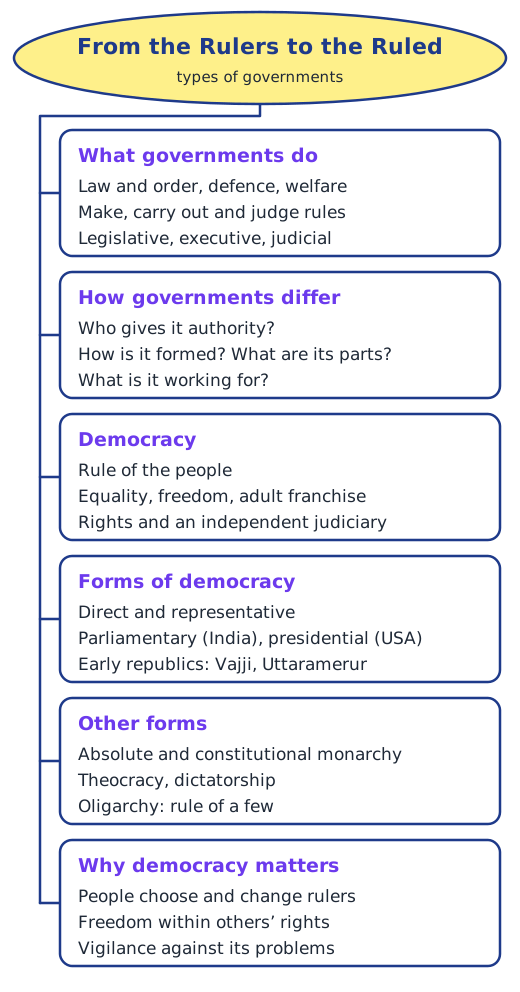
1. What are the different types of government? Democracy, which may be direct or representative, and parliamentary or presidential; monarchy, absolute or constitutional; theocracy; dictatorship; and oligarchy.
2. Where do governments get their power from? In a democracy, from the people, who elect representatives; in a monarchy, from birth into a royal family; in a theocracy, from religious belief and religious leaders; in a dictatorship, from one person seizing and holding power; in an oligarchy, from the wealth and influence of a small group.
3. How does a country’s government interact with the people? It makes rules, carries them out and settles disputes; it provides services such as schools, health care and roads, and looks after security and welfare. In a democracy people take part through elections, can question their representatives and can change the government; in other forms they have little say.
4. Why does democracy matter? Because the people choose their government and can change it, rights such as equality and freedom of speech are protected by an independent judiciary, and the government is meant to work for everyone. It has problems too, so citizens must stay alert.
Let’s Explore (page 186)
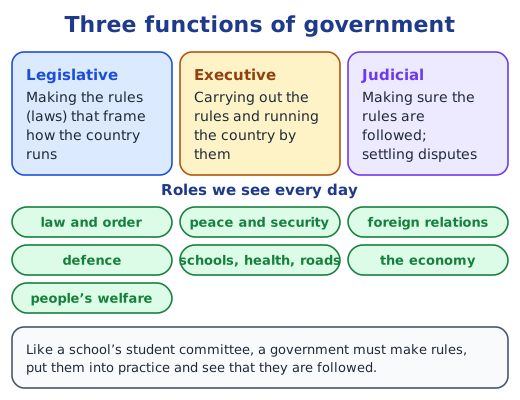
The Grade 6 picture and other roles of government. The picture shows the government’s roles in daily life. Other roles include running hospitals and vaccination drives, giving disaster relief, protecting forests and wildlife, collecting taxes, running railways, posts and electricity, issuing documents such as birth certificates and passports, holding elections, supporting farmers and research, and protecting heritage.
Think About It (page 187)
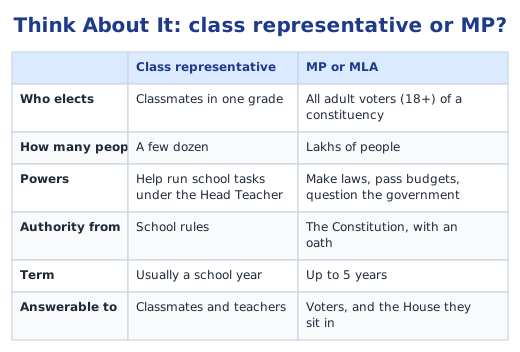
Class representatives versus MPs and MLAs. A class representative is chosen by a few dozen classmates, helps run school tasks under the Head Teacher, gets authority from school rules and usually serves for a school year. An MP or MLA is elected by all adult voters (18 and above) of a constituency of lakhs of people, makes laws and passes budgets, takes an oath under the Constitution, serves for up to five years and answers to voters and the House.
Let’s Explore (page 188)
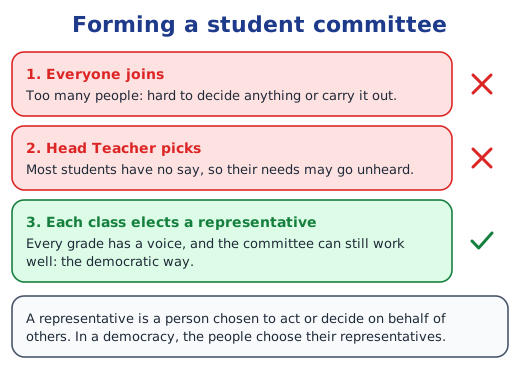
Which method is most effective? The third: each class elects a representative. Every grade gets a voice, the members are chosen by the students they serve, and a committee of representatives is small enough to decide and act. If everyone joins, decisions become very hard; if the Head Teacher picks, most students have no say.
Let’s Explore (page 196): Table 9.1
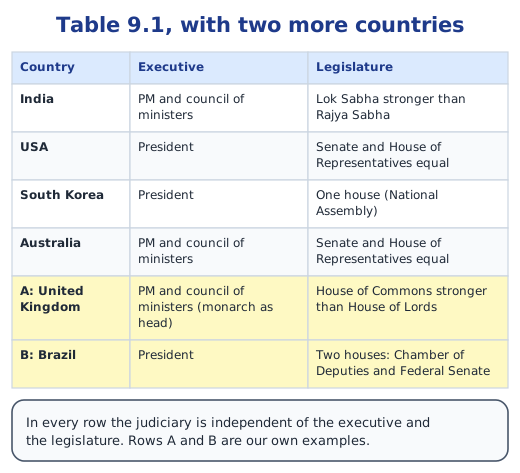
Two more countries (our choice). A: United Kingdom. Executive: the prime minister and council of ministers, with the monarch as nominal head; legislature: House of Commons (stronger) and House of Lords; judiciary: independent. B: Brazil. Executive: an elected president; legislature: the Chamber of Deputies and the Federal Senate; judiciary: independent. Similarities and differences: India, Australia and the UK have prime ministers who come from the legislature, while the USA, South Korea and Brazil have elected presidents; legislatures have one or two Houses with equal or unequal power; but in every case the judiciary is independent and people elect their representatives.
Let’s Explore (page 196): a democratic student committee
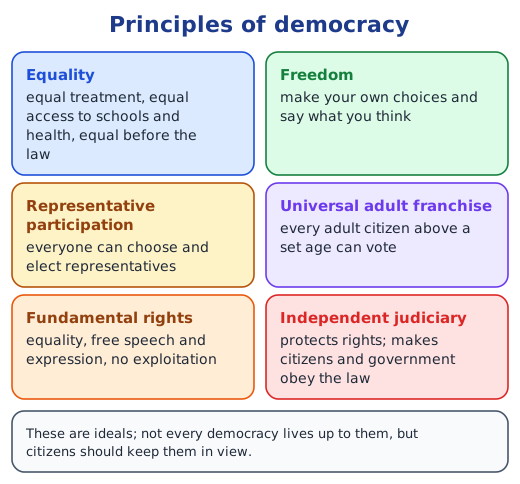
Core principles: equality, freedom, representative participation, universal adult franchise, fundamental rights and an independent judiciary. A plan: (1) decide the committee’s functions, such as timetables, sports, the mid-day meal, assembly speakers and No Bag Day activities; (2) let each class nominate candidates, with simple rules on who can stand; (3) hold a secret ballot in every class, counted openly with a teacher present; (4) let the committee elect a head and assign tasks; (5) review its work each month with students’ suggestions, and hold fresh elections each term.
Think About It (page 199)
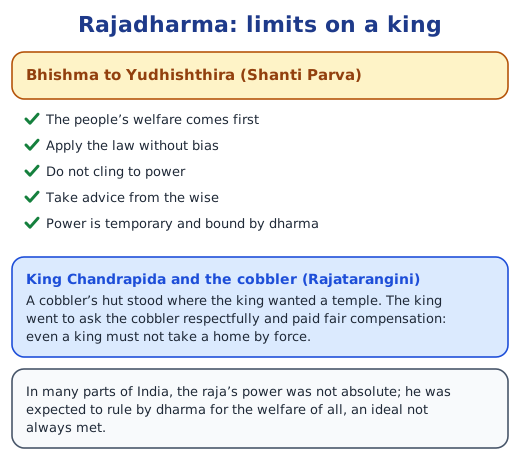
A king who believes he has divine powers. Such a king would see himself as answerable to no one, so he might ignore advice, punish anyone who questioned him, make and change laws at will and put his own interests above the people’s welfare. People would have no lawful way to stop unjust rule.
Let’s Explore (page 204)
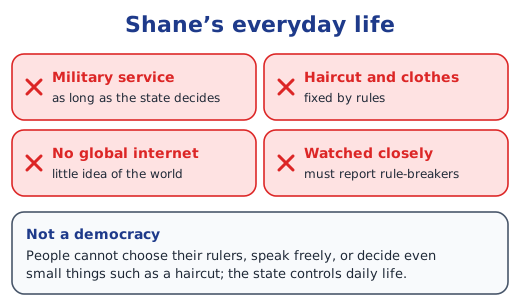
Is Shane’s country a democracy? No: people cannot choose or question their rulers, cannot speak freely or reach the global internet, and are watched all the time. His everyday life is controlled and fearful, with long military service, fixed haircuts and clothes and little knowledge of the world. Would we like to live there? No, because there is no freedom to choose, speak, learn about the world or even decide one’s own haircut, and no way to change the government.
Let’s Explore (page 205)
The 1889 cartoon (Fig. 9.13). Huge money bags labelled as business trusts, such as sugar, steel, copper and oil, tower over the small elected senators. At the top left, the ‘People’s Entrance’ is marked closed, while the entrance for monopolists stands open. So the wealthy trusts, not the people’s representatives, are really making decisions. Can a democracy turn into an oligarchy? Yes, if a few rich or powerful people gain control of elected bodies. People can keep democracy strong by voting thoughtfully, demanding honest representatives, supporting an independent press and independent courts, limiting the power of money in politics and staying informed.
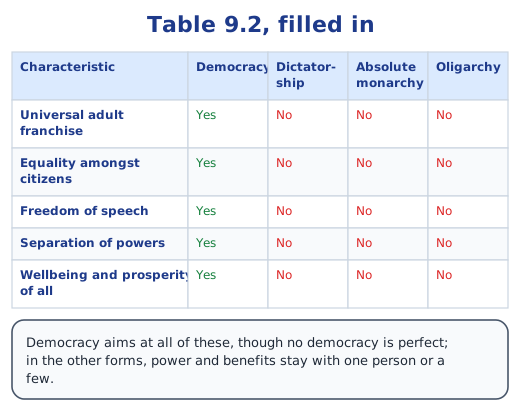
Table 9.2: for equality amongst citizens, freedom of speech, separation of powers, and wellbeing and prosperity of all citizens, the answers are Yes for democracy and No for dictatorship, absolute monarchy and oligarchy.
Let’s Explore (page 206)
Role play. Democracy: the class elects a monitor by secret ballot and votes on a rule. Monarchy: a ‘king’ who inherited the post decides, perhaps with advisers. Dictatorship: one student gives orders and punishes anyone who objects. Most students usually find democracy the most suitable, because everyone has a voice, rules can be questioned and leaders can be changed.
What can we do to stay vigilant (page 207)? As individuals, vote, check facts before believing or sharing news, and refuse to take part in corruption; as a society, support an independent press and independent courts, demand open and accountable government, and make sure institutions are not captured by a few.
Questions and activities (pages 207–208)
1. Democracy (direct and representative; parliamentary and presidential), monarchy (absolute and constitutional), theocracy, dictatorship and oligarchy.
2. India is a parliamentary democracy. It is a democracy because every adult citizen can vote to elect representatives, and parliamentary because the prime minister and council of ministers come from Parliament and stay in office only while they have the Lok Sabha’s confidence.
3. An independent judiciary (i) protects citizens’ fundamental rights, even against the government; (ii) ensures laws apply equally to everyone, including the rich and powerful; and (iii) keeps the legislature and executive within the limits of the Constitution and settles disputes fairly.
4. Yes. In a democracy people choose and can change their government, have equal rights and freedom of speech, power is divided among separate organs so none can misuse it easily, and the government is meant to serve everyone. Other forms keep power with one person or a few, without such checks. Democracy is not perfect, but its problems can be corrected peacefully.
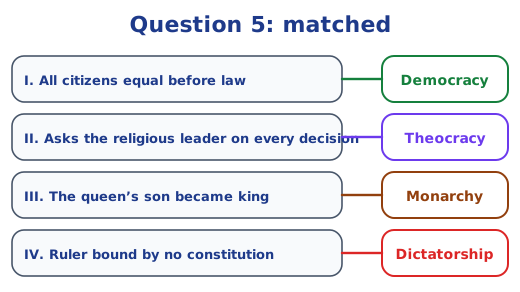
5. I. All citizens equal before law: Democracy. II. Government asks the religious leader on every decision: Theocracy. III. The queen’s son becomes king: Monarchy. IV. Ruler bound by no constitution: Dictatorship.
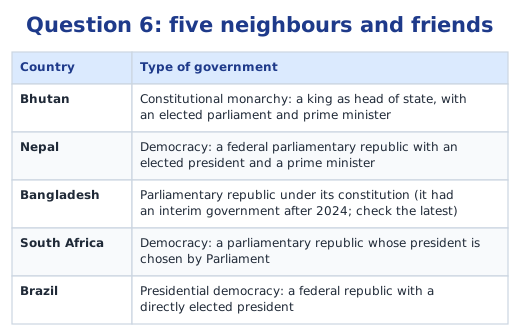
6. Bhutan: a constitutional monarchy with an elected parliament and prime minister. Nepal: a democracy, a federal parliamentary republic. Bangladesh: a parliamentary republic under its constitution (it was run by an interim government after 2024, so check the latest news). South Africa: a democracy, a parliamentary republic whose president is chosen by Parliament. Brazil: a presidential democracy.
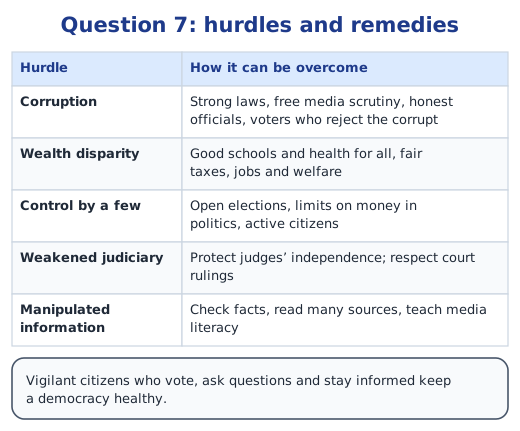
7. Hurdles: corruption, a widening gap between rich and poor, too much power over institutions in a few hands, a judiciary losing its independence, and information that is twisted or controlled. They can be overcome through strong anti-corruption laws and honest officials, good schooling, health care and jobs for all, open elections and limits on money in politics, protection of judges’ independence, fact-checking and media literacy, and alert, informed citizens.
8. In a democracy, the people elect their rulers for a fixed term, can replace them, and enjoy equal rights under a constitution, with power divided among separate organs. In a monarchy, power passes by birth within a royal family; in an absolute monarchy the monarch makes, enforces and judges laws. In a dictatorship, one person or group seizes power and rules without any limit from law or constitution, often suppressing opposition and freedom of speech.
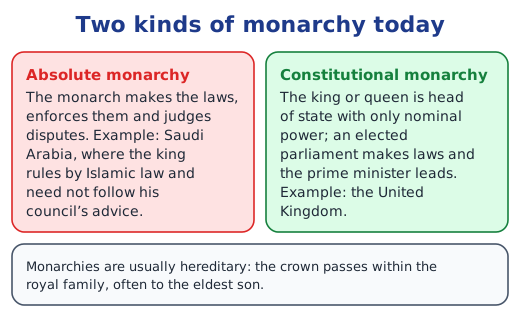
Short notes and more practice are on the topic pages: types of government, why democracy matters and parliamentary and presidential democracy.
Practice
-
Which phrase did Abraham Lincoln use for democracy?
Show answer
Answer: (b) Government of the people, by the people, for the people
-
In which country does the king rule by Islamic law as an absolute monarch?
Show answer
Answer: (b) Saudi Arabia
-
Which form of government is described by ‘the ruler is not bound by any constitution’?
Show answer
Answer: (d) Dictatorship
-
Give three reasons why the judiciary should be independent.
Show answer
Answer: So it can protect citizens’ fundamental rights even against the government; so that laws are applied fairly to everyone, including the powerful; and so that the legislature and executive stay within the limits of the constitution.
-
Why is India called a parliamentary democracy?
Show answer
Answer: Because the people elect Parliament, and the prime minister and council of ministers come from Parliament and stay in office only while they have the Lok Sabha’s confidence.
Stuck on a question?
Take a photo and Lagnever AI explains it step by step. Try it for 7 days for ₹2.
Get it on Google Play Open in browser
For parents: after the trial, the plan renews monthly by UPI or card autopay. You can cancel anytime in the app.