
Why democracy matters
Answer in short
Democracy matters because the people choose their government and can change it at the next election, so it must answer to them. Citizens enjoy equality, freedom of speech and an independent judiciary that protects their rights, and the government is meant to serve everyone. Yet democracies face hurdles such as corruption, wealth gaps and control by a few.
Stuck on a question? Take a photo and Lagnever AI explains it step by step. Try it for 7 days for ₹2. Get it on Google Play
Rule of the people
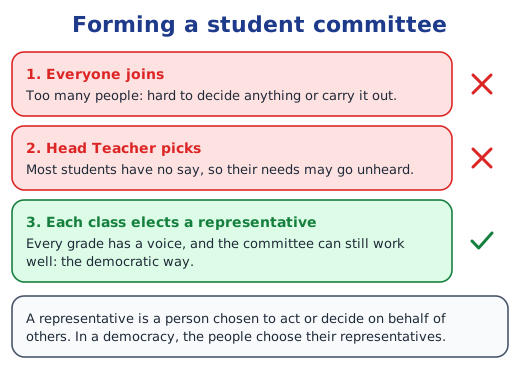
Democracy means rule of the people: power and authority come from the citizens. In the school story, electing one representative from each class gives every grade a say while keeping the committee small enough to work. A country works the same way, and the elected representatives make up its legislature. Abraham Lincoln’s phrase, government of the people, by the people, for the people, is still used to describe it.
Its principles
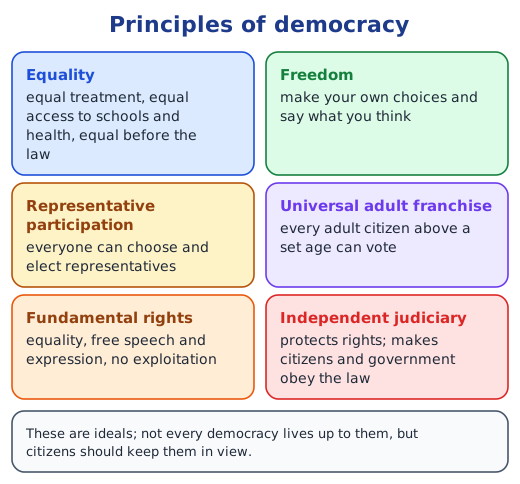
Every democracy rests on some basic principles. Equality means equal treatment, equal access to schools and health care, and equality before the law. Freedom means people can make their own choices and say what they think. Representative participation means everyone can elect representatives, through universal adult franchise, the vote for every adult above a set age. Fundamental rights, such as equality, freedom of speech and protection from exploitation, are protected, and an independent judiciary makes sure citizens and every part of the government obey the law. These are ideals, and not all democracies live up to them.
Rights that grew over time
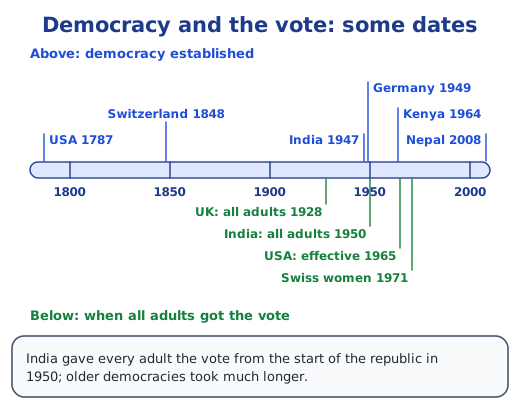
Even these principles took time to arrive. India gave every adult the vote from the start of the republic in 1950, while women in Switzerland voted only from 1971; effective universal suffrage came to the UK in 1928 and to the USA by 1965. Democracy itself began at different times: in the USA in 1787, Switzerland in 1848, India in 1947, Germany in 1949, Kenya in 1964 and Nepal in 2008.
Comparing the forms
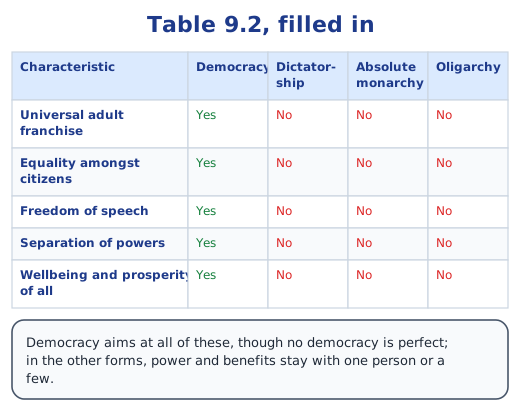
Comparing democracy with dictatorship, absolute monarchy and oligarchy makes the difference plain. Only democracy has universal adult franchise, equality among citizens, freedom of speech, separation of powers and the aim of wellbeing and prosperity for all. In the other forms, power and its benefits stay with one person or a small group.
Freedom with responsibility
In a genuine democracy, people can choose what to say, what to wear, what to believe and how to express themselves, as long as they do not harm anyone else’s rights. The government must protect those rights and provide basic needs, and if it fails, people can change their representatives at the next election. This constant check keeps the government focused on the wellbeing of all. More than half of the world’s countries are now democracies.
Threats to democracy
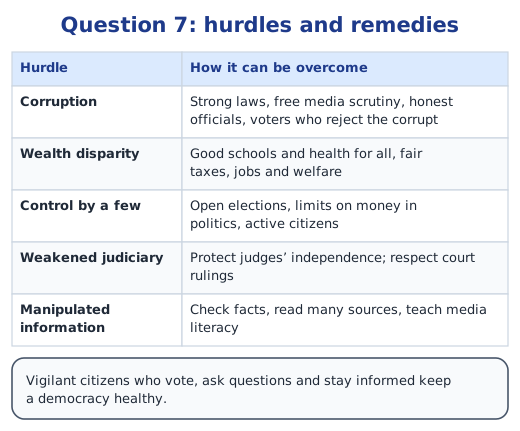
Democracies have problems too: corruption, gaps between rich and poor, too much control by a few over democratic institutions, a weakened judiciary and the manipulation of information. A cartoon from 1889, The Bosses of the Senate, shows the danger: huge money bags labelled as business trusts loom over elected senators, the people’s entrance is marked closed and only the monopolists’ door is open. Strong laws, fair chances for all, honest, open information, independent courts and alert citizens keep such threats in check.
Why it matters
Democracy shapes our daily lives, from what we may say to how our schools and roads are run, so understanding and protecting it is every citizen’s task. The other kinds of government are in types of government, and how democracies differ in parliamentary and presidential democracy. Answers to every question are in the NCERT solutions for Chapter 9; see also the full Chapter 9 notes.
Practice
-
Which is NOT a principle of democracy given in the chapter?
Show answer
Answer: (c) Hereditary rule
-
From when has India given every adult the right to vote?
Show answer
Answer: (c) 1950
-
In Table 9.2, which form of government has separation of powers?
Show answer
Answer: (d) Democracy
-
How can people correct a government that does not do its job?
Show answer
Answer: In a democracy they can vote out their representatives at the next election and choose new ones, which keeps a constant check on the government.
-
Name two hurdles a democracy may face.
Show answer
Answer: Any two of: corruption, wealth disparity, too much control by a few over institutions, erosion of the judiciary’s independence, and manipulation of information.
Questions students ask
What are the principles of democracy?
Equality, so all are treated equally and are equal before the law; freedom to choose and express opinions; representative participation, so everyone can elect representatives; universal adult franchise; fundamental rights such as equality, freedom of speech and protection from exploitation; and an independent judiciary that protects these rights.
Why is democracy better than dictatorship or absolute monarchy?
In a democracy, people choose and can change their rulers, everyone has equal rights and freedom of speech, power is divided among separate organs, and the government is meant to work for all. In a dictatorship or absolute monarchy, one person holds power without check, and citizens have little say or protection.
How can citizens keep democracy strong?
By voting thoughtfully, staying informed from many reliable sources, asking questions of their representatives, rejecting corruption, respecting the courts and the rights of others, and taking part in public life, from school committees to elections.
Stuck on a question?
Take a photo and Lagnever AI explains it step by step. Try it for 7 days for ₹2.
Get it on Google Play Open in browser
For parents: after the trial, the plan renews monthly by UPI or card autopay. You can cancel anytime in the app.