
Types of government
Answer in short
The main types of government are democracy, monarchy, theocracy, dictatorship and oligarchy. They differ in who gives the government its authority, how it is formed, how its parts work and whom it serves. In a democracy power comes from the people; in the others it rests with a king or queen, religious leaders, one ruler or a few.
Stuck on a question? Take a photo and Lagnever AI explains it step by step. Try it for 7 days for ₹2. Get it on Google Play
Why governments differ
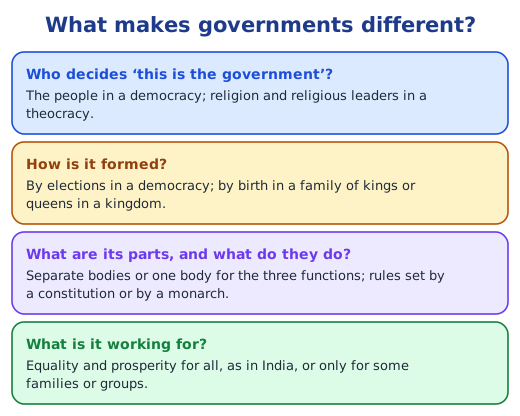
Every country has its own history, culture and hopes, so governments differ and change over time. Four questions help compare them. Where does the government’s authority come from? How is it formed? What are its parts and what does each do? And what is it working for? Democracy, monarchy, theocracy, dictatorship and oligarchy give different answers to each.
Democracy in brief
In a democracy the people are the source of power: they choose representatives, usually through elections, and the government must answer to them. Its rules are usually set down in a constitution, and the legislature, executive and judiciary are often separate. Democracies can be direct or representative, parliamentary or presidential, and the details are in parliamentary and presidential democracy.
Monarchy, then and now
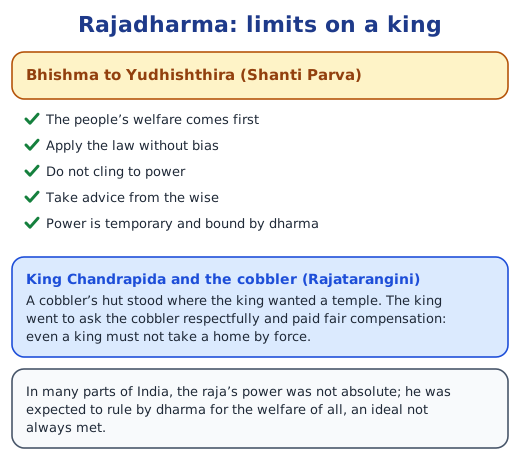
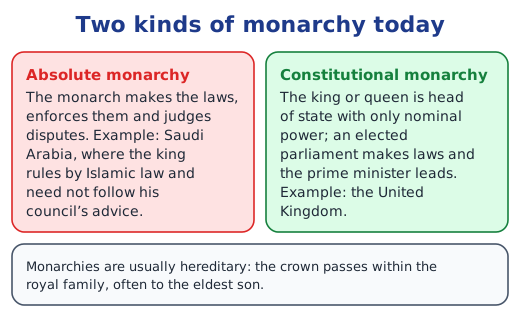
The mahajanapadas of ancient India were headed by kings guided by the sabha or samiti, and even great emperors relied on councils of ministers and officials, often seeking scholars’ advice on dharma. In some parts of the world kings held all power and claimed it came from God, but in much of India the raja was expected to rule within rajadharma, for the welfare of all. In the Mahabharata, Bhishma teaches Yudhishthira that a raja must put his people first, apply the law fairly and remember that power is temporary. Today a monarchy is rule by a hereditary king or queen. In an absolute monarchy, like Saudi Arabia, the monarch makes and enforces the laws and judges disputes. In a constitutional monarchy, like the United Kingdom, the monarch’s power is only nominal and an elected parliament and prime minister govern.
Theocracy, dictatorship and oligarchy
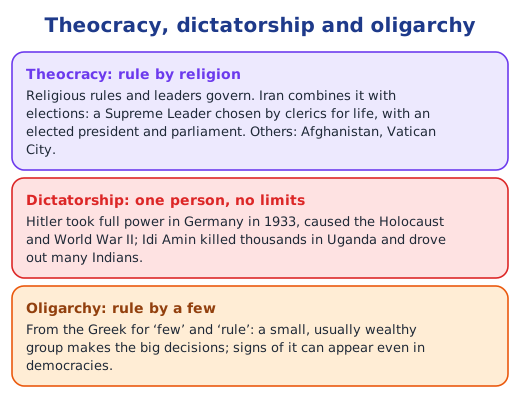
A theocracy is ruled by religious rules and leaders. Iran mixes theocracy with democracy: a Supreme Leader, chosen for life by a group of Islamic clerics, has the final say over all three branches, while an elected president and parliament run daily affairs. Afghanistan and Vatican City are other theocracies. In a dictatorship, one person or a small group holds power without any limit from a constitution or law. Adolf Hitler, made Chancellor of Germany in 1933, gave himself full power, caused the deaths of at least six million Jews in the Holocaust and of hundreds of thousands of Roma and others, and started World War II; Idi Amin killed thousands in Uganda and drove out many people of Indian origin. In an oligarchy, from Greek words meaning ‘few’ and ‘rule’, a small, usually wealthy group makes the big decisions.
Life without a say
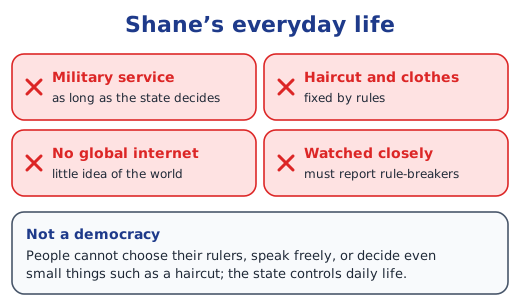
The chapter tells of Shane, who lives in North Korea. He must serve in the army for as long as the government decides, follow rules on his haircut and clothes, live without the global internet and report anyone who breaks the rules. When a tourist asked why everyone had the same haircut, he replied that people would like new styles but the government decides. Such control over daily life shows what it means to live without democracy.
Why it matters
Knowing the types of government helps us see how much our everyday freedoms depend on how our country is governed. Why democracy is valued, and what threatens it, is in why democracy matters. Answers to every question are in the NCERT solutions for Chapter 9; see also the full Chapter 9 notes.
Practice
-
Which country is given in the chapter as an absolute monarchy?
Show answer
Answer: (b) Saudi Arabia
-
Who chooses Iran’s Supreme Leader?
Show answer
Answer: (c) A group of Islamic clerics
-
What does the Greek word olígos mean?
Show answer
Answer: (c) Few
-
Why is Hitler’s Germany called a dictatorship?
Show answer
Answer: After becoming Chancellor in 1933, Hitler passed laws giving himself full power and removed the opposition, so he ruled with no limits from any constitution or law.
-
How was the power of the raja limited in many parts of India?
Show answer
Answer: Kings were expected to rule by rajadharma, according to dharma and for everyone’s welfare, to take advice from a council of ministers and wise scholars, and in early times to heed the sabha or samiti.
Questions students ask
What is the difference between absolute and constitutional monarchy?
In an absolute monarchy, such as Saudi Arabia, the monarch makes the laws, enforces them and judges disputes, and need not follow any council’s advice. In a constitutional monarchy, such as the United Kingdom, the king or queen is head of state with only nominal power, while an elected parliament makes laws and a prime minister leads the government.
What is a theocracy?
A theocracy is a government run according to religious rules and by religious leaders. Iran combines theocracy with elections: a Supreme Leader chosen for life by Islamic clerics has final authority, while an elected president and parliament handle daily governance. Afghanistan and Vatican City are other theocracies.
What is an oligarchy?
An oligarchy is rule by a few: a small, powerful group, usually wealthy families or influential people, makes the important decisions. Some ancient Greek states were oligarchies, and commentators warn that even democracies can show signs of oligarchy when a few politicians and businesspeople gain too much influence.
Stuck on a question?
Take a photo and Lagnever AI explains it step by step. Try it for 7 days for ₹2.
Get it on Google Play Open in browser
For parents: after the trial, the plan renews monthly by UPI or card autopay. You can cancel anytime in the app.