
Parliamentary and presidential democracy
Answer in short
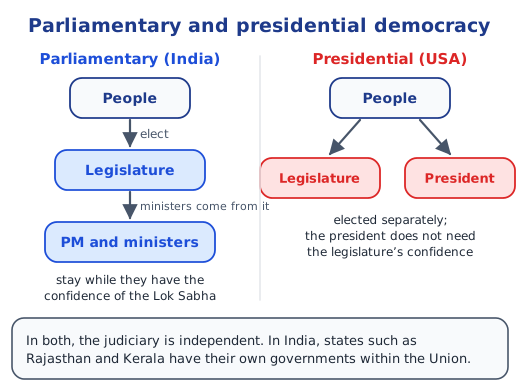
In a parliamentary democracy, like India, people elect the legislature and the prime minister and ministers come from it, staying in office while they keep the Lok Sabha’s confidence. In a presidential democracy, like the USA, the president is elected separately and does not need the legislature’s support. Both are representative democracies with independent courts.
Stuck on a question? Take a photo and Lagnever AI explains it step by step. Try it for 7 days for ₹2. Get it on Google Play
Direct and representative democracy
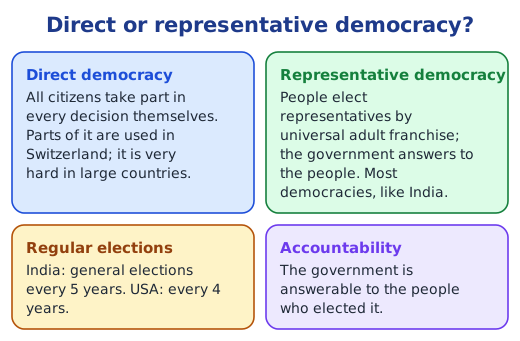
In a direct democracy, all citizens take part in every rule and decision themselves. Some forms of it are used in Switzerland, but it is very hard to run in a large country, just as a committee of the whole school would struggle to decide anything. In a representative democracy, people elect representatives through universal adult franchise; they do not govern directly, but the government is always accountable to them. Elections come at fixed intervals so that people can change their choices: every five years in India and every four years in the USA. Most democracies today are representative.
Parliamentary democracy
India is a parliamentary democracy. Voters choose the legislature; the executive is not elected directly, because chosen members of the legislature become ministers. The prime minister and council of ministers are members of Parliament and answer to it, continuing in office for as long as the Lok Sabha supports them. Australia also has a prime minister and council of ministers. Within India, states such as Rajasthan and Kerala have their own governments, but these work within the larger Union Government.
Presidential democracy
In a presidential democracy, the executive stands apart from the legislature: voters elect the president directly, and the president can stay in office without the legislature’s backing. The USA and South Korea are examples. In both kinds, the judiciary is independent of the executive and the legislature.
Comparing democracies
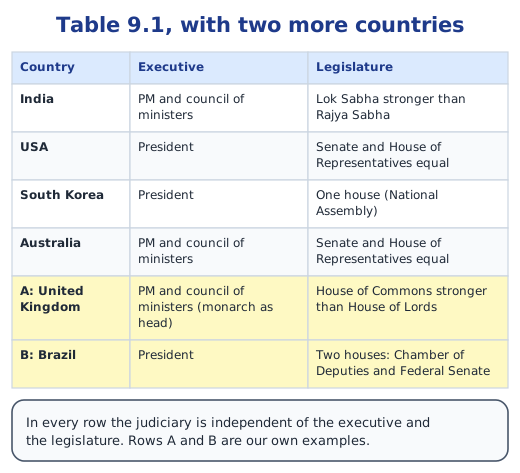
The executive is the organ that implements laws; the legislature makes them and is called Parliament in India and Congress in the USA. Most legislatures have two Houses. The Lower House is usually directly elected and more powerful, while the Upper House is elected or nominated: in India the Lok Sabha is stronger than the Rajya Sabha, but in the USA and Australia the two Houses have equal power, and South Korea has a single House, the National Assembly. Separation of powers means each of the three organs does its own job without stepping into the others’ work. Despite such differences, equality, freedom and universal adult franchise are common to all democracies.
Democracies keep changing
Democracies did not start out with every principle we know today, and they still differ in how they work. When some countries became democracies, not every adult could vote: effective universal suffrage came to the UK only in 1928 and to the USA by 1965, while women in Switzerland voted only from 1971. India gave the vote to every adult from the first day of the republic in 1950. The way a country elects its leaders, the number and powers of its Houses and the links between its organs all grow out of its own history, so no two democracies are exactly alike, even though all of them rest on the people’s choice.
Why it matters
Knowing how our parliamentary system works helps us understand why the Lok Sabha matters, how ministers are chosen and how our votes shape the government. Other forms of government are in types of government, and the case for democracy in why democracy matters. Answers to every question are in the NCERT solutions for Chapter 9; see also the full Chapter 9 notes.
Practice
-
How often are general elections held in India?
Show answer
Answer: (c) Every 5 years
-
What is India’s legislature called?
Show answer
Answer: (b) Parliament
-
Which country in Table 9.1 has a single-house legislature?
Show answer
Answer: (c) South Korea
-
What does separation of powers mean?
Show answer
Answer: Each of the three organs, the legislature, the executive and the judiciary, does its own job without stepping into the work of the others.
-
Why is direct democracy hard to run in a large country?
Show answer
Answer: Because every citizen would have to take part in every decision, which, as in the school story where everyone joins the committee, makes deciding and carrying out tasks very difficult.
Questions students ask
What is the difference between parliamentary and presidential democracy?
In a parliamentary democracy the executive is part of the legislature: in India the prime minister and council of ministers are members of Parliament and stay while they have the Lok Sabha’s confidence. In a presidential democracy the executive is separate: in the USA the president is elected by the people and does not need the legislature’s confidence.
What is representative democracy?
It is democracy in which people do not govern directly but elect representatives through universal adult franchise, as in India. The government stays accountable to the people, and regular elections, every five years in India and every four in the USA, let people change their choices.
What are the two Houses of Parliament in India?
The Lok Sabha is the Lower House, directly elected and more powerful; the Rajya Sabha is the Upper House. Most legislatures have two Houses, called by different names: in the USA, the House of Representatives and the Senate, which have equal power.
Stuck on a question?
Take a photo and Lagnever AI explains it step by step. Try it for 7 days for ₹2.
Get it on Google Play Open in browser
For parents: after the trial, the plan renews monthly by UPI or card autopay. You can cancel anytime in the app.