
Class 6 Social Science Chapter 10: Grassroots Democracy — Part 1: Governance Notes
This chapter in five lines
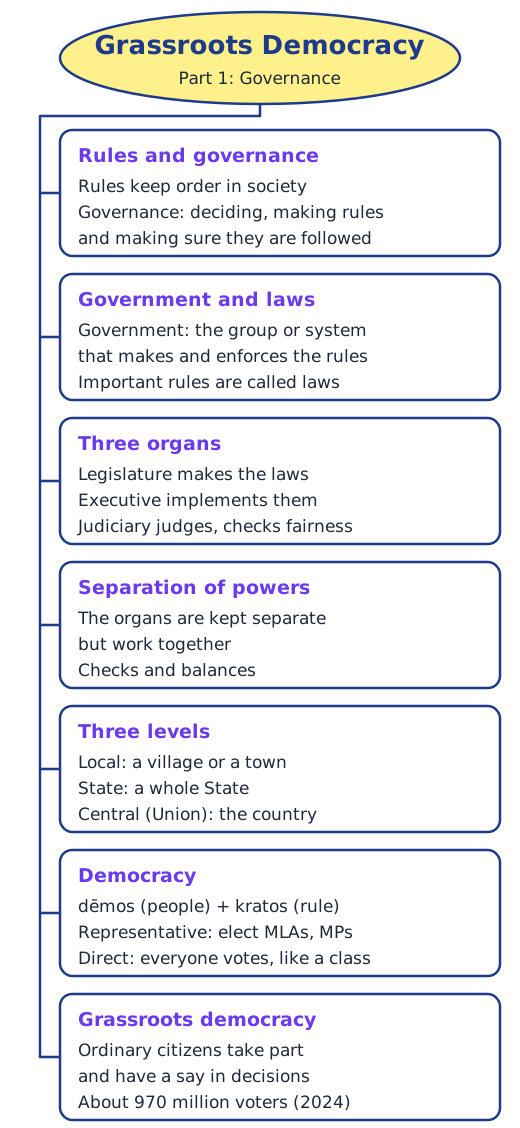
Governance is the process of taking decisions, organising the life of a society with rules, and making sure the rules are followed. The group of people or the system that does this is the government, and its more important rules are called laws. A government has three organs: the legislature makes laws, the executive implements them and the judiciary judges. In India it works at three levels: local, State and Central. Democracy means rule of the people, through elected representatives such as MLAs and MPs.
Why do we need rules?
People have lived in communities for a very long time, and when many people live together there can be disagreements and disorder. Rules keep order and harmony. There are rules at home, at school, in examinations, on the road and at work, where employers also follow the rules they have promised their employees. Picture two road crossings: at one, there are traffic lights, zebra crossings and footpaths, and everyone keeps to them; at the other, cars, cycles and people go every which way. Without rules, society simply could not function.
What are governance and government?
The process of taking decisions, organising society’s life with different sets of rules, and making sure the rules are followed is called governance. The group of individuals, or the system, that makes the rules and makes sure they are followed is the government. Its more important rules are called laws. Laws are not fixed forever: citizens have a say in them, just as students might ask their school to change a rule.
What does the government do for us?
The government plays a part in almost every corner of daily life. It builds roads and runs the railways, guards the borders, runs hospitals, sends fire and rescue teams when disaster strikes, controls traffic, runs courts and schools, delivers the post and oversees banking. Look around and you will find it in electricity, water, buses and much more.
The three organs of government
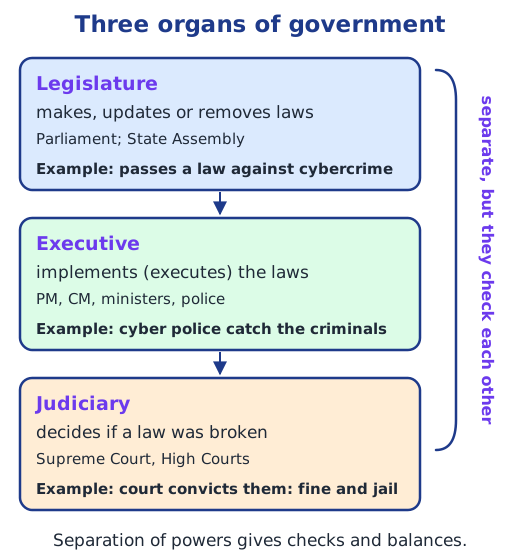
Digital money transfers have replaced money orders and demand drafts, but they have also produced cybercriminals who steal money without leaving their desks. Governments passed new laws against cybercrime, the cyber police caught some of the criminals, and courts convicted them, usually with a fine and some years in jail. This shows the three organs at work:
- The legislature makes new laws, and updates or removes old ones. It is an assembly of representatives of the people.
- The executive implements, or executes, the laws. It includes the head of the government (a president, a prime minister or a chief minister), the ministers and agencies that enforce law and order, such as the police.
- The judiciary is the system of courts. It decides whether someone has broken the law and what should follow, including punishment, and it can check whether an executive decision or a law is fair to all.
In a system of good governance, the three organs are kept separate, although they work together. This separation of powers creates checks and balances: each organ can check the others and restore balance if one goes beyond its role. More in three organs of government.
The three levels of government
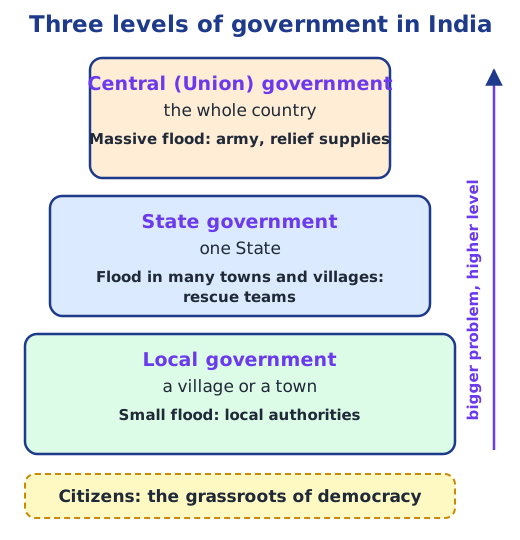
Any democratic government works at more than one level, and India, like many countries, has three: local government for a town or village, the State government, and the Central or Union government. Each level deals with different matters. If a bulb at home does not light, you first check the bulb and the switch, then call an electrician, and only then complain to the Electricity Board. In the same way, a small flood is handled by local authorities, a flood across several towns and villages brings State rescue teams, and a massive flood may bring the army and relief supplies from the Centre. More in levels of government in India.
The national and State governments
| Organ | National level | State level |
|---|---|---|
| Judiciary | Supreme Court of India | High Court |
| Legislature | Lok Sabha and Rajya Sabha | Vidhan Sabha (a few States have two houses) |
| Executive | President (nominal head), Prime Minister (executive head) | Governor (nominal head), Chief Minister (executive head) |
The President is also the Supreme Commander of the Indian Armed Forces. The Central government looks after matters such as defence, foreign affairs, atomic energy, communications, currency, trade between States, education and national policies. A State government looks after police and law and order, carries out Central laws in the State, and handles public health, education, agriculture, irrigation and local government. Education appears in both lists.
What is democracy?
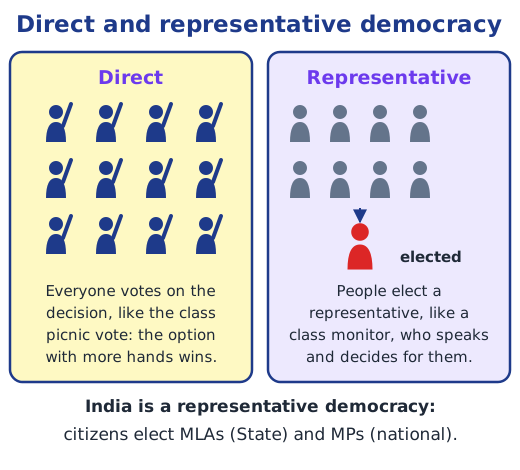
The word democracy comes from the Greek dēmos, ‘people’, and kratos, ‘rule’ or ‘power’, so it means ‘rule of the people’. All the people cannot rule at once, just as a whole class cannot go to the principal with a problem. A class sends its monitor; citizens elect representatives: Members of Legislative Assembly (MLAs) in the States and Members of Parliament (MPs) at the national level. They discuss laws and problems and try to convince each other through dialogue and debate. India is such a representative democracy, and the world’s largest, with some 970 million voters in 2024. Indian citizens aged 18 or more have the right to vote.
When a class chooses a picnic place by a show of hands, every student votes directly: that is direct democracy. Grassroots democracy means a system that enables and encourages ordinary citizens, the base of the whole structure, to take part and have a say in decisions that affect them.
Mottos and a President who inspired
The Government of India’s motto is Satyameva Jayate, ‘Truth alone triumphs’, and the Supreme Court’s is Yato Dharmastato Jayah, ‘Where there is dharma, there is victory’. Dr A.P.J. Abdul Kalam, the ‘Missile Man of India’ born in Rameswaram in 1931, was the 11th President of India from 2002 to 2007. Though the President is a nominal head, he inspired millions of young people to dream big and work hard. Answers to every question in the chapter are in the NCERT solutions for Chapter 10.
Key terms
| Term | Meaning |
|---|---|
| Governance | The process of taking decisions, organising society's life with rules, and making sure the rules are followed. |
| Government | The group of individuals or the system that makes the rules and makes sure they are followed. |
| Law | One of the more important rules made by the government for the whole society. |
| Legislature | The organ of government that makes new laws, and updates or removes old ones. It is an assembly of the people's representatives. |
| Executive | The organ that implements, or executes, the laws: the head of the government, the ministers and agencies such as the police. |
| Judiciary | The system of courts. It decides whether someone has broken the law and what should follow, and checks whether decisions and laws are fair. |
| Separation of powers | Keeping the three organs separate, although they work together, so that each can check the others. |
| Checks and balances | Each organ can check what the others do and restore balance if one acts beyond its role. |
| Levels (tiers) of government | In India: local government for a village or town, the State government, and the Central or Union government for the whole country. |
| Democracy | ‘Rule of the people’, from the Greek words dēmos (people) and kratos (rule or power). |
| Representative democracy | A democracy in which citizens elect representatives, such as MLAs and MPs, who discuss and decide on their behalf. |
| Grassroots democracy | A system that enables and encourages ordinary citizens to take part and have a say in decisions that affect them. |
| Nominal head | A head in name only. The President of India and the Governor of a State are not the actual executive heads, though they have powers in special situations. |
Topics in this chapter
Practice
-
Which organ of government makes laws?
Show answer
Answer: (b) The legislature
-
The Supreme Court of India is part of the:
Show answer
Answer: (c) judiciary
-
Who is the executive head of a State government?
Show answer
Answer: (b) The Chief Minister The Governor is the nominal head of a State; the Chief Minister is its executive head.
-
The word ‘democracy’ comes from Greek words that together mean:
Show answer
Answer: (b) rule of the people
-
A massive flood affects vast areas. Which level of government may also step in with the army and relief supplies?
Show answer
Answer: (c) The Central government Small floods can be handled locally and bigger ones by the State, but a massive flood can bring help from the Central government too.
Questions students ask
What are the main topics of Class 6 SST Chapter 10?
Why rules are needed, the meaning of governance and government, what the government does for us, the three organs of government and the separation of powers, the three levels of government, the national and State governments, and the meaning of democracy, representative democracy, direct democracy and grassroots democracy.
Is Grassroots Democracy — Part 1: Governance in the new Exploring Society book?
Yes. It is Chapter 10 of Exploring Society: India and Beyond, the Class 6 Social Science textbook used in the 2026-27 session. Chapters 11 and 12 continue with local government in rural and urban areas.
How many end-of-chapter questions does Chapter 10 have?
The “Questions, activities and projects” section has 4 items, including a project on the COVID-19 lockdown. Our NCERT solutions page answers them, along with the Big Questions and every Let's Explore activity.
Stuck on a question?
Take a photo and Lagnever AI explains it step by step. Try it for 7 days for ₹2.
Get it on Google Play Open in browser
For parents: after the trial, the plan renews monthly by UPI or card autopay. You can cancel anytime in the app.