
What are the three organs of government?
Answer in short
A government has three organs. The legislature makes laws and can update or remove them. The executive, led by the head of the government with ministers and agencies like the police, implements the laws. The judiciary, the system of courts, decides whether a law has been broken and what should follow. Keeping them separate gives checks and balances.
Stuck on a question? Take a photo and Lagnever AI explains it step by step. Try it for 7 days for ₹2. Get it on Google Play
A modern example: cybercrime
Until about 30 years ago, sending money to a relative far away meant queuing at the post office to fill in a money order form, and paying a business meant getting a demand draft from the bank and posting it. Today money moves instantly by digital means. But this has also created a new kind of criminal, who steals people’s hard-earned money digitally without even leaving the desk. Such crimes are called cybercrime.
Many governments passed new laws to fight cybercrime. Some cybercriminals have been arrested, and courts have convicted them; they are usually fined and jailed for some years. Three different parts of the government acted in this story. These are the three branches, or organs, of government.
The legislature: making laws
The legislature makes new laws, which is called ‘legislating’. Sometimes it updates or removes existing laws. It is an assembly of representatives of the people. In India:
- at the national level, two houses, the Lok Sabha and the Rajya Sabha, make national laws;
- in a State, the State Assembly or Vidhan Sabha makes laws. Most States have a single assembly; a few have two.
A house is an assembly where laws are discussed or passed. In the cybercrime story, the legislature passed the new laws against cybercrime.
The executive: carrying out laws
The executive implements, or ‘executes’, the laws. It includes the head of the government, who may be a president, a prime minister or a chief minister, the ministers, and agencies that enforce law and order. In the cybercrime story, that agency is the cyber police.
In India, the Central executive is led by the President of India, the nominal head and Supreme Commander of the Indian Armed Forces, with the Prime Minister as the executive head. A State’s executive is led by the Governor, its nominal head, with the Chief Minister as the executive head. Nominal means ‘in name only’: the President and the Governors have certain powers in special situations, but normally do not interfere in the work of the government.
The judiciary: judging and checking
The judiciary is the system of courts. It decides whether someone has broken the law and, if so, what should be done, including punishment if necessary. Sometimes it also examines whether a decision of the executive is right, or whether a law passed by the legislature is well thought out and fair to all. The Supreme Court of India is the highest court for the whole country, and each State has a High Court. In the cybercrime story, the courts convicted the criminals.
How the three organs work together
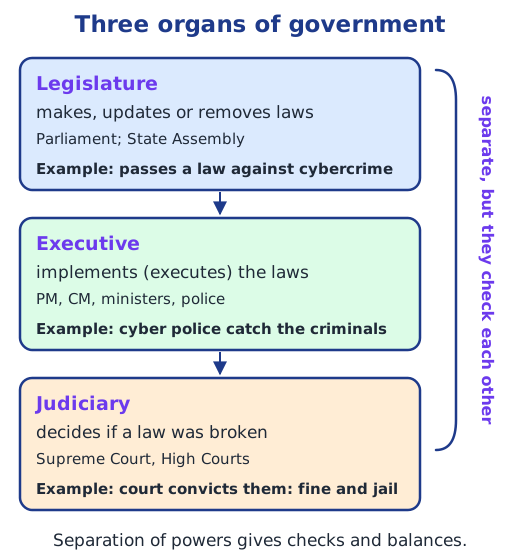
Each organ steps in at a different stage. The legislature makes the law, the executive enforces it, and the judiciary decides each case under the law.
Separation of powers
In a system of good governance, the three organs must be kept separate, although they interact and work together. This is called the separation of powers. It gives a system of checks and balances: each organ can check what the others are doing and restore balance if one acts beyond its expected role.
Think of a game in which one player makes the rules, plays the game and is also the referee. That player could change the rules to win and then declare every decision in their own favour. The same danger exists if one group controls all three organs of a government: it could make unfair laws, enforce them as it liked and judge its own cases. Separate organs prevent this.
The three organs at two levels
| Organ | National level | State level |
|---|---|---|
| Legislature | Lok Sabha and Rajya Sabha | Vidhan Sabha (a few States have two houses) |
| Executive | President (nominal head) and Prime Minister (executive head) | Governor (nominal head) and Chief Minister (executive head) |
| Judiciary | Supreme Court of India | High Court |
The government also works at three levels: local, State and Central. Read more in levels of government in India.
Practice
-
The cyber police who arrest cybercriminals belong to the:
Show answer
Answer: (b) executive
-
Which organ decides whether someone has broken the law?
Show answer
Answer: (c) The judiciary
-
The Lok Sabha and the Rajya Sabha are the two houses of the:
Show answer
Answer: (a) national legislature
-
What is meant by the separation of powers?
Show answer
Answer: Keeping the three organs separate, though they work together, so that each can check what the others do and restore balance if one goes beyond its role. This is called a system of checks and balances.
-
Name the executive head at the national level and in a State.
Show answer
Answer: The Prime Minister at the national level and the Chief Minister in a State. The President and the Governor are nominal heads.
Questions students ask
What are the three organs of government?
The legislature, which makes laws; the executive, which implements them; and the judiciary, the system of courts, which decides when a law has been broken and checks that decisions and laws are fair.
What is the separation of powers?
It means keeping the legislature, the executive and the judiciary separate, although they interact and work together. Each can then check the others, which is called checks and balances.
Is the President part of the executive?
Yes. The President of India leads the Central executive as its nominal head and is the Supreme Commander of the Indian Armed Forces, while the Prime Minister is the executive head.
Why should the three organs not be controlled by the same people?
Then one group could make unfair laws, enforce them as it liked and judge its own cases, and no one could stop it. Keeping the organs separate protects the people from such misuse of power.
Stuck on a question?
Take a photo and Lagnever AI explains it step by step. Try it for 7 days for ₹2.
Get it on Google Play Open in browser
For parents: after the trial, the plan renews monthly by UPI or card autopay. You can cancel anytime in the app.