
What are the three levels of government in India?
Answer in short
India's government works at three levels. Local government looks after a village or a town, the State government after a whole State, and the Central or Union government after the whole country. Each level deals with different matters: a small flood is handled locally, a bigger one by the State, and a massive one with help from the Centre.
Stuck on a question? Take a photo and Lagnever AI explains it step by step. Try it for 7 days for ₹2. Get it on Google Play
Many levels, and three in India
Any democratic government works at more than one level: a local level, close to the people, a national level, for the whole country, and in many countries a level in between. In many countries, including India, the government works at three levels, or tiers: local, State or regional, and national. In India these are:
- Local government, at the level of a village or a town;
- State government, at the level of a State;
- Central or Union government, at the national level.
Each level deals with different matters, so each problem goes to the level that can deal with it.
The bulb example
Suppose a bulb in your home does not light up. First you check the bulb, the switch and the fuse yourself. If that does not work, you call an electrician. If the electrician finds the problem is not inside your home at all, you go to the Electricity Board and file a complaint. These are three levels of dealing with one problem: you move up a level only when the level below cannot fix it.
The flood example
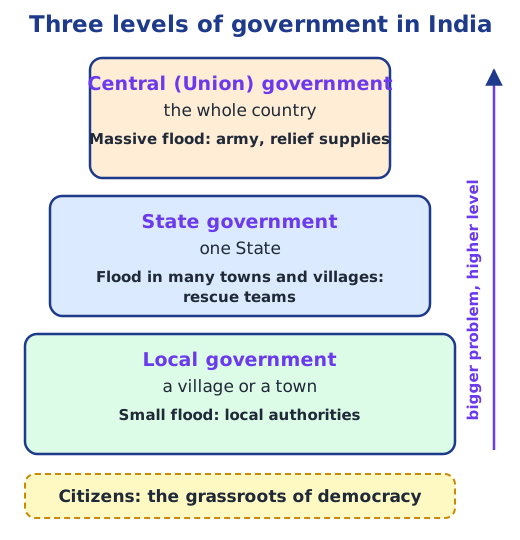
Imagine that after several days of heavy rain, part of a district is flooded.
- If the flood is not too severe, the local authorities may be able to deal with it.
- If it affects several towns and many villages, the State government steps in and sends rescue teams to help the people affected.
- If it is a massive flood covering vast areas, the Central government may also help, by sending relief supplies, the army and so on.
The three levels work together, each joining in when the problem grows beyond the one below.
Who leads each level, and what does it do?
| Level | Who leads it | Some of its work |
|---|---|---|
| Central government | President (nominal head) and Prime Minister (executive head) | Defence, foreign affairs, atomic energy, communications, currency, trade between States, education, national policies |
| State government | Governor (nominal head) and Chief Minister (executive head) | Police and law and order, carrying out Central laws in the State, public health, education, agriculture, irrigation, local government |
| Local government | Elected bodies of the village or town | Matters close to home, studied in the next two chapters |
Nominal means ‘in name only’. The President of India and the Governor of a State are not the actual executive heads. They have certain powers in special situations, but normally they do not interfere in the work of the Central or State government. The President is also the Supreme Commander of the Indian Armed Forces.
Notice that education is in both the Central and the State lists: the two levels share the work.
Each level has its own lawmakers and courts
The levels are not only about the executive. At the national level, laws are made by two houses, the Lok Sabha and the Rajya Sabha; in a State, by the Vidhan Sabha (most States have a single assembly, and a few have two). The Supreme Court of India is the court for the whole country, and each State has a High Court.
Where you meet each level
Ask two or three adults when they deal with the government, and at which level. Their answers will show all three levels in daily life. (Extra: for example, a birth certificate is registered by the local body, a driving licence comes from the State transport department, and a passport is issued by the Central government.)
The grassroots
Below all three levels are the citizens themselves. Grassroots democracy means a system that enables and encourages ordinary citizens, the base of the structure, to take part and have a say in the decisions that affect them. Local government is where this begins, and it is studied next in the book. To see how each government is organised inside, read three organs of government.
Practice
-
Which of these is not one of the three levels of government in India?
Show answer
Answer: (d) School management
-
Police and law and order are mainly the work of the:
Show answer
Answer: (b) State government
-
Defence and currency are looked after by the:
Show answer
Answer: (c) Central government
-
A street light in your village has stopped working. Which level of government would you go to first, and why?
Show answer
Answer: The local government, because it looks after matters close to home in a village or a town. A problem goes to the State or the Centre only when it is bigger than the local level can handle.
-
How is the bulb example like the three levels of government?
Show answer
Answer: If a bulb does not light, you first check the bulb, switch and fuse yourself, then call an electrician, and if the fault is outside your home you complain to the Electricity Board. A problem moves up a level only when the lower level cannot solve it, just as with local, State and Central governments.
Questions students ask
What are the three levels of government in India?
Local government for a village or a town, the State government for each State, and the Central or Union government for the whole country.
Why do we need three levels of government?
Each level deals with different matters. Local problems are handled close to the people they affect, State matters such as police and agriculture by the State, and national matters such as defence and currency by the Centre. A very big problem, like a massive flood, can get help from all three.
Who heads the Central and State governments?
The President of India is the nominal head of the Central government and the Prime Minister is its executive head. In a State, the Governor is the nominal head and the Chief Minister is the executive head.
Is local government explained in this chapter?
Only briefly. The next two chapters of the book study local government in villages and in towns and cities in detail.
Stuck on a question?
Take a photo and Lagnever AI explains it step by step. Try it for 7 days for ₹2.
Get it on Google Play Open in browser
For parents: after the trial, the plan renews monthly by UPI or card autopay. You can cancel anytime in the app.