
How are the Union and state governments organised?
Answer in short
India has one government for the whole country, the Union, and one for each state, each with its own legislature and executive. Parliament makes laws on the Union List, state legislatures on the State List, and both on the Concurrent List. In a state, the Governor is the nominal head and the Chief Minister leads the government.
Stuck on a question? Take a photo and Lagnever AI explains it step by step. Try it for 7 days for ₹2. Get it on Google Play
Do states have their own legislature and executive?
Yes. The Union has Parliament, with its law-making and executive sides, and every state has its own legislature and executive too. In Parliament, Members of Parliament (MPs) make laws for the country. In a state, Members of Legislative Assembly (MLAs) make laws on the subjects that the Constitution gives to the states, and on subjects that the states share with the Union.
Who makes laws on which subjects?
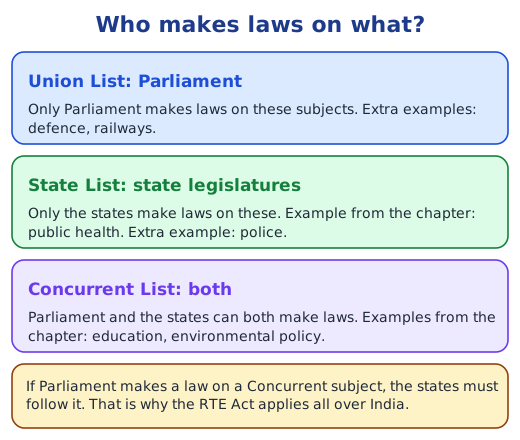
The Constitution sorts subjects into three lists, so that it is clear who can make laws on what:
- Union List: only Parliament makes laws on these. Extra examples: defence and railways.
- State List: only the state legislatures make laws on these. The chapter’s own example is public health; Extra example: police.
- Concurrent List: both can make laws. The chapter names education and environmental policy.
If Parliament makes a law on a Concurrent subject, the states are bound by it. That is why the RTE Act applies everywhere in India, even though education is a Concurrent subject. The chapter calls this sharing the interdependent nature of federalism.
How is a state government like the Union government?
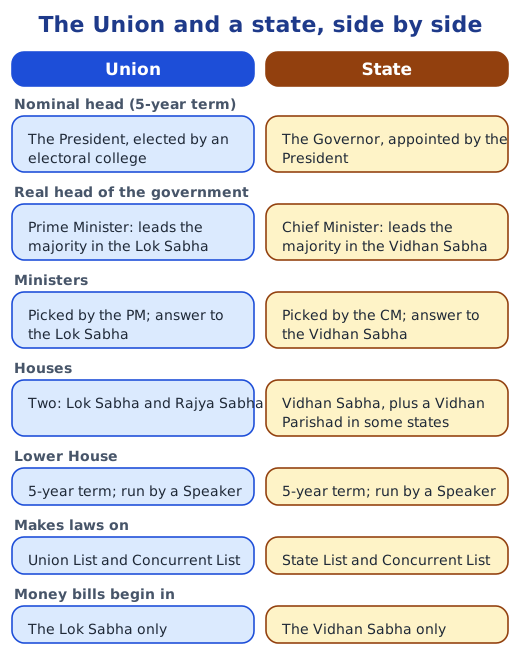
The states follow the Union’s pattern closely. Compare them piece by piece:
- Nominal head: the President, elected by an electoral college, for the Union; the Governor, appointed by the President, for a state. Both serve five-year terms.
- Real head of the government: the Prime Minister for the Union; the Chief Minister for a state. Each leads the party or coalition with a majority in the lower House.
- Ministers: selected by the Prime Minister or the Chief Minister, and collectively responsible to the Lok Sabha or the Vidhan Sabha.
- Lower House: the Lok Sabha or the Vidhan Sabha (Legislative Assembly), each with a five-year term and run by a Speaker.
- Upper House: the Rajya Sabha for the Union; a Vidhan Parishad (Legislative Council) in only some states.
- Laws: Parliament covers the Union and Concurrent Lists; a state covers the State and Concurrent Lists.
- Money: money bills start only in the Lok Sabha, or only in the Vidhan Sabha.
Which states have two Houses?
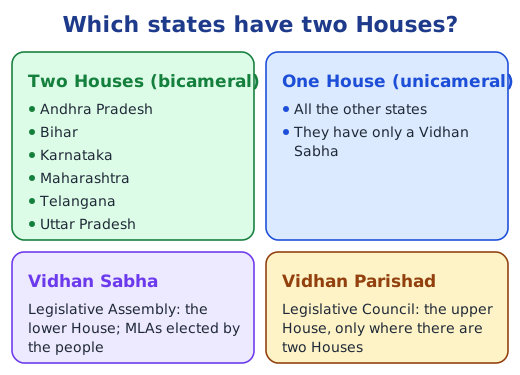
Parliament always has two Houses, but a state legislature can have one (unicameral) or two (bicameral). According to the chapter, six states are bicameral: Andhra Pradesh, Bihar, Karnataka, Maharashtra, Telangana and Uttar Pradesh. Every other state has only a Vidhan Sabha. In Karnataka, the legislature meets in the Vidhana Soudha, a building planned by Kengal Hanumanthaiah, a freedom fighter and later Chief Minister.
How often do Parliament and the assemblies meet?
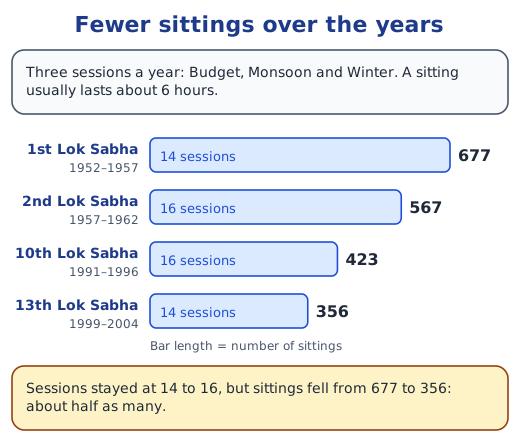
Parliament usually meets three times a year, in the Budget, Monsoon and Winter Sessions. Each session has sittings, usually about 6 hours long, which can be extended for urgent work. The state assemblies follow similar schedules. The chapter’s table shows a worrying trend: the 1st Lok Sabha (1952–1957) had 677 sittings, but the 13th (1999–2004) had only 356, though both had 14 sessions.
What problems do legislatures face?
Parliament and the assemblies are meant to be places for careful debate. The chapter names problems that get in the way: members who are often absent, uncooperative conduct, debates of poorer quality and a disrupted Question Hour. When sessions are cut short, some bills wait years to be discussed. The answer it offers is engaged citizens: stay informed, take part in public discussions, including the online consultations that government departments hold, and talk constructively with your MP and MLA.
Read on: What is India’s parliamentary system?, How does a bill become a law?, the chapter notes and the NCERT solutions.
Practice
-
Who is the de facto executive authority of a state?
Show answer
Answer: (b) The Chief Minister
-
On which list can both Parliament and the state legislatures make laws?
Show answer
Answer: (c) The Concurrent List
-
Which of these states has a bicameral legislature?
Show answer
Answer: (b) Bihar
-
The RTE Act applies all over India. Why, if education is not on the Union List?
Show answer
Answer: Education is on the Concurrent List, so both the Union and the states can make laws on it. When Parliament makes a law on a Concurrent subject, the states must follow it.
-
Name Parliament’s three sessions, and say how long a sitting usually lasts.
Show answer
Answer: The Budget, Monsoon and Winter Sessions. A sitting usually lasts about 6 hours, and can be extended for urgent business.
Questions students ask
What is the Vidhan Parishad?
It is the Legislative Council, the upper House of a state legislature. Only states with a bicameral legislature have one, and the chapter names six such states.
Who becomes Chief Minister?
Whoever leads the party or coalition with a majority in the Vidhan Sabha, just as the leader of the Lok Sabha majority becomes Prime Minister. The Chief Minister then selects the Council of Ministers. Extra: the Governor formally appoints the Chief Minister.
What is the Vidhana Soudha?
The building that houses Karnataka’s legislature. The chapter says it was the vision of Kengal Hanumanthaiah, a freedom fighter and member of the Constituent Assembly who became Chief Minister of Karnataka and later an MP.
Why do the Union and the states share some subjects?
Some matters, such as education and environmental policy, need the Union and the states to work together. The chapter calls this the interdependent nature of federalism: the Union can set common rules, and each state knows its own needs.
Stuck on a question?
Take a photo and Lagnever AI explains it step by step. Try it for 7 days for ₹2.
Get it on Google Play Open in browser
For parents: after the trial, the plan renews monthly by UPI or card autopay. You can cancel anytime in the app.