
NCERT Solutions Class 8 Social Science Chapter 6: The Parliamentary System: Legislature and Executive
Answers to the Big Questions, every Let’s Explore box, the Let’s Remember and Don’t Miss Out boxes that ask something, and all ten Questions and activities in Chapter 6, The Parliamentary System: Legislature and Executive, of Exploring Society: India and Beyond, Grade 8 Part 1. Page numbers follow the book (pages 139–162). Short notes: Chapter 6 notes.
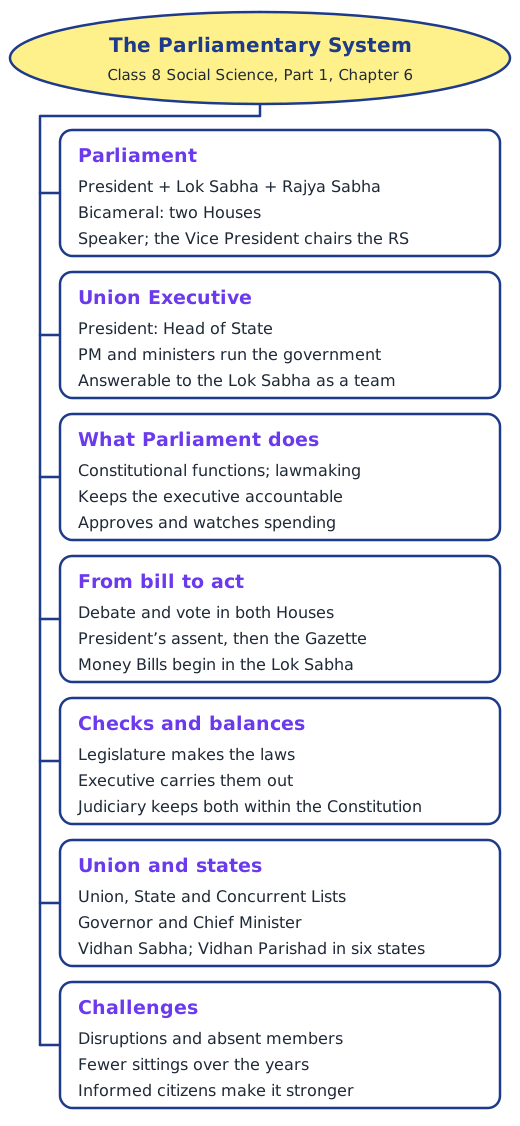
The Big Questions (page 139)
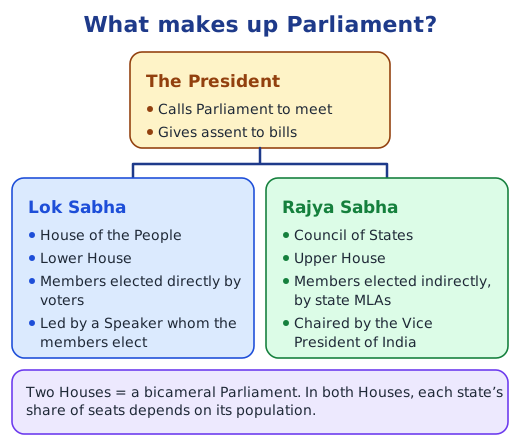
1. What is India’s parliamentary system, and what is its structure? It is a system in which the people elect their representatives to Parliament, and the government is formed from the majority in the Lok Sabha and stays answerable to it. Parliament has three parts: the President, the Lok Sabha (House of the People, elected directly) and the Rajya Sabha (Council of States, elected indirectly). Having two Houses makes it bicameral. The Lok Sabha is run by a Speaker whom its members elect, and the Rajya Sabha is chaired by the Vice President.
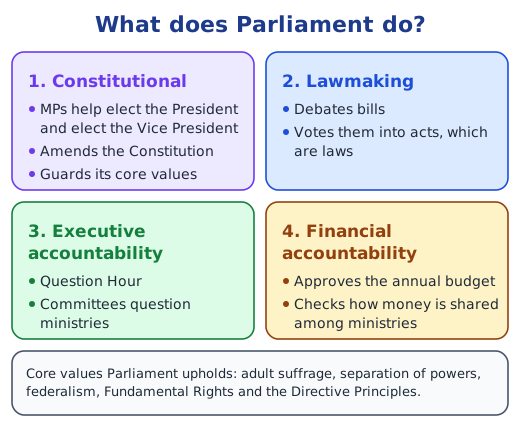
2. What are Parliament’s main functions? The chapter groups them under four heads. (1) Constitutional functions, such as electing the President and the Vice President, amending the Constitution, and upholding its core values: adult suffrage, separation of powers, federalism, and the Fundamental Rights and Directive Principles. (2) Lawmaking: turning bills into acts. (3) Executive accountability: making ministers explain their actions, through the Question Hour and committees. (4) Financial accountability: approving the annual budget and checking how funds are shared among ministries.
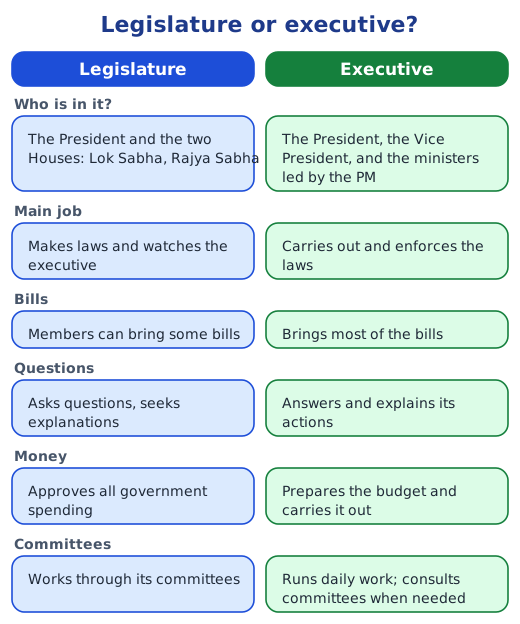
3. What do the legislature and the executive each do in India’s parliamentary democracy? The legislature, Parliament, makes laws, approves government spending and keeps questioning the executive and asking it to explain itself. The executive, made up of the President and Vice President plus the ministers under the Prime Minister, carries out and enforces the laws, runs the government day to day, introduces most bills and prepares the budget. The ministers come from Parliament but answer to the Lok Sabha.
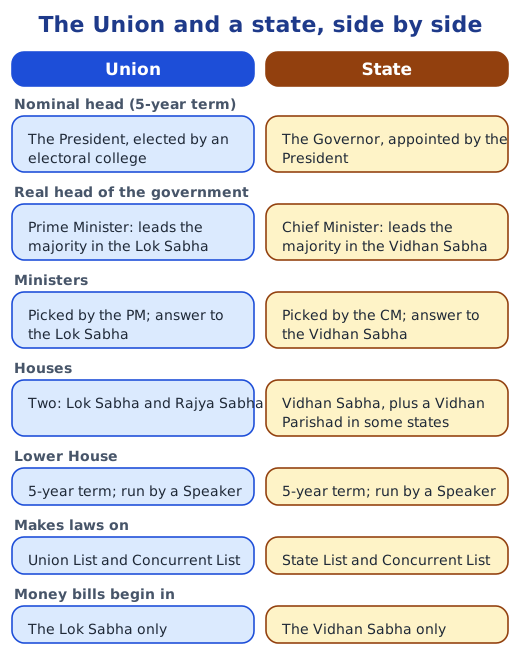
4. How are the legislature and the executive set up for the Union and for the states? The two levels follow the same pattern. The Union has the President (elected) as nominal head and the Prime Minister as real head; a state has the Governor (appointed by the President) and the Chief Minister. Parliament has two Houses, the Lok Sabha and the Rajya Sabha; a state has a Vidhan Sabha and, in six states, a Vidhan Parishad. In each case the ministers answer to the lower House. Parliament makes laws on the Union and Concurrent Lists, and the states on the State and Concurrent Lists.
Let’s Remember, Let’s Explore and Don’t Miss Out (pages 145–160)
Constitutional functions of Parliament (page 145). From earlier chapters: electing the President and the Vice President (elected MPs are part of the electoral college for the President, and all MPs elect the Vice President), and amending the Constitution. Extra: Parliament can also remove the President, or a judge of the Supreme Court or a High Court, through a special and difficult process.
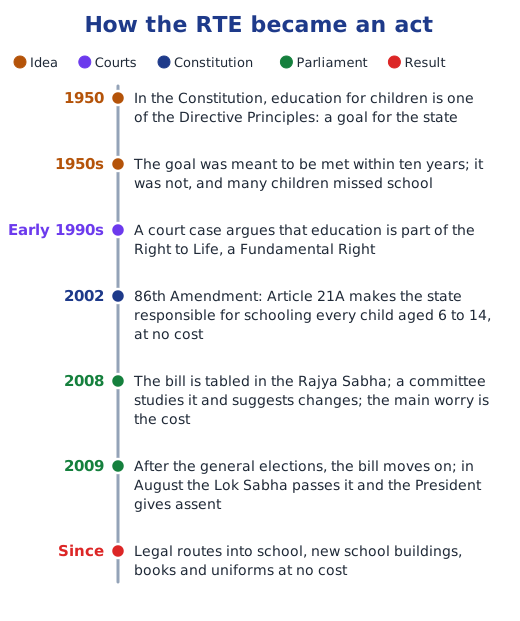
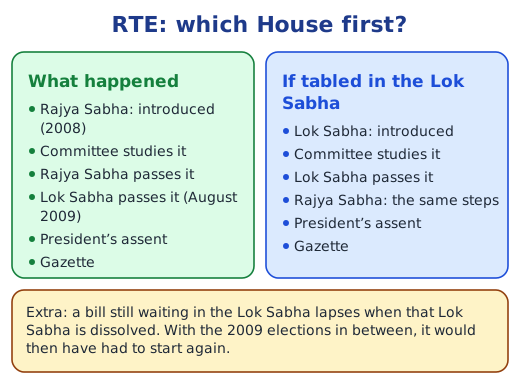
A chart of how the RTE became an act (page 148). 1950: education for children is a Directive Principle → early 1990s: a court case argues that education is part of the Right to Life → 2002: the 86th Amendment adds Article 21A → 2008: the bill is tabled in the Rajya Sabha and studied by a committee → the Rajya Sabha passes it → August 2009: the Lok Sabha passes it → President’s assent → Gazette notification: the RTE Act. If it had been tabled in the Lok Sabha: the same steps would have happened in the Lok Sabha first (introduction, reading, committee, consideration, clause-by-clause amendments, vote), then all over again in the Rajya Sabha, then assent and the Gazette. It is not a Money Bill, so it could start in either House. Extra: a bill still waiting in the Lok Sabha lapses when that Lok Sabha is dissolved, so with the 2009 elections in between it might have had to start again. A bill pending only in the Rajya Sabha does not lapse.
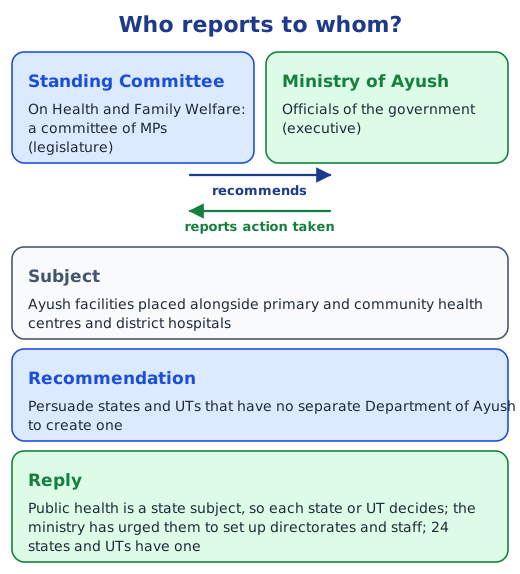
The Standing Committee extract (page 150). Who is reporting to whom? Government officials, from the ministry the committee oversees, report to the Standing Committee on Health and Family Welfare, a committee of MPs: the executive answers to the legislature. The subject: Ayush facilities set up alongside primary health centres, community health centres and district hospitals. The recommendation: the Ministry of Ayush should persuade the states and union territories that have no separate Department of Ayush to create one, so that the sector and its schemes develop faster. The reply: public health is a state subject, so setting up such a department is for each state or UT to decide; the ministry has asked them in meetings to set up separate directorates and posts, and 24 states and UTs now have a separate Ayush directorate.
Why does Parliament watch government spending? (page 151). Because the government spends the people’s money: the taxes and fees citizens pay. MPs, as the people’s representatives, must check that it goes to the purposes Parliament approved, is not wasted or misused, and reaches the people it is meant for. That is why the government must give Parliament full, correct information on time.
Why does Part V of the Constitution describe the executive before Parliament? (page 151). Some possible reasons: Part V deals with the Union, and the President heads both the Union and its executive, so it is natural to begin there. Parliament is easier to describe once the President and the ministers have been introduced, since the President calls Parliament to meet and the ministers sit in it. The order does not make the executive more important: the ministers still answer to the Lok Sabha. Extra: Part VI, on the states, follows the same order.
Ministers sit in Parliament: so are the powers really separate? (page 152). In a parliamentary system, the ministers are members of Parliament, but the functions stay separate. The legislature makes laws and the executive carries them out. Inside Parliament, the ministers must answer questions, explain their decisions to committees, get the budget approved and keep the support of most Lok Sabha members. And the judiciary stands fully apart, checking both. Extra: in a presidential system, such as that of the USA, ministers cannot be members of the legislature.
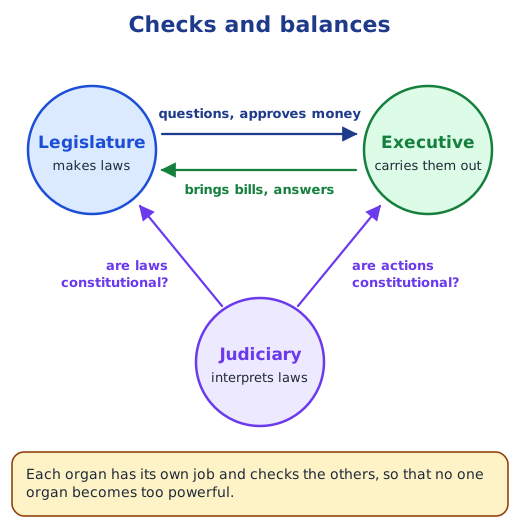
If one organ had all the power (pages 154–155). Nobody could stop it from misusing that power. It could pass unfair laws, enforce them harshly and judge its own case, so a citizen whose rights were violated would have nowhere to turn. How each organ checks the others: the legislature questions the executive in the Question Hour and in committees, controls its spending, and the government needs majority support in the Lok Sabha; the judiciary checks that laws passed by Parliament fit the Constitution, and steps in when a law is carried out in a way that breaks it. Is the judiciary itself reviewed? Extra: yes, in several ways: a higher court can hear an appeal against a lower court’s decision, a larger bench can reconsider an earlier ruling, Parliament can make a new law within the Constitution after a judgment, and Parliament can remove a judge through a special process. Examples (Extra): the chapter’s own RTE story: in 1993, in the Unni Krishnan case, the Supreme Court held that children have a right to education, and Parliament later added Article 21A. In 2001, while hearing a case on the right to food, the Supreme Court ordered governments to serve cooked midday meals in government primary schools. You will learn more in Part 2 Chapter 4, The Role of the Judiciary in Our Society.
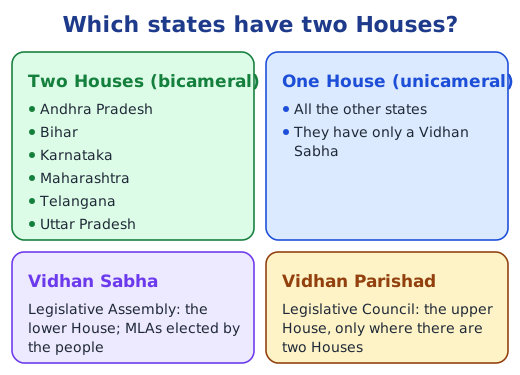
Your state’s legislature: one House or two? (page 157). If you live in Andhra Pradesh, Bihar, Karnataka, Maharashtra, Telangana or Uttar Pradesh, it is bicameral: a Vidhan Sabha and a Vidhan Parishad. Every other state is unicameral, with only a Vidhan Sabha. Extra: among the union territories, Delhi, Puducherry and Jammu and Kashmir have legislative assemblies of their own.
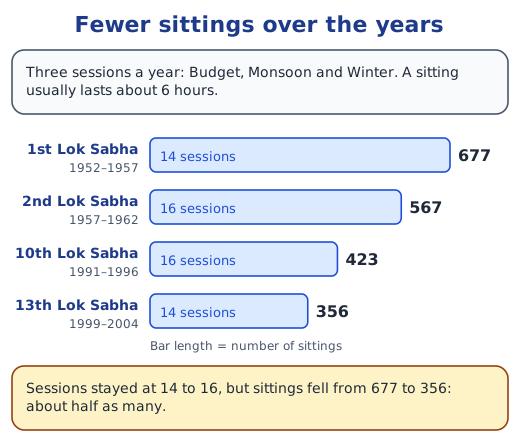
What the table of sittings shows (page 158). The number of sessions hardly changed (14 to 16), but the number of sittings fell steadily: 677 in the 1st Lok Sabha (1952–1957), 567 in the 2nd, 423 in the 10th (1991–1996) and 356 in the 13th (1999–2004), about half the first figure. So Parliament has been meeting on fewer days, leaving less time for debate, questions and careful lawmaking. Recent years: look up the numbers for later Lok Sabhas on the Lok Sabha’s official website, or ask your teacher, and add them to the table.
The statement on the Rajya Sabha’s productivity (page 158). A former Chairman of the Rajya Sabha said in 2021 that the House worked for about 78 per cent of its scheduled time in 2004–14 and about 65 per cent after that. In four sessions it worked for under a third of the time, once for only 6.80 per cent, and in 2018 it recorded its lowest yearly figure, 35.75 per cent, because of disruptions. Conclusions: a large part of the time set aside for the Rajya Sabha has been lost, and disruptions are the main reason given. Implications: the Rajya Sabha is meant to speak for the states and give bills a careful second look. When its time is lost, bills get less scrutiny or wait longer, fewer questions are asked, and the states’ voice in Parliament grows weaker.
A project on your state legislature (page 159). Data to collect: how many days the assembly sat each year, how many bills it passed, and how much time was lost to disruptions, from the assembly’s official website, newspapers or your teacher. Questions for an MLA: How many days did the assembly meet last year? Which bill took the most time? How often is the Question Hour disrupted? How do you collect the views of people in your constituency? What would help the assembly work better? Make an appointment through the MLA’s office, go with a teacher or parent, and present what you learn as a short report or chart.
A former Prime Minister’s words (page 160). Former Prime Minister Atal Bihari Vajpayee said in the Lok Sabha that governments and parties will come and go, but the country must stay, and its democracy must never die. The message: Parliament and its leaders serve the nation, not any one party; however fierce the debate, the country and democracy come first. Why protect democratic values when power changes? In a democracy, power changes hands through elections. The rules that make this possible, fair elections, respect for opponents, citizens’ rights and independent institutions, must stay the same whoever wins, so that every change of power is peaceful and every citizen stays safe.
Questions and activities (pages 161–162)
Q1. “Find out how many representatives from your state are in each House of the Parliament.” The answer depends on your state. In the Lok Sabha, each constituency elects one MP; in the Rajya Sabha, seats are shared among the states by population, and the state’s MLAs elect them. Look up your state on the official websites of the Lok Sabha and the Rajya Sabha, or ask your teacher, and write both numbers in a table. Extra, as examples: Uttar Pradesh, the state with the most seats, has 80 Lok Sabha seats and 31 Rajya Sabha seats; Goa has 2 and 1.
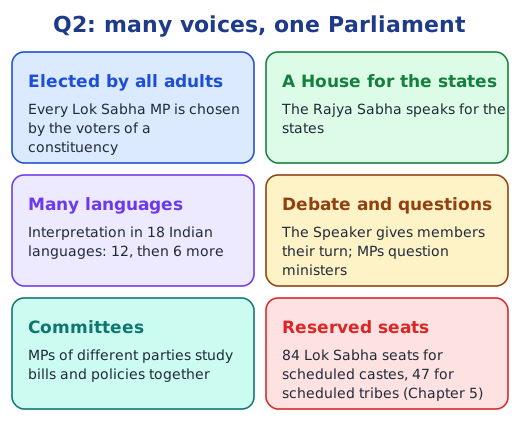
Q2. “What makes the Indian Parliament the ‘voice of the people’? How does it ensure that different opinions are heard?” The voice of the people: Lok Sabha members are elected directly by all adult citizens, one person, one vote, and the government is formed from them and must answer to them; the Rajya Sabha speaks for the states. Different opinions: MPs come from every part of the country and many parties; the Speaker gives members their turn to speak; MPs question ministers in the Question Hour; committees, often with MPs from different parties, study bills and policies; interpretation in 18 Indian languages lets members speak in their own language; and, as Chapter 5 showed, reserved seats bring the voices of scheduled castes and scheduled tribes into Parliament.
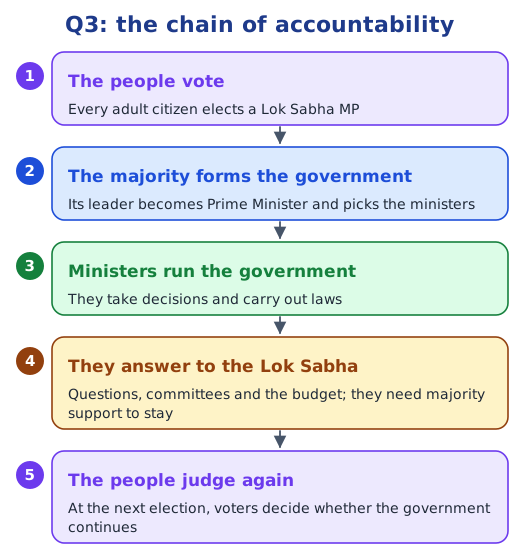
Q3. “Why do you think the Constitution made the Executive responsible to the Legislature?” (1) In a democracy, power belongs to the people. The people cannot watch the government every day, but the MPs they elect can. (2) It stops the government from acting on its own: ministers must explain their decisions, answer questions and get the budget approved. (3) The government can stay only while most Lok Sabha members support it, so it must keep the people’s trust. (4) The ministers answer as a team (collective responsibility), so the whole government takes responsibility for its decisions. This creates a chain: people elect MPs, MPs check ministers, and at the next election the people judge again.
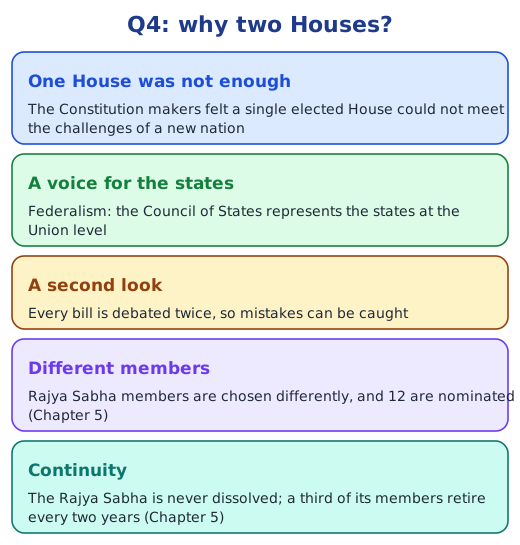
Q4. “Why do you think we have chosen the system of bicameral legislature at the Union level?” (1) The makers of the Constitution felt that one directly elected House would not be enough for the many challenges of a new nation. (2) India is federal: a Council of States gives the states their own voice at the Union level. (3) A second House means every bill is debated twice, so hasty decisions and mistakes can be caught. (4) Its members are chosen differently, by state MLAs, with 12 nominated by the President (Chapter 5), which brings in other views. (5) The Rajya Sabha is never dissolved, and a third of its members retire every two years (Chapter 5), which gives continuity.
Q5. “Try to track the journey of a recent bill passed by the Parliament. Identify in which House it was introduced. Were there any major debates or disagreements? How long did it take for the bill to become a law? Use newspaper archives, government websites, and Lok Sabha debates, or ask your teacher for help.” Make a timeline with these headings: the bill’s name and purpose; the House where it was introduced, and the date; whether it went to a committee; the main points debated and any amendments; the dates it passed each House; the date of the President’s assent; and the total time taken. Extra, a worked example: the Women’s Reservation Bill, 2023, which Question 7 mentions, was introduced in the Lok Sabha in September 2023. The Lok Sabha and then the Rajya Sabha passed it within the same week, with wide support, and the President’s assent followed later that month. In Parliament it took less than two weeks, although the idea had been discussed for more than 25 years.
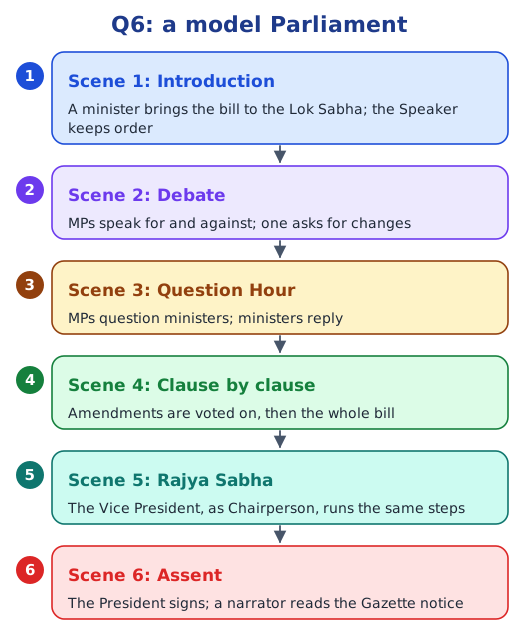
Q6. “Choose a recent law passed by the Parliament. Divide into teams to role-play different parts of the process — MPs debating in Lok Sabha and Rajya Sabha, ministers answering questions, and the President giving assent. Present a short skit showing how a bill becomes a law; enact a ‘model Parliament’.” Choose a law with your teacher; the RTE Act is a good choice if you want to use the chapter’s own example. Roles: the Speaker, the Rajya Sabha Chairperson (the Vice President), the minister who brings the bill, MPs for and against, a committee chair, the President and a narrator. Scenes: (1) the minister introduces the bill in the Lok Sabha; (2) MPs debate it, and one proposes a change; (3) Question Hour, where ministers answer; (4) clause-by-clause voting, then the final vote; (5) the Rajya Sabha repeats the steps; (6) the President gives assent, and the narrator reads out the Gazette notice. Keep the debate polite and the Speaker firm.
Q7. “The Women’s Reservation Bill, 2023, was passed with wide support. Why might it have taken over 25 years for this bill to be passed, despite being discussed for so long?” Possible reasons: (1) Extra: it changes the Constitution, so it needs a special majority in both Houses, which is possible only with broad agreement. (2) Many members backed the idea but disagreed on details, such as which seats would be reserved and how they would change from one election to the next, and whether some groups of women should have separate quotas within it. (3) Extra: a version passed by the Rajya Sabha in 2010 was still waiting in the Lok Sabha when that Lok Sabha’s term ended in 2014, so it lapsed. (4) Busy agendas, disruptions and other priorities kept pushing it back. The story shows that even a widely supported idea can take years, because a big change needs many people to agree on the exact words of the law. Extra: the bill was first introduced in 1996, and the 2023 law reserves one-third of the seats in the Lok Sabha and the state legislative assemblies for women.
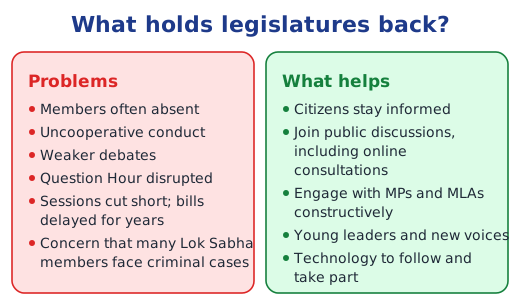
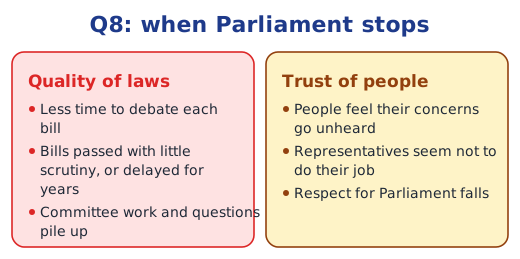
Q8. “Sometimes the Parliament is disrupted and does not function for the number of days it is supposed to. What impact do you think this has on the quality of laws and the trust people place in their representatives?” Quality of laws: with less time, bills are debated less, committee work and amendments are cut short, and some bills are passed in a hurry while others wait for years; laws made without careful study are more likely to have gaps. The Question Hour is lost, so the government answers fewer questions. Trust: people expect their representatives to discuss their problems. When sittings are lost, they feel unheard, think their MPs are not doing their job, and lose respect for Parliament. As the chapter says, this is a matter of concern for a democracy.
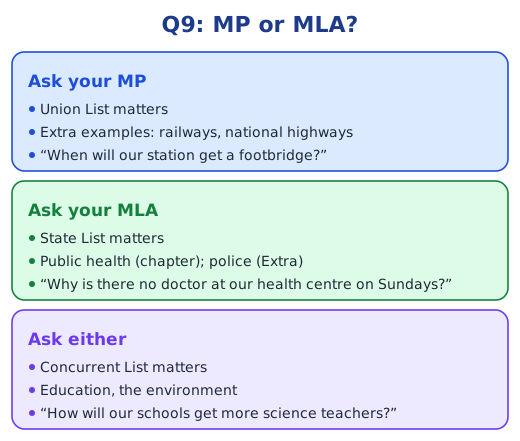
Q9. “Can you create ‘interest’ groups among students and list questions related to any policy that you may want to ask your MP and / or your MLA? How would these questions be different if it is to the MP instead of the MLA, and vice versa?” Form groups by interest, such as health, transport, the environment and education, and let each group write three questions. The difference: an MP works on the Union List and the Concurrent List, so questions to an MP are about national matters (Extra examples: railways and national highways), such as “When will our station get a footbridge?” An MLA works on the State List and the Concurrent List, so questions to an MLA are about state matters, such as public health (Extra: and the police): “Why is there no doctor at our health centre on Sundays?” For Concurrent subjects such as education and the environment, you could ask either.
Q10. “What is the role that the Judiciary plays in Indian democracy? What could happen if we didn’t have an independent judiciary?” Its role: the judiciary, working through a system of courts, interprets and applies the law and settles disputes. It is the custodian of the Constitution: it checks that laws passed by Parliament do not break the Constitution, steps in when the executive breaks it while carrying out laws, and protects Fundamental Rights. Without an independent judiciary: judges would have to please the government of the day, so a citizen whose rights were violated could not get a fair hearing. The legislature or the executive could pass or enforce unconstitutional laws with no one to stop them, and disputes would be settled by power, not by law.
Practice
-
When was the 18th Lok Sabha formed?
Show answer
Answer: (c) June 2024
-
What does a Gazette notification do?
Show answer
Answer: (b) Officially announces a new act
-
Which of these states has only one House?
Show answer
Answer: (c) Kerala
-
In a state, who matches the Prime Minister, and who matches the President?
Show answer
Answer: The Chief Minister matches the Prime Minister, as the real head of the government. The Governor matches the President, as the nominal head.
-
Why did the makers of the Constitution want a Rajya Sabha?
Show answer
Answer: They felt that one directly elected House would not be enough for a newly independent India, and, in the spirit of federalism, they wanted a Council of States to speak for the states.
Stuck on a question?
Take a photo and Lagnever AI explains it step by step. Try it for 7 days for ₹2.
Get it on Google Play Open in browser
For parents: after the trial, the plan renews monthly by UPI or card autopay. You can cancel anytime in the app.