
Class 8 Social Science Part 2 Chapter 4: The Role of the Judiciary in Our Society Notes
This chapter in five lines
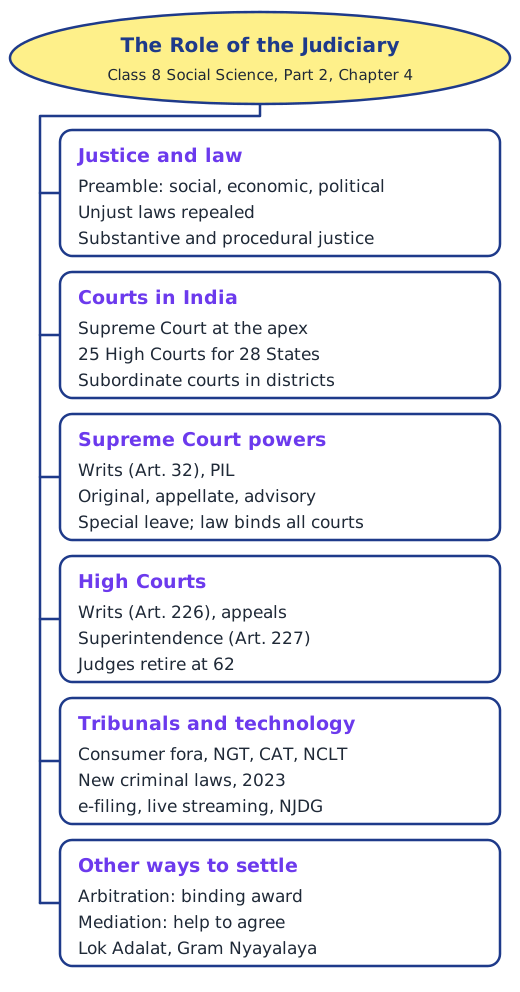
The Role of the Judiciary in Our Society explains how courts deliver justice. India has one unified system: the Supreme Court at the top, High Courts in the States and subordinate courts in the districts, with tribunals for special disputes. Courts protect Fundamental Rights through writs and Public Interest Litigation, and disputes can also be settled by arbitration, mediation and Lok Adalats.
What is this chapter about?
The chapter opens with the Big Questions: what justice means, why it matters for a fair and peaceful society, how the judiciary in India is organised and what it does, and what other ways exist to settle disputes. The Preamble to the Constitution promises every citizen social, economic and political justice, and the judiciary is the institution that decides disputes fairly according to law, so that everyone can live with equality and dignity.
Law and justice
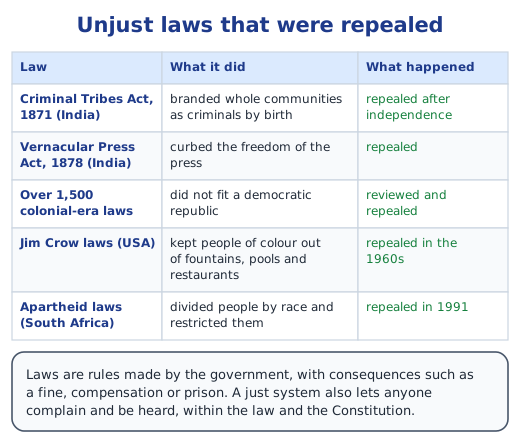
As societies grew, governments took on the task of keeping order, mainly by making laws: general rules with consequences, from a fine or compensation to prison. The judicial system lets anyone with a grievance complain, and lets the other side be heard. Laws themselves can be unjust. After independence, India repealed over 1,500 colonial-era laws, such as the Criminal Tribes Act, 1871, which treated whole communities as born criminals, and the Vernacular Press Act, 1878, which curbed the Indian-language press. The Jim Crow laws of the United States and South Africa’s apartheid laws were also repealed.
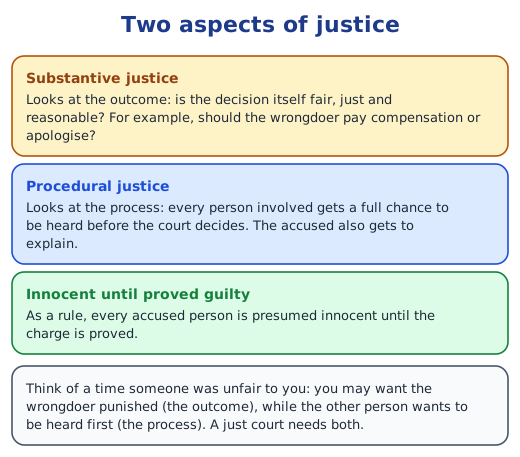
Justice has two sides. Substantive justice asks whether the outcome is fair; procedural justice gives every person a full hearing before a decision. As a rule, everyone is presumed innocent until proved guilty.
Courts in India
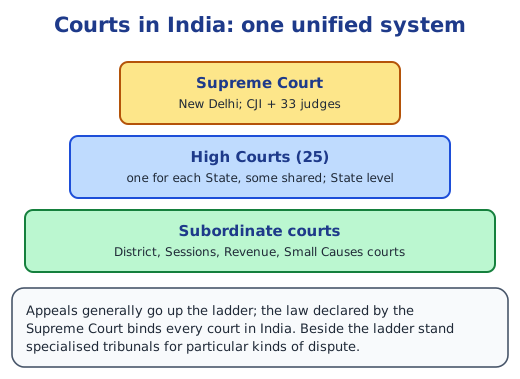
India has a unified judicial system shaped like a ladder: the Supreme Court at the apex, High Courts for the States and subordinate courts in the districts. The Supreme Court, provided for in Article 124, began on 26 January 1950 in New Delhi and is the final interpreter of the Constitution. It has the Chief Justice of India and 33 other judges, all appointed by the President, who retire at 65. Its motto, yato dharmastato jayah, means ‘Where there is dharma, there is victory.’ Read courts in India.
Powers of the Supreme Court
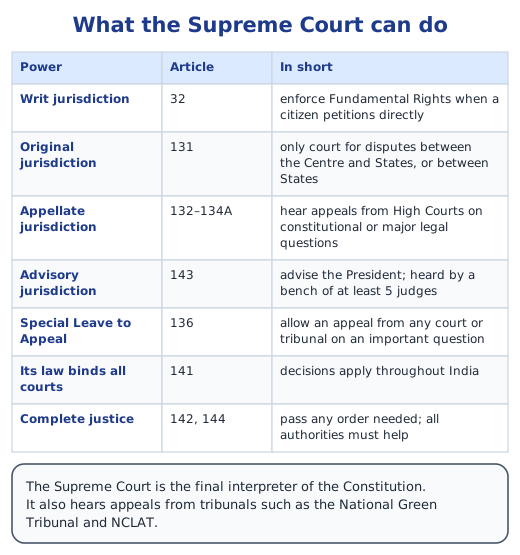
To enforce the Fundamental Rights in Part III of the Constitution, a citizen can file a writ petition directly in the Supreme Court (Article 32) or in a High Court (Article 226). The Supreme Court also created Public Interest Litigation, starting with Kapila Hingorani’s petition that freed under-trial prisoners held too long. It alone hears disputes between the Centre and States (Article 131), hears appeals, advises the President (Article 143), can grant special leave to appeal (Article 136), and its law binds every court in India (Article 141). Read powers of the Supreme Court.
High Courts and subordinate courts
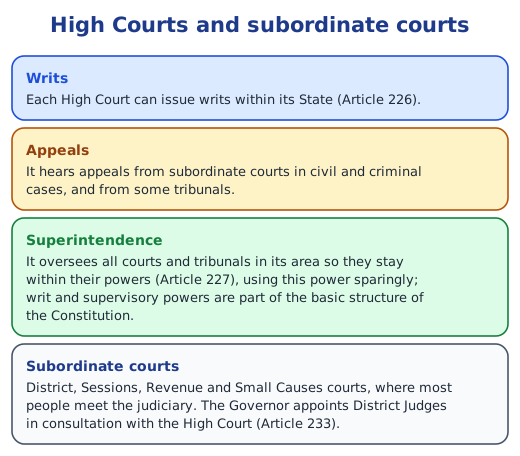
Article 214 provides a High Court for each State, but India’s 28 States have 25 High Courts because some are shared, such as the Gauhati High Court for Assam, Nagaland, Mizoram and Arunachal Pradesh. High Court judges are appointed by the President after consultation and retire at 62. A High Court issues writs, hears appeals and supervises all courts and tribunals in its area. Below it are the subordinate courts, District, Sessions, Revenue and Small Causes courts, where most people meet the judiciary.
Tribunals, new laws and digital courts
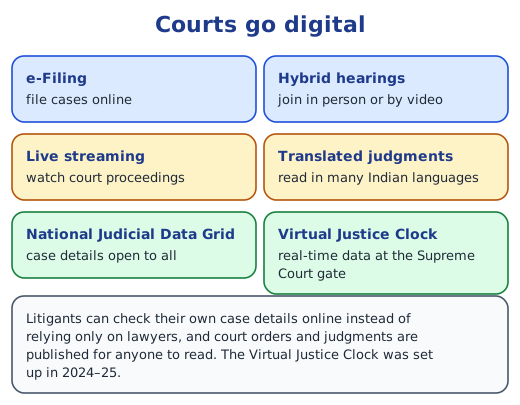
Specialised, quasi-judicial tribunals handle particular disputes: consumer commissions, the Central Administrative Tribunal, the National Green Tribunal, the National Company Law Tribunal and others. In 2023 three new laws replaced the Indian Penal Code, the Code of Criminal Procedure and the Indian Evidence Act. Courts now use e-filing, hybrid hearings, live streaming, translated judgments and the National Judicial Data Grid, so that litigants can follow their own cases.
Settling disputes outside the courtroom
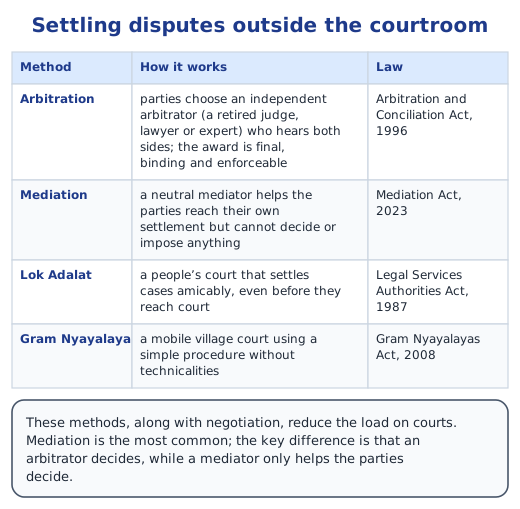
To reduce the courts’ load, litigants are encouraged to use arbitration, where an independent arbitrator gives a binding award; mediation, where a neutral mediator helps the parties agree but decides nothing; Lok Adalats, people’s courts that settle cases amicably; and Gram Nyayalayas, mobile village courts with simple procedures. Read alternate dispute resolution.
Before we move on
The judiciary is independent of the legislature and the executive, and checks that laws stay within the Constitution. It handles a huge number of cases at every level, and citizens help it by raising concerns about the rights of people, animals and the natural world. Answers to every question are in the NCERT solutions for Part 2 Chapter 4.
Key terms
| Term | Meaning |
|---|---|
| Judiciary | The branch of the State, independent of the legislature and executive, that settles disputes fairly according to law. |
| Law | A general rule made by the government to regulate people’s actions, with consequences for breaking it. |
| Substantive justice | Justice in the outcome: whether the decision itself is fair, just and reasonable. |
| Procedural justice | Justice in the process: everyone involved gets a full hearing before the court decides. |
| Writ petition | A petition to the Supreme Court (Article 32) or a High Court (Article 226) to enforce Fundamental Rights. |
| Public Interest Litigation (PIL) | A case filed to protect the rights of the public or of people who cannot approach the court themselves. |
| Original jurisdiction | The Supreme Court’s power to hear disputes between the Centre and States, or between States, first and alone. |
| Appellate jurisdiction | The power to hear appeals against the decisions of lower courts. |
| Advisory jurisdiction | The Supreme Court’s power to give its opinion to the President on important questions (Article 143). |
| Subordinate courts | Courts below the High Courts, such as District, Sessions, Revenue and Small Causes courts. |
| Tribunal | A body set up by law to settle one kind of dispute, such as consumer or environmental cases. |
| Litigant | A person involved in a legal case, whether suing or being sued. |
| Arbitration and mediation | Ways of settling disputes out of court: an arbitrator gives a binding decision; a mediator only helps the parties agree. |
| Lok Adalat | A people’s court that settles disputes amicably, under the Legal Services Authorities Act, 1987. |
Topics in this chapter
Practice
-
When did the Supreme Court of India come into existence?
Show answer
Answer: (c) 26 January 1950
-
Under which Article can a citizen go directly to the Supreme Court for Fundamental Rights?
Show answer
Answer: (b) Article 32
-
At what age does a High Court judge retire?
Show answer
Answer: (b) 62
-
Disputes between the Centre and a State are heard by the Supreme Court under its:
Show answer
Answer: (c) original jurisdiction
-
Which tribunal decides environmental issues?
Show answer
Answer: (c) National Green Tribunal
-
In which method of dispute resolution does a neutral person only help the parties agree?
Show answer
Answer: (b) mediation
Questions students ask
What are the main topics of Class 8 Social Science Part 2 Chapter 4?
Justice and law, including unjust laws that were repealed; substantive and procedural justice; the structure of courts in India; the Supreme Court, its judges and its powers; writs and Public Interest Litigation; High Courts and subordinate courts; tribunals; new criminal laws and digital courts; and alternate modes of dispute resolution.
Is The Role of the Judiciary in Our Society in the new NCERT Class 8 Social Science book?
Yes. It is Chapter 4 of Exploring Society: India and Beyond, Grade 8 Part 2, in the theme Governance and Democracy, on pages 125 to 142. The chapter was rewritten in the current edition, and these notes follow the official 2026 file.
What is the structure of the judiciary in India?
It is one unified system. The Supreme Court in New Delhi is at the top, the High Courts work at the State level (25 of them, some shared between States), and subordinate courts such as District and Sessions courts work at the district level. Specialised tribunals deal with particular kinds of disputes.
What is Public Interest Litigation?
PIL lets a person or group approach the Supreme Court (Article 32) or a High Court (Article 226) on an issue affecting the public, not only their own case. The Supreme Court introduced it to give real meaning to the right to life; the first reported PIL freed under-trial prisoners held for too long.
Stuck on a question?
Take a photo and Lagnever AI explains it step by step. Try it for 7 days for ₹2.
Get it on Google Play Open in browser
For parents: after the trial, the plan renews monthly by UPI or card autopay. You can cancel anytime in the app.