
Alternate dispute resolution: settling disputes outside the courtroom
Answer in short
Alternate dispute resolution means settling disputes without a full court trial, to reduce the courts’ burden. In arbitration an independent arbitrator gives a final, binding award; in mediation a neutral mediator only helps the parties agree; Lok Adalats settle cases amicably as people’s courts; and Gram Nyayalayas are mobile village courts with simple procedures.
Stuck on a question? Take a photo and Lagnever AI explains it step by step. Try it for 7 days for ₹2. Get it on Google Play
Why look beyond the courtroom?
Disputes arise all the time, at home, at work and in business, and many can be settled by talking, with help if needed. Indian courts carry a huge number of cases, so they increasingly encourage litigants to use alternate modes of dispute resolution: arbitration, mediation or conciliation, negotiation, Lok Adalats and Gram Nyayalayas. These are often quicker and cheaper, and they keep relationships friendlier. In mediation and Lok Adalats the parties themselves agree on the result, so there is usually no appeal and the matter ends sooner.
Arbitration
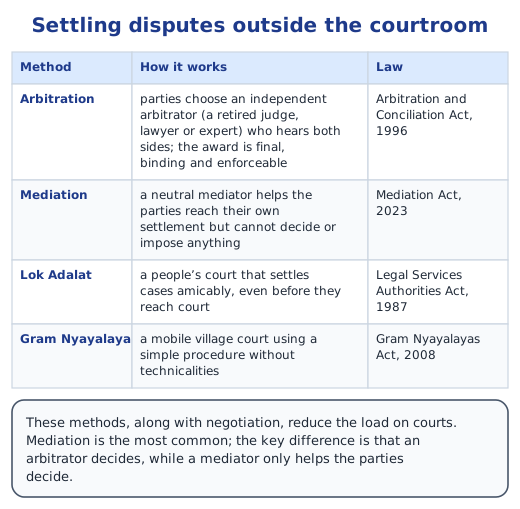
In arbitration the parties agree to hand their dispute to an independent adjudicator, an arbitrator, or a panel of arbitrators. The arbitrator could be a lawyer, an expert in the field or a retired judge, and must act fairly and impartially, letting each side present its case. The decision, called an award, is final and legally binding, and a court can enforce it. Arbitration in India follows the Arbitration and Conciliation Act, 1996.
Mediation
Of all these methods, mediation is used most often. A neutral mediator helps the two sides talk and find a settlement they both accept. Unlike an arbitrator, a mediator has no power to make a decision or impose a view. Mediation now has its own law, the Mediation Act, 2023.
Lok Adalats and Gram Nyayalayas
Lok Adalats, ‘people’s courts’, settle disputes amicably. They can resolve cases already pending in courts, and sometimes people approach them before going to court at all. Rooted in the idea of access to justice, they are recognised by the Legal Services Authorities Act, 1987, and help reduce the backlog without the rigours of a formal trial.
Gram Nyayalayas, set up under the Gram Nyayalayas Act, 2008, are village-level courts that travel from place to place. They decide disputes with a simple procedure and no technicalities, bringing justice closer to people and lightening the load on regular courts.
Which method suits which dispute?
Mediation suits disputes between people who will keep meeting, such as family members, neighbours or business partners, because it protects the relationship. Arbitration suits business disputes where both sides want an expert to decide and want a final answer. Lok Adalats often settle claims such as motor accident compensation or unpaid bills and loans, where a compromise is possible. Gram Nyayalayas help villagers who would otherwise travel far to reach a court. Serious crimes, however, are tried in the regular criminal courts.
Tribunals and consumer commissions
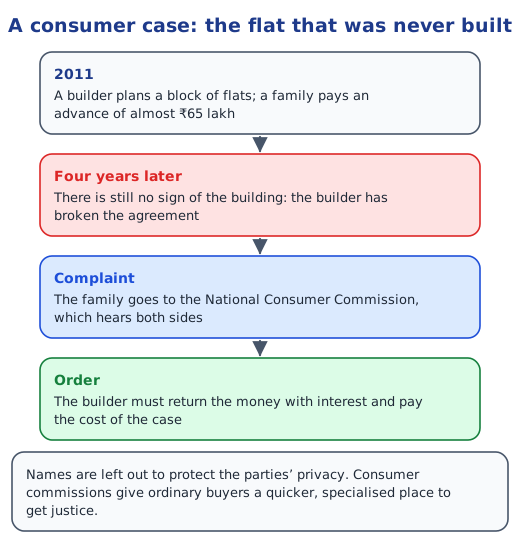
Specialised tribunals also take cases off the regular courts. In one example from the chapter, a family paid a builder an advance of almost ₹65 lakh in 2011, but four years later no building had begun. They complained to the National Consumer Commission, which heard both sides and ordered the builder to return the money with interest and pay the cost of the case.
Helping the system work
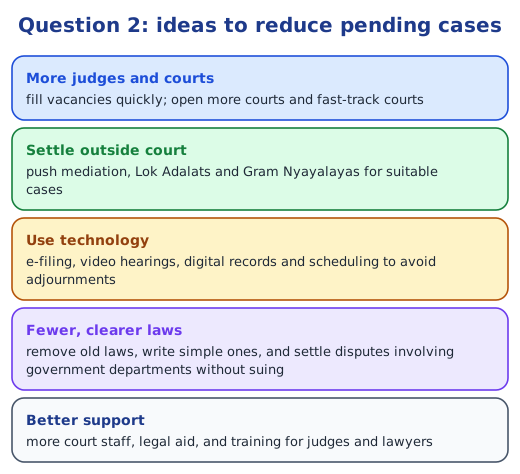
Faster settlement outside courts is one answer to the large number of pending cases; others include more judges and courts and the use of technology, from e-filing to live streaming. Citizens help too, by telling the courts about problems that harm people, animals or nature.
Read on: courts in India, powers of the Supreme Court, the chapter notes and the NCERT solutions.
Practice
-
Under which law are Lok Adalats recognised?
Show answer
Answer: (b) Legal Services Authorities Act, 1987
-
Who can be an arbitrator?
Show answer
Answer: (b) a lawyer, an expert or a retired judge
-
Gram Nyayalayas are:
Show answer
Answer: (b) mobile village-level courts
-
Why do courts encourage alternate dispute resolution?
Show answer
Answer: Courts have a huge number of pending cases. Settling suitable disputes through arbitration, mediation, negotiation or Lok Adalats is quicker and cheaper, keeps relationships friendlier and reduces the courts’ burden.
-
What did the National Consumer Commission do in the book’s case about a flat?
Show answer
Answer: After hearing the family and the builder, it ordered the builder, who had taken an advance of almost ₹65 lakh but built nothing in four years, to return the money with interest and pay the costs of the case.
Questions students ask
What is the difference between arbitration and mediation?
In arbitration the parties agree to let an independent arbitrator or panel decide; the arbitrator must act fairly and hear both sides, and the award is final, binding and enforceable by a court. In mediation a neutral mediator helps the parties reach a settlement themselves but cannot decide or impose anything.
What is a Lok Adalat?
A Lok Adalat is a people’s court where disputes are settled amicably, without the strict rules of a formal trial. It works under the Legal Services Authorities Act, 1987, can settle cases pending in courts, and helps reduce the backlog.
What are Gram Nyayalayas?
Village-level courts set up under the Gram Nyayalayas Act, 2008, to bring justice closer to people and reduce the load on regular courts. They move from place to place and use a simple procedure without technicalities.
Stuck on a question?
Take a photo and Lagnever AI explains it step by step. Try it for 7 days for ₹2.
Get it on Google Play Open in browser
For parents: after the trial, the plan renews monthly by UPI or card autopay. You can cancel anytime in the app.