
Powers of the Supreme Court
Answer in short
The Supreme Court enforces Fundamental Rights through writs (Article 32) and Public Interest Litigation. It alone decides disputes between the Centre and States (Article 131), hears appeals from High Courts, advises the President (Article 143) and can grant special leave to appeal (Article 136). Its law binds all courts, and it can pass any order for complete justice.
Stuck on a question? Take a photo and Lagnever AI explains it step by step. Try it for 7 days for ₹2. Get it on Google Play
Guardian of Fundamental Rights
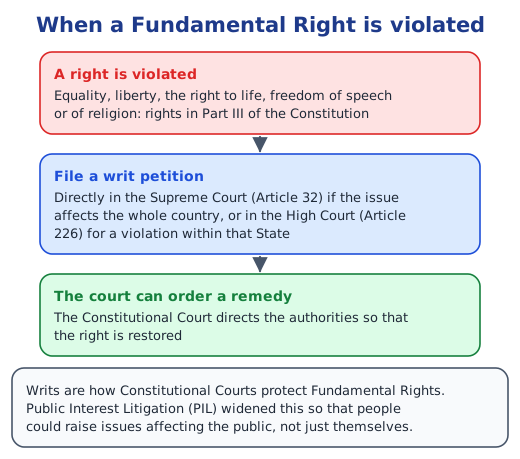
Part III of the Constitution lists the Fundamental Rights of every citizen, among them equality, liberty, the right to life and the freedoms of speech and religion. To make them real, the Constitution gives the Supreme Court and the High Courts writ jurisdiction. A citizen whose right is violated can file a writ petition directly in the Supreme Court under Article 32, where the issue matters for the whole country, or in the High Court under Article 226 for a violation within that State.
Public Interest Litigation
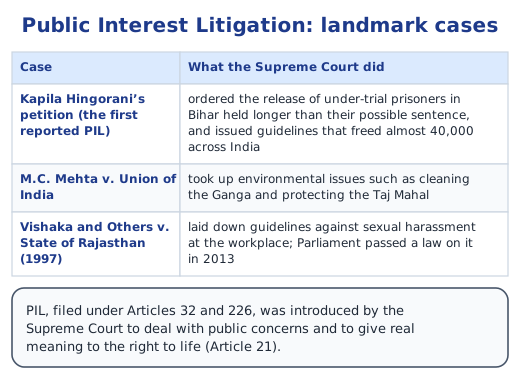
The Supreme Court introduced Public Interest Litigation (PIL), which is brought under Articles 32 and 226, to deal with matters of public concern and make the right to life (Article 21) real. The first reported PIL came from a lawyer, Kapila Hingorani, who read that some prisoners awaiting trial in Bihar had been jailed longer than any sentence they could have received. The Court ordered their release and issued guidelines that freed almost 40,000 under-trial prisoners across India. In M.C. Mehta v. Union of India it took up cleaning the Ganga and saving the Taj Mahal from pollution, and in Vishaka and Others v. State of Rajasthan (1997) it laid down guidelines against sexual harassment at the workplace, followed by a law in 2013.
Original, appellate and advisory jurisdiction
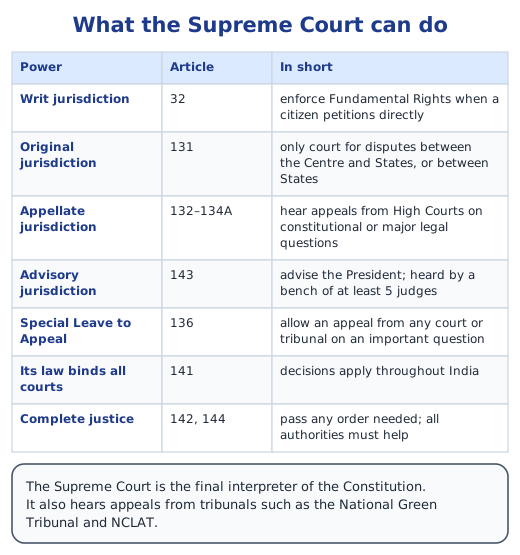
- Original jurisdiction (Article 131): only the Supreme Court can decide legal disputes between the Centre and one or more States, or among States, for example over sharing river water.
- Appellate jurisdiction: under Articles 132, 133 and 134A it hears appeals from final orders of a High Court when that High Court certifies that the case raises a question of interpreting the Constitution or a substantial question of law. It also hears criminal cases involving a death sentence or certified as fit for appeal (Articles 134 and 134A). Appeals from tribunals such as the National Green Tribunal and the National Company Law Appellate Tribunal come to it too.
- Advisory jurisdiction (Article 143): if the President asks for its opinion on an important question of law or fact, a Constitution Bench of at least five judges gives it.
Special leave and complete justice
Under Article 136 the Court has an extraordinary power to grant special leave to appeal against any judgment or order of any court or tribunal in India, where an important question of law arises or to do justice between the parties. The law it declares binds all courts in India (Article 141). It can pass any order needed for complete justice (Article 142), and all civil and judicial authorities must act in its aid (Article 144).
Why these powers matter
Together these powers make the Supreme Court the final interpreter of the Constitution, able to check that laws made by the legislature stay within it and that the executive does not overstep. They also let ordinary citizens, and even a newspaper reader like Kapila Hingorani, bring injustice to the Court’s notice.
Read on: courts in India, alternate dispute resolution, the chapter notes and the NCERT solutions.
Practice
-
Who filed the first reported Public Interest Litigation?
Show answer
Answer: (b) Kapila Hingorani
-
How many judges must hear a case under the advisory jurisdiction?
Show answer
Answer: (c) at least 5
-
Which case led to guidelines against sexual harassment at the workplace?
Show answer
Answer: (b) Vishaka and Others v. State of Rajasthan
-
What is the difference between Article 32 and Article 226?
Show answer
Answer: Both let a citizen file a writ petition to enforce Fundamental Rights. Article 32 is for going directly to the Supreme Court, usually where the issue has an all-India effect; Article 226 is for going to a High Court about a violation within that State.
-
What does Article 142 allow the Supreme Court to do?
Show answer
Answer: It allows the Supreme Court to pass any order needed to do complete justice in a case, and Article 144 requires all civil and judicial authorities to act in aid of the Court.
Questions students ask
What is a writ petition?
A writ petition is a request to a Constitutional Court to enforce Fundamental Rights, such as equality, liberty, the right to life and freedom of speech and religion. It can be filed in the Supreme Court under Article 32 or in a High Court under Article 226.
What is the original jurisdiction of the Supreme Court?
It is the Supreme Court’s exclusive power (Article 131) to decide legal disputes between the Government of India and one or more States, or between two or more States, such as disputes over river water.
What is a Special Leave Petition?
Under Article 136, the Supreme Court can, at its discretion, allow an appeal against any judgment or order of any court or tribunal in India where an important question of law arises or to do justice between the parties.
Stuck on a question?
Take a photo and Lagnever AI explains it step by step. Try it for 7 days for ₹2.
Get it on Google Play Open in browser
For parents: after the trial, the plan renews monthly by UPI or card autopay. You can cancel anytime in the app.