
Courts in India: one unified system
Answer in short
India’s courts form one unified system. The Supreme Court is at the top, with the Chief Justice of India and 33 judges, who retire at 65. Each State has a High Court, 25 in all as some are shared; their judges retire at 62. Below are subordinate courts such as District and Sessions courts, and tribunals handle particular disputes.
Stuck on a question? Take a photo and Lagnever AI explains it step by step. Try it for 7 days for ₹2. Get it on Google Play
A unified system
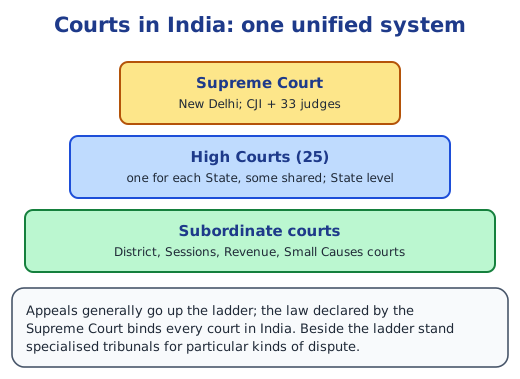
India has one judicial system for the whole country, arranged like a ladder. At the top, the Supreme Court; at the State level, the High Courts; and at the district level, the subordinate courts. Cases usually begin at the bottom, and appeals can go up. Alongside, special tribunals decide particular kinds of disputes. Because the system is unified, the law declared by a higher court guides every court below it.
The Supreme Court
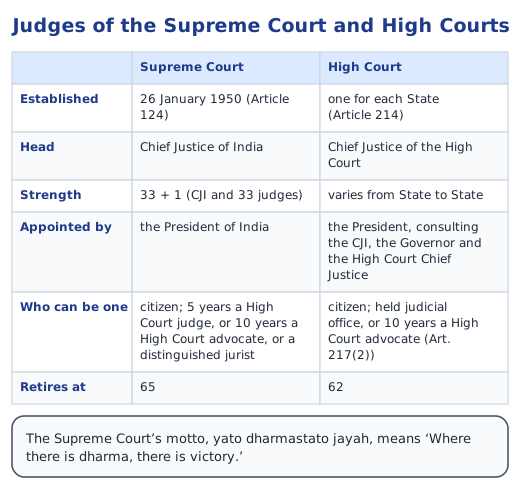
Article 124 of the Constitution set up the Supreme Court, which came into existence on 26 January 1950, the day the Constitution took effect. It sits in New Delhi and is the highest court in the land and the final interpreter of the Constitution. Its head is called the Chief Justice of India, and today it has 33 other judges. Every judge is appointed by the President of India and must be a citizen who has been a High Court judge for five years, or a High Court advocate for ten years, or a distinguished jurist in the President’s view. Supreme Court judges retire at 65. The court’s logo carries the Sanskrit motto yato dharmastato jayah: ‘Where there is dharma, there is victory.’
High Courts
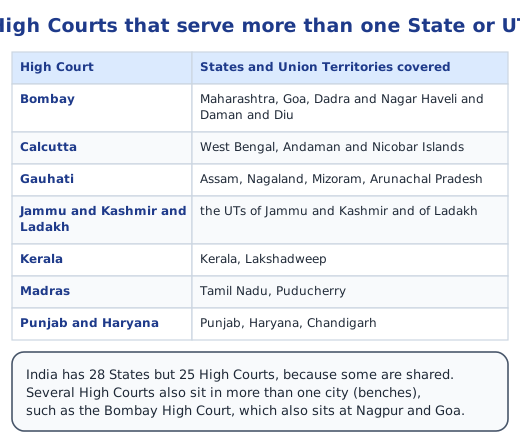
A High Court is the highest court in a State; Article 214 provides one for each State. India has 28 States but 25 High Courts, because some serve more than one State or Union Territory. The Bombay High Court, for example, covers Maharashtra, Goa and the Union Territory of Dadra and Nagar Haveli and Daman and Diu, and several High Courts sit in more than one city, called benches.
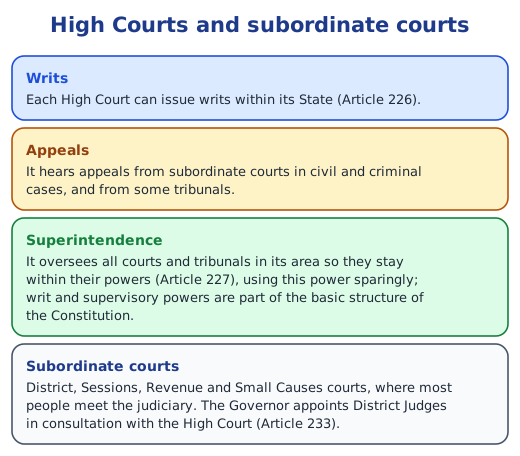
A High Court has a Chief Justice and other judges, their number depending on the State. They are appointed by the President after consulting the Chief Justice of India, the Governor and the High Court’s own Chief Justice. A High Court judge must be a citizen who has held judicial office or been a High Court advocate for ten years (Article 217(2)), and retires at 62. Within its State, a High Court issues writs (Article 226), hears appeals from lower courts and some tribunals, and supervises all courts and tribunals (Article 227).
Subordinate courts
Below each High Court is a network of subordinate courts: District Courts, Sessions Courts, Revenue Courts, Small Causes Courts and others. Articles 233 to 237 organise them and protect their independence, and each High Court must uphold their honour and integrity. District Judges are appointed by the Governor in consultation with the High Court. These are the courts closest to people, where most cases start.
Tribunals
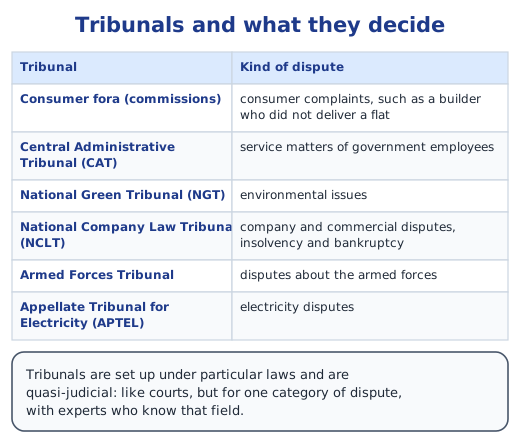
Specialised tribunals are set up under particular laws and are quasi-judicial: they work like courts but for one kind of dispute, often with experts in that field. Consumer commissions settle consumer complaints, the Central Administrative Tribunal handles government employees’ service matters, the National Green Tribunal deals with the environment, and the National Company Law Tribunal handles company disputes and insolvency.
Read on: powers of the Supreme Court, alternate dispute resolution, the chapter notes and the NCERT solutions.
Practice
-
Who appoints the judges of the Supreme Court?
Show answer
Answer: (b) the President of India
-
Which High Court covers Punjab, Haryana and Chandigarh?
Show answer
Answer: (b) Punjab and Haryana
-
Who appoints District Judges in a State?
Show answer
Answer: (c) the Governor, in consultation with the High Court
-
Who can be appointed a judge of the Supreme Court?
Show answer
Answer: A citizen of India who has been a High Court judge for five years, or an advocate of a High Court for ten years, or is a distinguished jurist in the President’s opinion.
-
Why are subordinate courts so important?
Show answer
Answer: They are where the judiciary comes into close contact with people: most cases begin in District, Sessions, Revenue or Small Causes courts, so they shape how ordinary citizens experience justice.
Questions students ask
How are courts organised in India?
As a single ladder: the Supreme Court at the top, a High Court for each State or group of States, and subordinate courts in every district. Appeals generally move up the ladder, and the law laid down by the Supreme Court binds all the courts below.
How many judges does the Supreme Court have?
Its current strength is 33 + 1: the Chief Justice of India and 33 other judges, all appointed by the President of India.
What is a tribunal?
A tribunal is a body set up under a particular law to settle one category of disputes. It is quasi-judicial, working like a court for that area; examples are consumer commissions, the National Green Tribunal and the Central Administrative Tribunal.
Stuck on a question?
Take a photo and Lagnever AI explains it step by step. Try it for 7 days for ₹2.
Get it on Google Play Open in browser
For parents: after the trial, the plan renews monthly by UPI or card autopay. You can cancel anytime in the app.