
NCERT Solutions Class 8 Social Science Part 2 Chapter 4: The Role of the Judiciary in Our Society
Answers to the Big Questions, every Let’s Explore and Don’t Miss Out box, and all five Questions and activities in Chapter 4, The Role of the Judiciary in Our Society, of Exploring Society: India and Beyond, Grade 8 Part 2. Page numbers follow the book (pages 125–142). Short notes: Part 2 Chapter 4 notes.
The Big Questions (page 125)
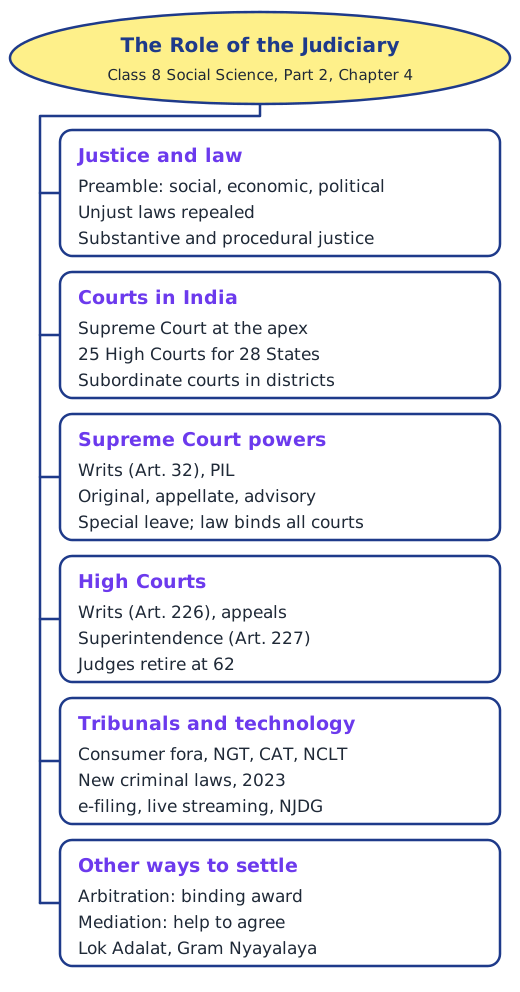
1. What is the concept of justice? Justice means that every person is treated fairly, according to law, and can live with equality and dignity. The Preamble promises social, economic and political justice to all citizens. Justice has two aspects: substantive justice, a fair outcome, and procedural justice, a full hearing for everyone before a decision. Every person is presumed innocent until proved guilty.
2. Why is it important for a just and harmonious society? Disagreements arise all the time. If people trust that disputes will be settled fairly, they turn to dialogue or the courts instead of force, so peace and harmony last. Justice also protects the weak against the strong; unjust laws such as the Criminal Tribes Act, the Jim Crow laws and apartheid show how whole groups lose their dignity when it is missing.
3. What is the structure and role of the judiciary in India? It is one unified system: the Supreme Court at the top, a High Court for each State or group of States, and subordinate courts in the districts, with specialised tribunals alongside. Independent of the legislature and the executive, it settles disputes according to law, protects Fundamental Rights through writs and Public Interest Litigation, makes sure laws respect the Constitution and the executive keeps within its limits.
4. What are the alternative modes of dispute resolution? Arbitration, where an independent arbitrator gives a binding award; mediation or conciliation, where a neutral person helps the parties agree; negotiation; Lok Adalats, people’s courts that settle cases amicably; and Gram Nyayalayas, mobile village courts with a simple procedure.
Let’s Explore and Don’t Miss Out (pages 127–139)
A time someone was not fair to you (page 127). A sample answer: once I was blamed for breaking a classmate’s pencil box without being asked what had happened. I felt angry and helpless. To make it right, the teacher needed to hear both of us before deciding, and the one at fault should have apologised and replaced the box. A fair, neutral person, here the teacher, could have set things right. This is exactly what courts do: hear both sides (procedural justice) and reach a fair outcome (substantive justice).
The Supreme Court’s logo (page 130). Familiar elements: at the top, a wheel (chakra) like the one on our national flag; below it, the lions of the Lion Capital of Ashoka at Sarnath, as in the national emblem; under them, a scroll with the motto yato dharmastato jayah, ‘Where there is dharma, there is victory’; and the words Supreme Court of India, all inside a decorative frame.
Articles 142 and 144 (page 133). The Supreme Court can pass any order needed to do complete justice in a case, and every civil and judicial authority in India must act in aid of the Court, so its orders are carried out.
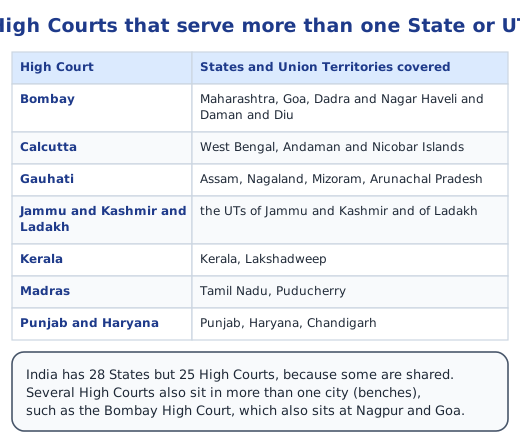
High Courts with more than one bench (page 135). Examples: the Allahabad High Court also sits at Lucknow; the Bombay High Court at Nagpur, Chhatrapati Sambhajinagar (Aurangabad) and Goa; the Madras High Court at Madurai; the Madhya Pradesh High Court (Jabalpur) at Indore and Gwalior; the Rajasthan High Court (Jodhpur) at Jaipur; the Karnataka High Court at Dharwad and Kalaburagi; and the Gauhati High Court at Kohima, Aizawl and Itanagar. Benches let people reach the High Court without travelling far. Check the current list with your teacher, as new benches are added from time to time.
The subordinate court closest to you (page 136). Usually the District and Sessions Court at your district headquarters; larger towns and tehsils also have courts of civil judges and judicial magistrates. Your district court’s website, listed on the eCourts portal, gives the address. Note down which courts sit there: civil, criminal, family or a Small Causes Court.
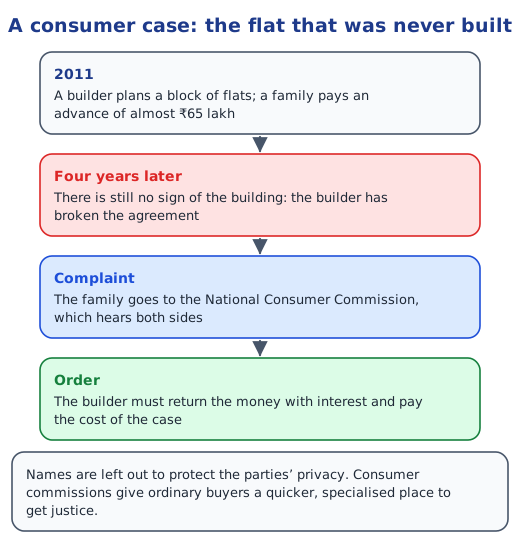
The flat that was never built (page 137). The builder broke the agreement by taking an advance of almost ₹65 lakh and building nothing for four years. As consumers, the family did not need to start an ordinary lawsuit: they went to the National Consumer Commission, a specialised body for consumer disputes. It heard both sides, which is procedural justice, and ordered a refund with interest and the cost of the case, which is substantive justice.
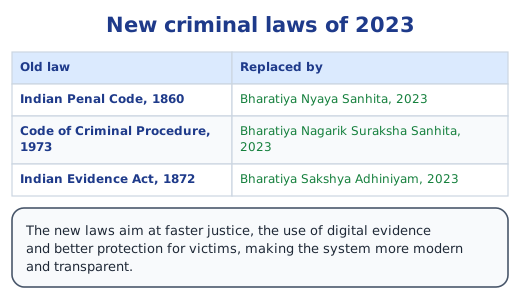
New criminal laws (page 138). In 2023 three new laws replaced colonial-era criminal laws. They aim to deliver justice faster, allow digital evidence and protect victims better.
Digital initiatives (page 139). e-Filing, hybrid hearings, live streaming of proceedings, judgments translated into many Indian languages, the National Judicial Data Grid and, since 2024–25, the Virtual Justice Clock at the Supreme Court’s main gates. They let litigants check their own cases and let anyone read court orders.
Questions and activities (pages 141–142)
1. A model letter to the High Court about a social issue.
To
The Hon’ble Chief Justice
High Court of [your State], [city]
Subject: Burning of garbage next to our school is harming children’s health
Respected Chief Justice,
I am a student of Class 8 at [school name], [town]. For several months, garbage has been dumped and burnt almost every morning in an open plot next to our school. The smoke enters our classrooms; many students cough and have watery eyes, and some with asthma have missed school. We have complained to the local municipal office, but the burning has not stopped.
Courts have held that the right to life under Article 21 includes the right to a clean environment. I respectfully request the Hon’ble Court to take note of this issue and direct the authorities concerned to stop the burning, clear the plot and arrange proper waste collection in our area.
Photographs and a list of dates are enclosed.
Yours faithfully,
[Name], Class 8, [school name and address]
[Date]
Keep such a letter short and factual: dates, places, what you have already tried and what you are asking for. The Supreme Court has sometimes treated letters from citizens as Public Interest Litigation.
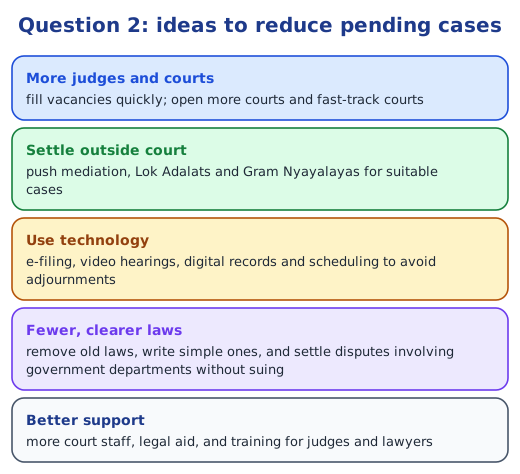
2. Innovative solutions for the large number of pending cases. As a member of the legislature or executive, I would: appoint more judges and fill vacancies quickly, with fast-track courts for the oldest cases; make mediation the first step for suitable family and civil disputes and hold more Lok Adalats, even on weekends, with Gram Nyayalayas in rural areas; use technology for e-filing, video hearings, digital records, translation and scheduling; limit adjournments and set time limits for each stage of a case; ask government departments, which are a party to many cases, to settle disputes before going to court; repeal outdated laws and write simpler ones; and add court staff and legal aid.
3. A moot court. Choose a judge, lawyers for each side, the litigants, witnesses and a court clerk.
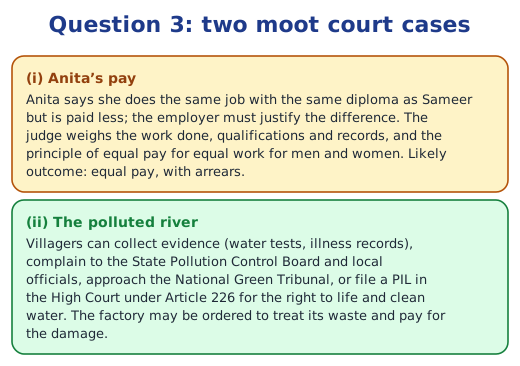
(i) Anita and Sameer. Anita’s side: she has the same ITI diploma, joined on the same day and does the same job as Sameer, yet is paid less; she asked her boss many times. Paying a woman less for equal work goes against equality before law (Article 14), the bar on discrimination on grounds of sex (Article 15) and the principle of equal pay for equal work for men and women (Article 39(d)). The factory’s side: it may claim that Sameer’s duties, shifts or output are different, and it must prove this with records. The judge considers: whether the work is the same in skill, effort and responsibility; whether qualifications and experience match; whether there is any reason other than gender; and the evidence, such as appointment letters, pay slips, duty charts and co-workers’ statements, after hearing both sides. Likely outcome: if the work is the same and there is no valid reason, the factory is ordered to pay Anita equally and to pay the difference she lost, possibly with costs.
(ii) The polluted river. The villagers can collect evidence (photos of the discharge, water samples tested at a government laboratory, records of illness from the health centre); raise the issue in the gram sabha and with the district administration; complain to the State Pollution Control Board, which can inspect the factory and order it to stop releasing untreated effluents; and, if nothing changes, approach the National Green Tribunal or file a Public Interest Litigation in the High Court (Article 226), since the right to life includes clean water, as M.C. Mehta did for the Ganga. Meanwhile they should use safe drinking water. The judge weighs proof that the factory caused the pollution, the harm to health and crops, the factory’s permits and treatment plant, and workers’ jobs, and may order the factory to treat its waste, stop the discharge until then, and pay for cleaning the river and for the harm caused.
4. An essay on an eminent judge from your State. Plan it in five parts: who the judge was and where they came from; their education and early career; their work as a High Court or Supreme Court judge; important judgments or firsts; and why they inspire you. Example for Kerala: Justice M. Fathima Beevi, from Pathanamthitta, began as an advocate, served as a judge in the lower courts and then in the Kerala High Court, and in 1989 became the first woman judge of the Supreme Court of India; she later served as Governor of Tamil Nadu. Her career opened the way for women in the higher judiciary. For your own State, look at the list of former judges on your High Court’s website and ask your teacher.
5. Interacting with someone in the judicial system. You could meet a judge, a lawyer, a court clerk, a mediator, a public prosecutor or a legal aid volunteer. Ask: What does a working day look like? How did you train for this work? What are the biggest challenges, such as the number of cases, delays and adjournments? How has technology changed your work? What gives you the most satisfaction? Take permission before recording, and do not ask about confidential case details. Present it in five or six slides: who you met, their role, a typical day, challenges, what gives them satisfaction, and what you learnt.
Practice
-
Which body ordered the builder to refund the family’s advance in the book’s example?
Show answer
Answer: (b) the National Consumer Commission
-
The Bharatiya Nyaya Sanhita, 2023 replaced:
Show answer
Answer: (c) the Indian Penal Code, 1860
-
Where could villagers go about a factory polluting their river?
Show answer
Answer: (b) the National Green Tribunal
-
What is the difference between substantive and procedural justice?
Show answer
Answer: Substantive justice looks at the outcome: is the decision fair, just and reasonable? Procedural justice looks at the process: does every person involved get a full hearing before the court decides?
-
Name two digital initiatives of Indian courts.
Show answer
Answer: Any two of: e-filing, hybrid (in-person and video) hearings, live-streamed hearings, judgments translated into Indian languages, the National Judicial Data Grid and the Virtual Justice Clock.
Stuck on a question?
Take a photo and Lagnever AI explains it step by step. Try it for 7 days for ₹2.
Get it on Google Play Open in browser
For parents: after the trial, the plan renews monthly by UPI or card autopay. You can cancel anytime in the app.