
Legislature, executive and judiciary
Answer in short
The legislature makes laws, the executive carries them out and makes policies, and the judiciary settles disputes, explains laws and protects rights. The executive has two parts: elected leaders, the political executive, and civil servants selected by exams, the permanent executive. The Constitution keeps the three in balance so that none becomes too powerful.
Stuck on a question? Take a photo and Lagnever AI explains it step by step. Try it for 7 days for ₹2. Get it on Google Play
Three pillars of government
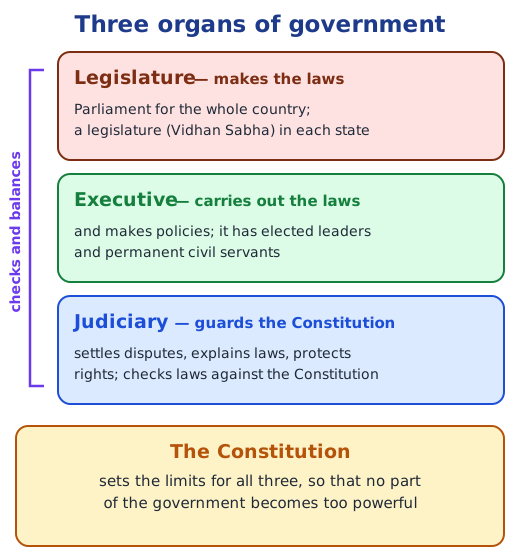
Every government does three jobs: making laws, carrying them out and making sure they are followed. In India each job belongs to a separate organ, and together they are called the three pillars of government. In some countries these organs are kept apart; in others they overlap. Most of our everyday dealings are with the executive, through its many departments.
Legislature: the lawmaking body
The legislature is the lawmaking body. In a democracy it represents the people, and it makes sure that governance follows well-defined laws rather than anyone’s personal wishes. Parliament makes laws for the whole country, and each state has its own legislature, such as the Vidhan Sabha of Jharkhand, which makes laws only for that state.
Executive: political and permanent
The executive carries out the laws, designs and runs policies, and manages the day-to-day work of government. The Constitution does not name its two parts, but they come from the way India’s parliamentary system works.
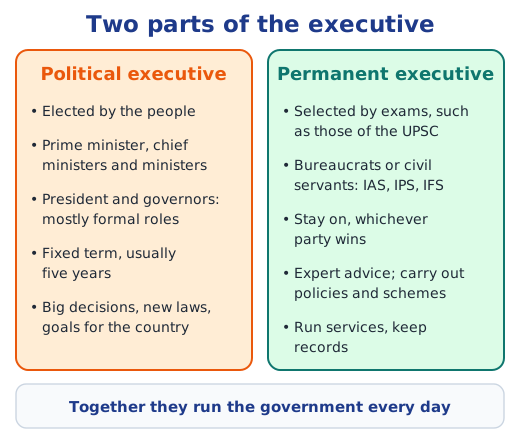
The political executive is made up of elected leaders: the prime minister, the chief ministers of the states and the ministers who work with them. The president and governors are counted here too, though their roles are mostly formal. These leaders make big decisions, bring in new laws, set goals and represent India abroad, and they hold office for a fixed term, usually five years. (Extra: the President is elected indirectly, by elected representatives, and governors are appointed by the President.)
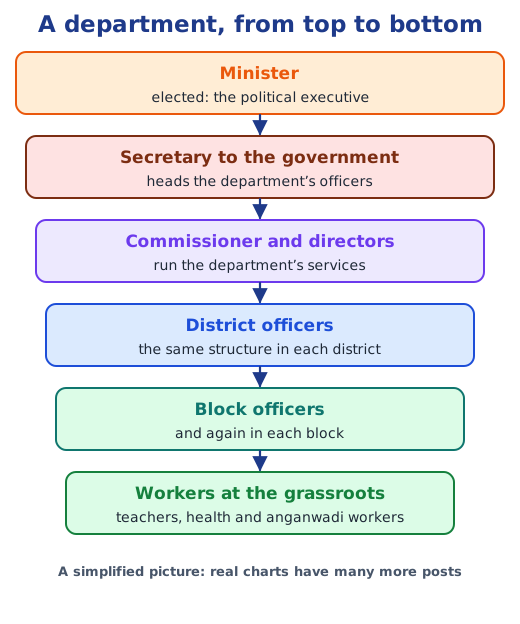
The permanent executive is made up of officers who are not elected but selected through examinations, such as those conducted through the Union Public Service Commission (UPSC). Such officers are known as bureaucrats or civil servants, and they are not replaced after elections. They advise, carry out policies and schemes, link citizens with the government through offices that run schools, roads and hospitals, and keep records. Well-known services include the IAS, IPS, IFS, IRS and the Indian Forest Service. The bureaucracy is arranged like a ladder, and the same pattern repeats in every district and block. At the grassroots its workers are the teachers, anganwadi and health workers and bus conductors we meet. It runs the census, elections, disaster relief, welfare schemes such as VB-G RAM G (set up by a 2026 Act for rural jobs and livelihoods) and drives like the COVID-19 vaccination.
A pioneer: C. B. Muthamma
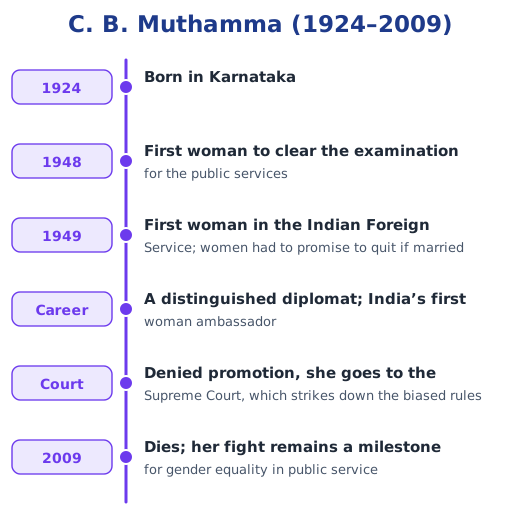
C. B. Muthamma (1924–2009) broke two barriers: in 1948 she was the first woman to pass the public services examination, and in 1949 the first woman to enter the Indian Foreign Service. Women officers then had to sign a promise to resign if they married. She went on to a distinguished career and became India’s first woman ambassador. When she was unjustly denied a promotion, she took her case to the Supreme Court, where judges led by Justice V. R. Krishna Iyer struck down the gender-biased rules. She also wrote that India’s freedom of thought and belief is what makes its democracy possible.
Judiciary: guardian of the Constitution
The judiciary makes sure everyone follows the law. It protects the laws, explains what a law means when its wording is unclear or disputed, protects the rights and liberty of citizens, and guards the Constitution through judicial review, acting as a referee when the government or anyone else breaks the law. If fundamental rights are violated, people can go to court. In India the judiciary is independent of the government and politicians. It upholds the rule of law: everyone, even the government, must obey the law.
Working together: a school example
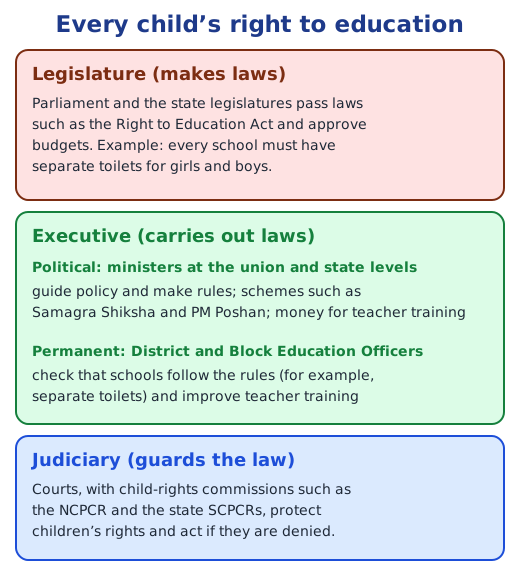
The three organs share the work of giving every child an education. Parliament and the state legislatures pass laws such as the Right to Education Act and approve budgets. Ministers guide policy and run schemes such as Samagra Shiksha and PM Poshan, while District and Block Education Officers check that schools follow the rules. Courts, with child-rights commissions, step in if children’s rights are denied.
Why it matters
Knowing which organ does what tells you where to go: lawmakers for new laws, officials for services, courts for justice. See also state and government and democracy and republic. Answers to the textbook questions are in the NCERT solutions for Part 2 Chapter 6; see all of Part 2 Chapter 6 notes.
Practice
-
Which organ of government makes the laws?
Show answer
Answer: (b) The legislature
-
Who belongs to the permanent executive?
Show answer
Answer: (b) An IAS officer
-
The chapter calls the judiciary the:
Show answer
Answer: (b) guardian of the Constitution
-
Name three functions of the bureaucracy.
Show answer
Answer: Carrying out laws, policies and schemes across the country; linking citizens with the government through departments and field offices that run schools, roads and hospitals and hear complaints; and keeping records of government work, decisions and procedures.
-
Why is an independent judiciary important?
Show answer
Answer: It protects the rule of law, the idea that everyone, even the government, must follow the law. Because no government or politician controls it, it can check unfair actions, make sure laws do not harm people’s rights and settle conflicts peacefully. Without it, democracy cannot survive.
Questions students ask
What are the three organs of government?
The legislature, which makes laws; the executive, which carries out laws and makes policies; and the judiciary, which settles disputes, explains what laws mean and protects people’s rights. The Constitution keeps checks and balances among them.
What is the difference between the political and the permanent executive?
The political executive is made up of elected leaders, such as the prime minister, chief ministers and ministers, who stay in power for a fixed term, usually five years. The permanent executive is made up of civil servants selected through exams such as the UPSC’s; they are not replaced after elections and carry out the government’s work whichever party rules.
Who was C. B. Muthamma?
Chonira Belliappa Muthamma (1924–2009), from Karnataka, became, in 1948, the first woman to pass India’s public services examination, and in 1949 the first woman in the Indian Foreign Service. She became India’s first woman ambassador, and when she was unfairly denied a promotion she went to the Supreme Court, which struck down rules biased against women.
Stuck on a question?
Take a photo and Lagnever AI explains it step by step. Try it for 7 days for ₹2.
Get it on Google Play Open in browser
For parents: after the trial, the plan renews monthly by UPI or card autopay. You can cancel anytime in the app.