
NCERT Solutions Class 7 Social Science Part 2 Chapter 6: The State, the Government, and You
Answers to every question in Part 2 Chapter 6, The State, the Government, and You, of Exploring Society: India and Beyond Grade 7 (2026-27): the Big Questions, the questions in the text, every Let’s Remember, Let’s Explore and Think About It box, and all five questions and activities. Page numbers follow the book (pages 143–168). Short notes: Part 2 Chapter 6 notes.
The Big Questions (page 143)
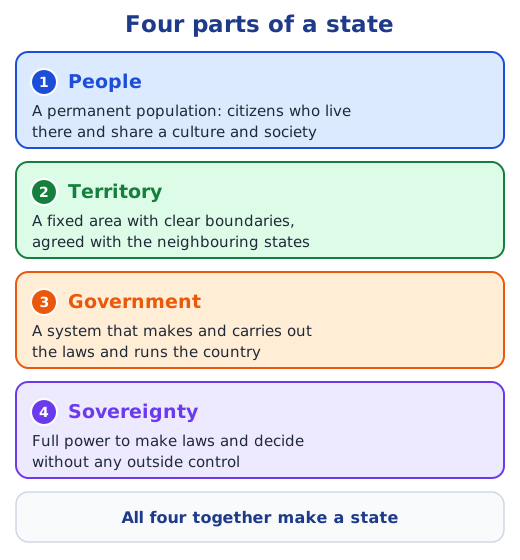
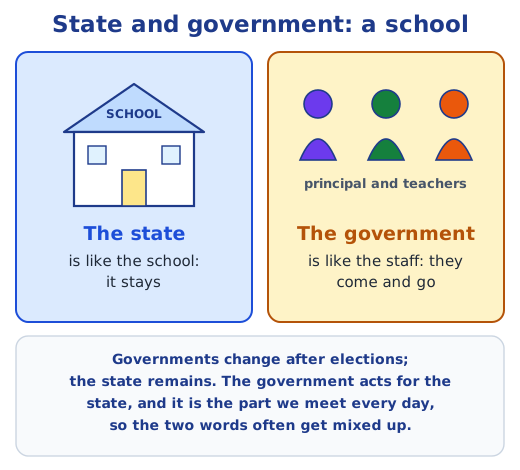
1. What is the difference between a state and a government? A state is a political organisation with authority over a defined territory and its people. It has four parts: a permanent population, a territory, a government and sovereignty. The government is only one of those parts: the leaders, ministers and officials who make and enforce laws and settle disputes. The state is lasting, while governments change after elections, just as a school remains while its principal and teachers come and go.
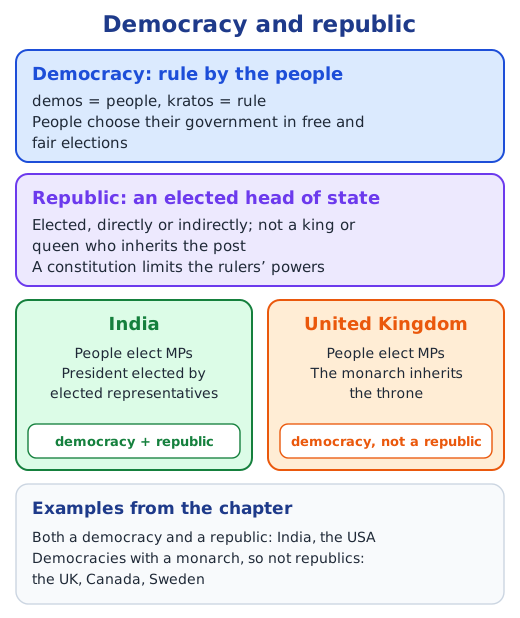
2. What is the difference between a democracy and a republic? What makes India a democratic republic? A democracy is rule by the people: citizens choose their government in fair elections. A republic is a state whose head is elected, directly or indirectly, and does not inherit the post; a constitution also limits the rulers’ powers. India is a democracy because its people elect their representatives, who form the government, and a republic because its head of state, the President, is elected by elected representatives. Its Constitution also protects every citizen’s fundamental rights against the dominance of the majority.
3. How do citizens engage with the government in day-to-day life? How can one make government work for the people? Every day we meet the government through its executive: government schools and teachers, anganwadi and health workers, hospitals, buses, ration shops, the police, and the municipality or panchayat that supplies water and clears garbage. To make it work for the people, citizens can file complaints at grievance offices or portals, ask for information under the RTI Act, raise issues in the media, work through civil society groups, write to their representatives and, once old enough, vote for leaders who will act on the issues they care about.
Let’s Remember (page 144)
Recount some differences between forms of government. In a democracy the people elect their leaders and can change them at the next election. In a monarchy a king or queen rules, and power passes down within one family. In a theocracy religious leaders rule, or the laws are based on one religion. In a dictatorship one person holds total power, and the people cannot freely choose or remove that ruler. In an oligarchy a small group, such as a few rich or powerful families, holds the power. Only in a democracy do ordinary people choose who governs them.
What is a state? (pages 144–146)
Why must a place have a permanent population to become a state? Can it not be a place people just visit? No state can exist without people. Visitors who come and go, like tourists, do not live together or share anything. People who live in a place and identify with it form a permanent population, which develops a common culture and society tied to that territory.
What is a geographically defined territory? An area with clear boundaries. The boundaries need not be natural features such as rivers or mountains; they are lines agreed upon with the neighbouring states.
What does sovereignty mean, and why is it essential for a state? Sovereignty is a state’s complete control over its own matters: it makes and carries out laws according to its own needs, and no other state or outside body may interfere in its internal affairs. Without it, another power would be deciding for the people, so the place would not truly be a state.
Why are “state” and “government” used interchangeably? The government works for the state and handles its everyday business, so it is the part of the state people actually see. We deal with the government, not with the state as a whole, which is why the two words get used for the same action.
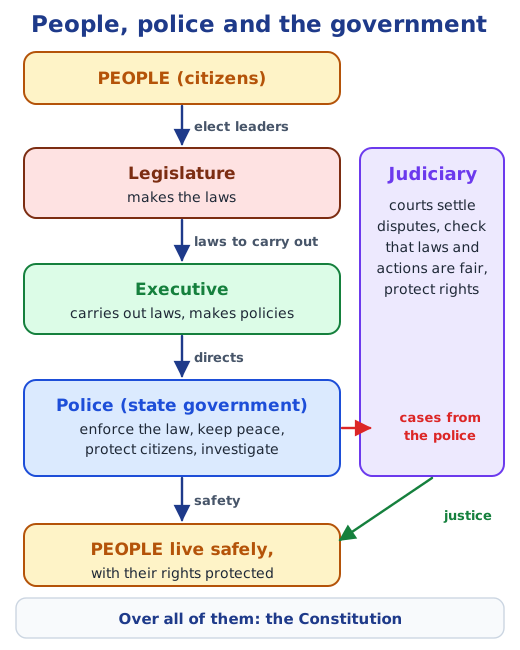
People, police and the government (page 147)
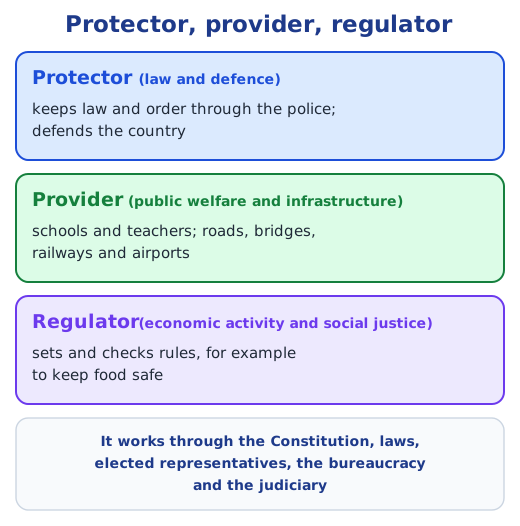
Are the police a part of the government? What do they do? Do citizens have any control over them? Yes: in India the police are part of each state government. They maintain law and order, protect citizens, investigate crimes and present cases to the courts, and they also run awareness drives on road safety, drugs and women’s safety. They may lawfully use force, but they must respect the rights the Constitution gives every citizen. Citizens have some control, though it is indirect. They elect the state government that runs the police. They can complain to senior officers, go to court if their rights are violated, and use grievance portals, RTI and the media.
Let’s Explore: government departments (page 148)
List government departments you know and what they do. For example:
- Public Works Department: builds and repairs roads, bridges and government buildings.
- Education Department: runs government schools and appoints teachers.
- Health Department: runs hospitals and health centres and holds vaccination drives.
- Electricity department: supplies power and collects the bills.
- Water supply board: supplies drinking water.
- Municipal corporation or council: collects garbage and keeps the streets clean.
- Transport Department: runs buses and issues driving licences.
- Fire services: put out fires and rescue people.
- Police Department: keeps law and order.
- Food and civil supplies: runs ration shops.
- Revenue Department: keeps land records.
All of these belong to the executive: they carry out the laws and policies the legislature makes.
Democracy and republic (pages 148–151)
Why did the makers of the Constitution use the words “democratic” and “republic” together? Because the two words say different things. “Democratic” means the people choose their government through elections. “Republic” adds that India’s head of state is elected, not a hereditary king or queen as in the UK, and that a constitution limits the rulers’ powers and protects everyone’s rights. Using both words makes clear that India is both.
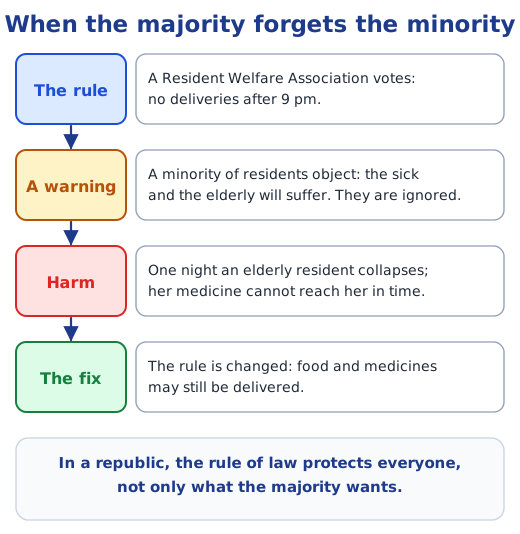
The RWA banned deliveries after 9 pm by a majority vote. Was this a fair rule? No. It was passed by a majority, but it ignored a minority who warned that the sick and the elderly would suffer, and an elderly resident was harmed when her medicine could not arrive. A fair rule must balance everyone’s needs. The changed rule kept the ban for most deliveries but allowed food and medicines, so it protected the minority too.
The government and you (pages 156–160)
Why do we still hear of bribery and corruption, and of problems such as poor schools and roads? A country as large as India has a huge government. Some officials misuse their power. Many people do not know their rights or how to complain. Records are not always open, and services can be slow, which gives room for bribes. That is why the chapter stresses transparency and accountability: open information, vigilance commissions and active citizens.
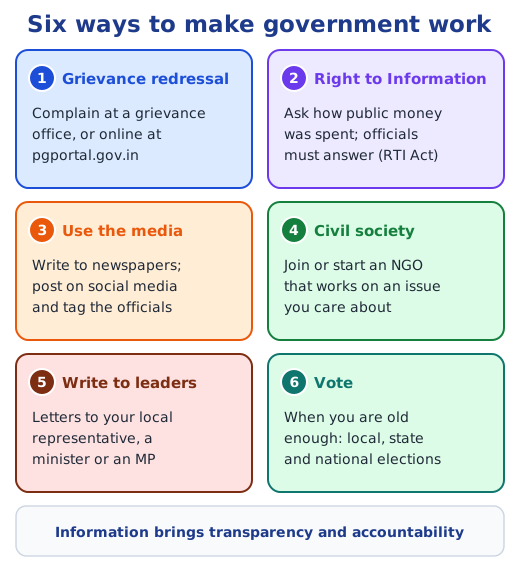
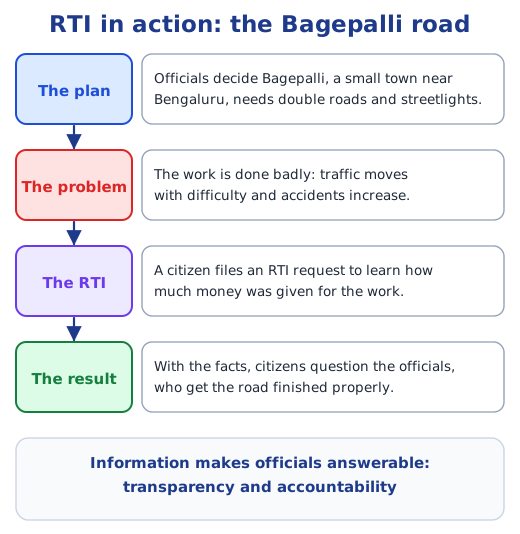
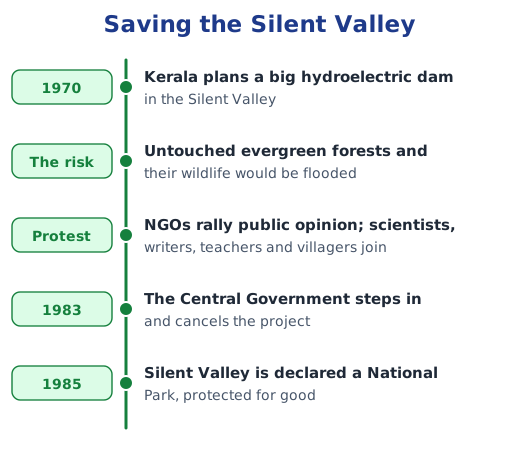
How do you make or help the government do what it is meant to do? How do you make sure your grievances are addressed? The chapter lists six ways. (1) File a grievance at a department’s grievance office, report corruption to a vigilance commission, or lodge a complaint on the Public Grievances Portal (pgportal.gov.in), which the department must answer within a set time. (2) Ask for information under the Right to Information Act. In Bagepalli, near Bengaluru, an RTI request about the money spent on a badly built road helped citizens get it finished properly. (3) Use the media, including social media accounts such as @RailwaySeva. (4) Work through civil society organisations; NGOs led the movement that saved Kerala’s Silent Valley. (5) Write to your local representatives, ministers or members of Parliament. (6) Vote in local, state and national elections once you are old enough.
Let’s Explore (page 160): collect newspaper editorials, find their topics and count how many are about government policies. Collect a week’s editorials from two or three newspapers and, in a group, write the topic of each in a table. Then mark those that discuss a government policy, law, scheme or decision. In most weeks a large share of editorials, often half or more, is about the government. This shows how the media keeps citizens informed and holds the government to account. For example, if 7 of 12 editorials discuss a policy, write “7 out of 12”.
Tiers of government (pages 161–163)
Let’s Remember: why do we have three levels of government? Can’t one level do everything? No. India has more than 1.4 billion people living in 28 states and 8 union territories, in countless towns and villages, speaking many languages. A single central government cannot know or meet the needs of every place. So the work is shared: the central government handles national matters such as defence and currency, state governments handle matters such as police and health, and local governments handle local needs such as water and streetlamps.
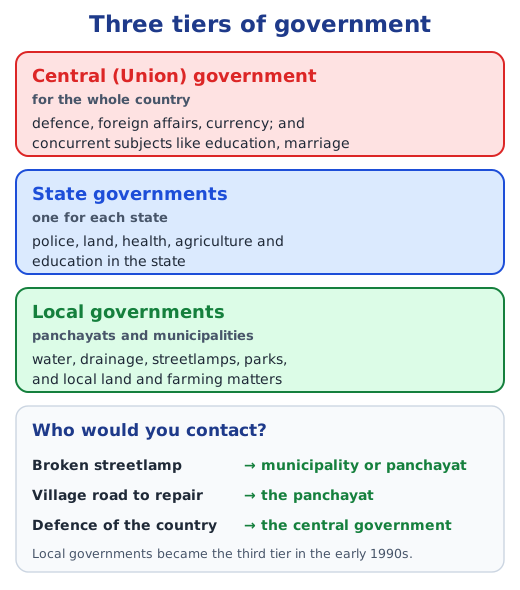
Think About It (page 162): who would you contact about a broken streetlamp? Would villagers ask the Central Government to repair a village road? For a broken streetlamp, the local government: the municipality or ward office in a town, or the gram panchayat in a village. For a village road, the villagers would go to their gram panchayat (or the block office), not the Central Government, which deals with national matters such as defence.
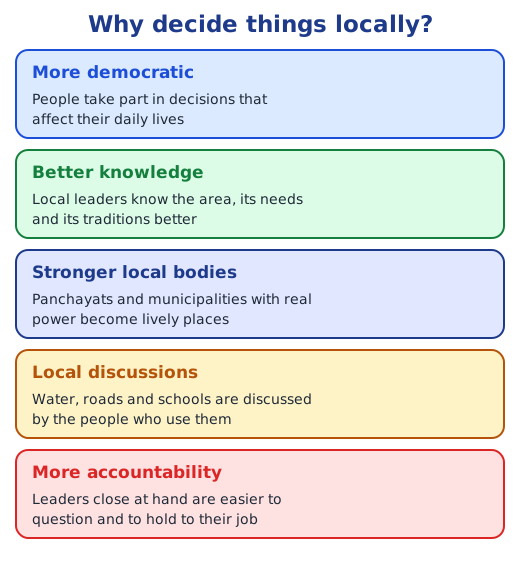
Let’s Explore (page 162): why should local decisions be taken locally as far as possible? Local people and their leaders know the area, its needs and its traditions better than anyone. Problems get solved faster when they need not travel up to distant offices. People can take part in decisions that affect their daily lives, and leaders who live nearby are easier to question. This also frees the state and central governments to focus on bigger matters, such as the country’s defence.
Let’s Explore: achievements and problems (page 165)
Five achievements, and which level of government made them possible. For example:
- More children in school: union and state governments, through the Right to Education Act and schemes like Samagra Shiksha, with schools run locally.
- Midday meals in schools under PM Poshan: union and state governments.
- Better roads: state and local governments, with central funds for highways.
- Mobile phones and the internet in villages: the central government, which looks after communications.
- Vaccination drives such as the COVID-19 drive: union and state health departments, carried out by local health workers.
Five problems people face, and where they should be addressed. For example:
- Garbage piling up on streets: the municipality or panchayat.
- Water shortages: local governments, with state water boards.
- Crowded government hospitals: the state health department.
- Potholed roads: local governments for local roads, state governments for state highways.
- Rising prices and a lack of jobs: central and state governments.
Answers will differ by place; what matters is matching each issue to the level closest to it.
Questions and activities (pages 166–167)
1. “Every democracy is a republic.” Is this statement true or false? Explain. False. A democracy only needs the people to choose their government. A republic also needs an elected head of state, not a hereditary one. Canada, Sweden and the UK elect their governments, but each has a monarch as head of state, so none of them is a republic. India and the USA are both democracies and republics.
2. Give two reasons why decentralisation is important in India. First, local leaders know their area’s needs and traditions better than distant officials, so local problems such as water supply, roads or schools are solved faster and better. Second, it makes the system more democratic and accountable: people take part in decisions that affect their daily lives, and leaders who live close by are easier to question.
3. A student council works like a mini-parliament. Should the president make all the decisions, or should power be shared? Power should be shared among all members. Members are elected by different classes, so sharing lets every group be heard; decisions improve when people with different views debate them; and no single person can misuse power or take unfair decisions. If the president is absent or wrong, the others can still act or correct the decision.
Should the student council make rules about the food you eat or the language you speak? No. These are personal choices tied to each student’s family, culture and rights. A council should deal only with matters it was set up for, such as events, cleanliness or sports, and it must respect everyone’s rights, just as the Constitution limits the government.
What can go wrong if the council is the most powerful body and no one questions it? It could make unfair rules, favour its friends, ignore the needs of smaller groups or misuse funds, and students would have nowhere to complain. Checks are needed: rules it must follow, teachers and the principal who can review its decisions, students who can question it, and elections that can replace its members.
4. India’s democracy in real life.
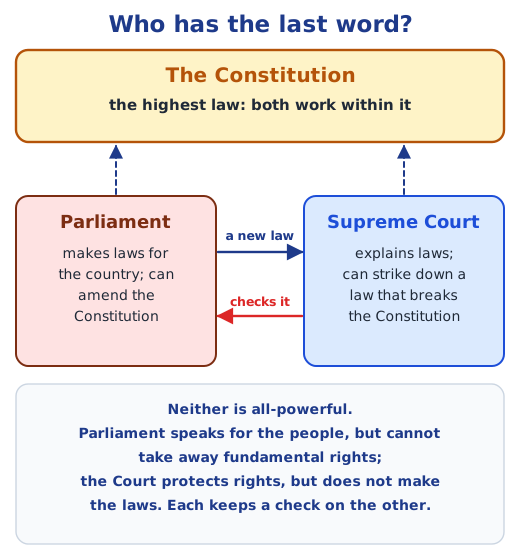
Should the Parliament be the most powerful institution in the country? No single institution should hold all power. Parliament represents the people and makes laws, but the executive carries them out and the judiciary checks that laws and actions follow the Constitution. This balance prevents misuse of power.
Should Parliament be able to make any law it wants, even if it affects your rights? No. The Constitution limits Parliament, so it cannot pass laws that take away fundamental rights such as equality before the law or freedom of speech and religion. Such laws can be struck down by the courts.
What could go wrong if lawmaking had no limits? Could it lead to unfair laws? Yes. A majority could pass laws that hurt minorities, silence critics or keep itself in power, the dominance of the majority that the chapter warns about. Rights would depend on whoever won the last election.
Who is more powerful in India, the Parliament or the Supreme Court? Neither is above the other; both work under the Constitution, which is supreme. Parliament makes laws and can even amend the Constitution. The Supreme Court explains laws and can strike down any law that breaks the Constitution. (Extra: since 1973 the Supreme Court has held that even amendments cannot change the Constitution’s basic structure.) Each checks the other, which is how checks and balances work.
5. Ask your parents or guardians how they dealt with the government in the past year; list and classify the items by level, and note the challenges. A sample list:
- Local government: paying property tax, getting a birth certificate, a water connection, complaining about garbage or a broken streetlamp.
- State government: a ration card, a driving licence from the transport office, the electricity bill, land records, admission to a state government school, a visit to a government hospital.
- Central government: a passport, income tax, updating Aadhaar, booking train tickets, a post office savings account.
Common challenges: long queues and repeated visits, many documents, websites that are hard to use, information only in some languages, and sometimes demands for bribes. Note which ones they solved through a grievance portal, a helpline or an RTI request.
Practice
-
Which statement is true?
Show answer
Answer: (c) One country may be a democracy and a republic at once
-
Streetlamps and drainage are usually the work of which tier of government?
Show answer
Answer: (c) Local
-
In which year was the Silent Valley declared a National Park?
Show answer
Answer: (c) 1985 The Central Government cancelled the dam in 1983, and two years later, in 1985, the valley became a National Park.
-
Give two reasons why decentralisation is important in India.
Show answer
Answer: Local leaders know their area, its needs and traditions better than distant officials, so problems like water supply or drainage get solved faster and better. And people get to take part in decisions that affect their daily lives, while leaders who live close by are easier to question, which makes them more accountable.
-
Should Parliament be able to make any law it wants? Why or why not?
Show answer
Answer: No. Parliament speaks for the people, but the Constitution limits its power so that a majority cannot pass laws that take away fundamental rights such as equality or freedom of speech. If a law breaks the Constitution, the courts can strike it down.
Stuck on a question?
Take a photo and Lagnever AI explains it step by step. Try it for 7 days for ₹2.
Get it on Google Play Open in browser
For parents: after the trial, the plan renews monthly by UPI or card autopay. You can cancel anytime in the app.