
Class 7 Social Science Part 2 Chapter 6: The State, the Government, and You Notes
This chapter in five lines
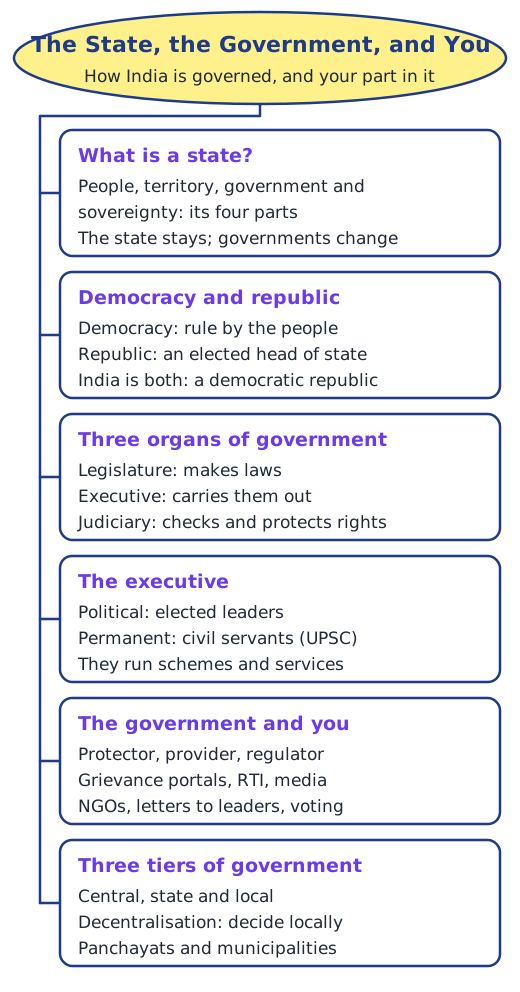
The State, the Government, and You explains how India is governed. A state has four parts: people, territory, government and sovereignty, and the government is the part that changes after elections. India is a democratic republic. Its legislature, executive and judiciary work at three levels, and citizens can make the government work through grievance portals, RTI, the media, NGOs, letters and votes.
What is this chapter about?
In Class 6 you met the three functions of a government (making laws, carrying them out and seeing that they are followed) and its three levels. This chapter goes further. It opens with a line of Socrates from Plato’s Republic: people who refuse to take part in ruling end up ruled by someone worse than themselves. It then asks three big questions: how a state differs from a government, how a democracy differs from a republic, and how citizens can make the government work for the people.
State and government
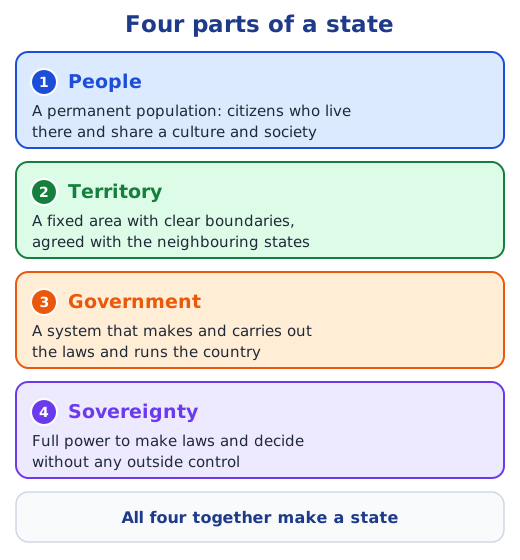
A state is a political organisation with the right to rule a defined territory and the people in it. It has four parts: a permanent population, a territory with agreed boundaries, a government, and sovereignty, the full power to make its own laws without outside control. The government is only one of these parts: the leaders, ministers and officials who make and enforce laws and settle disputes. Like teachers in a school, governments come and go after elections, but the state remains. The police, part of each state government, keep law and order. Read state and government.
Democracy and republic
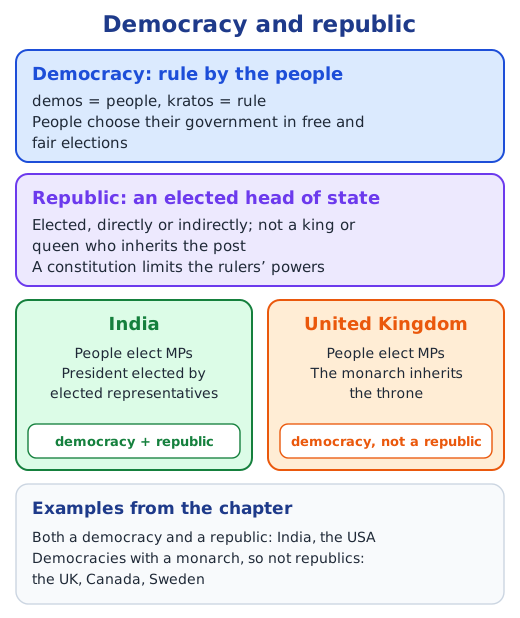
In a democracy the people rule by choosing their government in fair elections. In a republic, on the other hand, the head of state gets the post by election, direct or indirect, rather than by birth, and a constitution limits what rulers may do. The UK is a democracy with a monarch, so it is not a republic; India elects its President through its elected representatives, so it is a democratic republic. India’s Constitution protects every citizen’s fundamental rights, so a majority cannot trample a minority. See democracy and republic.
Three organs of government
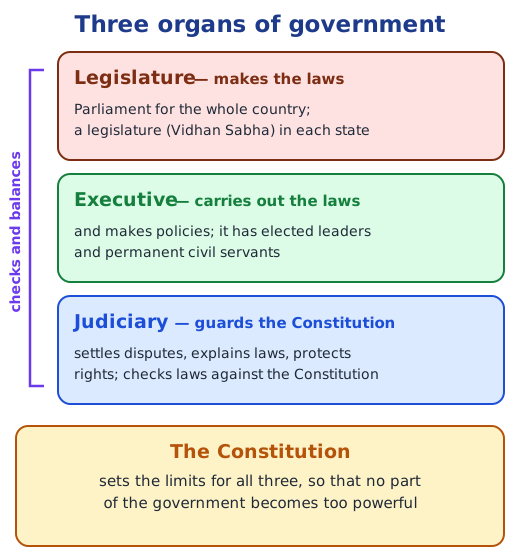
The legislature makes laws: Parliament for the country and a legislature in each state. The executive carries out laws and makes policies. Its political part is made up of elected leaders such as the prime minister and ministers; its permanent part is made up of civil servants selected by exams, from IAS officers to teachers and health workers at the grassroots. The judiciary, the independent guardian of the Constitution, settles disputes, explains laws and protects rights. Read legislature, executive and judiciary.
The government and you
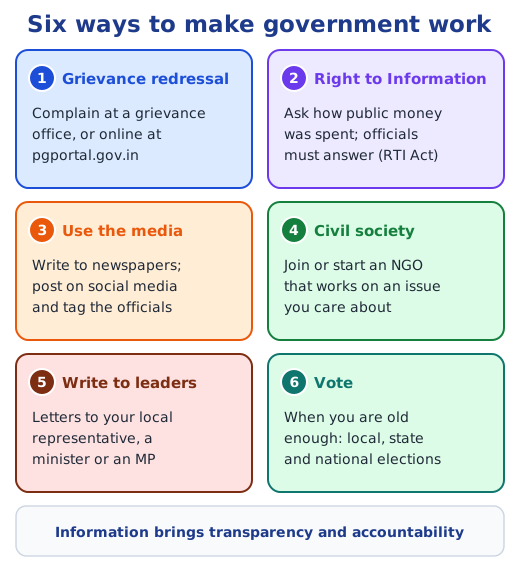
The government is a protector (law and defence), a provider (welfare, schools, roads, railways) and a regulator (for example, of food safety). Yet bribery, poor services and weak access to schemes remain. Citizens can push for change in six ways: grievance portals such as pgportal.gov.in, the Right to Information Act, the media, civil society organisations, letters to their representatives and, when old enough, the vote. In Bagepalli, an RTI request got a badly built road fixed; in Kerala, a people’s movement saved the Silent Valley forests.
Three tiers of government
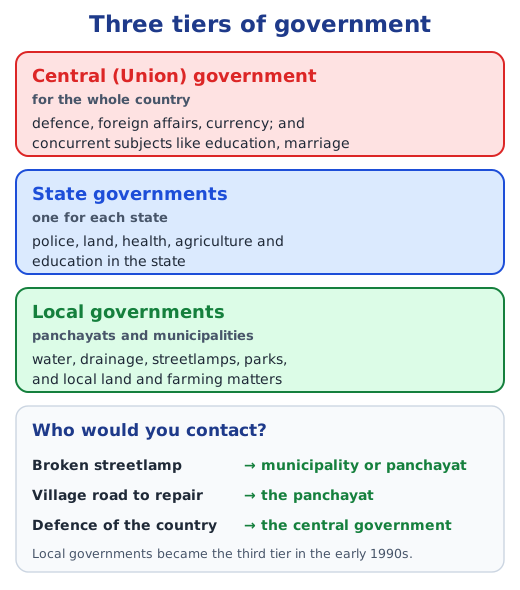
India is too large and varied for one government to meet every need, so power is shared among three tiers. The central government looks after defence, foreign affairs and currency; state governments look after police, land, health and agriculture; local governments, panchayats and municipalities, handle water, drainage, streetlamps and parks. Local governments became the third tier through amendments to the Constitution in the early 1990s. This decentralisation brings decisions closer to the people, who know their own problems better than anyone. Answers to every question are in the NCERT solutions for Part 2 Chapter 6.
Key terms
| Term | Meaning |
|---|---|
| State | A political organisation with the right to rule a defined territory and the people living in it. It has four parts: people, territory, government and sovereignty. |
| Government | The leaders, ministers and officials who make and enforce laws and settle disputes. It acts for the state and changes after elections, while the state remains. |
| Sovereignty | The state’s full power to make and carry out its own laws without outside control. No other state can interfere in its internal affairs. |
| Democracy | Rule by the people, from the Greek demos (people) and kratos (rule). People choose their government in fair elections. |
| Republic | A form of government whose head of state is chosen by election, directly or indirectly, instead of inheriting the post, and whose constitution limits the rulers’ powers. |
| Dominance of the majority | A situation in which only the majority’s interests are pursued, to the harm of minorities’ rights. A republic’s rule of law guards against it. |
| Political executive | Elected leaders such as the prime minister, chief ministers and ministers, who make the big decisions. The president and governors are counted here too, with mostly formal roles. |
| Permanent executive | Government officers selected through exams such as those of the UPSC, also called bureaucrats or civil servants. They stay whichever party wins and carry out laws and policies. |
| Right to Information (RTI) | A law that lets citizens request information on government work that concerns the public, such as how public money was spent. Officials are bound to answer. |
| Decentralisation | Spreading power and decision-making across levels of government, so that local problems are solved locally and bigger issues by the state or central government. |
Topics in this chapter
Practice
-
Which of these is NOT one of the four parts of a state?
Show answer
Answer: (d) A king or queen
-
In a republic, the head of state is:
Show answer
Answer: (b) elected, directly or indirectly
-
Which country is named in the chapter as a democracy but not a republic?
Show answer
Answer: (c) The UK
-
Officers selected through UPSC examinations belong to:
Show answer
Answer: (b) the permanent executive
-
Which law lets citizens ask how public money was spent?
Show answer
Answer: (a) The Right to Information Act
-
A broken streetlamp in your neighbourhood should first be reported to:
Show answer
Answer: (c) the municipality or panchayat
Questions students ask
What are the main topics of Class 7 Social Science Part 2 Chapter 6?
How a state differs from a government; the police; democracy and republic and why India is a democratic republic; the legislature, the political and permanent executive and the judiciary; how citizens can make the government work; and the three tiers of government and decentralisation.
Is The State, the Government, and You in the new NCERT Social Science book?
Yes. It is Chapter 6 of Exploring Society: India and Beyond, the Class 7 Social Science textbook Part 2 (2026-27), on pages 143 to 168, in the theme Governance and Democracy.
How is a state different from a government?
The state is the larger idea: a people living in a defined territory, with sovereignty and a government. The government is one part of it, the people and system that make and carry out laws. Governments change after elections, but the state remains, like a school whose teachers come and go.
Stuck on a question?
Take a photo and Lagnever AI explains it step by step. Try it for 7 days for ₹2.
Get it on Google Play Open in browser
For parents: after the trial, the plan renews monthly by UPI or card autopay. You can cancel anytime in the app.