
Democracy and republic: what is the difference?
Answer in short
In a democracy the people rule, choosing their government through fair and open elections. A republic, by contrast, has an elected head of state, chosen directly or indirectly instead of inheriting the post, and a constitution limits the rulers’ powers. India is both, while the UK, Canada and Sweden, each with a monarch, are democracies only.
Stuck on a question? Take a photo and Lagnever AI explains it step by step. Try it for 7 days for ₹2. Get it on Google Play
Two words in the Preamble
The Preamble to India’s Constitution uses the words “democratic” and “republic” side by side. People often treat them as meaning the same thing, so why use both? India had lived under British rule for nearly two centuries, yet at Independence it did not simply copy the British parliamentary system. While the Constitution was being made, its makers debated what kind of parliamentary democracy India should have, and one answer lies in these two words.
Democracy: rule by the people
At its heart, democracy means people’s rule: demos means people and kratos means rule. The people hold the power to pick their government in fair elections, and the government must answer to their representatives.
Republic: no king or queen
A republic fills its highest office, the head of state, by election, direct or indirect, never by birth: no king or queen inherits the post. A republic also limits its rulers’ powers through a constitution or laws.
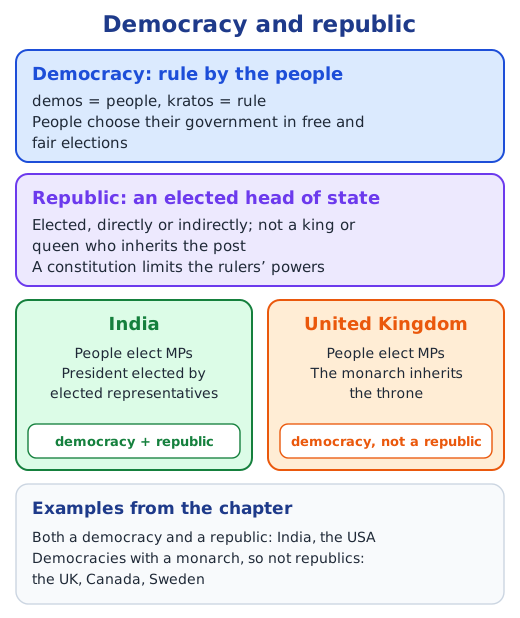
India and the United Kingdom show the difference. In both, people elect their representatives, and the government answers to parliament. But the UK has had a monarch as head of state for centuries, while the framers of India’s Constitution chose an elected head of state: the President, picked by elected representatives rather than by a direct vote of the people. So India is both a democracy and a republic, like the USA. Canada, Sweden and the UK each have a monarch, so they count as democracies but not as republics.
Protecting the rights of all
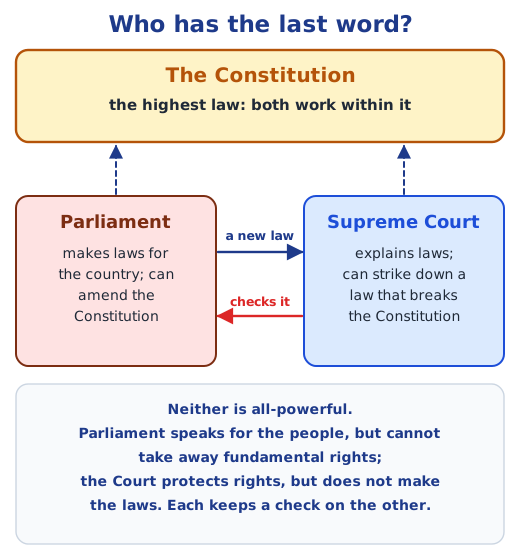
As a democratic republic, India gives fundamental rights to all its citizens through its Constitution. The Constitution and the law make sure that rule by an elected majority does not trample anyone’s fundamental rights. For example, some lands belong to tribal communities and are protected by law: companies and outsiders cannot buy or lease them without the community’s permission and due legal process. Mining was stopped in the Dongria Kondh community’s sacred hills in Odisha because the community opposed it.
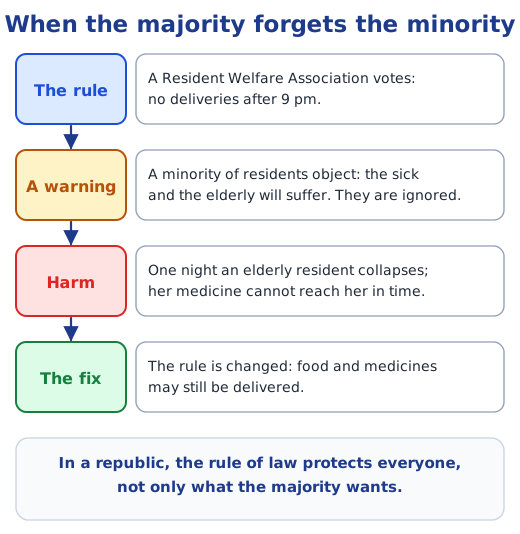
Why does this matter? A Resident Welfare Association once voted, by majority, to ban deliveries after 9 pm, brushing aside a few residents who said the sick and elderly would suffer. Then an elderly woman collapsed when her medicine could not reach her in time, and the rule was changed. When only the majority’s wishes count, minorities get hurt; this is called the dominance of the majority. In a republic the rule of law stands above the wishes of the majority. Republics such as India, France and the USA guard against it, and elected leaders cannot pass laws against basic rights such as freedom of speech and religion, or equality before the law. The Constitution also keeps any one part of the government from growing too powerful.
Washington says no to a crown
In 1782, near the end of America’s war of independence against Britain, an officer wrote to General George Washington suggesting that he become king of America. Washington firmly refused. A crown, he replied, would damage the new nation, and he trusted only government by the people, bound by a constitution. Years later, in 1789, he became the first President of the United States, elected rather than crowned.
Why it matters
Knowing what makes India a democratic republic helps you see why your vote counts and why your rights are protected even if you are in a minority. Read more in state and government and legislature, executive and judiciary. Answers to the textbook questions are in the NCERT solutions for Part 2 Chapter 6; see all of Part 2 Chapter 6 notes.
Practice
-
The word democracy comes from demos and kratos, which mean:
Show answer
Answer: (a) people and rule
-
How is India’s head of state, the President, chosen?
Show answer
Answer: (b) By a group of elected representatives
-
Which country is a democracy but not a republic?
Show answer
Answer: (c) Canada
-
Why did the RWA in the chapter change its rule on late deliveries?
Show answer
Answer: A majority vote had banned deliveries after 9 pm, ignoring residents who warned that the sick and elderly would suffer. When an elderly resident collapsed because her medicine could not reach her in time, the RWA allowed food and medicines to be delivered, protecting the minority.
-
What did George Washington do in 1782 that showed his belief in a republic?
Show answer
Answer: When one of his officers suggested that he become king of America, Washington firmly refused. He answered that it would damage the country, and that the only government he believed in was one by the people, under a constitution. In 1789 he became the United States’ first President.
Questions students ask
How is a democracy different from a republic?
A democracy is about who chooses the government: the people, in fair elections. A republic is about the head of state: elected, directly or indirectly, rather than a king or queen who inherits power, with a constitution limiting the rulers. A country can be both, like India, or only a democracy, like the UK.
Why is India called a democratic republic?
Because its people elect their representatives, who form the government, and its head of state, the President, is elected by elected representatives instead of inheriting the post. Its Constitution also limits the powers of those in office and protects the fundamental rights of every citizen.
Is every democracy a republic?
No. A democracy needs only that the people choose their government. The UK, Canada and Sweden do that, but each has a king or queen as head of state, so they are democracies but not republics. India and the USA are both.
Stuck on a question?
Take a photo and Lagnever AI explains it step by step. Try it for 7 days for ₹2.
Get it on Google Play Open in browser
For parents: after the trial, the plan renews monthly by UPI or card autopay. You can cancel anytime in the app.