
State and government: what is the difference?
Answer in short
A state is a political organisation with authority over a defined territory and its people, and it has four parts: people, territory, government and sovereignty. The government is only one of these parts: the leaders and officials who make laws, enforce them and settle disputes. Governments change after elections; the state remains.
Stuck on a question? Take a photo and Lagnever AI explains it step by step. Try it for 7 days for ₹2. Get it on Google Play
What is a state?
A state (the book also says nation) is a political organisation with the right to rule over a defined territory and the people who live there. The chapter lists four parts that every state has.
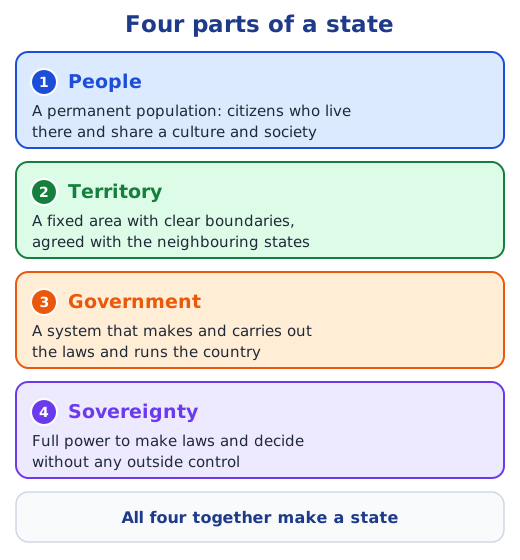
In a conversation in the book, a girl asks her older cousin, a political science student, to explain them. People come first: without a population there is no state. Tourists who visit and leave do not count, because they share nothing and do not live together. People who live in a place and identify with it form a permanent population, with its own culture and society. Territory means a geographically defined area with clear boundaries. These boundaries need not be rivers or mountains; they are lines agreed upon with the neighbouring states. Government is needed because people living together need laws, made and carried out. Sovereignty means the state alone decides its own affairs: no other state or outside body can interfere in its internal affairs. Without it, a place cannot be a state.
“state” or “State”?
In India, “state” has two uses. It can mean the Indian State, the whole country as a political organisation, or one of its units, such as the State of Kerala or Maharashtra. The chapter uses a small “s” except in such cases.
What is a government?
The government is the group of people, and the system, that runs the country. Its leaders, ministers and officials make laws, enforce laws and resolve disputes. It is only one part of the state, and it can change after elections while the state stays the same.
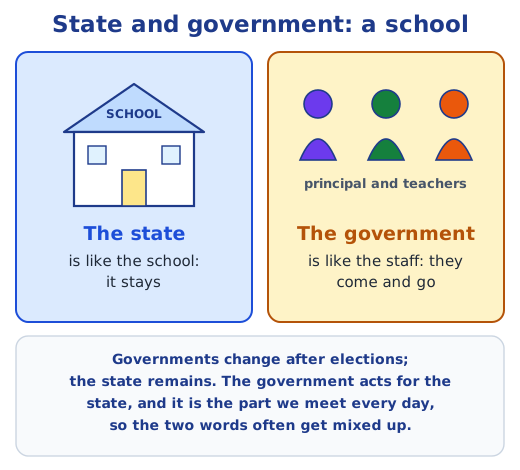
Picture the state as a school, with the government as its principal and teachers. Teachers leave and new ones join, yet the school carries on. Why, then, do people use the two words for the same action? The government works for the state and handles its everyday business, so it is the part of the state we actually see; we deal with the government, not with the whole state.
People, police and the state
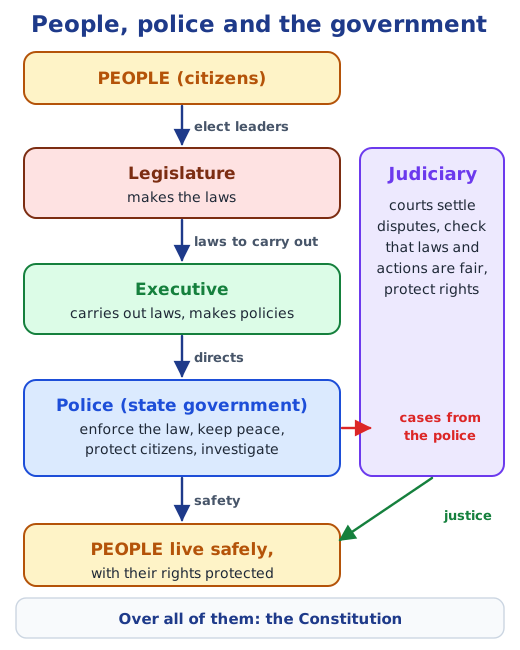
The police are the part of the government that many people see most often. In India they belong to each state government and work with local people in villages, towns and cities. As agents of the state they may lawfully use force so that people live safely, without crime or violence. They work with the courts and prisons, and they also run awareness drives about safety on the roads, drug abuse and the safety of women. Yet they must respect and protect the rights the Constitution gives every citizen.
Why have a government at all?
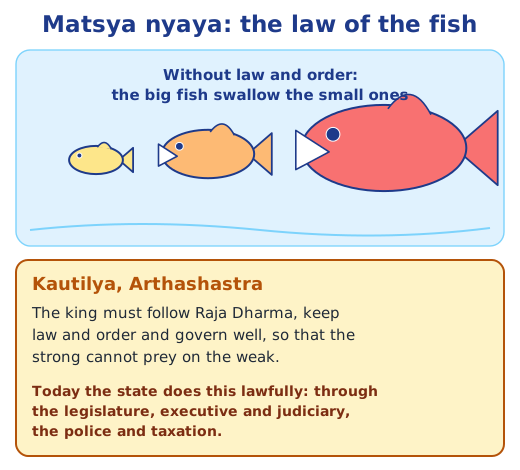
Kautilya, the author of the Arthashastra, wrote that the king, as the main authority of the state, must follow Raja Dharma, keep law and order and govern well. Without a government, he warned, society would fall into chaos, with the big fish eating the smaller ones. This is called matsya nyaya, the law of the fish. Today the Indian state works through institutions, the legislature, executive and judiciary, and it claims the lawful use of power, for example through the police and taxation.
Why it matters
Knowing the difference helps you see who is responsible for what: the state is lasting, while governments are chosen, judged and changed by the people. Read on in democracy and republic and legislature, executive and judiciary. Answers to the textbook questions are in the NCERT solutions for Part 2 Chapter 6; see all of Part 2 Chapter 6 notes.
Practice
-
Which part of a state means it can make its own laws without outside control?
Show answer
Answer: (c) Sovereignty
-
In the chapter’s school example, the government is like:
Show answer
Answer: (b) the principal and teachers
-
Which of these is a task of the police?
Show answer
Answer: (c) Maintaining law and order
-
Why must a state have a permanent population?
Show answer
Answer: Without people there can be no state. Visitors who come and go, like tourists, do not live together or share anything. People who live in a place and identify with it form a permanent population, which develops its own culture and society tied to that territory.
-
Why do people often use “state” and “government” as if they meant the same?
Show answer
Answer: The government works for the state and handles its everyday business, so it is the part of the state people actually see and deal with. That is why one action may be described as the state’s doing or as the government’s decision.
Questions students ask
How does a state differ from a government?
The state is the larger whole: a permanent population living in a defined territory, with a government and sovereignty. The government is one part of it, the people and system that make, enforce and apply the laws. Governments change after elections, but the state remains.
What are the four features of a state?
A permanent population (the people), a defined territory with boundaries agreed with neighbouring states, a government that makes and carries out laws, and sovereignty, the right to make its own laws and decisions with no outside control.
Are the police part of the government?
Yes. In India the police are part of each state government. They keep law and order, protect people, investigate crimes and present cases to the courts. They may lawfully use force to keep people safe, but they must respect and protect the rights given by the Constitution.
Stuck on a question?
Take a photo and Lagnever AI explains it step by step. Try it for 7 days for ₹2.
Get it on Google Play Open in browser
For parents: after the trial, the plan renews monthly by UPI or card autopay. You can cancel anytime in the app.