
Why do different people have different development goals?
Answer in short
People’s life situations differ, so their developmental goals differ, and one person’s development may be no development for another; it can even be destructive. Everyone wants more income, but people also want equal treatment, freedom, security and respect. So development is a mix of goals, and national development means finding a path that is fair for all.
Stuck on a question? Take a photo and Lagnever AI explains it step by step. Try it for 7 days for ₹2. Get it on Google Play
What does development mean to different people?
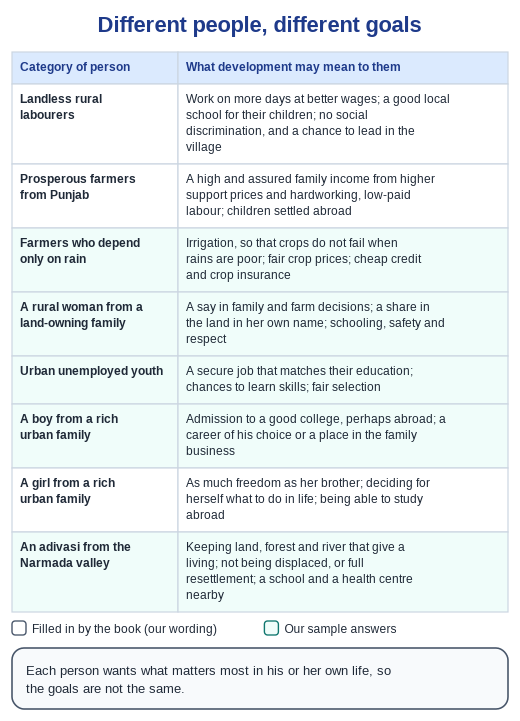
The chapter begins with a table of very different people: landless rural labourers, prosperous farmers from Punjab, farmers who depend only on rain, a rural woman from a land-owning family, urban unemployed youth, a boy and a girl from rich urban families, and an adivasi from the Narmada valley. It fills in a few rows and asks you to complete the rest.
Landless labourers want more days of work and better wages, a local school that teaches their children well, and a village with no social discrimination, where they too can become leaders. Prosperous farmers want a high and assured income, from better support prices for what they grow and from hardworking, low-paid labour, and hope to settle their children abroad. A girl from a rich urban family wants as much freedom as her brother and the power to decide what she does in life.
Our sample answers for the other rows are in the diagram below. The point is simple: each person seeks what is most important in his or her own life.
Can one person’s development hurt another?
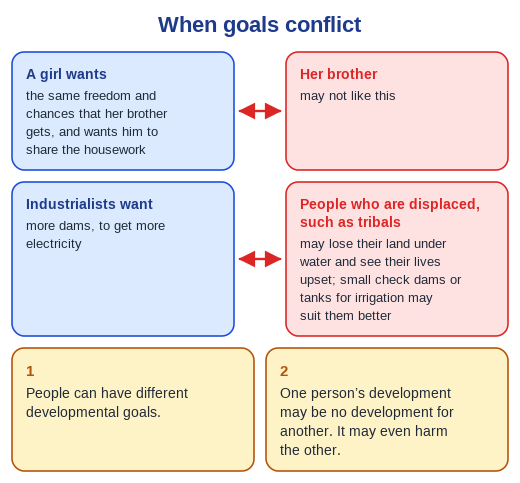
Yes. Sometimes two persons or groups want things that clash. The chapter gives two examples.
- A girl wants the same freedom and chances that her brother gets, and wants him to share the housework. Her brother may not like this.
- Industrialists may want more dams so that there is more electricity. But a dam can drown land and upset the lives of those it displaces, tribal people for example. They may resent this, and small check dams or tanks for irrigation may suit them better.
Two things follow. First, people can have different developmental goals. Second, one person’s development may be no development for another; it may even harm the other.
What do all these people have in common?
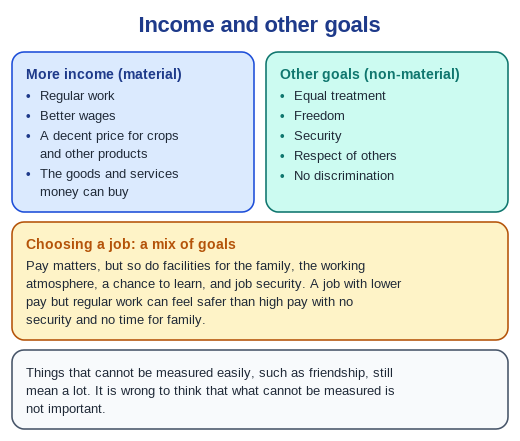
Go through the table again and one thing stands out. People want regular work, better wages and a fair price for whatever they grow or make. In other words, they want more income.
Is income all that people want?
No. Besides more income, people seek equal treatment, freedom, security and the respect of others. They resent discrimination. In some cases these goals may matter more than extra income or consumption, since a good life needs more than material goods.
Money, and the things it buys, is one factor our life depends on. But the quality of life also depends on non-material things. Think of what your friends mean to you: friendship cannot be measured in rupees, yet you value it. Many such things are not easily measured, so they are often ignored. That does not make them unimportant.
How do people weigh these goals?
Suppose a job is offered to you in a distant town. Before saying yes, you would think about more than the salary: facilities for your family, the working atmosphere, the opportunity to learn. One job may pay less but offer regular employment, which adds to your sense of security. Another may pay well but have no job security and leave no time for your family, which reduces your sense of security and freedom.
The same holds for society. When women earn through paid work, they gain dignity at home and in society. And where women are respected, housework is shared more and women working outside the home is accepted more readily. A safe and secure environment lets more women choose from many kinds of jobs or start a business.
So people’s developmental goals go beyond a better income to other important things in life. In judging development, people weigh a mix of goals.
What is national development?
If individuals seek different goals, their notions of national development will differ too. Ask your class what India should do for development and you will hear many answers; you may yourself think of several and not be sure of any. Different persons can have different, and even conflicting, notions of a country’s development.
But can every idea count equally? If they conflict, how does one decide? The chapter suggests the questions to ask:
- Which path would be fair and just for everyone?
- Could things be done in a better way?
- Would the idea help most people, or only a few?
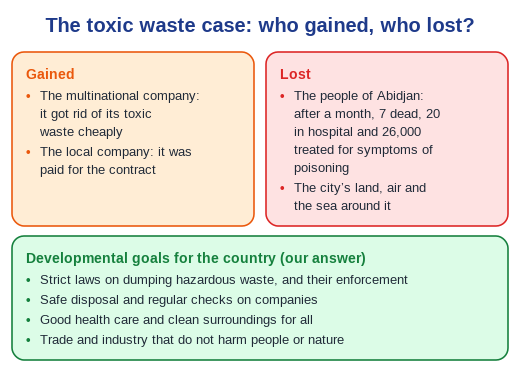
Thinking through such questions is what national development means. The chapter’s own example of what goes wrong is a newspaper report: a ship’s toxic waste was dumped in the city of Abidjan in Ivory Coast, and the people of the city paid with their health and lives for a deal that suited two companies.
Next, read how per capita income and human development are used to compare countries, or go back to the chapter notes or the NCERT solutions.
Practice
-
Which of these is a non-material goal?
Show answer
Answer: (c) Equal treatment
-
Industrialists may want more dams to get more electricity. Who may see this as destructive?
Show answer
Answer: (b) People displaced when land is submerged, such as tribals
-
According to the chapter, what do people in Table 1.1 have in common?
Show answer
Answer: (b) They all want more income in one way or another
-
Why might a job with lower pay still be chosen?
Show answer
Answer: Because it may offer regular employment, which gives a sense of security, or a good working atmosphere, a chance to learn and time for family. People weigh a mix of goals, not income alone.
-
What questions does national development ask?
Show answer
Answer: Whether every idea can count equally, how to decide when ideas clash, which path is fair and just for everyone, whether things could be done in a better way, and whether an idea helps most people or only a few.
Questions students ask
Why do people have different ideas of development?
Because their life situations are different. A landless labourer, a prosperous farmer and an urban unemployed youth face different problems, so each seeks what is most important for his or her own life.
Do “different goals” and “conflicting goals” mean the same?
No. A labourer wanting better wages and a girl wanting equal freedom have different goals that do not clash. Goals conflict when one hurts the other, as when more dams for industry submerge the land of tribal people.
Is income the most important goal?
It is one important goal, because people want regular work and better earnings. But the chapter says equal treatment, freedom, security and respect can at times matter more than extra income or consumption.
Stuck on a question?
Take a photo and Lagnever AI explains it step by step. Try it for 7 days for ₹2.
Get it on Google Play Open in browser
For parents: after the trial, the plan renews monthly by UPI or card autopay. You can cancel anytime in the app.