
NCERT Solutions Class 10 Economics Chapter 3: Money and Credit
Answers to all 13 exercises of Chapter 3, Money and Credit, of Understanding Economic Development, the Class 10 Economics textbook, to the Additional Project, and to every “Let’s Work These Out” question, table and thought bubble inside the chapter. Page numbers follow the 2026-27 reprint (pages 38–53), in the copy NCERT updated in August 2026. The exercises are quoted from the book, except one blank in Exercise 12 that we restate in our own words; the questions inside the chapter are restated in short. Many questions ask for your own view or your own area, so treat those answers as samples. Short notes: Chapter 3 notes.
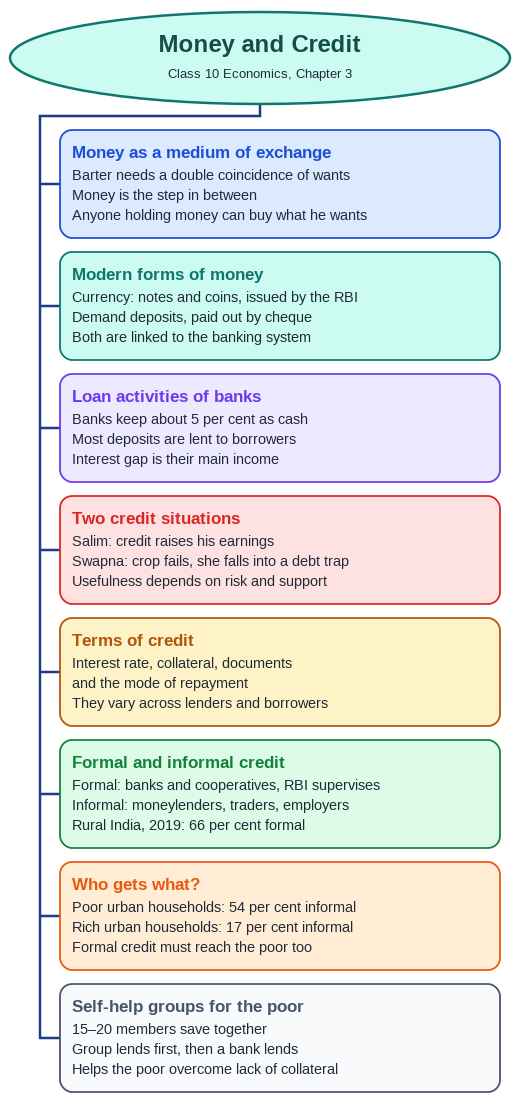
Questions and activities inside the chapter (pages 40–50)
Let’s Work These Out, page 40
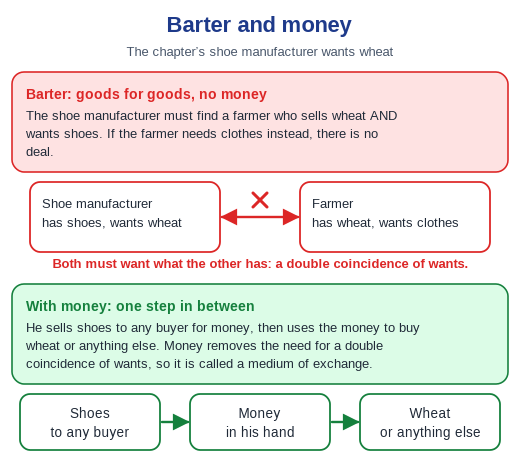
1. How does money make exchange easier? Without money, a person must find someone who has exactly what he wants and also wants exactly what he has. Money removes this need. You sell your goods or services to anyone who wants them, take money, and later buy whatever you need from anyone who sells it. Money also lets you sell now and buy later.
2. Examples of goods or services exchanged, or wages paid, through barter. Samples: a farm labourer paid in grain at harvest time; a village barber or carpenter paid a fixed share of each family’s crop every year; neighbours exchanging vegetables from their gardens for milk; old newspapers given to a hawker in return for steel utensils; children swapping books or stamps.
Let’s Work These Out, page 42
1. How would M. Salim write a cheque to withdraw Rs 20,000 in cash? Extra (banking practice, not described in the chapter): he fills in the date, writes “Self” in place of the payee’s name, writes “Twenty thousand only” in words and Rs 20,000/- in figures, and signs it as the account holder. He then presents it at his own bank branch, and the bank pays him the cash from his account.
2. Tick the right effect of Salim’s cheque to Prem. Option (ii): Salim’s balance goes down and Prem’s goes up. The cheque moves the amount out of Salim’s account and into Prem’s.
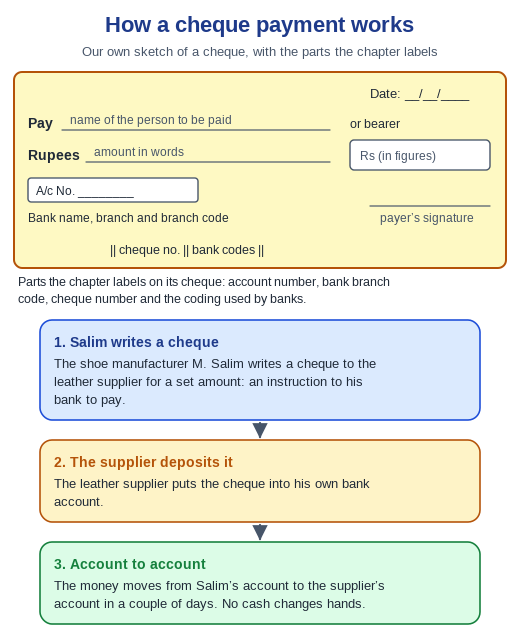
3. Why are demand deposits considered money? They can be withdrawn whenever the depositor wants, and with a cheque the depositor can pay someone directly out of them, without cash. Because people widely accept them as a means of payment, just like currency, they act as a medium of exchange, which is the essential feature of money.
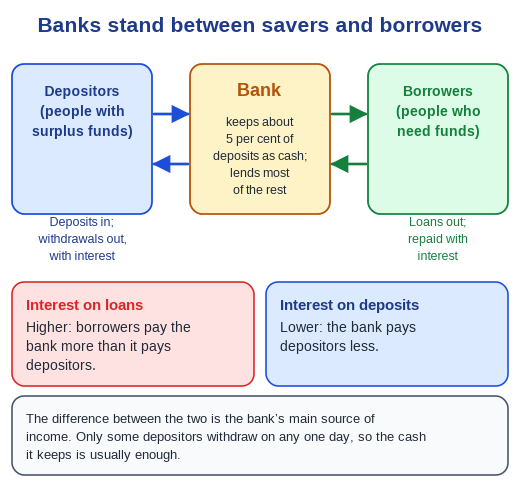
Thought bubble, page 42: what if all depositors asked for their money at the same time? The bank holds only about 5 per cent of its deposits as cash and has lent most of the rest, so it could not pay everyone at once. It would have to recall loans or get help from elsewhere, and depositors could lose trust in it. The system works because only some depositors withdraw on any one day.
Let’s Work These Out, page 44
1. Fill the table for Salim and Swapna.
| Salim | Swapna | |
|---|---|---|
| Why did they need credit? | To meet working capital needs (wages for extra workers and raw materials) for an order of 3,000 pairs of shoes | To meet the expenses of cultivating groundnut on her three acres |
| What was the risk? | Failing to finish and deliver the order on time | Crop failure (from pests or bad weather) on a costly moneylender’s loan |
| What was the outcome? | He delivered on time, made a good profit and repaid the loans | The crop failed, the debt grew, and she sold part of her land: a debt trap |
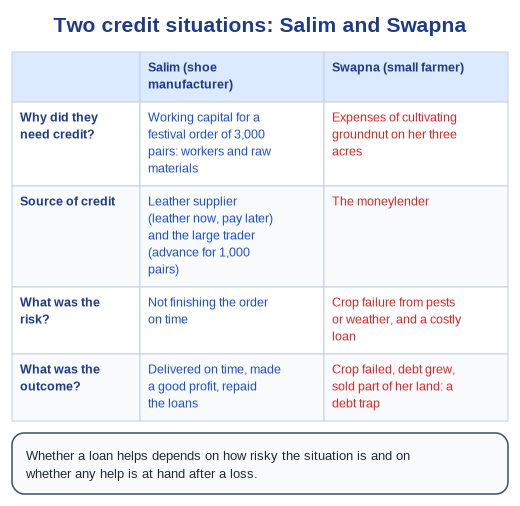
2. If Salim keeps getting orders, what would his position be after 6 years? If he keeps completing orders on time and repaying, his earnings would keep rising. He could save, buy more machines, hire more workers and expand his business. As a reliable borrower he might also get loans on easier terms, and in time he might need less credit for working capital.
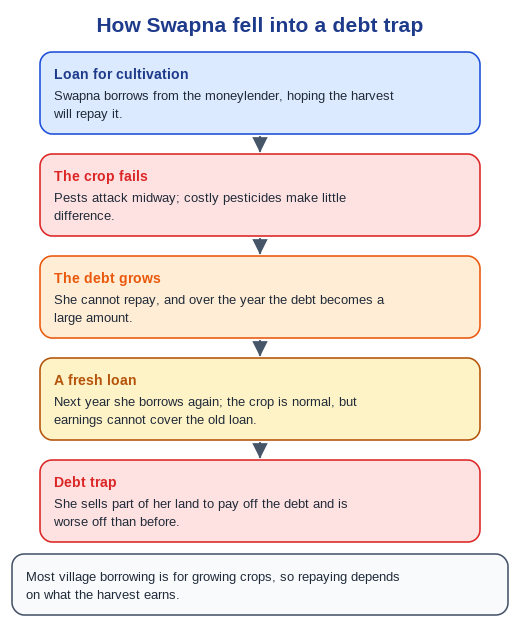
3. Why is Swapna’s situation so risky? Pesticides: they are expensive, and when the pest attack was severe they did not save the crop, so she lost both the crop and the money spent on them. Role of moneylenders: she borrowed from a moneylender, who charges high interest, so an unpaid loan grows quickly into a large debt. Climate: farming depends on weather, so a bad season can wipe out the income from which the loan must be repaid. With no insurance or other support in case of loss, one crop failure was enough to trap her in debt.
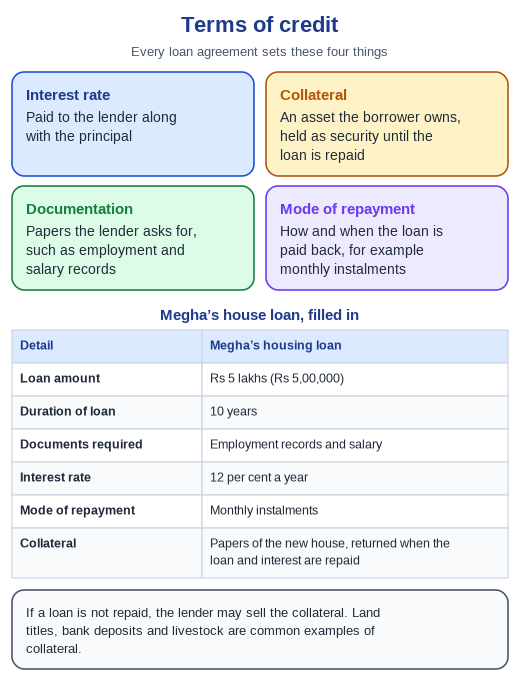
A House Loan, page 45: Megha’s housing loan
| Detail | Megha’s loan |
|---|---|
| Loan amount (in Rupees) | Rs 5,00,000 (Rs 5 lakhs) |
| Duration of loan | 10 years |
| Documents required | Employment records and salary |
| Interest rate | 12 per cent a year |
| Mode of repayment | Monthly instalments |
| Collateral | Papers of the new house |
Let’s Work These Out, page 45
1. Why do lenders ask for collateral? To protect themselves against non-repayment. If the loan is not repaid, the lender can sell the collateral and get the money back. Collateral also makes the borrower more careful to repay.
2. Does widespread poverty affect people’s capacity to borrow? Yes. Poor people often have no collateral such as land, a house or bank deposits, and no regular salary records, so banks are unwilling to lend to them. They are pushed towards informal lenders who charge high interest, which makes it harder to repay and to borrow again.
3. Easy terms of credit mean: low interest rate, easy conditions for repayment, less collateral and documentation requirements.
Let’s Work These Out, page 47
1. Sources of credit in Sonpur. The village moneylender, the agricultural trader, the bank, the landowner-employers, and the Krishak Cooperative.
2. Uses of credit in Sonpur. Cultivation (seeds, fertilisers and other farm inputs), the daily expenses of a labourer’s family in months without work, sudden illness, family functions, and through the cooperative, farm implements, agricultural trade, fishery and building houses.
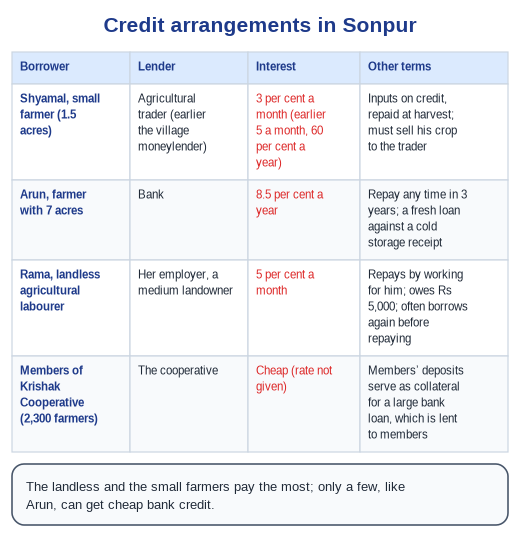
3. Compare the terms of credit. Small farmer (Shyamal): borrows from a trader at 3 per cent a month, inputs on credit repaid at harvest, and must sell his crop to the trader, often at a low price; earlier he paid a moneylender 5 per cent a month. Medium farmer (Arun): a bank loan at 8.5 per cent a year, repayable any time in three years, with a further loan available against his cold storage receipt. Landless worker (Rama): borrows from her employer at 5 per cent a month and repays by working for him, often taking a new loan before the old one is repaid. The poorer the borrower, the harsher the terms.
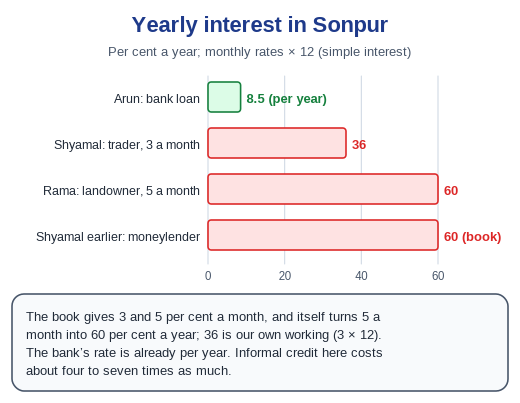
4. Why will Arun earn more from cultivation than Shyamal? Arun pays only 8.5 per cent a year, while Shyamal pays 3 per cent a month (36 per cent a year by our working). Arun can also store his potatoes and sell later at a better price, using a fresh bank loan against the cold storage receipt. Shyamal must sell his crop to the trader right after the harvest, when prices are low. So Arun keeps more of what he earns.
5. Can everyone in Sonpur get cheap credit? No. Only a few, like Arun, who have land to offer as collateral, get cheap bank loans; members of the Krishak Cooperative also get cheap credit. Small farmers and landless labourers depend on traders, moneylenders and landowners at high rates.
6. Tick the correct answers. (i) Rama’s debt will rise over the years: she takes fresh loans before repaying the old ones at 5 per cent a month. (ii) Arun is one of the few to take a bank loan because banks demand collateral which everyone cannot provide.
7. Credit arrangements in your area. Write about your own area. Sample record: a shopkeeper borrows from a bank against his shop papers at a yearly rate and repays monthly; a daily wage worker borrows small sums from a contractor and repays from wages; a woman takes a small loan from her self-help group; a family borrows from relatives for a wedding with no fixed date to repay. Compare the interest, collateral, documents and mode of repayment in each case.
Thought bubble, page 48
Why should a bank want borrowers to have a higher income? A bank earns from the interest on loans, and it can lend again only when loans are repaid. Borrowers with higher incomes repay on time, can borrow more, and also save more, which becomes the bank’s deposits. So a bank gains when its borrowers prosper.
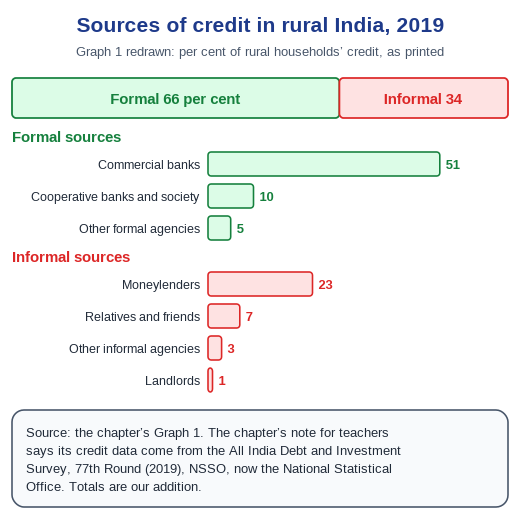
Graph 1, page 48: is more credit coming from the formal or the informal sector? From the formal sector: 51 + 10 + 5 = 66 per cent, against 23 + 7 + 3 + 1 = 34 per cent from informal sources.
Let’s Work These Out, page 50
1. How do formal and informal lenders differ?
| Formal sources | Informal sources |
|---|---|
| Banks and cooperatives | Moneylenders, traders, employers, relatives and friends |
| Supervised by the RBI | No one supervises them |
| Lower interest rates | Usually much higher interest |
| Ask for collateral and documents | Often lend without collateral, to people they know |
| Keep records and follow rules | Keep no records and may use unfair means to recover |
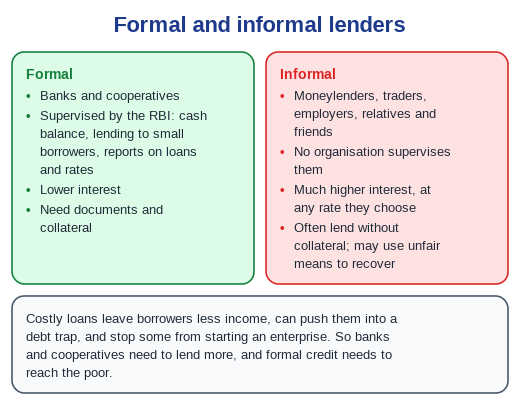
2. Why should everyone be able to borrow at reasonable rates? Costly credit eats up the borrower’s income and can lead to a debt trap. Credit at reasonable rates lets people grow crops, run businesses, set up small industries and earn more, which is crucial for the country’s development. The chapter’s note for teachers calls it a right of the people, without which many would be left out of development.
3. Should a supervisor like the RBI watch informal lenders? Why would it be hard? Yes, a supervisor could check unfair interest rates and harassment of borrowers. But the task would be very difficult: informal lenders are many and scattered, often in remote villages; their loans are personal and unrecorded; many lenders, such as relatives, friends and employers, are not in the lending business at all; and borrowers who depend on them may be afraid to complain.
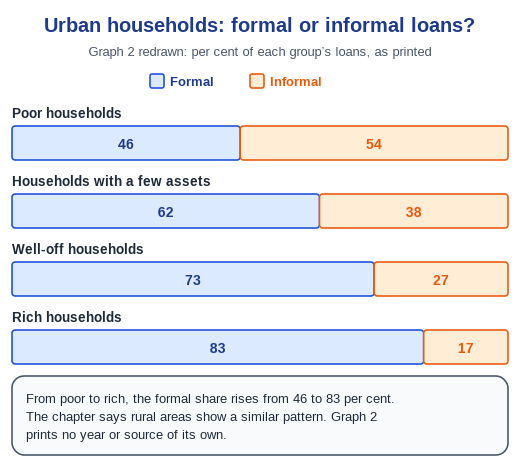
4. Why is the formal share higher for richer households? Richer households can offer collateral and documents, so banks lend to them readily. Poor households often lack both, may live far from a bank, and turn to informal lenders who know them and lend without collateral.
Thought bubble, page 50: a quilt worker asks whether a bank will lend to him. Probably not on his own, if he has no collateral and no salary papers. He would more likely borrow from an informal lender. If he joined a self-help group that saved regularly, the group could get a bank loan and lend to him.
Exercises (pages 52–53)
1. “In situations with high risks, credit might create further problems for the borrower. Explain.”
Answer: When the risk is high, the borrower may lose the very income that was meant to repay the loan.
- Example from the chapter: Swapna, a small farmer, borrowed to grow groundnut.
- Pests destroyed her crop, so she could not repay the loan.
- The debt grew. Next year she took a fresh loan. The crop was normal, but her earnings were not enough to clear the old loan.
- In the end she had to sell part of her land.
The loan was meant to raise her income but left her poorer. This is called a debt trap: a situation where a borrower cannot repay and keeps falling deeper into debt.
2. “How does money solve the problem of double coincidence of wants? Explain with an example of your own.”
Answer: Under barter, both people must want what the other has. This is the double coincidence of wants, and it is hard to find. Money removes this problem because it works as a medium of exchange (a go-between).
Example (our own):
- A potter wants a bicycle, but the bicycle seller does not want pots. With barter, there is no deal.
- With money, the potter sells his pots to anyone who wants them and collects money.
- He pays the bicycle seller in money.
- The bicycle seller can use that money to buy whatever he needs.
3. “How do banks mediate between those who have surplus money and those who need money?”
Answer:
- People with extra money deposit it in banks. The bank keeps it safe and pays interest on it.
- Banks keep only a small part of the deposits, about 5 per cent, as cash for people who come to withdraw.
- They lend most of the rest to people who need money for farming, business, housing and other work.
- Borrowers repay with interest. Banks charge borrowers a higher rate than they pay depositors.
- The difference between the two rates is the main income of banks.
In this way banks link savers and borrowers.
4. “Look at a 10 rupee note. What is written on top? Can you explain this statement?”
Extra (from the note itself; the chapter does not print it): at the top the note says Reserve Bank of India, and it carries a promise, signed by the Governor of the RBI, to pay the bearer the sum of ten rupees, with a line saying the Central Government stands behind it.
The statement shows that the note is money because it is authorised by the government. As the chapter explains, the RBI prints notes for the central government, nobody else may issue currency, and Indian law says no one may turn down a payment in rupees. The paper itself has no value; people accept it because the government and the RBI stand behind it.
5. “Why do we need to expand formal sources of credit in India?”
Answer:
- Informal loans are costly. Moneylenders and traders charge much higher interest. Borrowers keep less of their income and their debts grow.
- High cost stops new work. Some people do not borrow to start a business at all, because the loan costs too much.
- No one supervises informal lenders. They may use unfair means to get their money back.
- Formal loans are cheaper and supervised by the Reserve Bank of India (RBI).
- More formal credit, especially in villages, would raise incomes and help development.
- It must also reach the poor, who today get mostly informal loans.
6. “What is the basic idea behind the SHGs for the poor? Explain in your own words.”
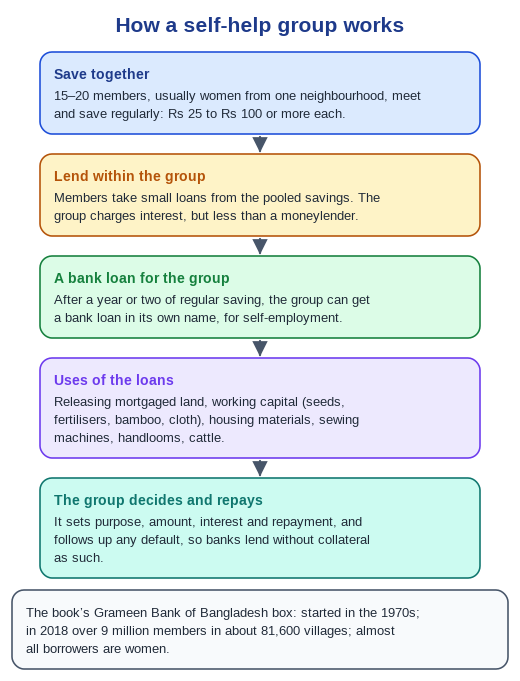
Answer: A self-help group (SHG) brings 15–20 poor people, mostly rural women, together.
- Members save a small amount regularly and pool their savings.
- The group gives small loans to its members at lower interest than moneylenders.
- After a year or two of regular saving, a bank gives a loan to the group. The group as a whole is responsible for repaying it.
- So the poor get timely, cheaper loans without collateral (an asset given as security).
- Members become more self-reliant. The regular meetings also let them discuss issues such as health, nutrition and domestic violence.
7. “What are the reasons why the banks might not be willing to lend to certain borrowers?”
Answer: Banks may not lend when:
- The borrower has no collateral (an asset to offer as security).
- The borrower has no proper documents, such as proof of a job or income.
- The borrower has no regular income.
- The borrower has not repaid earlier loans.
- The work is very risky, such as farming that depends only on rain.
Also, banks are not present everywhere in rural India.
8. “In what ways does the Reserve Bank of India supervise the functioning of banks? Why is this necessary?”
Answer: How the RBI supervises banks:
- It checks that banks really keep the minimum cash they must hold out of their deposits.
- It checks that banks lend to small farmers, small industries and other small borrowers, not only to big businesses and traders.
- Banks must report to the RBI from time to time how much they lend, to whom and at what interest rate.
Why this is needed: to keep depositors’ money safe, to make sure banks can pay people who come to withdraw, and to see that loans reach small borrowers on fair terms.
9. “Analyse the role of credit for development.”
Answer: Credit (loans) can help development, but it can also harm.
How credit helps:
- It gives working capital (money to run a business day to day), as for Salim in the chapter.
- Farmers can buy seeds and fertilisers, people can start businesses and small industries, and families can build houses.
- So cheap and affordable credit raises production and incomes.
How credit can harm: when the risk is high or the interest is very high, as for Swapna and Rama, the borrower can fall into a debt trap.
Conclusion: development needs more formal credit at fair rates, shared so that the poor also get it, through banks, cooperatives and SHGs.
10. “Manav needs a loan to set up a small business. On what basis will Manav decide whether to borrow from the bank or the moneylender? Discuss.”
Answer: Manav will compare the terms of credit (the conditions of the loan) of the two lenders.
- Interest rate: a bank usually charges much less than a moneylender. So more of his business income will stay with him.
- Collateral and documents: a bank asks for these. A moneylender may lend without them.
- Mode of repayment: he will check whether the instalments suit the way his business earns.
- Safety: banks are supervised by the RBI and keep proper records. A moneylender is not supervised and may use unfair means.
Conclusion: if Manav can meet the bank’s conditions, the bank loan is better. A costly moneylender’s loan would add to his risk.
11. “In India, about 80 per cent of farmers are small farmers, who need credit for cultivation.”
“(a) Why might banks be unwilling to lend to small farmers?” Small farmers often have little land or other assets to offer as collateral, few documents, and incomes that depend on an uncertain harvest, so banks see a high risk of non-repayment.
“(b) What are the other sources from which the small farmers can borrow?” Moneylenders, agricultural traders, landowners, relatives and friends, cooperative societies, and self-help groups.
“(c) Explain with an example how the terms of credit can be unfavourable for the small farmer.” Shyamal borrows from a trader at 3 per cent a month, about 36 per cent a year, against Arun’s bank rate of 8.5 per cent a year. He must also sell his crop to the trader just after the harvest, when prices are low, so the trader gains twice and Shyamal keeps less.
“(d) Suggest some ways by which small farmers can get cheap credit.” Banks and cooperatives could expand their lending in rural areas; small farmers could join cooperatives or form self-help groups that save and then borrow from banks as a group; and loans could be given on easier terms, with less collateral and simpler documents.
12. “Fill in the blanks:”
“(i) Majority of the credit needs of the _________________households are met from informal sources.” poor
“(ii) ___________________costs of borrowing increase the debt-burden.” High
“(iii) __________________ issues currency notes on behalf of the Central Government.” The Reserve Bank of India
“(iv) Banks charge a higher interest rate on loans than what they offer on __________.” deposits
(v) Restated in our own words: the asset a borrower owns and pledges to the lender as security until the loan is repaid is called ______. Collateral
13. “Choose the most appropriate answer.”
“(i) In a SHG most of the decisions regarding savings and loan activities are taken by (a) Bank. (b) Members. (c) Non-government organisation.” (b) Members.
“(ii) Formal sources of credit does not include (a) Banks. (b) Cooperatives. (c) Employers.” (c) Employers. Employers are an informal source.
Additional Project / Activity (page 53)
Purposes for which these people might need loans (sample answers):
| Occupation | Reason for needing a loan |
|---|---|
| Construction worker | Daily expenses in weeks without work, illness, or a family function |
| Graduate student who is computer literate | Higher studies, or a computer to start work or a small business |
| A person employed in government service | Buying or building a house, a vehicle, or children’s education |
| Migrant labourer in Delhi | Travel, rent and food until work is found, or money to send home |
| Household maid | Illness, children’s school fees, or a family function |
| Small trader | Working capital to buy stock, or a bigger shop |
| Autorickshaw driver | Buying his own autorickshaw, or repairs |
| A worker whose factory has closed down | Daily expenses until a new job, or to start some small work of his own |
Who might get a bank loan? Likely: the person in government service, and perhaps the small trader and the graduate student. Less likely: the construction worker, the migrant labourer, the household maid, the autorickshaw driver who does not own his vehicle, and the worker whose factory has closed. Criterion used: whether the person has a regular, recorded income and assets or documents to offer as collateral, which is what banks ask for.
Practice
-
In Graph 1, what is the total share of informal sources in rural credit in 2019?
Show answer
Answer: (b) 34 per cent
-
Rama pays 5 per cent a month on Rs 5,000. How much interest is that for one month?
Show answer
Answer: (c) Rs 250
-
After Salim pays Prem by cheque, what happens to their bank balances?
Show answer
Answer: (b) Salim’s falls and Prem’s rises
-
In Graph 2, by how many percentage points is the formal share of rich households higher than that of poor households?
Show answer
Answer: 83 − 46 = 37 percentage points.
-
Why is a self-help group able to get a bank loan without collateral?
Show answer
Answer: The group as a whole is responsible for repayment and its members follow up any default seriously, so the bank trusts the group instead of asking for collateral.
Stuck on a question?
Take a photo and Lagnever AI explains it step by step. Try it for 7 days for ₹2.
Get it on Google Play Open in browser
For parents: after the trial, the plan renews monthly by UPI or card autopay. You can cancel anytime in the app.