
Class 10 Economics Chapter 3: Money and Credit Notes
This chapter in five lines
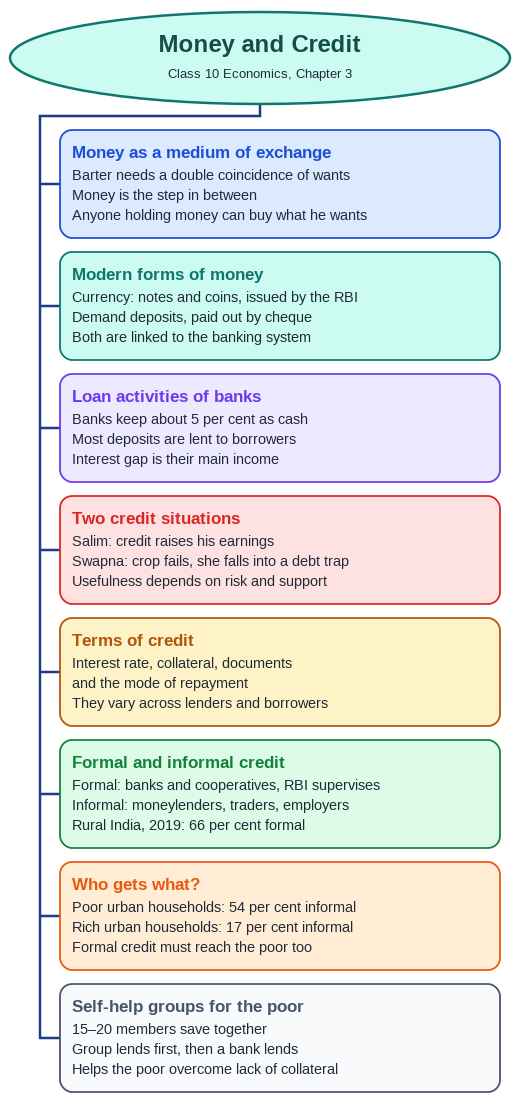
Money removes the need for a double coincidence of wants, so it works as a medium of exchange. Modern money is currency and bank deposits. Banks lend most of their deposits, and every loan has terms of credit. Formal loans from banks and cooperatives are cheaper than informal ones, but the poor still depend mostly on informal lenders.
What is this chapter about?
Think of one ordinary day. You buy a pencil, your family pays the milkman, a neighbour gets a salary, and a shopkeeper lets someone take rice now and pay next week. Money and promises to pay money run through all of it. This third chapter of Understanding Economic Development has two parts. The first part asks what money is and how modern money is tied to banks. The second part looks at credit: why people borrow, when a loan helps and when it hurts, and why the poor find it so hard to get cheap loans.
Why do we use money?
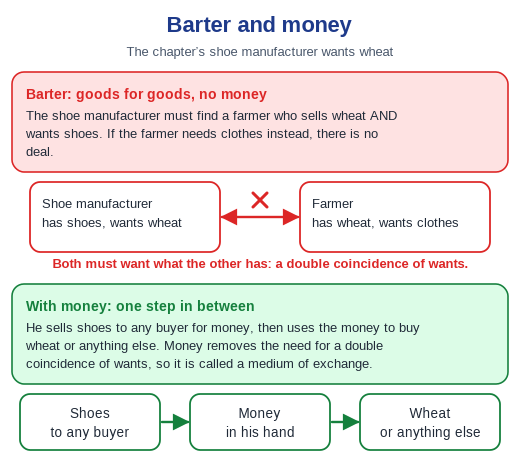
In a barter system, goods are exchanged directly. The chapter’s shoe manufacturer wants wheat, so he must find a farmer who sells wheat and wants shoes. Both sides must want what the other has; this is the double coincidence of wants. With money, he simply sells his shoes to anyone who will buy them, and then buys wheat, or anything else, with the money. Because money is the step in between, it is called a medium of exchange. Read Money as a medium of exchange.
What are the modern forms of money?
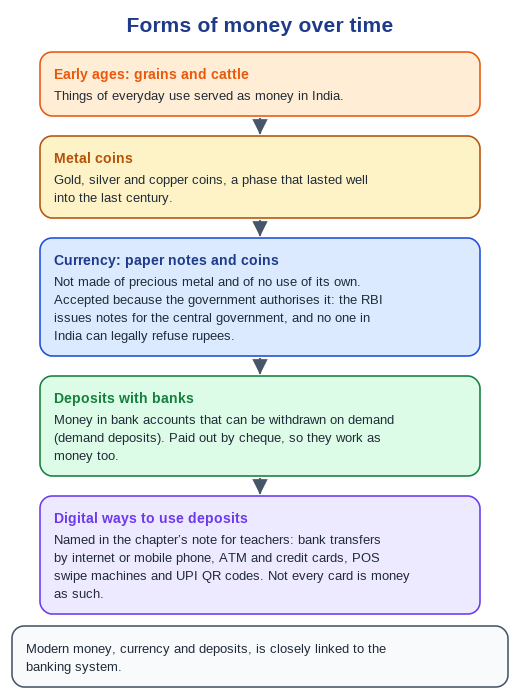
Indians once used grains and cattle as money, and later coins of gold, silver and copper. Modern money has two forms. Currency, paper notes and coins, is not made of precious metal and has no use of its own; it is accepted because the government authorises it. The Reserve Bank of India prints notes for the central government, and by law nobody in India may turn down a payment in rupees. The second form is deposits with banks. People keep spare cash in bank accounts, where it is safe and earns interest, and can take it out whenever they need it; such deposits are called demand deposits. With a cheque, the account holder tells the bank to pay someone directly, so demand deposits also work as money. The chapter’s note for teachers adds the newer, digital ways of using deposits, such as transfers by mobile phone and UPI QR codes at shops.
What do banks do with deposits?
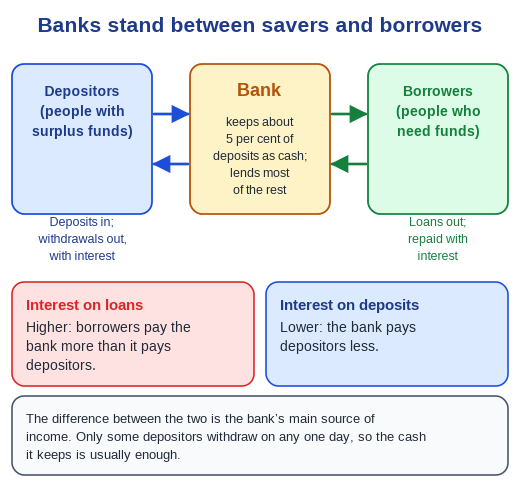
Only a few depositors come to withdraw cash on any given day, so banks in India keep only about 5 per cent of their deposits as cash and lend most of the rest. In this way banks stand between people with surplus funds (depositors) and people who need funds (borrowers). Borrowers pay them more interest than they pay depositors, and that gap is their main income.
Does credit always help?
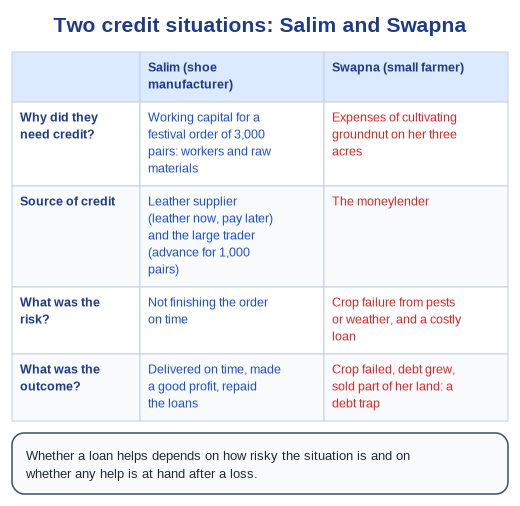
Credit is an agreement in which a lender gives money, goods or services now in return for a promise of payment later. Salim, the shoe manufacturer, takes leather on credit and an advance from a trader to finish a festival order of 3,000 pairs; he delivers on time, earns a good profit and repays. Swapna, a small farmer, borrows from a moneylender to grow groundnut; pests destroy the crop, her debt grows, and she finally sells part of her land. This is a debt trap. So whether a loan helps depends on how risky the situation is and on whether any help is at hand if things go wrong. Read Credit situations and terms of credit.
What are the terms of credit?
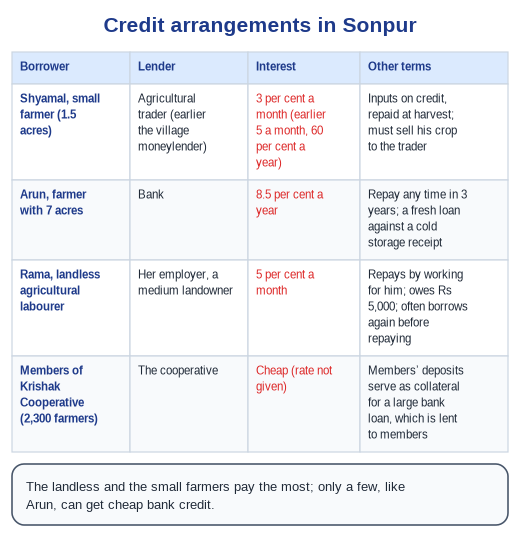
Every loan sets an interest rate, and the lender may ask for collateral, an asset of the borrower held as security until the loan is repaid, which the lender may sell if the borrower fails to pay. Lenders also ask for documents and fix a mode of repayment. Together these are the terms of credit. Megha’s house loan shows all four: Rs 5 lakhs at 12 per cent a year for 10 years, repaid monthly, with salary papers as documents and the house papers as collateral. In the village of Sonpur, the terms depend on who you are: Rama, a landless labourer, pays her employer 5 per cent a month, Shyamal pays a trader 3 per cent a month and must sell him his crop, while Arun, with seven acres, gets a bank loan at 8.5 per cent a year.
What are formal and informal sources of credit?
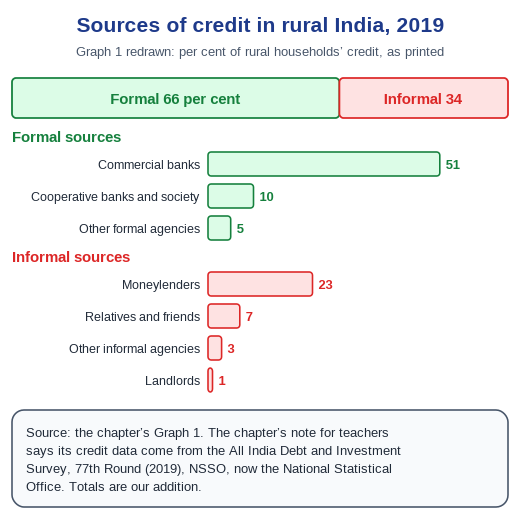
Formal loans come from banks and cooperatives, which the RBI supervises: it checks that banks keep their cash balance and lend to small cultivators and small industries too, not only to profit-making businesses. Informal lenders, such as moneylenders, traders, employers, relatives and friends, are supervised by no one. They can charge any rate, and most charge much more than formal lenders, so borrowers keep less of their income and may fall into a debt trap. Graph 1 shows that in rural India in 2019 about two-thirds of credit (66 per cent) came from formal sources, but moneylenders still gave 23 per cent. Graph 2 shows that poor urban households took 54 per cent of their loans from informal sources, while rich households took only 17 per cent. So formal credit has to grow, and it has to reach the poor. Read Formal and informal sources of credit.
How do self-help groups help the poor?
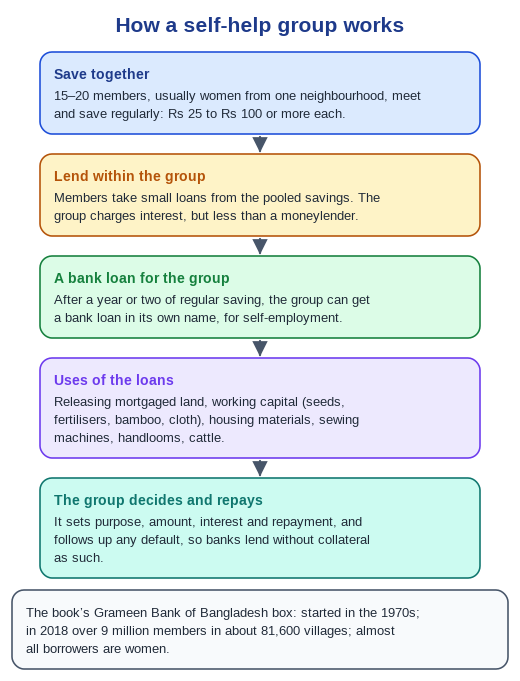
A self-help group (SHG) has 15–20 members, usually women from one neighbourhood, who save regularly, each putting in Rs 25 to Rs 100 or more. Members borrow small amounts from the group at less interest than a moneylender charges. After a year or two of regular saving, the group can get a bank loan in its own name, for self-employment. The group decides on the loans and makes sure they are repaid, so banks lend to poor women in SHGs without asking for collateral. The meetings also give women a place to discuss health, nutrition and domestic violence. The chapter’s box on the Grameen Bank of Bangladesh, which had over 9 million members in 2018, shows the same idea working at a large scale.
Before we move on
The chapter ends with 13 exercises and an additional project on who might need loans in a city. Answers to all of them, and to every question inside the chapter, are in the NCERT solutions for Chapter 3. This chapter picks up the cheap credit for farmers that Chapter 2: Sectors of the Indian Economy called for, and Chapter 4, Globalisation and the Indian Economy, comes next.
Key terms
| Term | Meaning |
|---|---|
| Double coincidence of wants | In barter, what one person wants to sell must be exactly what the other wants to buy, and the other way round. Money removes this need. |
| Medium of exchange | Money acts as the step in between in exchange: people sell things for money and then use the money to buy what they want. |
| Currency | Paper notes and coins. In India the RBI prints notes for the central government, and no one may legally refuse rupees. |
| Demand deposits | Money kept in bank accounts that can be withdrawn whenever the account holder wants. Because they can be paid out by cheque, they count as money. |
| Cheque | A written order to the bank to pay a set amount from the account holder’s account to the person named on it. |
| Credit (loan) | An agreement in which a lender gives the borrower money, goods or services in return for a promise of payment in the future. |
| Debt trap | A situation in which a borrower cannot repay, the debt keeps growing, and getting out is very hard, as for Swapna. |
| Collateral | An asset the borrower owns, such as land, a building, a vehicle, livestock or bank deposits, which the lender holds as security until the loan is repaid. |
| Terms of credit | The interest rate, collateral, documents required and mode of repayment of a loan taken together. |
| Formal and informal sources of credit | Formal: banks and cooperatives, supervised by the RBI. Informal: moneylenders, traders, employers, relatives and friends, whom no organisation supervises. |
| Self-help group (SHG) | A group of 15–20 people, mostly rural women from one neighbourhood, who save regularly, lend to members and can then get bank loans as a group. |
Topics in this chapter
Practice
-
Money is called a medium of exchange because it:
Show answer
Answer: (b) acts as the step in between in exchanges
-
Who issues currency notes in India for the central government?
Show answer
Answer: (b) The Reserve Bank of India
-
About what share of their deposits do banks in India hold as cash, according to the chapter?
Show answer
Answer: (a) About 5 per cent
-
Which of these is NOT a formal source of credit?
Show answer
Answer: (c) A moneylender
-
By Graph 1, what share of rural households’ credit in 2019 came from moneylenders?
Show answer
Answer: (c) 23 per cent
-
Interest rate, collateral, documents and mode of repayment together are called the:
Show answer
Answer: (a) terms of credit
Questions students ask
What are the main topics of Class 10 Economics Chapter 3?
Money as a medium of exchange, modern forms of money (currency and bank deposits, with cheques), how banks lend, two credit situations, terms of credit, credit arrangements in a village, formal and informal credit with two graphs, and self-help groups for the poor.
Is Money and Credit in the 2026-27 NCERT book?
Yes. It is Chapter 3 of Understanding Economic Development, the Class 10 Economics textbook marked Reprint 2026-27, on pages 38 to 53. NCERT updated this book in August 2026, and these notes follow that current copy.
Why do the poor depend on informal credit?
Many villages have no bank nearby, and bank loans need documents and collateral, which the poor often lack. Moneylenders know them personally and lend without collateral, but they charge very high interest, keep no records and may harass borrowers.
Are ATM cards and credit cards money?
The chapter’s note for teachers says plastic cards often replace cash, but not all of them are money as such. Money here is the currency and the deposits in bank accounts; a card is only a way of using those deposits or of taking credit.
Stuck on a question?
Take a photo and Lagnever AI explains it step by step. Try it for 7 days for ₹2.
Get it on Google Play Open in browser
For parents: after the trial, the plan renews monthly by UPI or card autopay. You can cancel anytime in the app.