
What are formal and informal sources of credit, and who gets what?
Answer in short
Formal credit comes from banks and cooperatives, which the RBI supervises; informal credit comes from moneylenders, traders, employers, relatives and friends, whom nobody supervises. Informal loans usually cost much more. Richer households get most of their loans from formal sources, the poor from informal ones, so formal credit must grow and reach the poor, for example through SHGs.
Stuck on a question? Take a photo and Lagnever AI explains it step by step. Try it for 7 days for ₹2. Get it on Google Play
How are loans grouped?
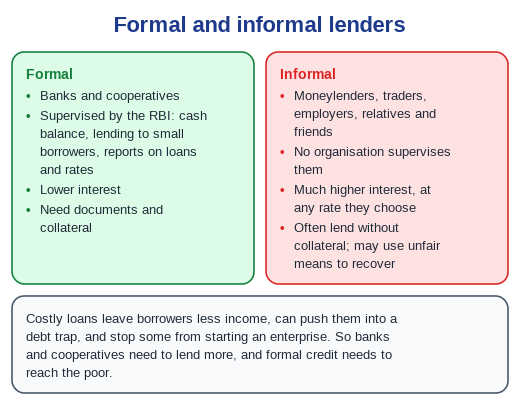
The stories of Salim, Swapna and the people of Sonpur show loans from many kinds of lenders. They can be sorted into two groups. Formal sector loans come from banks and cooperatives. Informal sector loans come from moneylenders, traders, employers, relatives and friends, and so on.
Who supervises formal lenders?
The Reserve Bank of India (RBI) keeps watch over formal lenders. It makes sure banks hold the minimum cash they are supposed to keep from their deposits. It also checks that loans go to small farmers, small industries and other small borrowers, and not just to businesses and traders out to make a profit. From time to time, banks must report to the RBI how much they lend, to whom, and at what interest rate.
No organisation supervises the credit activities of informal lenders. They can fix any interest rate they please, and nobody prevents them from recovering loans by unfair methods.
Where does rural India borrow from?
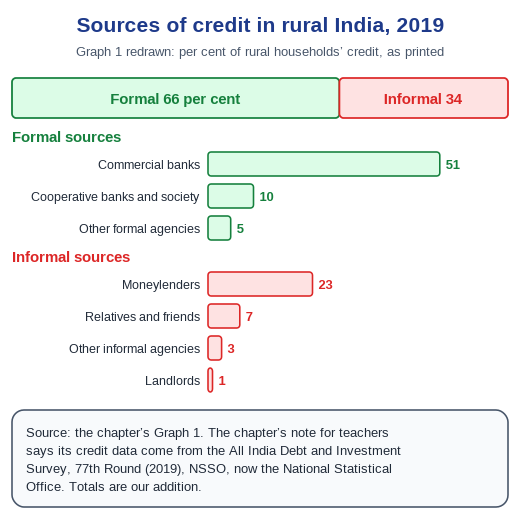
Graph 1 in the chapter, Sources of Credit in Rural India, 2019, shows the share of each source in the credit of rural households. Formal sources give about two-thirds: commercial banks 51 per cent, cooperative banks and societies 10 per cent and other formal agencies 5 per cent, which adds up to 66 per cent. Informal sources give the remaining third: moneylenders 23 per cent, relatives and friends 7 per cent, other informal agencies 3 per cent and landlords 1 per cent, which adds up to 34 per cent. The chapter’s note for teachers says this data comes from the All India Debt and Investment Survey, 77th Round (2019), conducted by the NSSO, now the National Statistical Office.
Why is costly informal credit a problem?
Most informal lenders charge much higher interest than formal lenders, so informal loans cost the borrower far more. A higher cost means a bigger part of the borrower’s earnings goes into repaying the loan, leaving less to live on, as for Shyamal in Sonpur. Sometimes the amount to be repaid is more than the borrower earns, and the debt keeps rising, as for Rama, which can end in a debt trap. High interest also stops people who might want to start an enterprise from borrowing at all. That is why banks and cooperatives need to lend more: cheap and affordable credit would let more people grow crops, run businesses and set up small industries, and it is crucial for the country’s development.
Who gets formal credit?
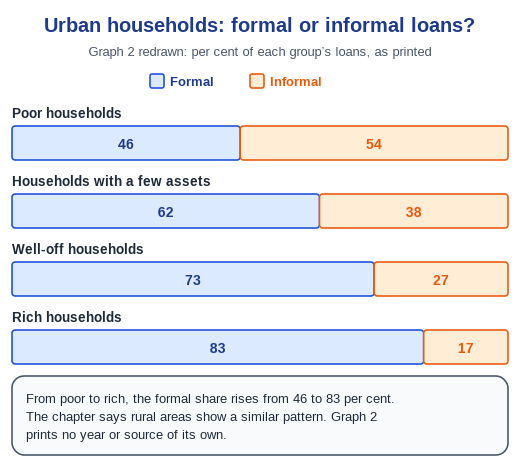
Graph 2 divides urban households into four groups, from poor to rich, and shows what share of each group’s loans came from formal and informal sources.
| Urban households | Formal (per cent) | Informal (per cent) |
|---|---|---|
| Poor households | 46 | 54 |
| Households with a few assets | 62 | 38 |
| Well-off households | 73 | 27 |
| Rich households | 83 | 17 |
So the richer the household, the larger its share of cheap formal loans. The chapter says a similar pattern is found in rural areas. Two lessons follow. First, the text says formal lenders still cover only around half of what rural people need to borrow (Graph 1 for 2019 shows about two-thirds, so this line seems to rest on older figures), so banks and cooperatives must lend more, especially in rural areas. Second, formal credit must be shared more equally, so that the poor also benefit from cheaper loans.
Why do the poor still borrow informally?
Many villages have no bank, and even where there is one, a bank loan is much harder to get than an informal one. As Megha’s case showed, banks need proper documents and collateral, and the lack of collateral is one of the main reasons the poor do not get bank loans. Moneylenders know their borrowers personally and often lend without collateral, even before earlier loans are repaid. But they charge very high interest, keep no records and harass poor borrowers.
How do self-help groups help?
A newer way of reaching the poor is to organise rural poor people, especially women, into small self-help groups (SHGs) that put their savings together. An SHG usually has 15–20 members living near one another who meet and save at regular intervals, each adding Rs 25 to Rs 100 or more as they can afford. Members take small loans from the group at interest that is still lower than the moneylender’s. If the group saves regularly for a year or two, it can borrow from a bank. The loan is sanctioned in the group’s name for self-employment: to release mortgaged land, for working capital such as seeds, fertilisers, bamboo and cloth, for housing materials, or for assets like sewing machines, handlooms and cattle.
The members themselves decide the purpose, amount, interest and repayment schedule of each loan, and the group is responsible for repayment; if one member does not repay, the others follow it up seriously. This is why banks lend to poor women in SHGs without collateral. SHGs also help women become financially self-reliant, and their regular meetings are a platform to discuss health, nutrition, domestic violence and other social issues.
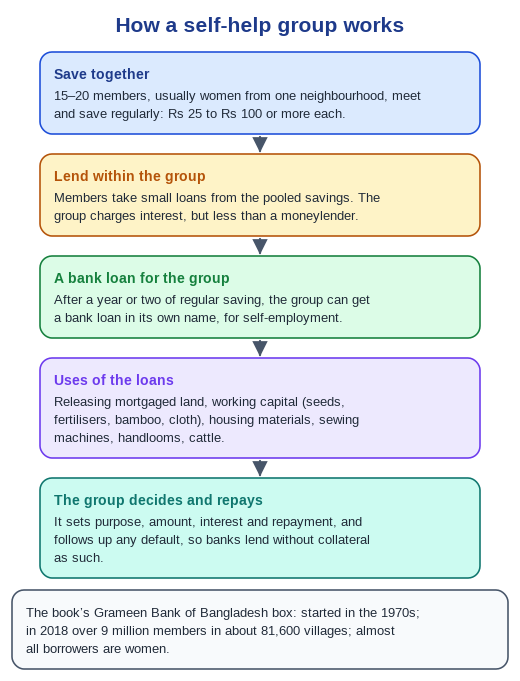
The chapter ends with the Grameen Bank of Bangladesh, which began as a small project in the 1970s and by 2018 had over 9 million members across about 81,600 villages. Almost all its borrowers are poor women, who have shown that they repay reliably and can run small income-earning activities.
Back to the Chapter 3 notes or on to the NCERT solutions.
Practice
-
Who keeps a watch on formal lenders in India?
Show answer
Answer: (b) The Reserve Bank of India
-
By Graph 1, what share of rural credit in 2019 came from commercial banks?
Show answer
Answer: (c) 51 per cent
-
By Graph 2, what share of loans of rich urban households came from informal sources?
Show answer
Answer: (a) 17 per cent
-
Why are banks willing to lend to poor women organised in SHGs without collateral?
Show answer
Answer: Because the group as a whole is responsible for repayment, and other members follow up seriously if any member does not repay.
-
Add up the formal sources in Graph 1.
Show answer
Answer: Commercial banks 51 + cooperative banks and society 10 + other formal agencies 5 = 66 per cent; the informal sources add up to the other 34 per cent.
Questions students ask
What is the difference between formal and informal credit?
Formal credit comes from banks and cooperatives, which follow RBI rules and usually charge lower interest but ask for documents and collateral. Informal credit comes from moneylenders, traders, employers, relatives and friends, whom no one supervises; they often lend without collateral but usually charge much more.
Why do richer households get more formal credit?
Banks ask for collateral and proper documents, which richer households can provide. The poor often lack both, and many villages have no bank, so the poor turn to informal lenders who know them personally.
What is the Grameen Bank of Bangladesh?
It is the chapter’s example of reaching the poor with credit at reasonable rates. It began as a small project in the 1970s and by 2018 counted over 9 million members across about 81,600 villages; almost all its borrowers are poor women. Its founder, Professor Muhammad Yunus, received the 2006 Nobel Prize for Peace.
Stuck on a question?
Take a photo and Lagnever AI explains it step by step. Try it for 7 days for ₹2.
Get it on Google Play Open in browser
For parents: after the trial, the plan renews monthly by UPI or card autopay. You can cancel anytime in the app.