
When does credit help, and what are the terms of credit?
Answer in short
Credit is money, goods or services given now against a promise to pay later. It helped Salim finish an order and earn more, but pushed Swapna into a debt trap when her crop failed. Every loan has terms of credit: interest rate, collateral, documents and mode of repayment, and these vary with the lender and the borrower.
Stuck on a question? Take a photo and Lagnever AI explains it step by step. Try it for 7 days for ₹2. Get it on Google Play
What is credit?
Many everyday transactions involve credit in some form. Credit, or a loan, is an agreement in which the lender gives the borrower money, goods or services now, and the borrower promises to pay in the future. The chapter tells two stories to show that credit can work very differently.
How did credit help Salim?
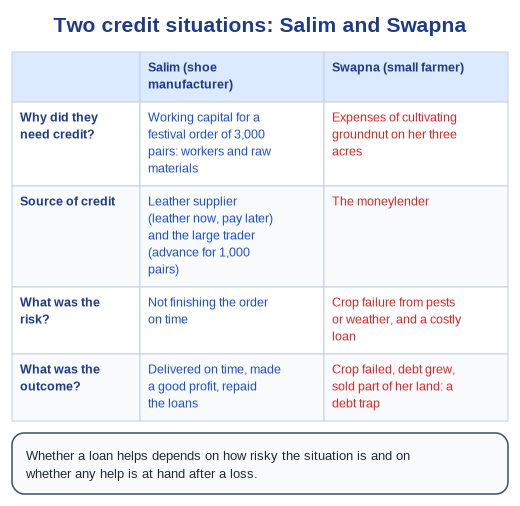
Two months before the festival season, the shoe manufacturer Salim gets an order from a large trader for 3,000 pairs of shoes, due in a month. To finish on time he must hire more workers for stitching and pasting and buy raw materials. He borrows in two ways: the leather supplier agrees to give him leather now and be paid later, and the large trader pays him an advance in cash for 1,000 pairs. At the end of the month Salim delivers the order, makes a good profit and repays what he borrowed. Here credit met his working capital needs: it paid for the running costs of production, helped him finish on time, and raised his earnings.
Why did Swapna fall into a debt trap?
Swapna, a small farmer, grows groundnut on three acres. She borrows from a moneylender to pay for cultivation, hoping to repay from the harvest. Midway through the season pests attack the crop, expensive pesticides make little difference, and the crop fails. She cannot repay, and over the year the debt grows large. The next year she takes a fresh loan; the crop is normal, but the earnings do not cover the old loan. In the end she sells part of her land to clear the debt. Credit left her worse off than before. This is a debt trap: a hole that is very hard and painful to climb out of.
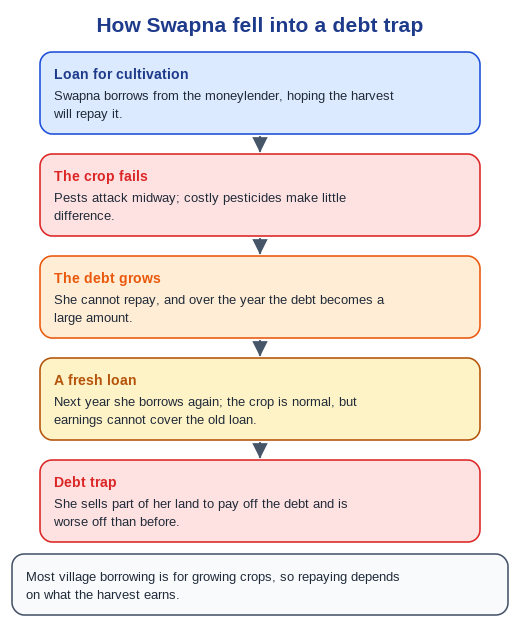
Most borrowing in villages is for growing crops, which needs seeds, fertilisers, pesticides, water, electricity and repairs. At least three to four months pass between buying these inputs and selling the crop, so farmers take crop loans at the start of the season and repay after the harvest. Repayment depends almost wholly on the income from farming. So, the chapter concludes, a loan is useful or harmful depending on the risks involved and on whether any support is available if there is a loss.
What are the terms of credit?
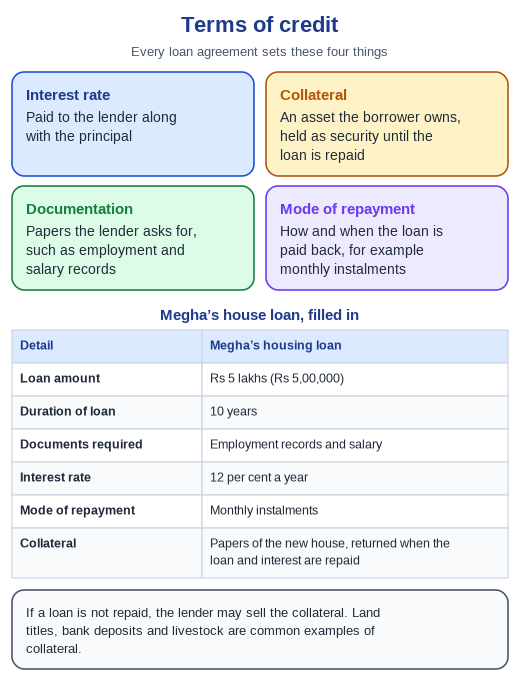
Every loan agreement fixes an interest rate, which the borrower pays the lender along with the principal. Lenders may also ask for collateral: an asset the borrower owns, such as land, a building, a vehicle, livestock or deposits with banks, which stays with the lender as security until the debt is cleared. If the loan is not repaid, the lender may sell it. Lenders also ask for documents and set a mode of repayment. Interest rate, collateral, documentation and mode of repayment together are the terms of credit. They vary a great deal from one loan to another, depending on the lender and the borrower.
Megha’s house loan shows all four. She borrowed Rs 5 lakhs from a bank to buy a house, at 12 per cent a year, to be paid back over 10 years in monthly instalments. The bank asked for her employment records and salary papers, and kept the papers of the new house as collateral, to be returned only when she has repaid the whole loan with interest.
What credit arrangements exist in Sonpur?
Two students, Rohit and Ranjan, visit Sonpur, a small irrigated village, on 15 November 2019 and record what they hear.
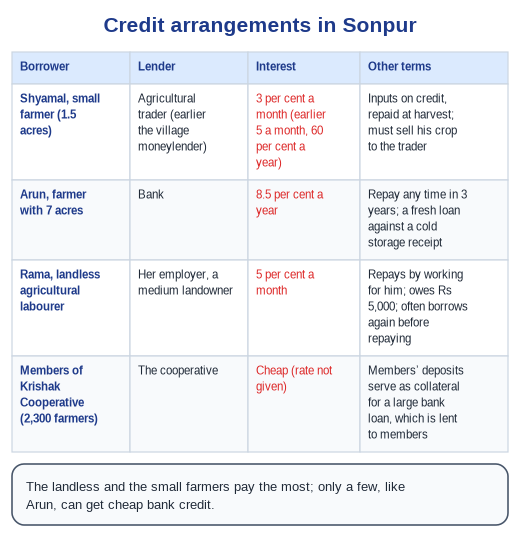
- Shyamal, a small farmer with 1.5 acres, needs loans every season. He once paid the village moneylender 5 per cent a month (60 per cent a year). Now he borrows from an agricultural trader at 3 per cent a month: the trader supplies farm inputs on credit, to be repaid at harvest, and makes him promise to sell his crop to the trader. This makes repayment prompt, and because crop prices drop just after the harvest, the trader buys cheap and sells later at a profit.
- Arun, with seven acres, is one of the few in Sonpur with a bank loan, at 8.5 per cent a year, repayable any time within three years. He plans to repay after the harvest, keep the rest of his potatoes in cold storage and take a fresh bank loan against the cold storage receipt.
- Rama, an agricultural labourer, has no work for several months a year and borrows for daily expenses, illness and family functions from her employer, a medium landowner, at 5 per cent a month. She repays by working for him, often borrows again before repaying, and owes him Rs 5,000. For the landless in Sonpur, landowner-employers are the only source of credit.
Apart from banks, villagers also get cheap loans from cooperatives. The Krishak Cooperative near Sonpur has 2,300 farmer members. It takes their deposits, uses them as collateral for a large bank loan, and lends the money to members for farm implements, cultivation, trade, fishery, houses and other needs.
Back to the Chapter 3 notes or on to Formal and informal sources of credit.
Practice
-
Salim used credit mainly to meet:
Show answer
Answer: (b) the working capital needs of production
-
Which of these is NOT one of the terms of credit?
Show answer
Answer: (d) The borrower’s age
-
Arun got a bank loan in Sonpur at:
Show answer
Answer: (c) 8.5 per cent a year
-
Why did Shyamal have to promise to sell his crop to the trader?
Show answer
Answer: So the trader could be sure the loan was repaid promptly. It also let the trader buy the crop cheaply after the harvest and sell it later at a higher price.
-
How does the Krishak Cooperative raise money to lend to its members?
Show answer
Answer: It accepts deposits from its 2,300 farmer members and, using these deposits as collateral, takes a large loan from a bank. It lends these funds to members, and once they repay, it lends again.
Questions students ask
What is a debt trap?
A debt trap is a situation in which a borrower cannot repay a loan, the debt keeps growing, and getting out of it is very painful. Swapna fell into one when her groundnut crop failed and she finally had to sell part of her land.
Why do lenders ask for collateral?
Collateral protects the lender. If the loan is not repaid, the lender may sell the asset, such as land or a building, to get the money back.
Why do farmers need credit?
Crop production costs a lot, for seeds, fertilisers, pesticides, water, electricity and repairs, and there are at least three to four months between buying these inputs and selling the crop. So farmers borrow at the start of the season and repay after the harvest.
Stuck on a question?
Take a photo and Lagnever AI explains it step by step. Try it for 7 days for ₹2.
Get it on Google Play Open in browser
For parents: after the trial, the plan renews monthly by UPI or card autopay. You can cancel anytime in the app.