
How does money work as a medium of exchange?
Answer in short
In barter, both people must want exactly what the other has, a double coincidence of wants. Money removes this need: you sell to anyone for money and buy anything with it, so money is a medium of exchange. Modern money is currency, which the government authorises, and demand deposits in banks, which cheques let people use.
Stuck on a question? Take a photo and Lagnever AI explains it step by step. Try it for 7 days for ₹2. Get it on Google Play
Why does everyone want money?
Look at the transactions around you in a single day: goods bought and sold, services paid for, wages given, and sometimes only a promise to pay later. Almost all of them use money. The reason is simple: a person who holds money can exchange it for any good or service he or she wants. So everyone is happy to be paid in money first and then use that money to buy what they need.
What is the double coincidence of wants?
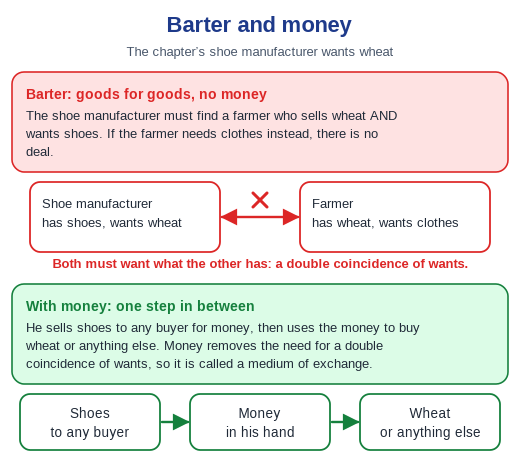
The chapter takes a shoe manufacturer who wants to sell shoes and buy wheat. Without money he would have to exchange shoes for wheat directly. He would need a farmer who has wheat to spare and who also happens to want shoes. Each must want the other’s goods. This is called the double coincidence of wants: what one person wants to sell is exactly what the other wants to buy. Under barter, when goods are swapped directly with no money, such a match is a must, and it is often missing. The farmer may need clothes, not shoes.
How does money solve the problem?
Money provides the crucial step in between. The shoe manufacturer only has to find someone who will buy his shoes. Once he has money, he can buy wheat, or anything else, in the market. He no longer needs a farmer who both sells wheat and wants shoes at the same moment. Because money stands in the middle of the exchange, it is called a medium of exchange.
How has money changed over time?
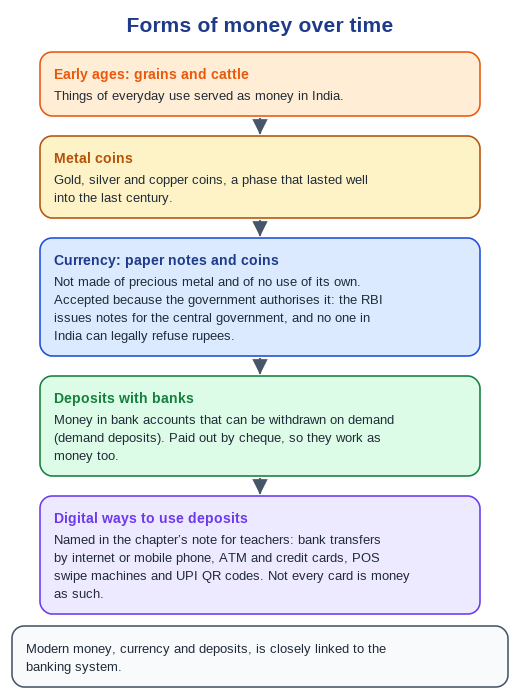
Before coins, many things served as money. Since very early times Indians used grains and cattle. Then came metal coins of gold, silver and copper, a phase that lasted well into the last century. The book shows coins from different periods: early punch-marked coins, Gupta coins, a Tughlaq coin, a gold mohar of Akbar’s reign and a modern coin.
Why is paper currency accepted?
Modern currency, paper notes and coins, is not made of precious metal, and unlike grain or cattle it has no everyday use. It has no use of its own. People take it because the government authorises it. In India the Reserve Bank of India prints notes for the central government, and the law allows no other person or body to issue currency. The law also makes the rupee something nobody in India may turn down when a payment is made in it. That is why the rupee is so widely accepted.
What are demand deposits?
People need only some cash for their daily needs. A worker paid at the end of the month has extra cash at its start, so he deposits it in a bank account in his name. The bank keeps the money safe and pays interest on it, and he can withdraw it whenever he needs it. Because these deposits can be withdrawn on demand, they are called demand deposits.
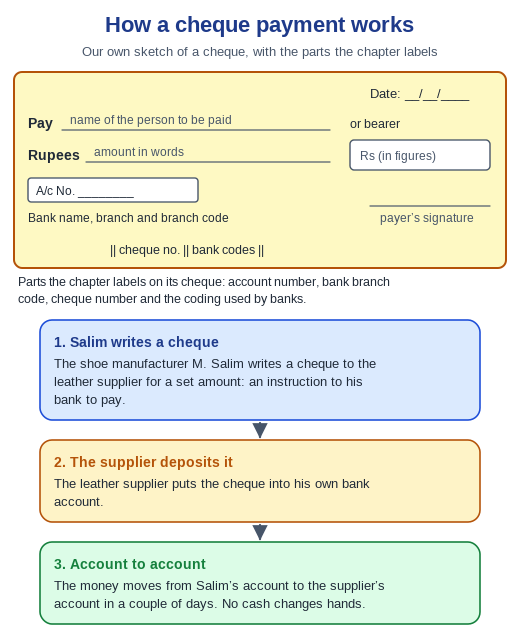
Demand deposits have one more feature that makes them money: payment by cheque. A cheque is a written order telling the bank to pay a fixed sum out of the writer’s account to the person whose name is on it. In the chapter’s example, the shoe manufacturer M. Salim writes a cheque to his leather supplier, who deposits it in his own bank; in a couple of days the money moves from one account to the other, without any cash. Because people accept such deposits for payments as readily as notes and coins, they count as money today. And since deposits and cheques exist only because banks exist, modern money depends closely on the banking system.
The chapter’s note for teachers adds that, more and more, people use their bank deposits rather than cash: bank-to-bank transfers by internet or phone, cheques, ATM and credit cards, POS swipe machines, and UPI QR codes at shops. It adds a caution: cards often replace cash, but a card is not always money in itself.
What do banks do with the deposits?
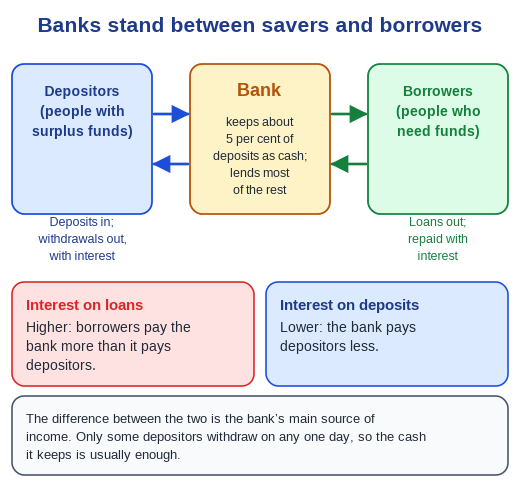
A bank holds back only a small slice of its deposits as cash: about 5 per cent in India today. This cash pays depositors who come to withdraw on a given day, and since only some depositors come on any one day, it is enough. Banks use the major portion of deposits to give loans, for which there is a huge demand. In this way banks mediate between depositors, who have surplus funds, and borrowers, who need funds. Borrowers pay the bank more interest than the bank pays its depositors, and this gap is what mainly keeps banks running. The book asks you to think about what would happen if all depositors asked for their money on the same day: the bank would not have enough cash to pay them all at once.
Back to the Chapter 3 notes or on to Credit situations and terms of credit.
Practice
-
A double coincidence of wants is needed in:
Show answer
Answer: (a) a barter system
-
People accept modern currency in exchange because:
Show answer
Answer: (b) it is authorised by the government
-
Deposits that can be withdrawn whenever the account holder wants are called:
Show answer
Answer: (c) demand deposits
-
What is the main source of income of banks?
Show answer
Answer: The difference between the higher interest they charge borrowers on loans and the lower interest they pay depositors on deposits.
-
Why can a bank manage with only about 5 per cent of its deposits as cash?
Show answer
Answer: On a normal day only a few depositors ask for cash, so a small cash balance covers them.
Questions students ask
What does double coincidence of wants mean?
It means that what one person wants to sell is exactly what the other person wants to buy, and the other way round. In barter both sides must want each other’s goods at the same time, which is hard to arrange.
Why are demand deposits considered money?
They can be withdrawn on demand, and with a cheque the account holder can pay someone directly from them without using cash. People accept them for payments just as they accept notes and coins, so they are money today.
What happens to the money we deposit in a bank?
The bank keeps a small part, about 5 per cent in India, as cash to pay depositors who come to withdraw. It lends most of the rest to people who need loans, and charges them more interest than it pays depositors.
Stuck on a question?
Take a photo and Lagnever AI explains it step by step. Try it for 7 days for ₹2.
Get it on Google Play Open in browser
For parents: after the trial, the plan renews monthly by UPI or card autopay. You can cancel anytime in the app.