
Class 10 Economics Chapter 2: Sectors of the Indian Economy Notes
This chapter in five lines
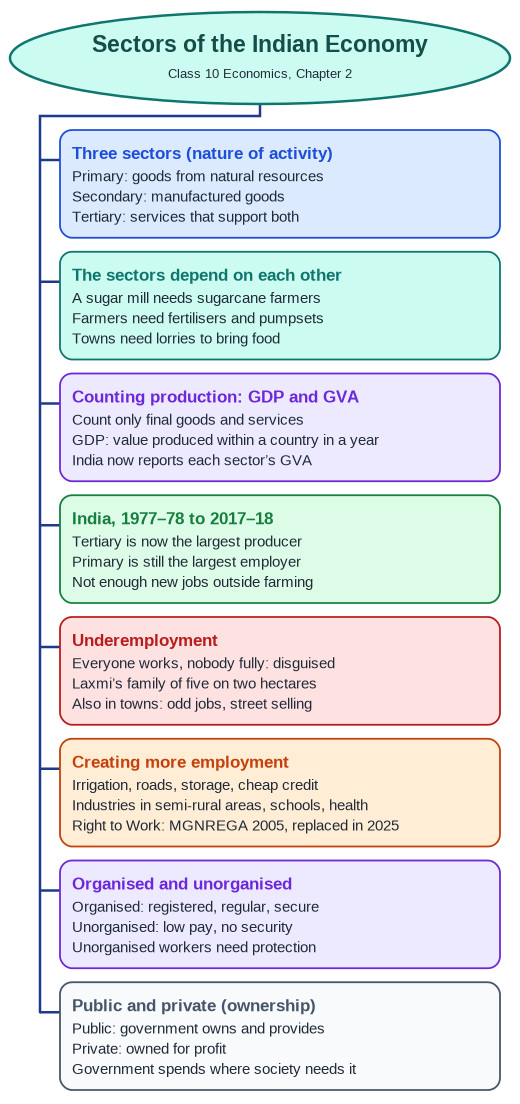
Economic activities are grouped into primary, secondary and tertiary sectors by the nature of the activity. In India the tertiary sector now produces the most, but the primary sector still employs the most people, so many farm workers are underemployed. Activities are also grouped as organised or unorganised, by conditions of work, and as public or private, by ownership.
What is this chapter about?
Look out of the window for a minute. A farmer is watering a field, a truck is carrying bricks, a shopkeeper is weighing rice, a mechanic is fixing a scooter. Each of them is doing an economic activity. With so many activities going on, we need a way to sort them into groups, which economists call sectors. This second chapter of Understanding Economic Development sorts the economy in three ways: by the nature of the activity (primary, secondary, tertiary), by the conditions of work (organised, unorganised) and by who owns the enterprise (public, private). Each way of sorting helps us see a different problem, and the chapter’s biggest worry is jobs.
What are the three sectors?
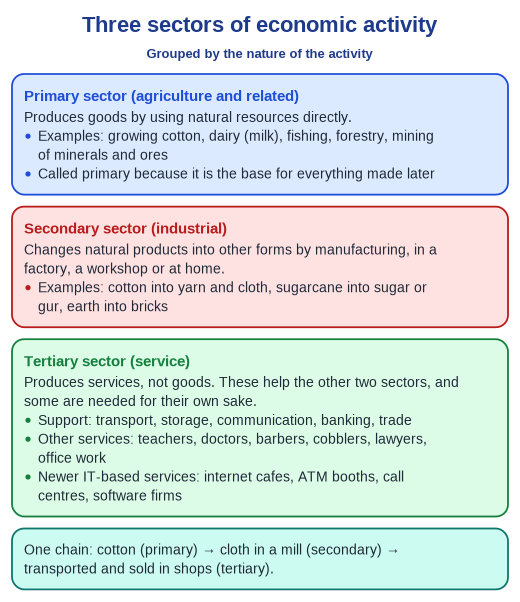
When goods are produced by using natural resources directly, the activity belongs to the primary sector: growing cotton depends on rain, sun and climate; dairy depends on animals and fodder; minerals and ores come from the earth. It is called primary because it is the base for everything made later, and since most of it is farming and related work, it is also called the agriculture and related sector. The secondary sector changes natural products into other forms by manufacturing: cotton into yarn and cloth, sugarcane into sugar or gur, earth into bricks. The tertiary sector produces services rather than goods: transport, storage, communication, banking and trade help the other two sectors, while teachers, doctors, barbers, lawyers and newer IT-based services such as call centres are needed for their own sake. Read Primary, secondary and tertiary sectors.
Do the sectors depend on each other?
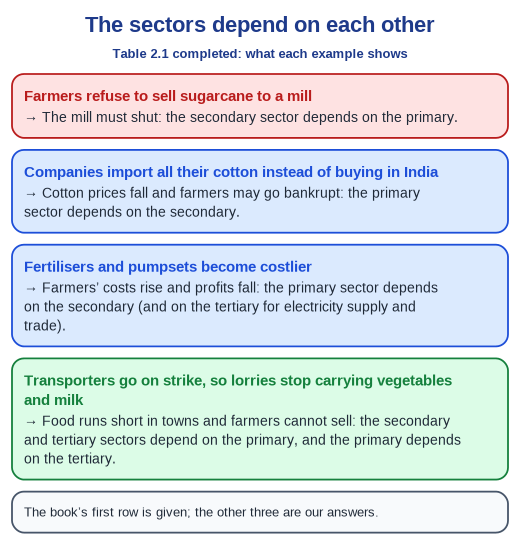
Yes, closely. If farmers stop selling sugarcane to a mill, the mill must shut. If companies buy all their cotton from abroad, Indian cotton prices fall and farmers may go bankrupt. If fertilisers or pumpsets become costlier, farmers earn less. And if transporters go on strike, towns run short of vegetables and milk while farmers cannot sell. Table 2.1 in the book gives these examples and asks you to say what each one shows.
How is production counted?
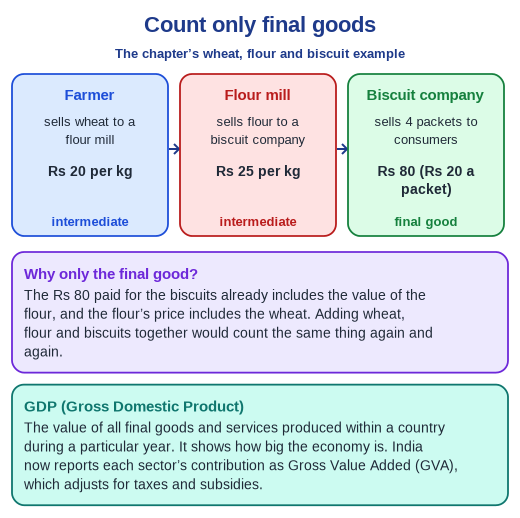
We cannot add cars to nails, so economists add values instead: 10,000 kg of wheat at Rs 20 a kg is worth Rs 2,00,000. But only final goods and services are counted. In the chapter’s example, a farmer sells wheat to a flour mill at Rs 20 a kg, the mill sells flour to a biscuit company at Rs 25 a kg, and the company sells four packets of biscuits for Rs 80. The Rs 80 already includes the flour and the wheat, so counting all three would count the same value several times. The value of final goods and services produced within a country during a year is its Gross Domestic Product (GDP). In India a central government ministry estimates it with the help of the states and union territories. India now reports each sector’s contribution as Gross Value Added (GVA), which adjusts for taxes and subsidies.
How have the sectors changed in India?
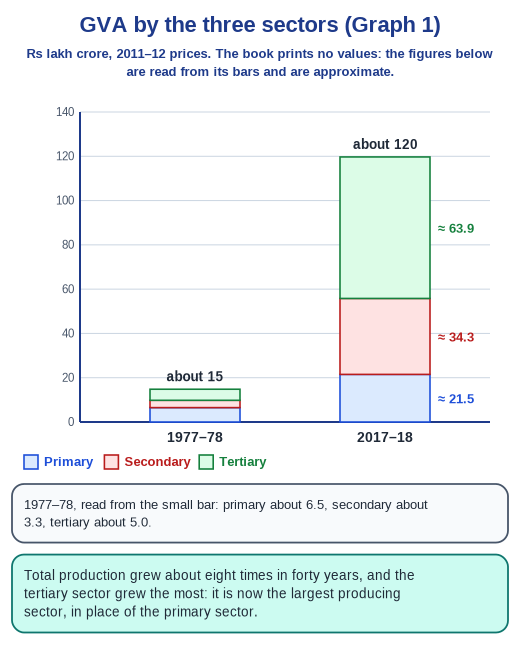
In the history of today’s developed countries, the primary sector came first; then factories grew and the secondary sector became the most important; and in the last 100 years services took the lead in both production and jobs. India’s data for 1977–78 and 2017–18, forty years apart, show only half of this pattern. Production grew in all three sectors but most in the tertiary sector, which is now the largest producing sector in place of the primary sector. The reasons the chapter gives: basic services such as hospitals, schools, police, courts, banks and transport are needed everywhere; farming and industry create demand for transport, trade and storage; richer people want more services like eating out, tourism and private schools; and new information and communication technology services are growing fast. But only a part of the service sector is thriving: many service workers, such as small shopkeepers and repair persons, barely earn a living.
Where do most people work?
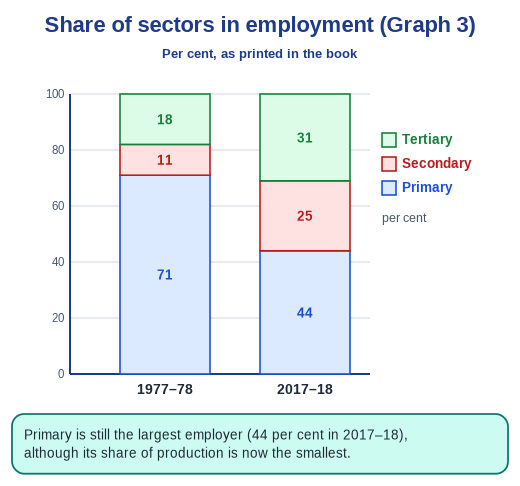
Here is the remarkable fact. By Graph 3, the primary sector’s share of jobs fell from 71 per cent in 1977–78 to 44 per cent in 2017–18, yet it is still the largest employer, while its share of production has fallen to about a fifth (the chapter says about one sixth). Not enough jobs were created outside farming: industrial output rose more than nine times but industrial jobs only about three times, and service output rose 14 times but service jobs only about five times.
What is disguised unemployment?
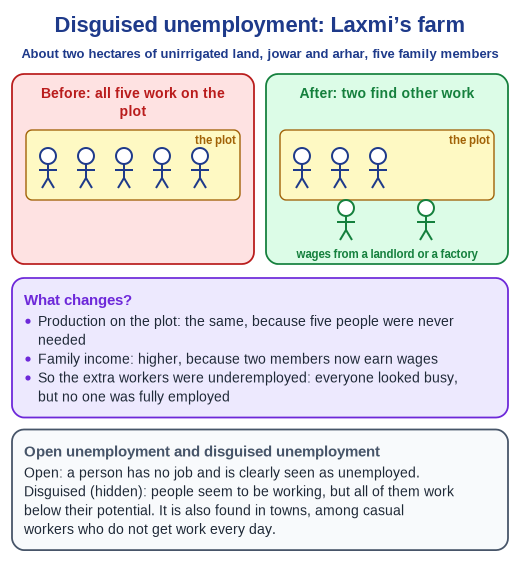
When more people work in farming than it needs, they are underemployed. Laxmi owns about two hectares of unirrigated land; all five members of her family work on it the whole year because they have nowhere else to go. Nobody sits idle, yet nobody is fully employed. If two of them took jobs elsewhere, the farm would produce as much as before and the family would earn more. This hidden kind of unemployment is called disguised unemployment, unlike open unemployment, where a person clearly has no job. It is also seen in towns, among casual workers who do not find work every day. Read Underemployment and how to create more employment.
How can more jobs be created?
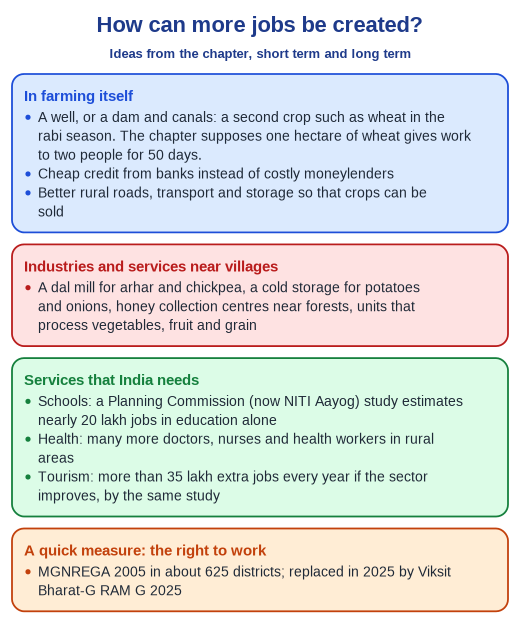
The chapter gives many ideas: wells, dams and canals so that farmers can grow a second crop; cheap bank credit; rural roads, transport and storage; industries and services in semi-rural areas, such as dal mills, cold storages and honey collection centres; and more schools, health services and tourism. As a quick measure, the Union Government made a law implementing the Right to Work in about 625 districts: MGNREGA 2005, which promised 100 days of work a year to rural people who were able to work and needed it, or an unemployment allowance. The chapter adds that in 2025 this Act was replaced by Viksit Bharat-G RAM G 2025.
What are the organised and unorganised sectors?
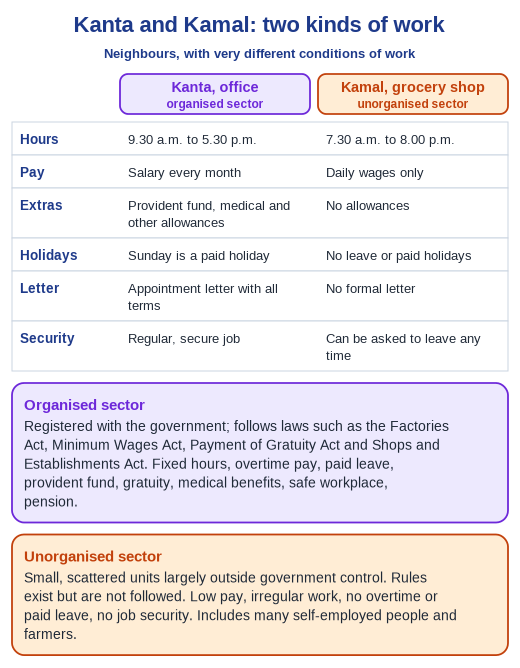
Kanta works in an office from 9.30 a.m. to 5.30 p.m., with a monthly salary, provident fund, paid Sundays and an appointment letter. Her neighbour Kamal works in a grocery shop from 7.30 a.m. to 8.00 p.m. for daily wages, with no leave and no letter, and can be told to leave at any time. Kanta is in the organised sector: registered enterprises that follow laws such as the Factories Act and the Minimum Wages Act. Kamal is in the unorganised sector: small, scattered units where rules exist but are not followed. By Table 2.3, for the late 1990s, only about 17 per cent of India’s workers had organised sector jobs. Unorganised workers, in villages and in towns, need protection on wages, safety and health. Read Organised and unorganised sectors.
What are the public and private sectors?
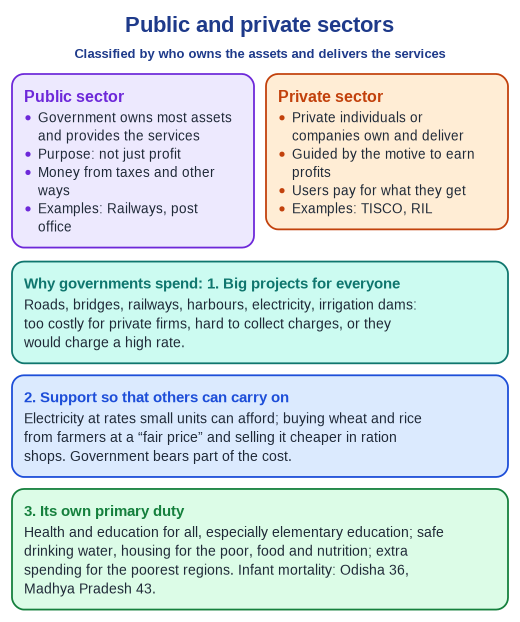
The third way of sorting looks at ownership. In the public sector the government owns most of the assets and provides the services, like the Railways or the post office; in the private sector, individuals or companies own the assets and work for profit. Governments spend on things society needs that private firms will not provide at a reasonable cost (roads, bridges, harbours, electricity, irrigation), on support for farmers and small industry, and on duties such as health and education for all.
Before we move on
The chapter closes with a Let’s Recall table (Table 2.4) that asks what each classification taught us, and with 24 exercises. Answers to all of them, and to every question inside the chapter, are in the NCERT solutions for Chapter 2. The ideas here link back to Chapter 1: Development, whose health and education goals the chapter returns to, and forward to Chapter 3, Money and Credit, which takes up the cheap credit that farmers like Laxmi need.
Key terms
| Term | Meaning |
|---|---|
| Primary sector | Activities that produce goods by using natural resources directly, such as farming, dairy, fishing, forestry and mining. Also called the agriculture and related sector. |
| Secondary sector | Activities that change natural products into other forms by manufacturing, in a factory, a workshop or at home. Also called the industrial sector. |
| Tertiary sector | Activities that produce services rather than goods, such as transport, storage, communication, banking and trade, and services like teaching or health care. Also called the service sector. |
| Final goods and intermediate goods | Final goods reach the consumer, like biscuits. Intermediate goods, like wheat and flour, are used up in making final goods, so they are not counted separately. |
| Gross Domestic Product (GDP) | The value of all final goods and services produced within a country during a particular year. It shows how big the economy is. |
| Gross Value Added (GVA) | The measure India now uses for each sector’s contribution, in line with global practice. It adjusts for taxes and subsidies. |
| Underemployment (disguised unemployment) | A situation in which people seem to be working, but all of them work less than their potential. It is hidden, unlike open unemployment. |
| Open unemployment | A person has no job and is clearly seen to be unemployed. |
| Right to Work | The idea behind MGNREGA 2005, which promised 100 days of work a year to rural people who needed it. In 2025 it was replaced by Viksit Bharat-G RAM G 2025. |
| Organised sector | Enterprises registered with the government that follow labour laws, with regular, secure work and benefits such as paid leave and provident fund. |
| Unorganised sector | Small, scattered units largely outside government control, with low-paid, irregular and insecure work. |
| Public sector and private sector | In the public sector the government owns most assets and provides the services; in the private sector, individuals or companies own them and work for profit. |
Topics in this chapter
Practice
-
Making sugar from sugarcane is an activity of the:
Show answer
Answer: (b) secondary sector
-
Which sector was the largest employer in India in 2017–18, according to Graph 3?
Show answer
Answer: (a) Primary
-
Why are intermediate goods not counted separately in GDP?
Show answer
Answer: (b) Their value is already included in the final goods
-
Five members of a family work on a small plot that needs only three. This is an example of:
Show answer
Answer: (b) disguised unemployment
-
Public and private sectors are classified on the basis of:
Show answer
Answer: (c) ownership of assets
-
Which of these is a feature of the organised sector?
Show answer
Answer: (c) Provident fund and paid holidays
Questions students ask
What are the main topics of Class 10 Economics Chapter 2?
The three sectors (primary, secondary, tertiary) and how they depend on each other; counting production as GDP and GVA; how the sectors changed in India between 1977–78 and 2017–18; underemployment and how to create more jobs; the organised and unorganised sectors; and the public and private sectors.
Is Sectors of the Indian Economy in the 2026-27 NCERT book?
Yes. It is Chapter 2 of Understanding Economic Development, the Class 10 Economics textbook marked Reprint 2026-27, on pages 18 to 37. NCERT updated the book in August 2026, and these notes follow that current copy, including its mention of Viksit Bharat-G RAM G 2025.
Which sector is the largest in India?
It depends on what you measure. By production (GVA) the tertiary sector has been the largest since it overtook the primary sector, as Graph 1 shows for 2017–18. By employment the primary sector is still the largest, with 44 per cent of workers in 2017–18.
What is the difference between open and disguised unemployment?
In open unemployment a person has no work and everyone can see it. In disguised unemployment people seem to be working, but more people are doing a job than it needs, so each works below his or her potential, as on Laxmi’s small farm.
Stuck on a question?
Take a photo and Lagnever AI explains it step by step. Try it for 7 days for ₹2.
Get it on Google Play Open in browser
For parents: after the trial, the plan renews monthly by UPI or card autopay. You can cancel anytime in the app.