
What is disguised unemployment, and how can more jobs be created?
Answer in short
Disguised unemployment, or underemployment, means people seem to be working but all of them work below their potential, because more people do a job than it needs. In India too many people stay in farming. More jobs can come from irrigation, credit, roads, rural industries, schools, health and tourism, and from a legal right to work.
Stuck on a question? Take a photo and Lagnever AI explains it step by step. Try it for 7 days for ₹2. Get it on Google Play
Why are so many people still in farming?
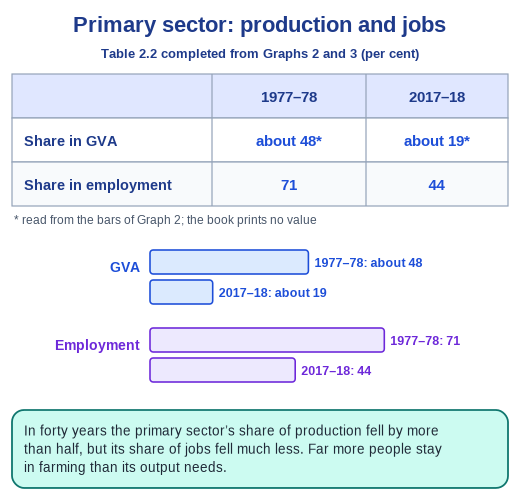
Over forty years, from 1977–78 to 2017–18, India’s production shifted towards services, but jobs did not shift as much. By Graph 3 in the book, the primary sector’s share of workers fell from 71 per cent to 44 per cent, and it is still the largest employer. The reason is simple: not enough jobs were created in industry and services. Industrial output went up more than nine times, but industrial jobs only about three times. Service output rose 14 times, but service jobs only about five times. So a large part of the workforce stays in agriculture, which produces a much smaller share of the country’s output.
What is underemployment?
Does this mean farm workers are not producing as much as they could? In a way, yes: there are more people in agriculture than are needed. Even if some of them moved out, production would not fall. These workers are underemployed.
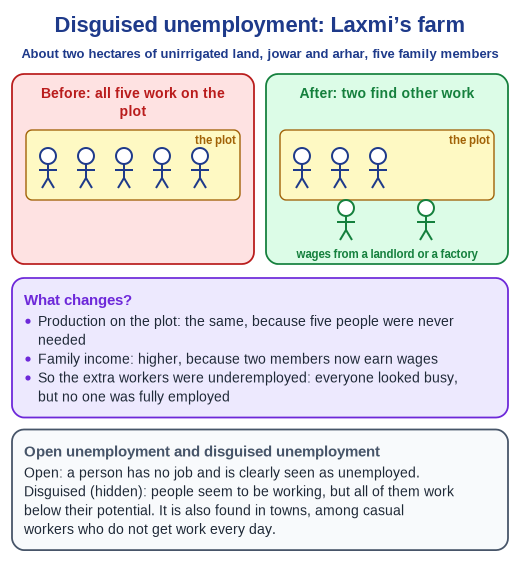
The chapter tells the story of Laxmi, a small farmer with about two hectares of unirrigated land that depends only on rain, growing crops like jowar and arhar. All five members of her family work on the plot throughout the year, because they have nowhere else to go. Everyone is busy and nobody sits idle, but the work is simply divided among them. No one is fully employed.
Now suppose a landlord, Sukhram, hires one or two of them to work on his land, or two of them get factory jobs. The small plot never needed five people, so it still produces as much as before, and the family now earns wages on top. There are lakhs of farmers like Laxmi in India, so many people could move out of farming into proper work elsewhere without any loss of farm output.
How is it different from open unemployment?
Someone who has no job and is clearly seen to be unemployed is in open unemployment. Underemployment is hidden: people appear to be working, yet all of them work below their potential. That is why it is also called disguised unemployment.
It is not only a village problem. In towns there are thousands of casual workers who look for work every day as painters, plumbers or repair persons, and many do not find it daily. Others push a cart or sell something on the street the whole day and earn very little. They do this work because they have no better opportunity.
How can more jobs be created?
The chapter suggests several ways, starting with Laxmi’s own farm.
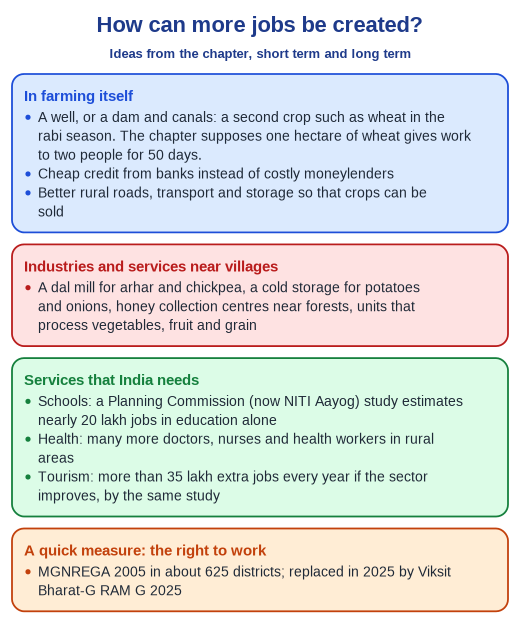
- Water. If the government spends some money, or a bank gives a loan, to dig a well, Laxmi can irrigate her land and grow a second crop, wheat, in the rabi season. The chapter supposes that one hectare of wheat employs two people for 50 days, so two more family members get work on their own field. A dam and canals serving many farms could create much more work in farming itself.
- Roads, transport and storage. Bigger harvests must be sold. Better rural roads, transport and storage give work not only to farmers but also to people in transport and trade.
- Credit. Laxmi needs seeds, fertilisers, equipment and a pumpset. Borrowing from moneylenders at high interest hurts her; credit from a local bank at a reasonable rate would help. Chapter 3, Money and Credit, takes this up.
- Industries and services near villages. A dal mill for arhar and chickpea, a cold storage for potatoes and onions, honey collection centres near forests, and units that process vegetables, fruit and grain for outside markets would create jobs in semi-rural areas, not only in big cities.
- Education and health. In India about 60 per cent of the population is aged 5–29 years, and only about 51 per cent of them attend educational institutions. More schools would need more buildings, teachers and staff; a study by the erstwhile Planning Commission (now NITI Aayog) estimates nearly 20 lakh jobs in education alone. Better health care would need many more doctors, nurses and health workers in rural areas.
- Each region’s own strengths. Tourism, regional crafts or new services like IT. The same study says improving tourism could give more than 35 lakh people extra work every year.
What is the right-to-work law?
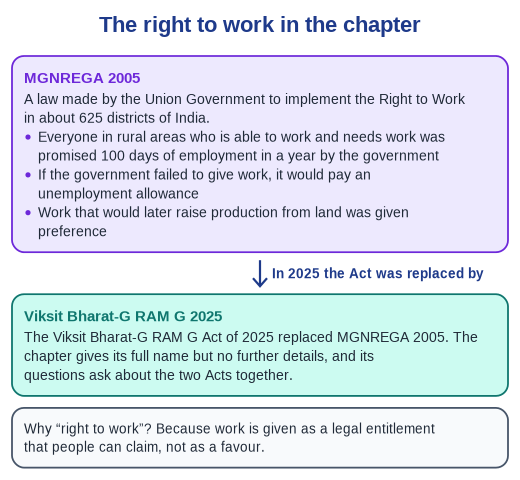
Most of these ideas take a long time. For the short term, the Union Government made a law implementing the Right to Work in about 625 districts of India: MGNREGA 2005. Under it, everyone in rural areas who was able to work and needed work was promised 100 days of employment a year by the government. If the government failed to provide work, it would give an unemployment allowance. Work that would raise production from land in future was given preference. The chapter adds that in 2025 this Act was replaced by Viksit Bharat-G RAM G 2025, and gives no further details of the new Act.
Back to the Chapter 2 notes, or read about the organised and unorganised sectors.
Practice
-
Underemployment occurs when people:
Show answer
Answer: (c) are working less than what they are capable of doing
-
Under MGNREGA 2005, how many days of work a year were promised in rural areas?
Show answer
Answer: (b) 100
-
In the chapter’s example, how many people can one hectare of wheat employ, and for how long?
Show answer
Answer: (b) Two people for 50 days
-
Why does production on Laxmi’s farm not fall when two members leave?
Show answer
Answer: Because the small plot never needed all five. The work was only being shared out among them, so the remaining three can do it, while the two who leave earn extra income.
-
Name two ways the chapter suggests to create jobs in semi-rural areas.
Show answer
Answer: Setting up a dal mill to process pulses such as arhar and chickpea, or a cold storage for potatoes and onions. (Also: honey collection centres near forests, and units that process vegetables, fruit and grain.)
Questions students ask
Why is it called disguised unemployment?
Because it is hidden. An unemployed person with no job is clearly visible, but underemployed people appear to be working. Only when you see that the work could be done by fewer people do you notice that some of them are, in effect, unemployed.
Why should we worry about underemployment?
It keeps family incomes low, wastes people’s skills and effort, and keeps many people poor in farming. It also means the country is not using its workers fully, which slows development.
What happened to MGNREGA 2005?
The chapter says that in 2025 the Act was replaced by Viksit Bharat-G RAM G 2025. It gives no further details of the new Act; its questions ask about MGNREGA 2005 or Viksit Bharat-G RAM G 2025 together.
Stuck on a question?
Take a photo and Lagnever AI explains it step by step. Try it for 7 days for ₹2.
Get it on Google Play Open in browser
For parents: after the trial, the plan renews monthly by UPI or card autopay. You can cancel anytime in the app.