
What are the primary, secondary and tertiary sectors?
Answer in short
The primary sector produces goods from natural resources, the secondary sector manufactures goods from them, and the tertiary sector provides services. The three depend on each other. Production is counted as the value of final goods and services. In India the tertiary sector now produces the most, but the primary sector still employs the most people.
Stuck on a question? Take a photo and Lagnever AI explains it step by step. Try it for 7 days for ₹2. Get it on Google Play
How are economic activities grouped?
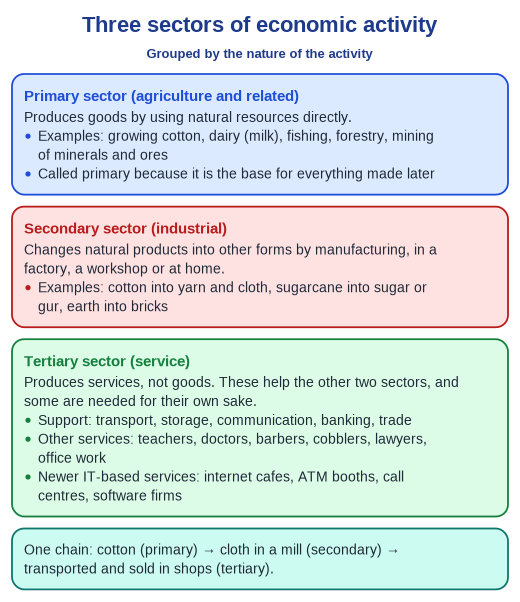
Some people around us produce goods, such as wheat, cloth or bricks; others produce services, such as transport, teaching or banking. To make sense of thousands of such activities, the chapter groups them by the nature of the activity into three sectors.
Primary sector. Here goods are produced by using natural resources directly. Cotton grows over a crop season and depends mainly on rainfall, sunshine and climate. Milk depends on the animals and on fodder. Minerals and ores come straight from the earth. The sector is called primary because it is the base of everything made afterwards, and because most of its products come from agriculture, dairy, fishing and forestry, it is also called the agriculture and related sector.
Secondary sector. This is the next step: natural products are changed into other forms through manufacturing. Cotton fibre is spun into yarn and woven into cloth; sugarcane becomes sugar or gur; earth becomes bricks, and bricks become houses. The making can happen in a factory, a workshop or even at home. Because the sector grew along with industries, it is also called the industrial sector.
Tertiary sector. These activities do not produce goods. They provide services that support the other two: goods must be transported by trucks or trains, stored in godowns and sold in wholesale and retail shops; people talk on the phone, send letters and borrow from banks. Other services are needed for their own sake: teachers, doctors, washermen, barbers, cobblers, lawyers and office workers. Newer services based on information technology, such as internet cafes, ATM booths, call centres and software companies, have become important too. So the tertiary sector is also called the service sector.
Why do we say the sectors are interdependent?
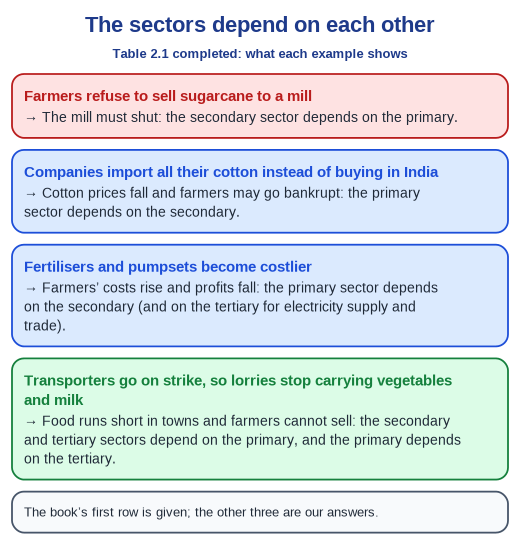
Although we put activities into three boxes, the boxes lean on one another. A sugar mill depends on farmers who grow sugarcane. Cotton farmers depend on companies that buy Indian cotton. Farmers buy tractors, pumpsets, electricity, pesticides and fertilisers, so a rise in their prices cuts farmers’ profits. And everyone in industry and services needs food, which reaches towns only if transporters keep running. A problem in any one sector soon reaches the others.
How do we measure what each sector produces?
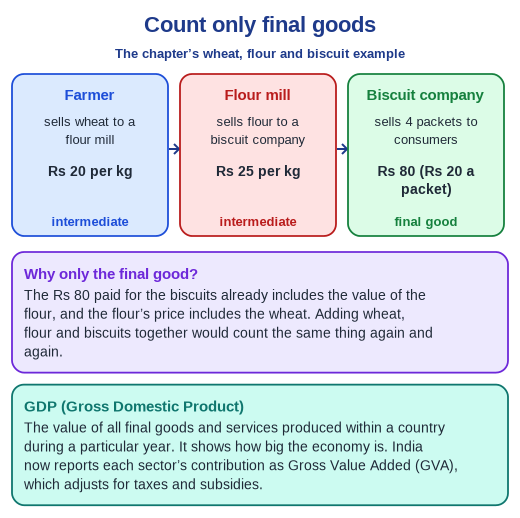
Adding cars, computers, nails and furniture makes no sense, so we add their money values. The chapter’s numbers: 10,000 kg of wheat at Rs 20 a kg is worth Rs 2,00,000; 5,000 coconuts at Rs 15 each are worth Rs 75,000.
There is one precaution. Only final goods and services, the ones that reach consumers, are counted. Wheat sold to a flour mill and flour sold to a biscuit maker are intermediate goods; they are used up in making the biscuits, and the biscuits’ price of Rs 80 already includes them. Counting all three would count the wheat three times. The value of all final goods and services produced within a country during a particular year is the Gross Domestic Product (GDP), which shows how big the economy is. India now reports each sector’s contribution as Gross Value Added (GVA), to be in line with global practice.
How have the sectors changed over time?
In today’s developed countries, farming came first. As it prospered and produced more food, people could take up crafts, trade and transport. Over more than a hundred years, factories spread and the secondary sector became the most important in production and jobs. In the past 100 years there has been a further shift to the tertiary sector, which now produces the most and employs most people in those countries.
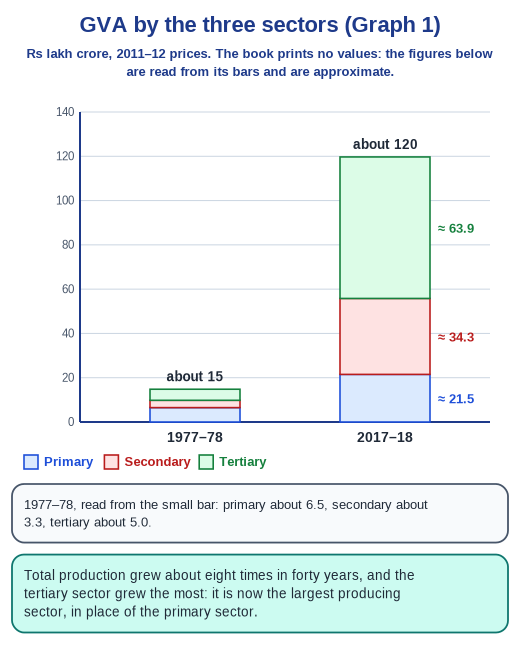
India’s data compare 1977–78 and 2017–18. Graph 1 in the book shows production rising in all three sectors, but most in the tertiary sector, which is now the largest producing sector in place of the primary sector. The book prints no values on Graphs 1 and 2; read from the bars, total GVA rose from about Rs 15 lakh crore to about Rs 120 lakh crore.
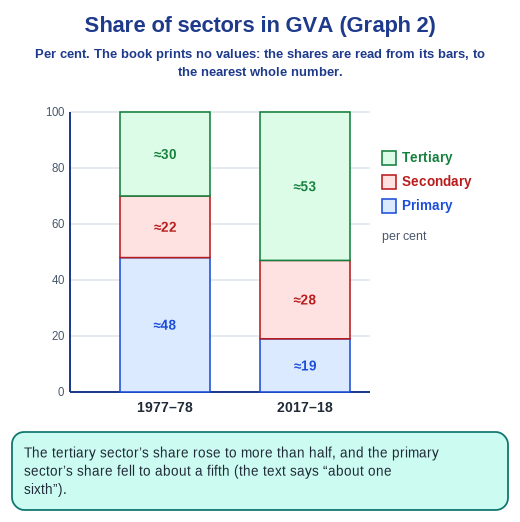
Graph 2 turns these into shares. The tertiary sector’s share of GVA is now more than half (between 50 and 60 per cent in 2017–18), while the primary sector’s share has fallen sharply.
Why has the tertiary sector grown so much?
The chapter gives four reasons. First, every country needs basic services: hospitals, schools, post offices, police stations, courts, municipal bodies, defence, transport, banks and insurance, and in a developing country the government must provide many of them. Second, more farming and industry means more demand for transport, trade and storage. Third, as incomes rise, some people want more services like eating out, tourism, private hospitals and schools, and professional training, especially in big cities. Fourth, services based on information and communication technology have grown fast in the last decade or so.
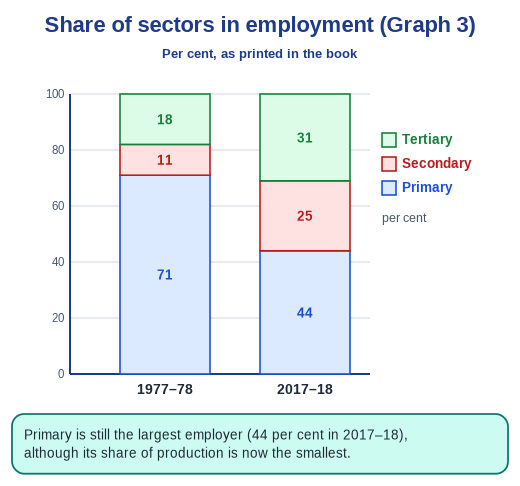
But the growth is uneven. A few services employ highly skilled workers, while a very large number of people, such as small shopkeepers, repair persons and transport workers, barely manage to earn a living. And jobs did not follow production: the primary sector still employs the most people, which leads to the problem of underemployment.
Back to the Chapter 2 notes or on to the NCERT solutions.
Practice
-
A fisherman catching fish is working in the:
Show answer
Answer: (a) primary sector
-
Which of these is a tertiary activity?
Show answer
Answer: (c) Storing grain in a godown
-
In the chapter’s example, the biscuit company sells four packets for Rs 80. Which value is counted in GDP?
Show answer
Answer: (c) Rs 80 for the biscuits
-
Why is the primary sector called ‘primary’?
Show answer
Answer: Because it forms the base for all the other products that we make later: cloth needs cotton, sugar needs sugarcane, bricks need earth.
-
Give two reasons from the chapter why the tertiary sector has become so important in India.
Show answer
Answer: Basic services such as hospitals, schools, police, courts, banks and transport are needed in every country; and the growth of farming and industry raises the demand for transport, trade and storage. (Also: richer people want more services, and new IT-based services are growing fast.)
Questions students ask
What is the basis of dividing activities into primary, secondary and tertiary sectors?
The nature of the activity: whether it uses natural resources directly, changes natural products by manufacturing, or provides a service.
What is the difference between GDP and GVA?
GDP is the value of all final goods and services produced within a country in a year. GVA is the measure India now uses for each sector’s contribution; it adjusts for taxes and subsidies. The chapter says you will learn the difference in detail in higher classes.
Is the whole service sector growing well in India?
No. A limited number of services employ highly skilled, educated workers and are growing. But a very large number of service workers, such as small shopkeepers, repair persons and transport workers, barely earn a living because they have no other work.
Stuck on a question?
Take a photo and Lagnever AI explains it step by step. Try it for 7 days for ₹2.
Get it on Google Play Open in browser
For parents: after the trial, the plan renews monthly by UPI or card autopay. You can cancel anytime in the app.