
What are the organised and unorganised sectors, and the public and private sectors?
Answer in short
By conditions of work, activities are organised (registered, regular, secure, with benefits) or unorganised (low-paid, irregular, insecure). Most Indian workers are in the unorganised sector and need protection. By ownership, activities are public, where the government owns assets and provides services, or private, where individuals or companies own them for profit.
Stuck on a question? Take a photo and Lagnever AI explains it step by step. Try it for 7 days for ₹2. Get it on Google Play
Kanta and Kamal: what is the difference?
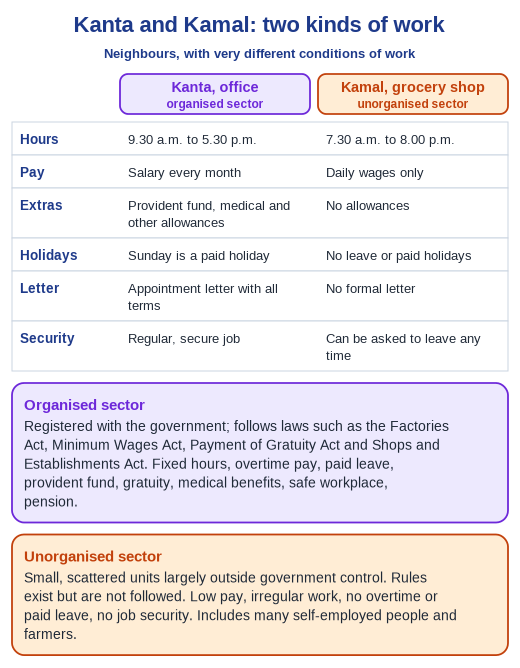
The chapter sorts activities a second way, by how people are employed: their conditions of work, and whether any rules are followed. It begins with two neighbours.
Kanta works in an office from 9.30 a.m. to 5.30 p.m. Her salary comes regularly at the end of each month. She gets provident fund as the government’s rules require, along with medical and other allowances. Sunday is a paid holiday, and when she joined she got an appointment letter setting out all the terms of her work.
Kamal is a daily wage labourer in a grocery shop. He works from 7.30 in the morning till 8.00 at night, gets only his wages, and is not paid for the days he does not work, so he has no leave or paid holidays. He never got a letter saying he was employed, and he can be asked to leave at any time.
What is the organised sector?
Kanta works in the organised sector. It covers enterprises or places of work where the terms of employment are regular, so people have assured work. These enterprises are registered with the government and must follow rules given in laws such as the Factories Act, the Minimum Wages Act, the Payment of Gratuity Act and the Shops and Establishments Act. Some people in this sector work for themselves, but they too must register and follow the rules.
Workers here have security of employment. They work fixed hours and are paid overtime for extra hours. They get paid leave, payment during holidays, provident fund and gratuity, are supposed to get medical benefits, and the factory manager must provide drinking water and a safe workplace. When they retire, they get a pension.
What is the unorganised sector?
Kamal works in the unorganised sector: small, scattered units, largely outside the control of the government. Rules and regulations exist but are not followed. Jobs are low-paid and often not regular; there is no overtime, paid leave, holidays or sick leave. People can be asked to leave without any reason, for example when there is less work in some seasons, and much depends on the whims of the employer. The sector also includes a large number of people working on their own, such as street sellers and repair workers, and farmers who work on their own and hire labourers when needed.
How many workers are in each sector?
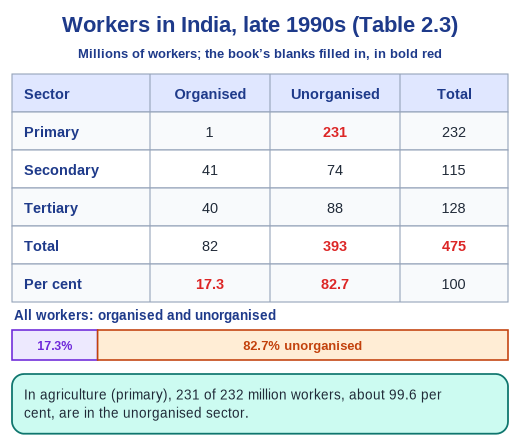
Table 2.3 in the book gives the estimated number of workers in the late 1990s, in millions, with some blanks to fill. Primary: 1 organised, so 231 unorganised out of 232. Secondary: 41 and 74, total 115. Tertiary: 40 and 88, total 128. Altogether 82 million organised and 393 million unorganised, out of 475 million. So about 83 per cent of workers were in the unorganised sector and only about 17 per cent had organised sector jobs; in agriculture, almost all workers (about 99.6 per cent) were unorganised.
How can unorganised workers be protected?
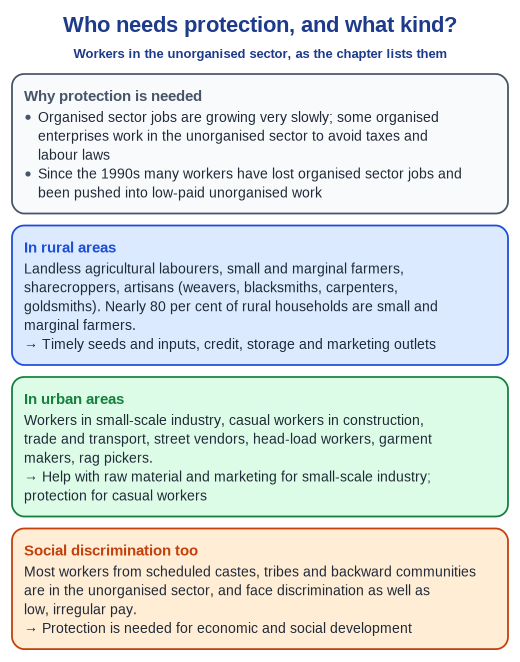
Organised sector jobs are the most sought after, but they have grown very slowly. Some organised enterprises even operate in the unorganised sector to evade taxes and avoid labour laws, and since the 1990s many workers have lost organised sector jobs and been pushed into low-paid unorganised work. So besides more work, these workers need protection and support.
In rural areas they are mostly landless labourers, small and marginal farmers, sharecroppers and artisans; nearly 80 per cent of rural households are small and marginal farmers, who need timely seeds and inputs, credit, storage and marketing outlets. In urban areas they are workers in small-scale industry, casual workers in construction, trade and transport, street vendors, head-load workers, garment makers and rag pickers; small-scale industry needs help with raw material and marketing, and casual workers everywhere need protection. Most workers from scheduled castes, tribes and backward communities are in this sector and also face social discrimination, so protection matters for both economic and social development.
What are the public and private sectors?
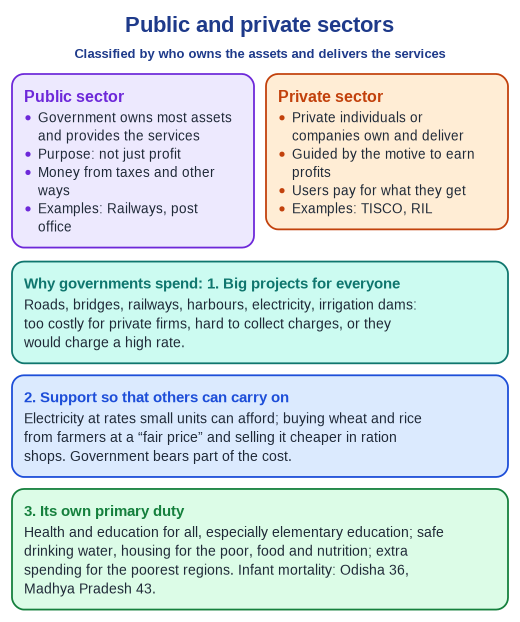
The third classification is by ownership: who owns the assets and is responsible for delivering services. In the public sector the government owns most of the assets and provides the services; the Railways and the post office are examples. In the private sector private individuals or companies own the assets and deliver the services; the chapter names Tata Iron and Steel Company Limited (TISCO) and Reliance Industries Limited (RIL). Private activities are guided by profit, and we pay them for what we get. The public sector’s purpose is not just profit; governments raise money through taxes and other ways.
Governments spend for three kinds of reasons. Some things, like roads, bridges, railways, harbours, electricity and irrigation through dams, need huge sums and are hard to charge for, so private firms would not provide them at a reasonable cost. Some activities need support: the government supplies electricity at rates small units can afford, and buys wheat and rice from farmers at a ‘fair price’ to sell more cheaply through ration shops, bearing part of the cost. And some are its own duty: health and education for all, safe drinking water, housing for the poor, food and nutrition, and extra spending in the poorest regions. The chapter notes that the infant mortality rate of Odisha (36) or Madhya Pradesh (43) is higher than that of some of the poorest regions of the world.
Back to the Chapter 2 notes or on to the NCERT solutions.
Practice
-
Which of these is an unorganised sector activity?
Show answer
Answer: (b) A headload worker carrying cement in a market
-
By Table 2.3, about what percentage of India’s workers were in the organised sector in the late 1990s?
Show answer
Answer: (b) About 17
-
Railways and the post office are examples of the:
Show answer
Answer: (b) public sector
-
Name three benefits that workers in the organised sector get.
Show answer
Answer: Any three of: paid leave, payment during holidays, provident fund, gratuity, medical benefits, overtime pay, a safe workplace with drinking water, and a pension after retirement.
-
Why does the government provide electricity to small-scale units at lower rates?
Show answer
Answer: Selling electricity at its full cost of generation would push up their production costs, and many small units might shut down. So the government supplies it at rates they can afford and bears part of the cost.
Questions students ask
Who works in the unorganised sector?
In villages: landless labourers, small and marginal farmers, sharecroppers and artisans such as weavers, blacksmiths, carpenters and goldsmiths. In towns: workers in small-scale industry, casual workers in construction, trade and transport, street vendors, head-load workers, garment makers and rag pickers.
Why do unorganised sector workers need protection?
Their pay is low and irregular, their jobs are not secure, and they get no paid leave or other benefits. Many workers from scheduled castes, tribes and backward communities are in this sector and also face social discrimination.
Why must the government spend on some activities?
Some things society needs, like roads, bridges, harbours, electricity and dams, cost too much for private firms or would be charged at a high rate. Some activities need government support, like selling grain cheaply through ration shops. And some, like health and education for all, are the government’s own duty.
Stuck on a question?
Take a photo and Lagnever AI explains it step by step. Try it for 7 days for ₹2.
Get it on Google Play Open in browser
For parents: after the trial, the plan renews monthly by UPI or card autopay. You can cancel anytime in the app.