
NCERT Solutions Class 10 Economics Chapter 4: Globalisation and the Indian Economy
Answers to all 13 exercises of Chapter 4, Globalisation and the Indian Economy, of Understanding Economic Development, the Class 10 Economics textbook, to the Additional Activity / Project, and to every “Let’s Work This Out” and “Let’s Work These Out” question inside the chapter. Page numbers follow the 2026-27 reprint (pages 54–73), in the copy NCERT updated in August 2026. The exercises are quoted from the book; the questions inside the chapter are restated in short. Many questions ask for your own view, so treat those answers as samples and support your view with points from the chapter. Short notes: Chapter 4 notes.
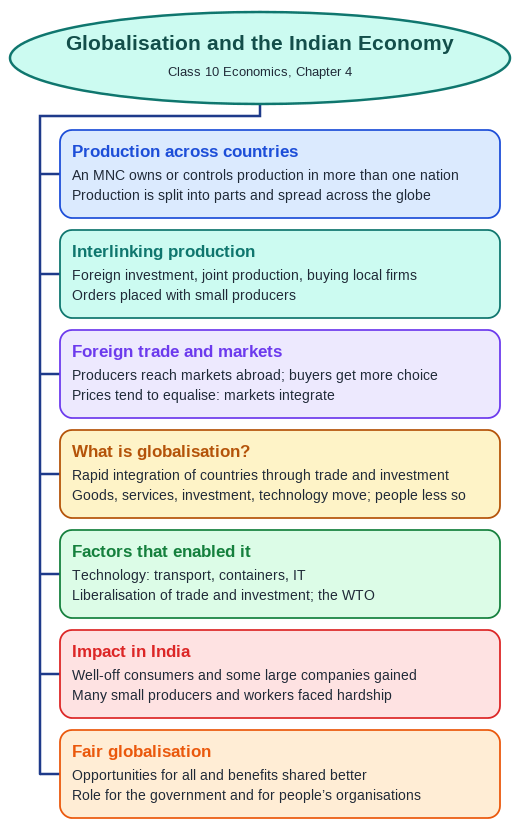
Questions inside the chapter (pages 57–70)
Let’s Work This Out, page 57
Complete the statement on how garment production is spread across countries (a garment brand labelled “Made in Thailand” that picks the cheapest option at each step, starting with cotton fibre from Korea). Sample answer: …get cotton fibre from Korea, have it spun and woven into cloth in China, get it dyed and printed in India, buy zippers and buttons from another Asian country, have the garments stitched in Thailand where the label is attached, and then ship them for sale in stores in Europe and the US. (Any chain is fine if each step is placed where it is cheapest or nearest the market.)
Let’s Work These Out, page 59 (the car company passage)
1. Is the car company an MNC? Why? Yes. It owns and controls production in more than one country: the passage says its production is spread over 26 countries, including its plant in India.
2. Meaning of foreign investment, and the company’s investment in India. Foreign investment is money spent by an MNC to buy assets such as land, buildings, machines and equipment in another country. The company spent Rs 1700 crore to set up its plant near Chennai.
3. Explain how such MNCs gain both a large market and lower costs in India. India has a very large number of buyers, so an MNC producing here can sell to them directly. At the same time, labour and many other resources cost less in India, and local suppliers can provide parts, so the cost of producing each car is lower. The company used its Indian plant both to sell cars in India (88,000 in 2017) and to export them (1,81,000 in 2017).
4. Why develop India as a base for car components, given (a) labour and resource costs, (b) local parts suppliers, (c) nearness to buyers in India and China? (a) Lower wages and cheaper resources reduce the cost of each component. (b) Many local manufacturers already make auto parts, so the company can buy inputs nearby, quickly and cheaply, without setting everything up itself. (c) India and China together have a very large number of buyers, so components and cars made here can reach big markets with low transport costs.
5. How will this production lead to interlinking of production? The plant was set up together with an Indian maker of jeeps and trucks, it buys parts from local suppliers, it exports cars and engines to other countries, and it sends components to the company’s factories elsewhere. Production in India thus becomes one link in a chain spread over many countries.
6. How is an MNC different from other companies? Other companies produce in one country, even if they sell abroad. An MNC owns or controls production in more than one country, spreads parts of production to wherever costs are lowest or markets are nearest, and usually has very large wealth and influence over local producers.
7. Why are nearly all major multinationals American, Japanese or European? These are developed countries. Their companies grew big early, have huge wealth to invest abroad, own advanced technology and well-known brands, and are backed by strong home markets. That lets them set up or buy production units in many other countries.
Let’s Work These Out, page 61
1. What linked countries in the past, and what is new now? In the past it was foreign trade: raw materials, food and finished goods crossed borders while production stayed within countries. Now MNCs also invest across borders and split production among countries, so countries are linked by foreign investment and production as well as trade.
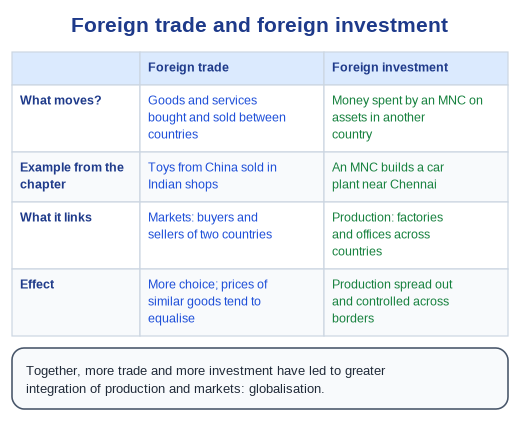
2. How do foreign trade and foreign investment differ?
| Foreign trade | Foreign investment |
|---|---|
| Buying and selling goods and services between countries | Money spent by an MNC on assets such as land, buildings and machines in another country |
| Links markets of different countries | Links production in different countries |
| Example: toys from China sold in India | Example: an MNC building a car plant in India |
3. China buys steel from India. What happens to (a) Chinese steel makers, (b) Indian steel makers, (c) Chinese firms that use steel? (a) They face more competition; if Indian steel is cheaper, they may lose sales and have to cut prices or improve quality. (b) They get a bigger market and can expand sales and production. (c) They get more choice and possibly cheaper steel, which lowers their cost of production.
4. How will this lead to integration of the steel markets of the two countries? Steel will move from the Indian market to the Chinese market. Buyers in China can choose between Chinese and Indian steel, producers in the two countries compete directly, and the prices of steel in the two markets will tend to become equal. The two markets begin to work like one.
Let’s Work These Out, page 62
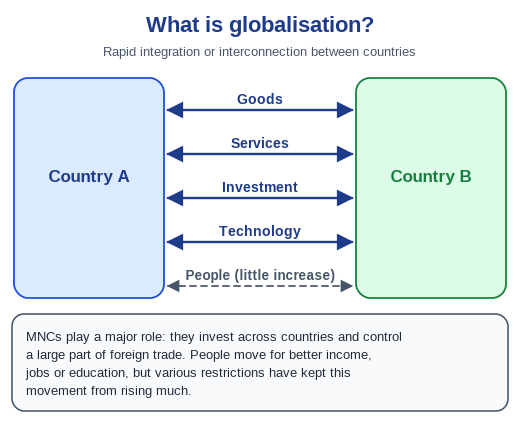
1. What part do MNCs play in globalisation? MNCs look for cheap places to produce around the world, so they raise foreign investment. They also control a large part of foreign trade, trading goods, parts and services among their units and markets in many countries. In this way they drive the integration of production and markets.
2. In what ways can countries be linked? Through the movement of goods, services, investment and technology, and also through the movement of people between countries.
3. Choose the correct option. (b) greater competition among producers. Producers in different countries begin to compete in the same markets.
Let’s Work These Out, page 63
1. Underline the words that show the use of technology in the magazine example. The words are: text sent through Internet; orders on design sent using telecommunication facilities; designing done on a computer; magazines sent by air; payment made instantly through the Internet (e-banking).
2. How is IT connected with globalisation? Would globalisation be possible without it? IT lets people in different countries share information, give instructions, transfer designs and make payments instantly and cheaply. This allows production, especially of services such as designing, call centres and data entry, to be split among countries and managed from far away. Without the growth of IT, globalisation could not have reached its present speed and scale; trade in goods might still happen, but spreading services and coordinating complex production across countries would be very hard.
Let’s Work These Out, page 64
1. Meaning of liberalising foreign trade. Removing or reducing the barriers or restrictions a government places on imports and exports, such as taxes on imports and quotas, so that businesses can decide more freely what to buy from or sell to other countries.
2. Use the toys example to show a quota working as a trade barrier. Is it a good idea? If the government sets a quota allowing only a fixed number of toys from China into India in a year, imports cannot go beyond that limit, however cheap the toys are. Indian toy makers then face less competition and can keep selling. Discussion (sample view): a quota can protect a new or weak industry for a while, as India did after Independence, but if kept too long it denies buyers cheaper and better goods and may let protected producers become careless about quality. So it should be judged case by case and used only for a limited time.

Let’s Work These Out, page 66
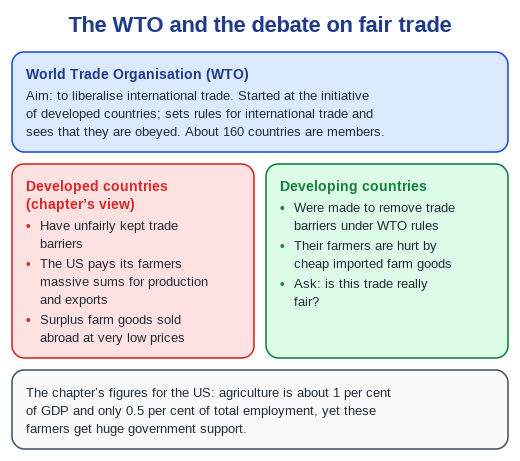
1. Fill in the blanks about the WTO. Blanks in order: (1) developed (countries whose initiative started it); (2) liberalise international trade (its aim); (3) international trade (what its rules are about); (4) the rules are obeyed (what it checks); (5) fair (what trade in practice is not); (6) removed trade barriers (what developing countries like India have done, while many developed countries still protect their producers).
2. What can be done to make trade between countries fairer? Sample points: developed countries could also cut the large payments that let their farmers sell at very low prices; WTO rules could be applied equally to all members; developing countries could act together to negotiate fairer rules; and developing countries could be allowed some protection for weak sectors such as small farmers while they grow stronger.
3. Discuss whether government support for production, such as massive payments to farmers or support for environmentally friendly goods, is fair. Sample view: massive payments that let one country’s farmers sell their surplus abroad at abnormally low prices are unfair to farmers in poorer countries, who cannot compete. Support for environmentally friendly goods is easier to defend, because it serves a wider public purpose, such as less pollution, that the market alone may not reward. Even then, it is fairer if all countries may give such support under the same rules.
Let’s Work These Out, page 67
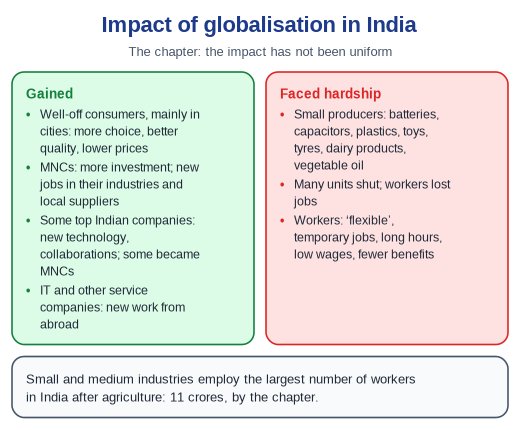
1. Who in India has gained from competition? Consumers, especially well-off people in cities, have more choice, better quality and lower prices. New jobs have come up in industries where MNCs invested, local suppliers have prospered, top Indian companies have modernised, and IT service firms have found new work.
2. Should more Indian companies become MNCs? How would it help the people? Sample view: yes, it can help. Indian MNCs earn profits abroad, gain new technology and markets, and can create more jobs and income at home, along with taxes for the government. The benefit to people depends on whether these gains also create good jobs and reach workers, not only owners and shareholders.
3. Why do governments want more foreign investment? Foreign investment brings money for new factories, offices and infrastructure, new technology and ways of production, more jobs, and more exports. Governments hope it will raise production and incomes in the country.
4. Who has opposed SEZs, and why? Extra (the chapter asks you to find this out; this is a general summary, not from the book): opposition has come mainly from farmers whose land is taken for the zones, farm workers and others who depend on that land for their living, and some workers’ groups. Their reasons include loss of land and livelihood, too little compensation or rehabilitation, fears that labour laws will be weaker inside the zones, and the concern that tax breaks to companies mean less public money. As Chapter 1 showed, what is development for some can be destructive for others.
Let’s Work These Out, page 68
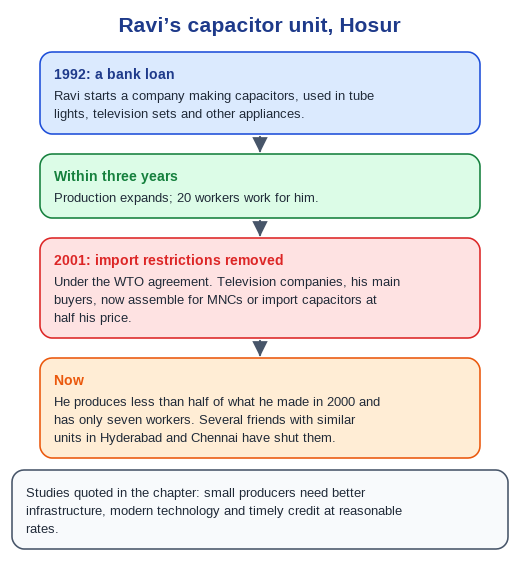
1. How was Ravi’s unit affected by rising competition? After import restrictions on capacitors were removed in 2001, his main buyers, the television companies, either moved into assembling sets for MNCs or imported capacitors at half his price. His orders fell; he now produces less than half of what he did in 2000, and his workforce has dropped from 20 to seven.
2. Should producers like Ravi stop production because their costs are higher than producers abroad? Sample view: not necessarily. Small units employ a very large number of workers (11 crore in small and medium industries, by the chapter), so closing them would mean many lost jobs. With better infrastructure, technology and credit, many could lower their costs and compete. Some support for a period, as the chapter suggests under fair globalisation, may be better than closing down.
3. Small producers need (a) better infrastructure and networks, (b) modern technology, (c) timely credit at reasonable rates.
- How would these help? (a) Good roads, power, water, raw materials and marketing and information networks cut costs and delays and help them reach buyers. (b) Modern technology raises productivity and quality. (c) Timely, reasonably priced credit lets them buy machines and inputs without falling into costly debt.
- Will MNCs invest in these? Mostly not. Roads, power and water serve everyone and earn little direct profit for one company, and MNCs have no reason to help small producers who are their competitors.
- Does the government have a role? Yes. Such facilities are public goods that the market alone does not provide well, and the government is responsible for the interests of all its people, including small producers and their workers.
- Other steps the government could take (samples): training workers in new skills, helping small producers sell abroad, helping them form cooperatives or clusters to buy inputs and sell together, and, if needed, using trade barriers for a limited time.
Let’s Work These Out, page 70
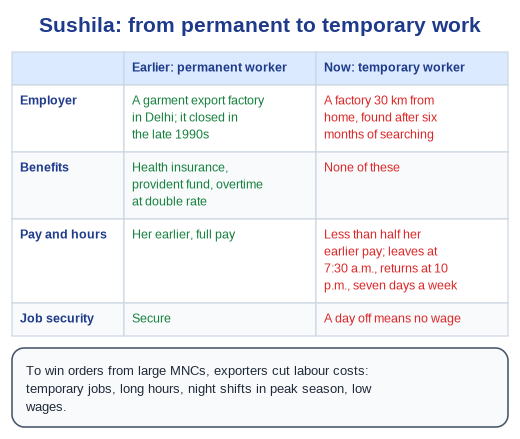
1. Effects of competition in the garment industry on workers, Indian exporters and foreign MNCs. Workers: temporary jobs, long hours, night shifts in the peak season, low wages and no benefits, as in Sushila’s case. Indian exporters: they must cut costs hard to win orders from MNCs, mainly by cutting labour costs, and orders fluctuate. MNCs: they get garments at the lowest prices and earn large profits.
2. What can each do so workers get a fair share of the benefits? (a) Government: enforce labour laws properly, set and check minimum wages and safe conditions, and support small exporters. (b) Employers at exporting factories: pay fair wages and overtime, give regular jobs and benefits such as health insurance and provident fund, and limit working hours. (c) MNCs: pay their suppliers fair prices and require and check decent working conditions in the factories they buy from. (d) Workers: organise in unions or associations, learn their rights and bargain together.
3. Summarise the employers’ and workers’ views on flexible employment. Employers: flexibility lets them hire workers only when there is a lot of work, keep labour costs low and win orders against tough competition. Workers: flexibility takes away job security, regular pay and benefits such as health insurance, provident fund and overtime, and makes them work very long hours for less pay, as Sushila’s case shows.
Exercises (pages 72–73)
1. “What do you understand by globalisation? Explain in your own words.”
Answer: Globalisation is the process of rapid integration (linking) of countries through trade and investment.
- Companies, especially MNCs (multinational corporations, which produce in more than one country), now make goods in many countries and sell them everywhere.
- So goods, services, investment and technology cross borders much more than before.
- Production in one country now depends on production in others.
- Producers and buyers from different countries take part in the same markets.
2. “What were the reasons for putting barriers to foreign trade and foreign investment by the Indian government? Why did it wish to remove these barriers?”
Answer:
Why the barriers were put up:
- After Independence, Indian industries were just starting in the 1950s and 1960s.
- Competition from imports could have stopped them from growing.
- So the government protected producers within the country. It allowed only essential imports, such as machinery, fertilisers and petroleum.
Why the government wanted to remove them:
- Around 1991, the government decided that Indian producers were ready to compete with producers around the world.
- It felt that competition would make them improve their performance and quality.
- Powerful international organisations also supported this change.
3. “How would flexibility in labour laws help companies?”
Answer:
- Companies need not hire workers on a regular (permanent) basis.
- They can hire workers for short periods when there is a lot of work, and let them go when orders fall.
- They need not give the benefits that permanent workers get.
- This cuts their labour cost. They can offer lower prices, win more orders, compete better and earn more profit.
(The chapter also shows the other side: workers’ jobs become insecure.)
4. “What are the various ways in which MNCs set up, control or produce in other countries?”
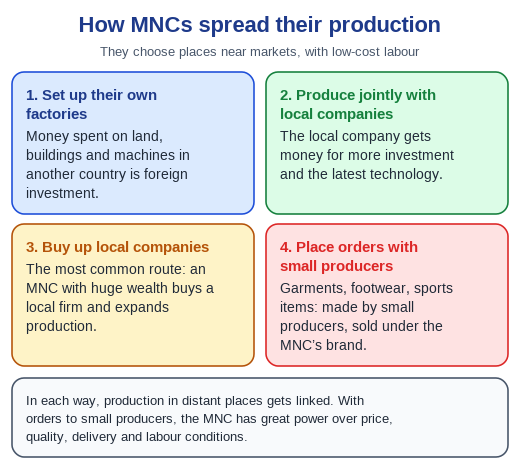
- By setting up their own factories and offices, that is, by foreign investment.
- By setting up production jointly with local companies, bringing money and the latest technology.
- By buying up local companies and then expanding production; this is the most common route.
- By placing orders for production with small producers, as in garments, footwear and sports items, and selling the goods under their own brand names. They control the price, quality, delivery and labour conditions of these producers.
5. “Why do developed countries want developing countries to liberalise their trade and investment? What do you think should the developing countries demand in return?”
Answer:
Why developed countries want this:
- Their MNCs and producers want new markets for their goods and services.
- They also want cheaper places to produce.
- If developing countries remove barriers, these companies can sell there easily, set up factories, buy local companies and earn more profit.
What developing countries could ask for in return (sample view):
- Developed countries should also remove their own trade barriers, especially the large payments they give their farmers, which let them sell farm goods abroad at very low prices.
- WTO rules should apply equally to all countries.
- Developing countries’ goods and services should get easier entry into developed countries’ markets.
- Developing countries should be allowed to protect weak groups, such as small farmers and small producers, until they can compete.
6. “‘The impact of globalisation has not been uniform.’ Explain this statement.”
Answer: Globalisation has helped some groups much more than others.
Who gained:
- Well-off consumers in cities: more choice, better quality and lower prices.
- MNCs: they invested and earned profits. New jobs came in their industries, and local suppliers grew.
- Some top Indian companies modernised, and a few became MNCs themselves.
- IT and service companies found new work.
Who lost:
- Many small producers were hit by cheaper imports and competition from MNCs. Industries such as batteries, capacitors, plastics, toys, tyres, dairy products and vegetable oil suffered, and many units closed, as Ravi’s story shows.
- Many workers now have temporary jobs with long hours, low pay and no benefits, like Sushila.
So the gains went mostly to people with education, skill and wealth.
7. “How has liberalisation of trade and investment policies helped the globalisation process?”
Answer:
- Liberalisation means removing barriers or restrictions set by the government. India removed many barriers on imports, exports and foreign investment.
- Goods could now be imported and exported easily.
- Foreign companies were allowed to set up factories and offices in India.
- So MNCs could spread their production to new countries. Foreign trade and foreign investment grew, and these two link countries together.
- The WTO pushed countries to liberalise further.
In this way liberalisation, together with new technology, made rapid globalisation possible.
8. “How does foreign trade lead to integration of markets across countries? Explain with an example other than those given here.”
Answer: Foreign trade lets goods made in one country be sold in another. Buyers can choose between local and imported goods. Producers of both countries then compete in the same market, and prices of similar goods in the two markets come closer.
Example (our own):
- Suppose cheaper, good-quality bicycles from another country start selling in India.
- Indian buyers get more choice and pay less.
- Indian bicycle makers must cut costs or improve their bicycles to keep their buyers.
- The foreign makers sell more.
- Bicycle prices in the two countries come closer. The two bicycle markets become linked, that is, integrated.
9. “Globalisation will continue in the future. Can you imagine what the world would be like twenty years from now? Give reasons for your answer.”
Sample answer (your own view is welcome): twenty years from now, more goods and services will probably be produced in several countries at once, because transport and IT keep getting faster and cheaper. More services, such as teaching, health advice and office work, may be done online across borders. Buyers may have even more choice, and more companies from developing countries like India may become multinationals. At the same time, competition will remain tough, so small producers and workers may still face insecurity unless governments and people’s organisations push for fair rules. Whether the world becomes better for most people will depend on how fairly the benefits of globalisation are shared.
10. “Supposing you find two people arguing: One is saying globalisation has hurt our country’s development. The other is telling, globalisation is helping India develop. How would you respond to these arguments?”
Answer: Both people are partly right, so I would bring the two views together.
Globalisation has helped:
- Many consumers got more choice, better quality and lower prices.
- New investment and jobs came in some industries.
- Some Indian companies grew, and some became MNCs.
- IT services found new work.
Globalisation has hurt:
- Many small producers lost out to imports and MNCs, and many units closed.
- Many workers now have insecure, low-paid jobs.
My view: the impact has not been the same for everyone. The real question is how to make globalisation fair, so that more people gain. This needs proper labour laws, support for small producers, fairer rules at the WTO, and active people’s organisations.
11. “Fill in the blanks.”
“Indian buyers have a greater choice of goods than they did two decades back. This is closely associated with the process of ______________. Markets in India are selling goods produced in many other countries. This means there is increasing ______________ with other countries. Moreover, the rising number of brands that we see in the markets might be produced by MNCs in India. MNCs are investing in India because _____________ ___________________________________________ . While consumers have more choices in the market, the effect of rising _______________ and ______________has meant greater _________________among the producers.”
Answers, in order: globalisation; foreign trade; India offers cheap labour and other resources and a large market close at hand (any answer on these lines); foreign trade and foreign investment; competition.
12. “Match the following.”
| (i)–(v) | Match |
|---|---|
| “(i) MNCs buy at cheap rates from small producers” | “(b) Garments, footwear, sports items” |
| “(ii) Quotas and taxes on imports are used to regulate trade” | “(e) Trade barriers” |
| “(iii) Indian companies who have invested abroad” | “(d) Tata Motors, Infosys, Ranbaxy” |
| “(iv) IT has helped in spreading of production of services” | “(c) Call centres” |
| “(v) Several MNCs have invested in setting up factories in India for production” | “(a) Automobiles” |
13. “Choose the most appropriate option.”
“(i) The past two decades of globalisation has seen rapid movements in (a) goods, services and people between countries. (b) goods, services and investments between countries. (c) goods, investments and people between countries.” (b) goods, services and investments between countries. The movement of people has not risen much, because of restrictions.
“(ii) The most common route for investments by MNCs in countries around the world is to (a) set up new factories. (b) buy existing local companies. (c) form partnerships with local companies.” (b) buy existing local companies.
“(iii) Globalisation has led to improvement in living conditions (a) of all the people (b) of people in the developed countries (c) of workers in the developing countries (d) none of the above” (d) none of the above. The gains have not reached all people; workers in developing countries, like Sushila, have often lost out; and the chapter does not say the gains went to all people in developed countries either. It says the well-off and those with education, skill and wealth gained most.
Additional Activity / Project (page 73)
I. Branded products produced by MNCs. Collect the packets or labels of everyday products at home (soap, toothpaste, shampoo, biscuits, garments, a phone or a television). On each, read the name and address of the maker. Mark which come from MNCs (companies producing in many countries, often with a head office abroad) and which from Indian companies. Note that some Indian companies are themselves MNCs. A table with columns Product, Brand, Company, MNC or not, How we found out works well. We do not list companies here; find them from the labels.
II. Study of an Indian industry or service. Pick one industry or service (for example, mobile phones, two-wheelers, garments, toys, dairy, or call centres) and collect information from newspapers, magazines, books, television, the Internet and interviews. Arrange your findings under the seven points the book lists: (i) the main producers or companies; (ii) whether the product is exported; (iii) whether MNCs are among the producers; (iv) how strong the competition is; (v) working conditions; (vi) any major change in the past 15 years; (vii) problems people in the industry face. Link your findings to the chapter: who has gained, who has lost, and what could make the industry’s growth fairer.
Practice
-
In the chapter’s case study, how many cars in all did the car company sell in India and export from India in 2017?
Show answer
Answer: (c) 2,69,000
-
Which match is correct?
Show answer
Answer: (b) Garments, footwear, sports items: MNCs buying from small producers
-
Ravi had 20 workers and now has seven. By how many has his workforce fallen?
Show answer
Answer: (b) 13
-
By Exercise 13(iii), whose living conditions has globalisation improved?
Show answer
Answer: (d) none of the above: the chapter shows that the gains have not reached all people, nor all workers in developing countries.
-
Why is a quota a trade barrier?
Show answer
Answer: It limits the quantity of a good that can be imported, so it restricts foreign trade, just as a tax on imports does.
Stuck on a question?
Take a photo and Lagnever AI explains it step by step. Try it for 7 days for ₹2.
Get it on Google Play Open in browser
For parents: after the trial, the plan renews monthly by UPI or card autopay. You can cancel anytime in the app.